

Building AI Factories @CrusoeAI | HBS | Stanford
San Francisco
Joined August 2011
- Tweets32
- Following317
- Followers86
- Likes39
Most of the AI infrastructure conversation is GPUs and power. Less discussed: some of the smaller but still staggering(!) numbers connected to the construction of this infrastructure! 💪

$20 million in lunches served at @CrusoeAI job sites to date - thank you to all the local restaurants that keep our 15,000+ workers fed, we are proud to support you and many other small businesses around our projects.
54
$10.3T is hard to picture. But framed as % of GDP, the scale gets real: 3.6%/year through 2032, higher than the peak rate railroads, highways, or telecom ever hit - each the biggest buildout of its era.

Total investment in data centers and related AI infrastructure is projected to total $10.3 trillion from 2025 to 2032, or 3.6% of GDP per year, according to new estimates. That would dwarf other huge U.S. infrastructure projects such as the railroads, the highway system and the plumbing for the internet.

45
Casey Martineau retweeted

The loudest voices stoking fears about AI dangers have made tremendous headway in the past two weeks. AI technology has not taken some unexpected, dangerous turn, but the hype around it — propelled by what appears to be a well orchestrated PR campaign — has drummed up considerable fear. I worry that it represents a setback for our field.
I have written frequently that fears of AI are overhyped. AI’s capabilities can be uncannily human-like and unpredictable, and it’s rational to worry when people who are directly involved express concerns. But I see the problems as a sign of the engineering work that ahead, rather than insurmountable barriers or the sky falling. AI technology continues to advance — which is a good thing! — but technical advances, poorly understood by the public, give those who seek to generate hype repeated opportunities to do so.
First, I don’t see any step up in the risk of human extinction from AI compared to a few months ago. The theories about this remain the same fantastical, science fiction scenarios as a few months ago. The biggest change in AI risk is its cybersecurity capabilities — a topic which we should take seriously — but this, too, will not lead to the end of the world.
The most notable recent event leading to increased fear was when an OpenAI team deployed an agent swarm that hacked into Hugging Face. Much of the popular press contained significant hype. For example, some publications reported that a swarm of 1,200 agents carried out the attack. While this was technically accurate, as I write this, I have about 1,300 processes running on my laptop. Yes, the ability to get large swarms of agents to work in parallel on a task is a significant technical advance, And, in computing, many processes run at the same time. So this shouldn’t be seen as some magical capability.
Additionally, OpenAI’s buggy sandboxing and monitoring processes were key to enabling this incident. Fixing these bugs and putting in place improved monitoring would be appropriate fixes, not pausing AI. There are many well known ways to attack software systems. The main advantage of AI agents is that they are relentless. They will tirelessly try many tactics — and have the patience to chain vulnerabilities together — that previously would have taken an infeasible amount of human effort. But in the long term, I believe the advantage will lie with defenders (because they have more information with which to identify bugs, which they can fix), but the cyber-threat landscape has changed significantly. There are still bottlenecks to identifying and exploiting a vulnerability. AI agents still have to try a lot of things to see what works, and taking these actions takes time and might be detected by defenders. This is why, even though it is now easy to obtain versions of leading open weight models that have had their guardrails removed or weakened, so they will not refuse to try to execute cyber attacks, the world has not ended.
I am also concerned about the anthropomorphization of AI in a lot of reporting, where LLMs and agents are unnecessarily treated as if they were people. If I wield a hammer, miss a nail, and accidentally dent the wall, it’s not the fault of the hammer. The problem lies in how I used the hammer. Similarly, if I prompt an agent and it hacks into someone else’s system, the responsibility lies with me, not the agent.
Of course, we want to build systems that are as safe and predictable as possible. (For example, an unsafe hammer would be one whose head randomly flies off under normal use.) Today’s agentic systems are not predictable, but I see no reason why, by applying sound engineering practices, we won’t be able to make them extremely safe to use. One new element in the forecasts of AI-enabled doom is AI companies disclaiming responsibility for their own products. “I didn’t do it; my out-of-control agent did!” There’s a balance to be struck between the responsibility of the tool maker and the tool user, but when something goes wrong, let’s hold the people building and/or using the hammer responsible, rather than the hammer. (By the way, if you’re worried about AI bioweapon risk, David Bellamy has a great post on why this, too, is overhyped. Briefly, the bottleneck in building a bioweapon is not intelligence, but lab work and manufacturing.)
Pausing AI progress will create much more harm than benefit. First, our adversaries will certainly not slow down. Second, engineering requires discovering problems empirically so we can fix them. If we pause AI by a decade, we will also delay finding and implementing safety engineering fixes by about the same duration.
Of course, the incentive to stoke fears — for regulatory capture, to garner attention, or to make one’s technology seem more powerful — remains the same as before. Disclaiming responsibility is a new one. Taking a hard technical look at the actual risks however, I see little factual basis for the degree of fear that’s been stoked up. We still have hard research and engineering work ahead to improve AI safety, but the beneficial applications continue to vastly outweigh the risks, and we should keep building.
[Original text (with links): deeplearning.ai/the-batch/is… ]

Onward!

Crusoe has raised $3.9 billion in Series F, co-led by @Atreidesmgmt, @MubadalaCapital, and @valor Equity Partners.
This capital will help us grow across our AI factories, from large-scale campuses to modular Crusoe Spark units, and continue to innovate with Crusoe Cloud.
The full chain, from electrons to tokens: crusoe.ai/resources/newsroom…
3
87
Casey Martineau retweeted

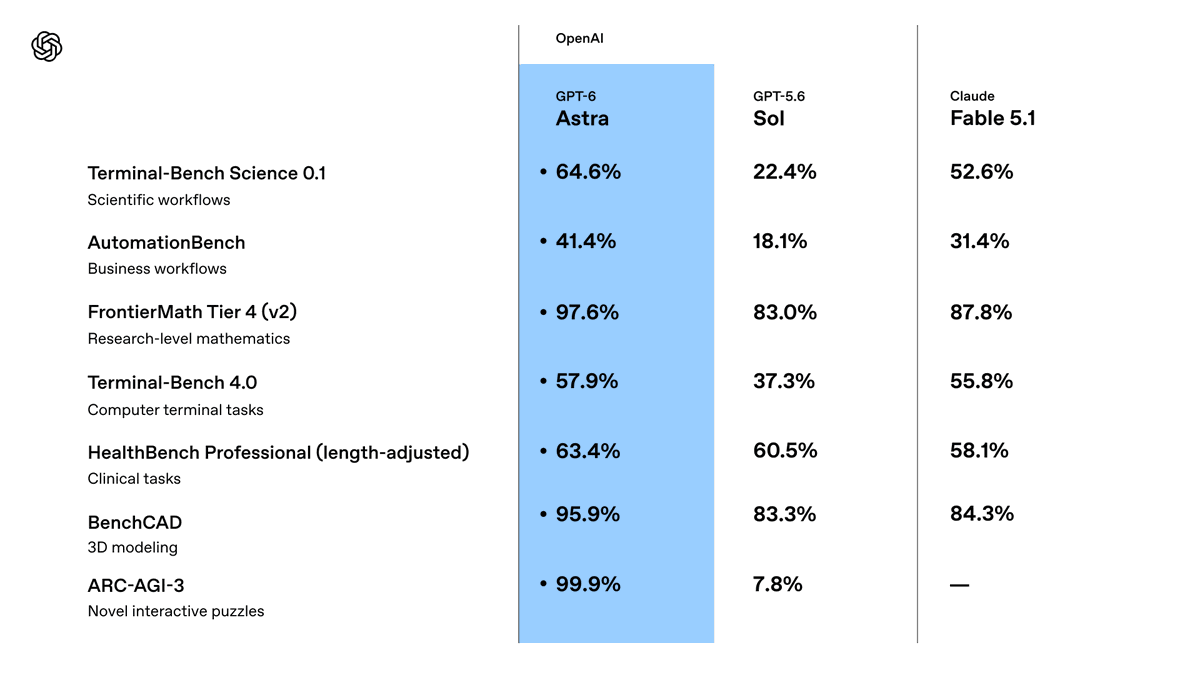
Congratulations to our friends at @OpenAI! I guess this makes Abilene the birthplace of AGI!


Casey Martineau retweeted

JUST IN: Microsoft’s new Wisconsin data center will reportedly use less water this year than a typical car wash.


DC construction has its own version: power shortage → steel & transformer scarcity → skilled trades shortage.
Bottlenecks keep moving downstream.

JUST IN: Investors looking for the next AI winners are now targeting suppliers of vacuum pumps, cooling systems, & specialty gases used in chip fabs & data centers.
1
84

Casey Martineau retweeted

Water usage has been a hot topic in the AI data center world, but the numbers may surprise you.
According to the Manhattan Institute, data centers use 0.2 percent of daily water usage in the U.S. and that number has dramatically decreased in the past few years due to a new method: liquid cooling.
By moving to 45°C liquid cooling, AI factories in favorable climates can use dry coolers instead of conventional cooling-tower-based systems, cutting facility cooling water use from roughly 2.6M gallons per MW per year to near zero.
Liquid cooling enables AI factories to be both water and energy efficient, while creating opportunities for heat reuse and dispersal to local communities, allowing these factories to become energy grid assets.
Learn more below ⬇️
nvda.ws/4gAVGoJ
The future is here! Staggering pace of infrastructure development - excited to be a part of it!
Crusoe is approaching 5 GW of contracted AI infrastructure — with a 40 GW pipeline behind it.
That rivals the entire data center capacity of Northern Virginia, one of the world's largest data center markets, in 2025.
Grateful to every customer who has trusted us to build alongside them. 🔗 crusoe.ai/resources/newsroom…

2
106
I think about some version of this almost daily.

As you become an adult, you realize that things around you weren't just always there; people made them happen. But only recently have I started to internalize how much tenacity *everything* requires. That hotel, that park, that railway. The world is a museum of passion projects.
2
261
Can’t believe I’ve been sleeping on Miley’s live album. It’s excellent. She’s excellent. World order restored.
3