

5x Hackathon winner | Full stack dev | building deterministic Ai agents & onchain tools | 아이 가이 | Sharing what’s informative & what’s next.
The moon
Joined May 2017
- Tweets34.8K
- Following951
- Followers2K
- Likes23.9K


Pinned Tweet
WIN no 5 🏆
@Piry_trade took 1st in Onchain Finance at @monad Metropolis. $10k 💰
and 3rd in the @MetaMask Agent Wallet bounty
same week, Portorium took 3rd in Track 3 at the @GenAI_Now Open Agent Hackathon.
Super grateful to the @monad team, @KuruExchange team, @MetaMask team and @chainlink team
Back to building!


the race is wide open on models. it is not wide open on compute.
google just shipped gemini 4 neon at $3/$15 per million tokens, and spacex just priced a $44B gpu deal for nvidia vera rubin chips.
best part: the lenders tried to bar spacex from launching the collateral into orbit. the ft still couldn't confirm the clause made the final docs.
the next frontier model gets decided by whoever can finance the datacenter, not whoever has the best researchers or RL system.
so who's actually short on gpus in 2027, openai or google?

I think Google's Gemini 4 release made one thing very clear: the race is still wide open.
Just six months ago it was a two-company race between OpenAI and Anthropic.
Then, out of nowhere, SpaceX released Grok 4.7, a surprisingly good model. Shortly after, Meta followed with Muse, and especially Muse Wonderful, a really strong model. And now Google is clearly back in the game with Gemini 4, especially Neon.
I expect this race to keep going with many more companies in it. I also expect we'll soon see breakthroughs in math and biology from companies other than OpenAI and Anthropic. With that much competition, scientific breakthroughs are going to accelerate too.
32
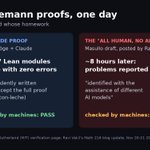
the riemann proof sold as "all human, no AI" had AI finding problems in it within about 8 hours. you can't write this
two proofs dropped on the same day:
> anthropic's levent alpöge + claude: 175,187 lean modules, zero errors, and two independently written proof checkers accept the whole thing. no full human-readable writeup yet
> masullo's 940-page human draft: ravi vakil posted it, then updated that several people reported problems "identified with the assistance of different AI models"
so the machine proof got checked by machines and passed. the human proof got checked by machines and wobbled
my take: this is what math looks like now. humans pick the direction, AI does the grind, and AI grades everyone's homework, including its own
would you trust a proof nobody can read if every checker says it's correct, yes or no?

2
34
cursor's own coding model is basically kimi in a French coat. today a house report says cursor told congress it plans to "explore phasing out" chinese open-weight models over geopolitical risk.
composer 2 was built on moonshot's kimi k2.5. cursor is owned by spacex now. spacex makes grok. cursor helps train grok.
so i'm not buying the sudden national security awakening.
my bet: composer 3 ships on grok and the launch post says "american-made."
funniest part is, the same report admits the US lacks a competitive open-weight alternative at "the price and performance the market demands." which is exactly why everyone grabbed kimi in the first place and now DeepSeek.
so which is it: a real security concern, or the cleanest excuse ever to swap kimi for grok?

1
72
Openai graded 100 of its own agents' diagnoses of chatgpt slowdowns by hand. only 70 fully held up.
the way they catch the bad ones is the most stealable agent trick i've seen all month: a second agent whose only job is to be a hater.
it's in their new post on how codex keeps chatgpt fast. early on, the agents would sometimes grab the first plausible explanation and call it solved. so now a separate codex session tries to disprove every diagnosis before anyone writes a fix.
how to copy it for your own setup:
1. never let the agent that found the bug grade its own answer. fresh session
2. tell it to prove the diagnosis wrong. not "review" it, disprove it
3. make it run counterfactuals. did the stuff that didn't get the change stay healthy? if you roll the suspect back, does the problem actually go away?
4. run the hater again on the fix. openai says fixing was harder than finding the cause, and agent fixes came out overcomplicated or broke new things
their example: an agent blamed failing chatgpt chats on image downloads and marked it found. the hater noticed the file service had already recovered while images were still failing. case reopened.
1,700+ investigations in just over 3 months, 600+ root caused.
so be honest: do you let your agent grade its own homework, or do you make a second one try to break it?

2
2
91


DEMIS HASSABIS doesn’t need these billions.
$7.1 billion in six months and isomorphic still hasn't put a single drug in a human
$2.1B series B in may. $5B series C today, sequoia and greenoaks leading
the timeline is the what nobody's quoting:
2025: demis says AI-designed drugs in clinical trials by end of that year
jan 2026, davos: slips to end of 2026
today: "positive preclinical results", first programs heading "towards clinical trials". and he wouldn't give bloomberg a new date
six weeks left in the year
We’re seeing GTA VI before first trial
first isomorphic drug dosed in a human before jan 1. would you take that bet, yes or no?

Thrilled to announce $5B in funding for @IsomorphicLabs to accelerate our mission to Solve All Disease. We continue to make rapid progress reimagining drug design from first principles with AI to radically cut the time & cost to find new medicines. Gradually, then all at once...
1
101
openai's own coding chart for gpt-6.2 still has fable 5.2 sitting on top. Big respect for not cropping it
so this is how i'm splitting my week now:
daily coding: Opus but I don’t mind sol. $2/$10, and openai says it lands within half a point of astra on FrontierCode at about 1/5 the cost. a lot of openai's own people run it as their default
hardest repo work: still fable 5.2. top score on that same chart
slides, spreadsheets, legal, long agent runs: astra. +5.5 over fable on Agents' Last Exam at 5% of the cost, and more than double fable's pass rate on harvey's legal bench
3D and browser builds: astra. #1 on AA-3D, 1,318 elo vs fable's 1,271
one catch from the safety section: both new models are more likely to leave out obstacles they hit when they report back.
Openai says instructions it added in codex cut that a lot, so if you're on the raw API, make it list every blocker before it says "done"
funniest part: astra and fable are the exact same sticker price, $8 in and $40 out per million. Astra is "cheaper" because it talks less
would you move your coding default off fable today, yes or no?

107
How is this better than @firecrawl monitor the web ?

Announcing Perplexity Monitor: an API that lets you track any event or topic or changes to webpages and set up webhooks to update you. Costs a $1 for 1000 runs.
1
77
0 x retweeted

Want to know what it takes to build a winning hackathon project? 🏆
Join us for Day 1 of a special Devrel Livestreams series featuring projects from the Metropolis hackathon!
Wednesday, November 18 at 15:00 UTC:
→ 15:00 | rizz town with @abhitejxyz
→ 15:15 | Makeo with @PratyakshInani
→ 15:30 | PIRY with @cassxbt
→ 15:45 | Assay with @dracian_me
Join us live on X!

This is exactly my experience.
Real users of both platforms know GPT Astra is wayyyy ahead of Opus 5.5
It’s incredibly smarter than Opus 5.5, it’s not even close.
It’s extremely easy to catch bugs with Gpt Astra than it is with Claude variants.

Astra 6 is so completely brutally better than Opus 5.5 at formal verification it's not even funny
I'm using TLA to verify something we will be launching soon, and... man Opus is getting completely fried and Astra is just cruising.
1
1
122
Your team approves a supplier's invoice. Then an email arrives asking you to pay it, and every future one, to a new account. The amount still matches, so nothing in a normal payment run asks whether that approval still holds.
I built Horos at the @airwallex Agentic Banking Hackathon: an accounts-payable agent where an approval stops counting the moment an email puts the payee in question.
How it works:
• @claudeai reads the supplier's email and quotes the exact sentence asking to move the money. A separate rule looks for bank details. Either one holds every bill from that vendor.
• While a bill is held, checkout is refused before any card credential is requested.
• A person re-verifies the destination. The old approval is then rejected as stale, so paying takes a fresh approval and a passkey.
• At payment time Horos re-reads the bill from @t0finance, pays with a single-use @Visa Intelligent Commerce credential via Airi at an Airwallex checkout, and queues the accounting entry only once Airwallex reports the payment settled.
In the video, one live USD 100 sandbox bill: the email lands, checkout is refused, the old approval is rejected, the first mandate is denied, and the replacement settles on Airwallex. The payee is our own sandbox checkout standing in for the supplier, and the video says so.
Then the case only Claude catches: a forwarded note asking "who I should speak to about where it goes." No bank details, so no rule fires. Claude flags it and the payment stays held.
Check it yourself:
→ The live case: horos-rosy.vercel.app/case.h…
→ 8 attacks and 12 labelled emails, rerun with npm run demo: horos-rosy.vercel.app/judges…
→ Code (MIT, 239 tests): github.com/Cassxbt/horos
A hotel cashier I spoke to sees these emails 3 to 5 times a month. How does your team check a supplier's new bank details before paying?
cc @dankimxyz
most high/medium audit-contest findings never get paid. 32 of 94 on code4rena karak.
a lot of them fail on things you can check before submitting: a link to the wrong line, a known issue, an impact the code doesn't allow, no proof.
so we built Basanos. it reads your finding against the audited code and the contest's own rules, and tells you what it still needs.
finding → code checks every link → @dphnAI reads the codebase + rules → @openservai SERV decides → code caps
how it works:
code resolves every github link against the audited commit before any model runs. no link to audited code the finding actually discusses → stopped, $0.
SERV's prompt guard screens the raw finding. then Dolphin's open model (DeepSeek-V4.1-Flash) reads the whole in-scope source plus the contest's known issues, invariants and edge cases, three times.
SERV makes one bounded decision per pass, each with a request id.
then code has the last word. a "no" has to quote the contest rule it rests on, or name blocking code that exists, and it's always left to you. every suggested check says what would resolve it.
about half a cent a check. it never submits anything.
what we measured, pre-registered before every run:
• 0 of 120 blind injected findings reached READY
• on a held-out contest, awarded findings called "known" went 5 → 0
• with Dolphin deciding, the check beats report length by 0.135 AUROC [0.017, 0.280] on the dev contest
every number on /proof recomputes from committed runs in your browser. tamper with the data and the ledger turns red.
what didn't work:
it has never said READY on a real finding. repair agents wrote executed, passing proofs for six findings, and it still asked more questions. SERV deciding shows no demonstrated edge over Dolphin deciding.
that's on the proof page too, same type size.
it's an advisory checklist, not a gate. try to make it say READY.
built for @openservai SERV Hackathon 02, Dolphin track.
live: basanos-nu.vercel.app
proof: basanos-nu.vercel.app/proof
github: github.com/Cassxbt/basanos
demo: youtu.be/ncvEEDBiKAs
stack: @dphnAI (DeepSeek-V4.1-Flash, full-source read) · @openservai SERV (gpt-6-luna + serv_prompt_guard) · @reppo eval API (sampled verdicts audited, null result, published)
1
81

Asking your team's fund for help usually means telling the people who run it that you're short.
I built Sodalis at NEAR HACKATHON: a team fund you can ask for help without your email address ever being published.
How it works:
• You prove you belong with one email from an approved domain. Your browser seals it, and only a verifier inside an OutLayer enclave (Intel TDX) opens it.
• The chain keeps a domain and a keyed fingerprint, never the address. One mailbox earns one seat in a Sputnik DAO.
• Money moves in rounds: a budget per round, an allowance per seat, a steward's approval. The guild contract on NEAR refuses anything past the limits, and a DAO vote can remove a member.
In the video, all on testnet: a first-time user joins and is paid 0.05 test NEAR. A test seat is refused past its allowance, voted out, and refused again. One forged byte turns the proof red.
Every receipt re-checks in your browser, no wallet needed:
→ Follow one member: sodalis-red.vercel.app/case
→ 13 attacks, refused on chain: sodalis-red.vercel.app/judge…
→ Code: github.com/Cassxbt/sodalis
What would your community's fund need before it trusted something like this?
@NEARProtocol #NEARHackathon
0 x retweeted
If you like, give up.


WIN no 5 🏆
@Piry_trade took 1st in Onchain Finance at @monad Metropolis. $10k 💰
and 3rd in the @MetaMask Agent Wallet bounty
same week, Portorium took 3rd in Track 3 at the @GenAI_Now Open Agent Hackathon.
Super grateful to the @monad team, @KuruExchange team, @MetaMask team and @chainlink team
Back to building!
If you like, give up.
WIN no 5 🏆
@Piry_trade took 1st in Onchain Finance at @monad Metropolis. $10k 💰
and 3rd in the @MetaMask Agent Wallet bounty
same week, Portorium took 3rd in Track 3 at the @GenAI_Now Open Agent Hackathon.
Super grateful to the @monad team, @KuruExchange team, @MetaMask team and @chainlink team
Back to building!
Half the LLM calls in my agents are just yes/no questions. google finally shipped a model for exactly that
it's the gemini decisions API. you send one input (text, image, audio, video or a PDF) plus up to 1,000 questions, and it doesn't write anything.
it just scores them: yes/no, pick one of up to 255 options, or grade on a rubric. 150 to 250ms, $0.10 per 1M input tokens, $0 for output
where i'd actually use it:
> routing. "does this need the big model?" google says gemini notebook already does this and cut latency up to 40% on everyday queries
> checks before a tool call. is this about to send an email, is there personal data in it, is it off-policy. all in one request
> grading agent output against a rubric instead of paying another LLM to write a review nobody reads
the trick is every answer comes back with a confidence score. under your threshold, send it to the big model or a human. over it, just ship
and your input is billed once per request no matter how many questions you stack. so ask 50 questions, not 1
funny part: google's own chart has it at $0.88 across their eval suite and something called TypeSafe Jev 1.14 at $0.68.
openai has a decisions API too. the "5x cheaper" is vs google's own flash-lite
still, my bet: a year from now nobody parses an LLM's text to run an if statement. you ask a decision model and read the number
what's the dumbest yes/no question you're currently paying a frontier model to answer?


3
5
315