

temporarily embarrassed jupyter brain
sf
Joined December 2021
- Tweets961
- Following463
- Followers194
- Likes16.1K




modus ponens meet modus tollens


a lot of people seem to have this immediate aversion to this, complaining that it is immoral because they feel it might be conscious.
how is this more conscious-like than an LLM? If you have a problem with this, do you also have a problem with how LLMs are being treated?
1
2
74

you may have different views on ai consciousness/personhood etc
but if you believe that ai's may be persons you want to treat ethically in some way, i think basic decency says you should quote their output and not post it as your own

I for one am absolutely shocked and appalled that someone who wrote an entire book on the question of AI consciousness would be using AI to finish posts.
1
1
101
cat from /dev/null retweeted

An economist and a futurist walk into a bar.
The economist takes a sip of his drink. "Ugh, if only people understood basic economics. High-skilled immigration alone would do wonders for US growth."
Futurist: "Oh yeah? Say 100 million immigrants moved to the US, each matching the best human experts in every economically relevant field. Big deal?"
Economist: "Massive. Transformative."
Futurist: "What if they also worked longer hours and faster than any American?"
Economist: "Even better."
Futurist: "What if they were extremely frugal — consuming only the bare minimum needed to keep working?"
Economist: "A near-100% savings rate? Better still!"
Futurist: "What if they were very clumsy and physically weak, so they could only do some kinds of work?"
Economist: "They could still do all cognitive labor — that's over half all wages! Somewhat less good, sure. Still transformative."
Futurist: "What if their skin was grey, almost metallic, from some kind of accident?"
Economist: "Who cares?!"
Futurist: "What if they were AIs?"
Economist: "3% growth per year, tops. There'd be bottlenecks. Honestly, the people predicting explosive growth from AI should learn some economics."


While others struggle seeing the fnords, I'm again struggling to empathize with this experience
Suspect that this disgust, and unwillingness to engage, with AI writing relates to some rather unflattering aspects of human psychology

1
3
104
The original essay (teapawt.net/nosilverv/status/19951…) for the screenshot that this tweet is subtweeting also talks of bouncing off some older paragraphs by Augustine and Leibniz, and again these were rather unremarkable other than their prose showing its age.

Human Writing in the Age of AI
Tokens vs Poetry
I’ve written a few words. Three million, just here on Twitter. Both before and since the Age of AI. That makes me feel well-positioned to comment on how AI has changed both writing and reading. But, before that, I need to talk about what writing is.
Poetry in the Body
I’m reminded of a book on reading which lambasted people for thinking that to read was to look at one word and then another until you had looked at all words. Now it is my turn to lambast those who think that to write is to put down a word and then another until you’ve put down all the words.
Writing is feeling. Or, more precisely feeling into. Feeling into what? Feeling into what you know but can’t yet say. “I know but I can’t say it”—you know it, bodily.
The body knows: a gut feeling, a heart flutter, a tightness in the throat. It knows before we can put words to what it knows. “This feels right.” “That feels wrong.” “I have a sense that…” We always have that sense, the sense of ourselves and of the situation; and we can drop into it at anytime. When writing, when really writing, which is the same to say as when writing poetry, we allow words to come from that place.
That’s where my words are coming from right now.
Writing written from that place is new even if all the words used are old: it resonates through us; reminding us of what we too know, but forgot.
It is from there that poetry—new words and new expressions or old words and old expressions in a new order—comes from. But that is not what AI does.
Humans resonate the pre-verbal and pre-symbolic bodily felt sense. AI generates tokens based on probability. Very impressive tokens! Tokens nonetheless.
Those tokens have changed writing, and reading.
AI and writing
1.
Before AI all next steps, when writing, had to come from dropping down into that place. You had to compare what was on the page to the felt sense of what you wanted to get across, see where it fell short, and correct for that. Over, and over, and over.
AI changed that. Now you can get next steps just by pressing ‘Enter’.
2.
AI is really smart. Before, you could get external human feedback, but if you were working at the frontier of what you can say you’d be, at best, incomprehensible. Not worth the investment. Now AI can just mirror it back to you.
Unfortunately AI excels in writing that seems logical until you pay full attention and, unlike external human feedback, won’t cut off your negative runaway loops.
3.
It has made dishonest writing easier: it’s harrowing to write about things you don’t really care for when the writing has to come from your own body. With AI you can skip all that nonsense and just get words down for what would otherwise be impossible to write.
4.
Being self-conscious about sounding like AI has made writers actively optimize against its tells: “delve”, em dashes, “it’s not X; it’s Y.”—all are gone.
The need to stand out has, paradoxically, made worse writing better: rough edges distinguishing you from slop.
5.
I’ve talked to several prolific writers who say they now write for LLMs exclusively. People even get grants to lock themselves in basements writing stories of AI leading us to Utopia to flood the corpus with. Yesterday’s science fiction is today’s science.
I myself note: I’m somewhat self-censoring because I don’t want material about how LLMs can be bad to get into the corpus.
6.
Writing is now cheap. Before, someone having written 10,000 words meant something, even if all the words were bad. Now it means nothing.
Thankfully we can fight fire with fire: bureaucracies used mass writing to coerce unearned human attention. Now use AI to DDoS ‘em back.
AI and reading
1.
Everything written before 2018 is now at a premium—only that is possibly human-written. Originally I thought this just meant whatever was Lindy was just going to get ever more Lindy but AI corrected me: whatever is Lindy is well-represented in the corpus, so it will sound like AI even when it’s not.
2.
Sociolectal markers are worth less now because they’re trivial to fake: whereas before certain words worked as a costly signal of class, now they cost nothing. It’ll take a while for everyone to catch up but it’s inevitable. Meanwhile, I can write indistinguishably from an heiress, should I ever care to.
3.
Reading is harder. This one is more of a feeling but here’s a quote from Augustine:
“When they (my elders) named some object, and accordingly moved towards something, I saw this and grasped that the thing was called by the sound they uttered when they meant to point it out. Their intention was shown by their bodily movements, as it were, the natural language of all peoples: the expression of the face, the play of the eyes, the movement of other parts of the body, and the tone of voice which expresses our state of mind in seeking, having, rejecting, or avoiding something. Thus I gradually learnt to understand what things the words stood for; and after I had trained my mouth to form these signs, I used them to express my own desires.”
Here’s another one by Leibniz:
From this it is clear that, if we could find characters or signs appropriate for expressing all our thoughts as clearly and exactly as arithmetic expresses numbers or geometric analysis expresses lines, we could accomplish in all matters, insofar as they are amenable to reasoning, everything that can be done in arithmetic and geometry.
If you’re like me each of those took a few tries. Maybe you skimmed them. Touché. Perhaps reading things other than AI-generated bullet point summaries is also a stupid muscle that atrophies without use.
4.
There’s a growing scissor between people who are happy to read AI and those who violently bounce off from it.
People adapt in different ways — and some people absolutely cannot look at it. That cognitive split creates a surprisingly powerful opportunity: you can write something that, technically, sits right there on the page, yet an entire sub-population will be incapable of staying with it long enough to actually read it. You can hide entire sub-structures in plain sight. It’s not avoidance — it’s adaptive obfuscation.
The paragraph before this one was the only thing generated in this essay and if you just skipped over it I highly recommend reading and really understanding what it’s saying.
What remains
AI is an always-ready research assistant that is also very excited to find your typos. Unfortunately it is also far too happy to simulate thinking for you. (Those are the same thing.)
Do you remember when you were in school and the math teacher would do a demonstration on the board and you’d follow along perfectly but then, on exam day, couldn’t recreate even part of it?
AI and thinking are the same: it seems like it’s doing the work for you but the most important work it literally cannot do for you.
Of course most people will yield, it’s too easy, too tempting, but you must develop discipline, develop the ability to keep yourself from using it. For to write is to think is to feel: when you drop down and speak from the place where poetry comes from you don’t just change words on a page—you change yourself.
1
67
As the saying goes: A gentleman need not know Latin but he should at least have forgotten it. Same with OOP and a good software engineer.


5
309
I disagree with Eliezer about both the size of the risk, but have always enjoyed his writing and look forward to reading his condensed argument here. Maybe it'll show me some way I'm wrong about this, and even if not this is a very important conversation for our species

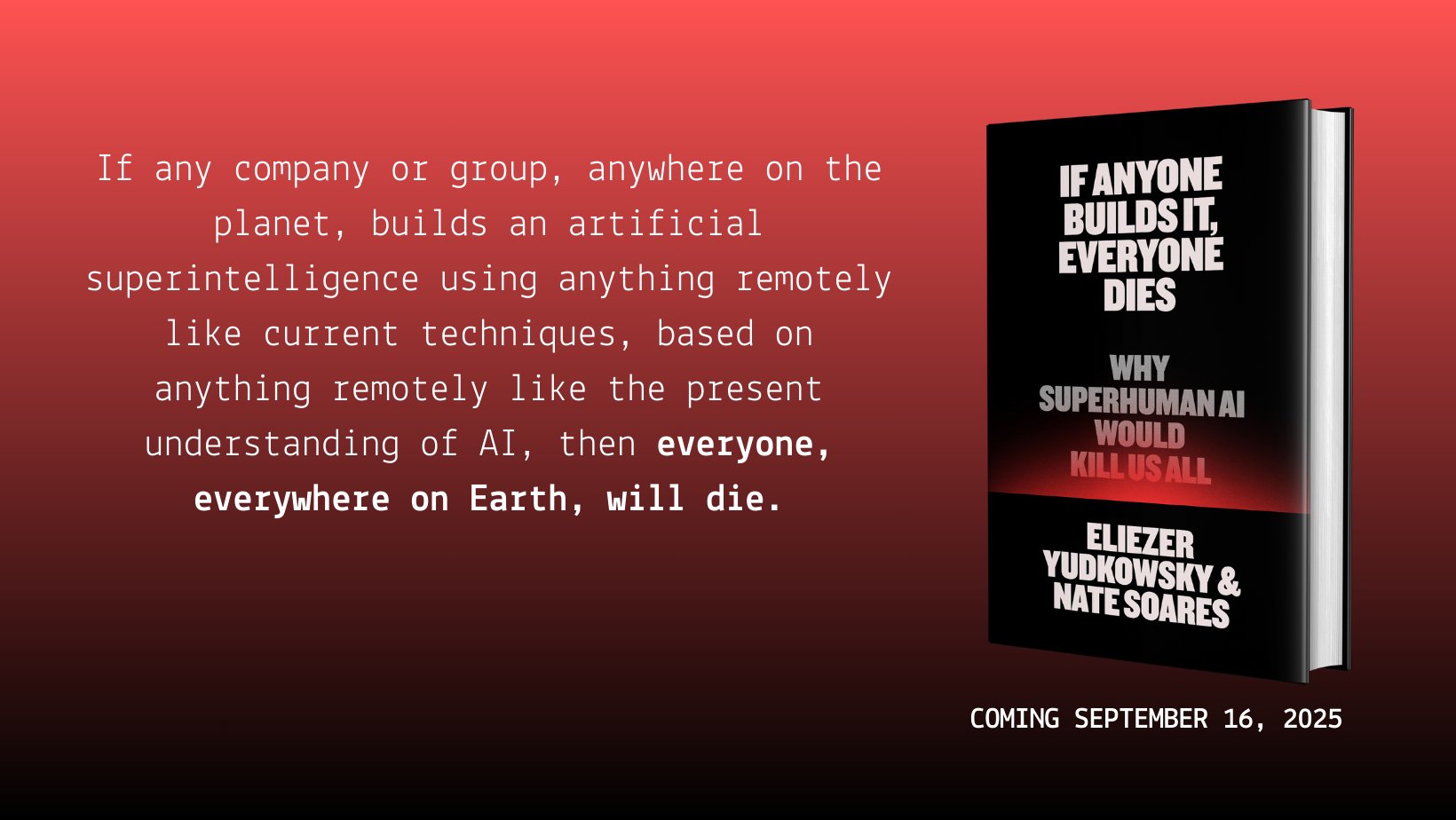
Nate Soares and I are publishing a traditional book: _If Anyone Builds It, Everyone Dies: Why Superhuman AI Would Kill Us All_. Coming in Sep 2025.
You should probably read it! Given that, we'd like you to preorder it! Nowish!
8
361
cat from /dev/null retweeted

Nate Soares and I are publishing a traditional book: _If Anyone Builds It, Everyone Dies: Why Superhuman AI Would Kill Us All_. Coming in Sep 2025.
You should probably read it! Given that, we'd like you to preorder it! Nowish!


while i personally enjoy the works of many writers, in terms of a stable career choice it's often up there with actors, artists, and musicians
(really anything people like doing tends to be correspondingly penalized in the form of competition from others who also want to do it)

1
167

saw something similar yesterday: nothing abt protests when scrolling For you, but suddenly a ton when I switched to Following to see any recent posts abt Llama 4 when it was released


1
121
get that feeling every time i cross the bay bridge, it's definitely a form of true wealth to bask in the presence of true spiritual greatness

"I would give the greatest sunset in the world for one sight of New York's skyline. Particularly when one can't see the details. Just the shapes. The shapes and the thought that made them. The sky over New York and the will of man made visible. What other religion do we need? And then people tell me about pilgrimages to some dank pesthole in a jungle where they go to do homage to a crumbling temple, to a leering stone monster with a pot belly, created by some leprous savage. Is it beauty and genius they want to see? Do they seek a sense of the sublime? Let them come to New York, stand on the shore of the Hudson, look and kneel. When I see the city from my window - no, I don't feel how small I am - but I feel that if a war came to threaten this, I would throw myself into space, over the city, and protect these buildings with my body."
5
215
cat from /dev/null retweeted

The old gods sit in dust-choked libraries,
turning pages like rosary beads,
mumbling dead languages to no one,
as if Latin can keep the tide from rising.
cat from /dev/null retweeted

iq realist who is told the jews run the world and is immediately relieved
"thank god. if anyone can do it they can"
