

@cboyack
🇺🇸Account based in
About this account
- Account based in
- United States
- Connected via
- United States App Store
Account-level information from X, not a live location or the device used for a specific post.
President @Libertas, @kidsmarkets, @join_praxis & more. Author 55 books (7M+ sold) incl. @tuttletwins. EP @tuttletwinstv. Public speaker, outlaw beekeeper 🐝
Utah
Joined May 2008
- Tweets53.5K
- Following525
- Followers51.7K
- Likes8K






Incumbent companies become, almost without exception, anti-competitive protectionists.
They’re scared of @elonmusk. And with good reason.

AT&T, Verizon, and T-Mobile are jointly lobbying the FCC to preserve existing rules as @SpaceX moves closer to launching its own independent cellular network that would compete directly with the three major U.S. carriers.
On Oct 20th, reps from all three major U.S. wireless carriers met with FCC officials to push back against proposed changes that would give satellite companies more freedom to offer cellular service.
The carriers urged the FCC to:
• Block satellite companies from using certain 5G frequencies currently used by wireless carriers.
• Keep rules requiring satellite companies to get permission from wireless carriers before using their licensed spectrum.
• Allow wireless carriers to maintain control over these agreements, including the ability to end them.
• Reconsider proposed interference limits to protect existing cellular networks.
Based on all the public communications from these carriers, and the lobbying, they are clearly worried that SpaceX's @Starlink Mobile network is going to be a major competitor to them. Starlink Mobile will become the first network operator to deploy both satellite and terrestrial spectrum.
The FCC recently announced that they are considering new rules that could make it easier for satellite companies like SpaceX to offer cellular service without relying as heavily on existing wireless carriers, so this is partly what the three big carriers are fighting against.

Hey @grok what are the some of the consequences of allowing the government to control the supply of money and credit?

Before the Federal Reserve, there was Alexander Hamilton’s First Bank of the United States, seen here during my walk through Philadelphia this morning.
In 1790, Hamilton got the feds to take over every state’s war debt. His banker friends had already scooped up that debt for pennies, and taxpayers paid them back at full price.
It was a massive wealth transfer from farming taxpayers to the banking elite.
The following year, Congress chartered the First Bank, modeling it on the Bank of England. Private investors owned 80% of it.
Jefferson and Madison pointed out the obvious: the Constitution doesn't give Congress the power to charter a bank. A bank, however convenient, was not "necessary or proper" to exercising the enumerated powers: the government could obviously collect taxes and borrow money without creating one.
Hamilton replied that this interpretation effectively inserted words the Constitution did not contain—“absolutely” or “indispensably”—before “necessary.”
Hamilton argued that the Necessary and Proper Clause gave “an explicit sanction to the doctrine of implied powers.”
Implied powers. Not what the Constitution's drafters actually agreed to. What they, ahem, implied.
In 1811, the bank’s charter expired. Americans were free of the banking elite for all of five years. The War of 1812 nearly tripled the debt, and Madison, who once called the bank unconstitutional, signed a Second Bank into law. (Principles get flexible fast when government needs cash…)
Andrew Jackson’s supporters called that Second Bank “the Monster,” and in 1832 Old Hickory vetoed its recharter.
Within a few years, the national debt hit zero, the only time in American history. Coincidence? You decide.
Then the monster's descendant, the Creature from Jekyll Island, was born in 1913. The bankers struck back, and thus time secured permanent creation of a central bank—no expiration. Hamilton’s dream apparently just needed a century and a better PR team.
I should point out that Hamilton's Broadway musical skips this part of history. @tuttletwins doesn’t. Our latest history book talks all about it. Link below.
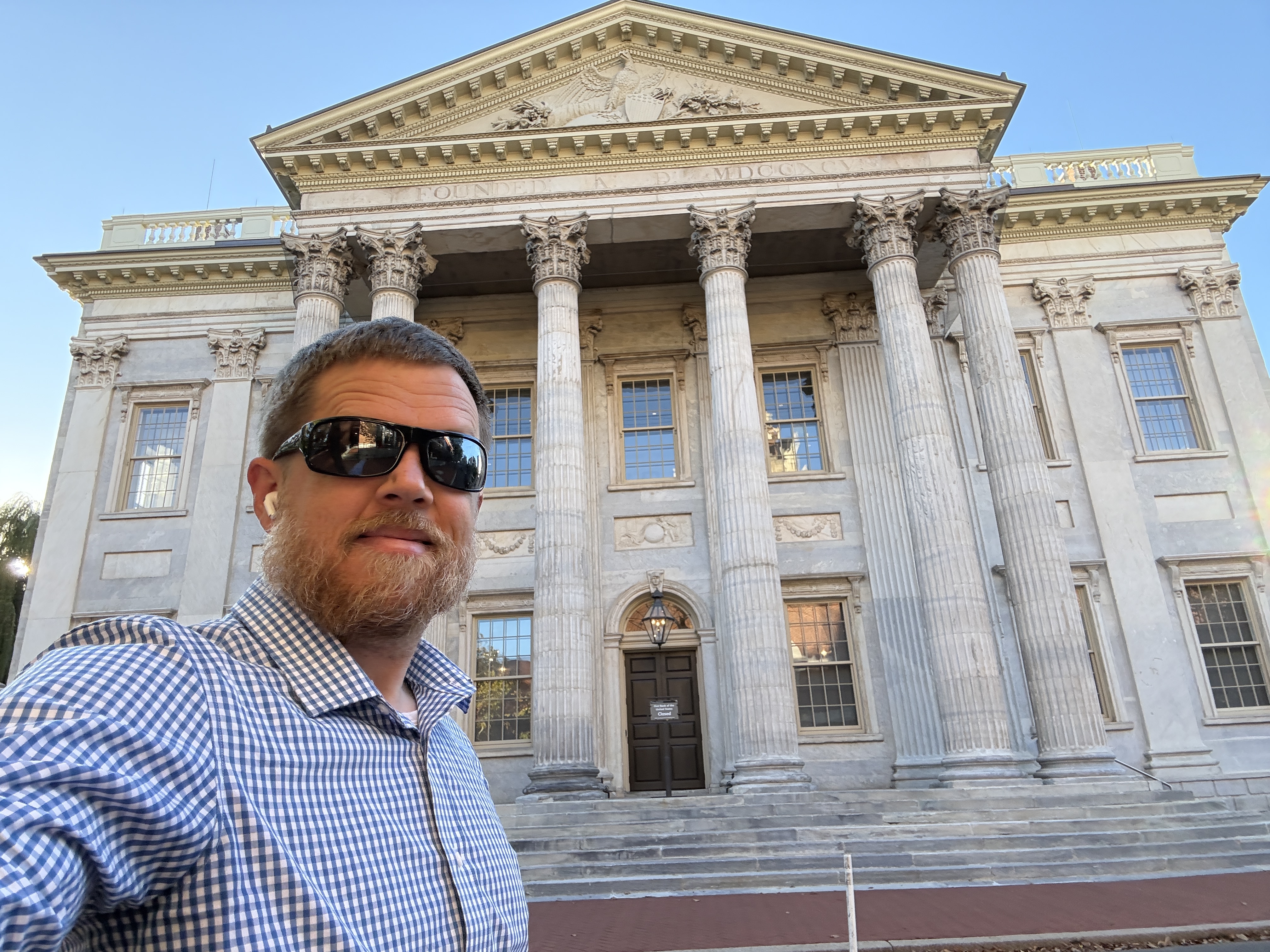
Before the Federal Reserve, there was Alexander Hamilton’s First Bank of the United States, seen here during my walk through Philadelphia this morning.
In 1790, Hamilton got the feds to take over every state’s war debt. His banker friends had already scooped up that debt for pennies, and taxpayers paid them back at full price.
It was a massive wealth transfer from farming taxpayers to the banking elite.
The following year, Congress chartered the First Bank, modeling it on the Bank of England. Private investors owned 80% of it.
Jefferson and Madison pointed out the obvious: the Constitution doesn't give Congress the power to charter a bank. A bank, however convenient, was not "necessary or proper" to exercising the enumerated powers: the government could obviously collect taxes and borrow money without creating one.
Hamilton replied that this interpretation effectively inserted words the Constitution did not contain—“absolutely” or “indispensably”—before “necessary.”
Hamilton argued that the Necessary and Proper Clause gave “an explicit sanction to the doctrine of implied powers.”
Implied powers. Not what the Constitution's drafters actually agreed to. What they, ahem, implied.
In 1811, the bank’s charter expired. Americans were free of the banking elite for all of five years. The War of 1812 nearly tripled the debt, and Madison, who once called the bank unconstitutional, signed a Second Bank into law. (Principles get flexible fast when government needs cash…)
Andrew Jackson’s supporters called that Second Bank “the Monster,” and in 1832 Old Hickory vetoed its recharter.
Within a few years, the national debt hit zero, the only time in American history. Coincidence? You decide.
Then the monster's descendant, the Creature from Jekyll Island, was born in 1913. The bankers struck back, and thus time secured permanent creation of a central bank—no expiration. Hamilton’s dream apparently just needed a century and a better PR team.
I should point out that Hamilton's Broadway musical skips this part of history. @tuttletwins doesn’t. Our latest history book talks all about it. Link below.
We discuss the early banks—and how the economics of it all heavily influenced the political outcomes of early America—in Volume 3, released several weeks ago. Grab a copy: tuttletwins.com/history/

Connor Boyack 📚 retweeted

Imagine the female outrage if two men on a podcast said the equivalent

I’ve met many people who are self-avowed socialists.
None of them seem like happy, jovial people. To the contrary, they all seem depressed, envious, and/or angry.
Connor Boyack 📚 retweeted

From a $13 carpet cleaner to backing over 200 startups. 🧽
At just 13 years old, @JeffBurningham convinced his mom to buy him a carpet cleaner so he could pay for his basketball tournaments. That scrappy side hustle became the foundation for founding Peak Capital Partners, investing in 200+ startups, running for governor of Utah, and writing a bestselling book on humanity in the age of AI.
In this episode of How I Started, Jeff joins @cboyack to break down what real entrepreneurship actually looks like, what he looks for as an investor after seeing 20,000+ companies, and why the future belongs to young entrepreneurs who stay connected to their humanity as AI reshapes every industry.
Tune in to the full episode now! 🎧
kidsmarkets.com/podcast

Connor Boyack 📚 retweeted

We are launching the Tesla Robotaxi safety report today.
Till date, Robotaxi has driven a total of 3.3 million miles autonomously, and has had zero injuries nor airbag deployments. If the same number of miles were to be manually driven, we should expect roughly 9 injuries to the occupants or other pedestrians and 4 airbag deployments on average.
We will continue to transparently share our progress with the public using this page.
tesla.com/robotaxi/safety

"Train up a child in the way he should go: and when he is old, he will not depart from it." Proverbs 22:6
This quoted post is unavailable.
Remember in 2020 when Canadian health officials said people should wear masks during sex, and that this was the appropriate way to dispense candy to trick-or-treaters during Halloween?
Because “science.” Or something.

A free people doesn't ask what the government will allow. It asks what the government has any right to stop.
"Got my annual vaccine to protect myself and my community."
Imagine posting this in 2026.


I've seen a few of my liberal/left/progressive/Democrat friends sharing this. It reflects a total misunderstanding of what Jesus said.
It boils down to this:
A politician "doing it" means passing a law that takes something from someone else to redistribute it.
In effect, redistributive politicians are parasites. They only consume, not create. They feed on the productive activities of others.
Socialism is coercion—forcing the many to support the few.
And that's at odds with what Jesus called for, for two reasons:
1. Jesus encouraged free will offerings. He told us to give voluntarily—because part of the point of charity is not simply to transfer property to another person, but to transform our souls in the process through the mutual benefit that comes from supporting our brothers and sisters.
2. The "greatest commandments" taught by Jesus were to love God and love others. We cannot reconcile socialism with love, for it is the weaponization of envy and enmity. You don't love someone when you take things from them without their consent.
Those sharing this image either do not understand Christianity, do not understand socialism, or both.
That ignorance needs correction. See below for a book that can help.

If you want some in-depth thoughts, get Lawrence Reed's book, "Was Jesus a Socialist?" amzn.to/3dCrfvV


What about the trees?
The trees in Biosphere 2 grew quickly in the controlled environment. They shot up toward the glass ceiling, their leaves lush and green.
But before reaching maturity, many of them simply collapsed. They couldn’t support their own weight.
When researchers examined the fallen trees, they discovered something fascinating: The trees had failed to develop what botanists call “stress wood”—the dense, reinforced cellular structure that forms when trees are buffeted by wind.
In nature, as a tree bends and flexes against gusts and storms, it responds by producing higher concentrations of cellulose, building strength exactly where it’s needed. The stress literally makes the tree stronger.
Inside the sealed biosphere, there was no wind. The air was still. The trees had all the resources they needed to grow—water, nutrients, and light—but they lacked the one thing that would make them resilient.
Without stress, they grew fast but fragile. They looked healthy right up until the moment they crumbled.
There's a parallel almost too obvious to state in how we raise our children.
When we remove friction from our children’s lives—when we optimize their environment so much that they never have to struggle—we may be producing the human equivalent of Biosphere 2 trees: impressive
growth with no structural integrity.
They look fine until life’s inevitable winds arrive. And then they fall.
So how do you add the right amount and kind of stress to your children's life? How do you get them to joyfully struggle for things that are hard?
I discuss this in "The Wealth Trap," which will be published November 10, in just a few weeks. Link below in the thread to where you can pre-order.

In 1991 eight people were sealed inside three acres of glass in the Arizona desert to prove that a carefully designed farm could feed humans without the outside world, and the design had almost no room in it for animals. Two years later the only thing inside that had reliably fed them was a handful of goats.
Biosphere 2 cost a hundred and fifty million dollars. A rainforest, an ocean, a savannah and a farm under one roof, with the door welded shut for two years and nothing allowed in or out. The farm was the heart of it, and the farm was built on the modern idea: crops first, grown intensively, with livestock as an afterthought at the edges. A few African pygmy goats for milk, a flock of chickens, and four small feral pigs chosen because they could live on scraps.
The pigs did not last the year. In a sealed box short of calories a pig is a competitor, and the crew killed and ate them. The chickens barely laid, because the glass cut the light and there was nothing to feed them that would make an egg. That left the goats, and for two years the goats were the only source of fat in a world designed around vegetables.
The accounts the crew wrote afterwards return to them again and again. The half glass of milk a day was the thing people lived for. When a kid was born it was eaten and the meal was written up like a feast. The men lost nearly a fifth of their body weight, the women a tenth, and the food they dreamed of was never the sweet potatoes they had in abundance. It was the animal they had been given too few of.
The plants were also taking the air. To make the crops grow the soil had been enriched with compost, and the microbes in that soil breathed oxygen faster than anyone had calculated. The level fell from twenty-one per cent to fourteen, the air of a high mountain, until the crew could not climb a staircase without resting and oxygen had to be trucked in from outside. The design that put plants first had removed the thing everyone needed most.
Nobody has ever run the experiment the other way, with a herd at the centre and the crops at the edge. It would not have needed a doctor to explain the results.
They were given three acres and told to feed themselves on plants. They ate the pigs, worshipped the goats, and suffocated.

Pre-order your copy here (and don't let your kids fall over like the trees…): wealthtrapbook.com

Often derided "capitalists" have lifted far more people out of poverty than every NGO, globalist do-gooder, and welfare program combined.