







Do magnets… $MP

MP Materials sits on what Ross Perot Jr. calls "the Saudi Arabia of rare earth" in California. Jim Litinsky bought the company out of bankruptcy and wanted to start making magnets too.
Ross brought him to Alliance in Fort Worth, and at the groundbreaking for the first magnet facility, Jim told him:
"Ross, I can't believe it. It took me three weeks to get the air quality permit in Fort Worth. It had taken me over two years in California."
Then the Pentagon bought 15% of MP Materials and asked Jim for a magnet plant 10 times bigger, right away.
"So now we're building a $1.2 billion building for Jim."

China urges US to halt proposed expansion of outbound investment curbs reut.rs/4dXAiIj reut.rs/4dXAiIj

$USAR $9.31…
Wow, can’t say I ever expected to see $USAR this cheap without any sort of Rare Earth deal with China.
Here’s my honest late night thoughts about the company:
Context: I personally never loved the company enough to hold. The Serre Verde acquisition was a big de-risking step for the company in my eyes, but of course dilution came with it. Ironically when they locked this in, the stocks collapse started. But you could argue the collapse is completely macro-related and I’d agree.
Maybe a hot take, but the only value I see in $USAR is with Serre Verde and Less Common Metals, who they’ve aquired. But that also comes with risk.
I don’t think Round Top is that great or valuable… and they haven’t proven they can even process rare earths outside of acquisitions.
They just buy other companies, in completely different parts of the world (Brazil, France) which in my eyes can create even further complications.
Honestly one of the big things for me was the Lutnick connection… it is potentially a major stain on the company. I do believe the Democrats will gun for Lutnick and in turn $USAR in the future if they gain majority power. I have since the day it happened to be honest.
I still think $USAR has potential especially if you’re buying around here, it’s just never been my personal choice in the “mine to magnet” mania. I’d rather stick with the one company who’s already doing it.
I honestly think $MP has more potential than $USAR even at current levels at least long term. People are sleeping on the fact that they will be a first mover in the magnet space…
But short term $USAR does trade very well overall and if and when the sector gets hot again I’d be shocked if $USAR wasn’t one leading the charge.
I do own $ALOY as my YOLO “mine to magnet” play personally… but only 1000 shares for now.

NEWS: U.S. Pentagon Declares China’s “Confucius Institutes” a National Security Threat
The U.S. Department of War announced today, October 23, that China’s Confucius Institutes have been designated a threat to American national security.
What exactly are Confucius Institutes?
They are Chinese government-backed educational programs established through partnerships with universities around the world, including in the United States.
Their stated purpose is to teach Mandarin Chinese, promote Chinese culture, and facilitate educational exchanges.
However, U.S. officials have long raised concerns that these institutes can serve as instruments of Chinese government influence on American campuses, potentially undermining academic freedom and creating risks involving sensitive research.
The designation comes as Washington continues tightening restrictions on research partnerships with Chinese institutions over national-security concerns.
Earlier this week, China criticized U.S. restrictions targeting Chinese research institutions, calling them discriminatory and harmful to scientific cooperation.
This is another point of friction between Washington and Beijing as their competition expands beyond trade and into education, scientific research, and technology access.
reuters.com/world/china/pent…

I can’t even drive home from work without missing a new development these days…
All the focus is on Iran, but there’s so much going on between the U.S. and China right now.
👀 “These models, developed primarily in China, are being used by black hat hackers to wreak havoc on the Western capitalist structure. Presumably, this has been part of China's plan the entire time, and we're seeing its implications fall out in real time.”

# Black October
For anyone who knows me even somewhat well, it's clear that I am a 99th percentile tech optimist. However, the vibes have shifted for me quite a bit in the last 18 hours, and I feel a moral imperative to share what I'm thinking and feeling with my circles so that everyone can understand, and hopefully take seriously, what's happening right now. I think October 2026 will have many chapters written about it in the history books.
You know those scenes in financial movies like Margin Call where someone realizes that they're all fucked, and no one else sees it yet? And that person feels like they're crazy, and then suddenly everyone is pulling an all-nighter in a boardroom and freaking out? Yeah, that's kind of how this is feeling right now in the SF/Bay Area/AI circles.
We're 48 hours into what is being called Black October. In the last 2 days there have been several dozen cyber attacks which, in isolation, would each have been the worst to happen in an entire calendar year. Every sector from government to education to big tech and banks is being massively affected, and people are starting to freak out.
In a nutshell, what's happened is that frontier AI models have gotten to a point where they are as advanced as the most sophisticated programmers, with one critical difference: they can work 24/7, and you can spin up 10,000 of them with a single command and they'll work together tirelessly until they accomplish their task. The most advanced models today are from companies like Anthropic and OpenAI, whose current best technology is so good that they haven't been able to roll it out to everyone yet because of the national security risks it poses.
Meanwhile, the best open source models (where anyone can just download the model weights and do whatever they want with them, uncensored) are slightly behind the frontier but still 90-95% as capable. These models, developed primarily in China, are being used by black hat hackers to wreak havoc on the Western capitalist structure. Presumably, this has been part of China's plan the entire time, and we're seeing its implications fall out in real time.
In red-pilled AI circles, we've been sharing and reading papers called things like "Situational Awareness" and "AI 2027" for the last year or so, which at the time felt a bit like near-term speculative fiction. They laid out the case for why Artificial General Intelligence (AI smarter than any human at any knowledge task) and Recursive Self-Improvement (models that are able to use themselves to get better) weren't half-baked future ideas anymore, but instead an inevitable outcome of the linear progress that's happening.
These papers would then talk about things like "takeoff scenarios," trying to envision how that moment would come to be and what it would be like when it happened. It would either be a "slow takeoff" that would play out over the course of months and quarters, happening subtly and only obvious to a few. Or, it would be a "fast takeoff" where it would pretty much happen instantly, like a bit flipping from 0 to 1.
From everything that I can see and am feeling, we are currently experiencing the fast takeoff scenario. Beyond the crazy security vulnerabilities that have come out recently, there have also been massive breakthroughs in life sciences, fundamental computer science, materials science, and pure mathematics that have all landed in the same time frame. While I still firmly believe that AI will be a net positive for humanity, it's more clear to me than ever that the societal and individual risk is very real, and is playing out NOW.
For as much conviction as I have that this is happening, the thing that's caused me to lose sleep is that I don't really know what to do about it, or more importantly, what to tell you, reader, to do about it. So, the best I can do is make a few suggestions that have always been a good idea but are more timely now than ever:
Set up 2-factor authentication for everything. I use Duo.
Use a password manager across your devices. I use 1Password.
Get an identity protection app set up. I use Alta.
Move your IoT devices to their own network. Claude helped me do this.
And last, but certainly not least, if you've been avoiding leaning into AI, see this as a catalyst to wake up and start using it. Don't just use the chat mode version of ChatGPT/Claude; click that Code/Work button and see how easily you can have AI write code to help you with your job. One of the biggest vulnerabilities was in a massively popular programming language called PHP, and the prompt that set it off was literally, "Find vulnerabilities in php."
This is an unprecedented time for humanity, but as we've done with many things before, we will prevail so long as we are kind, loving, and open-minded to the world.
Much love.
NEWS: U.S. Department of Energy Officially Designates Helium as a Critical Material
The U.S. Department of Energy announced today, October 23, that helium has officially been added to its Critical Materials List, becoming the 20th material to receive the designation.
The decision comes as global helium supplies face growing disruptions, particularly from the ongoing conflict in the Middle East and restrictions on Russian exports.
Helium is essential to several industries that the United States is investing heavily in, including semiconductor manufacturing, quantum computing, aerospace, defense, and advanced energy technologies.
In semiconductor manufacturing, helium is used for cooling, photolithography, and leak detection. It is also essential for cooling superconducting systems used in many quantum computers, where temperatures must approach absolute zero.
The United States is already the world’s largest helium producer, accounting for approximately 43% of global production in 2025, or 81 million cubic meters.
However, domestic production has remained relatively stagnant since 2021, with existing extraction facilities operating near capacity.
Despite having substantial helium resources, expanding production requires additional processing infrastructure, investment, and years of development.
Sound familiar?
This is something I’ve repeatedly emphasized when discussing rare earths and critical minerals.
Having the resources in the ground means very little without the domestic infrastructure needed to extract, process, and deliver them at commercial scale.
Helium is another example of how vulnerabilities can exist even when a country possesses substantial natural resources.
Today’s designation could help unlock additional federal financing for domestic helium production while increasing government attention toward supply-chain security.
It does not automatically fund new projects or immediately increase production.
As the United States continues expanding its semiconductor, AI, quantum computing, and defense industries, securing reliable supplies of the materials supporting those technologies will become increasingly important.
The United States cannot afford to build out its next generation of advanced industries while overlooking the physical supply chains required to support them.
apnews.com/article/energy-cr…

🤖 Made with AI


BREAKING: General Motors Cancels Major Supply Agreement With New U.S. Rare-Earth Magnet Factory $UUUU $GM
According to a new Reuters report, General Motors has terminated its long-term supply agreement with German magnet manufacturer Vacuumschmelze (VAC), which recently opened a $500 million rare-earth magnet manufacturing facility in South Carolina.
The facility was designed to produce nearly 2,000 metric tons of rare-earth magnets annually, with approximately 90% of its production originally intended for GM.
Although GM terminated the agreement on July 1, 2026, the details of the dispute were newly reported today.
VAC has since initiated arbitration proceedings seeking damages related to the canceled agreement.
Here’s where things get interesting…
Energy Fuels ($UUUU) previously announced an agreement to acquire VAC for approximately $1.9 billion.
According to Reuters, the dispute could potentially affect the acquisition price as the companies evaluate the financial implications of losing such a significant customer.
reuters.com/legal/litigation…
BREAKING: U.S. Treasury Proposes Expanding Investment Restrictions on Chinese Technology Companies
The U.S. Treasury Department proposed a rule Thursday to crack down on American high-tech investments such as supercomputing and artificial intelligence in China, Russia, North Korea and other “countries of concern.’'
The U.S. government has been working for years to deny China and other adversaries investments that could help them boost their military power.
That program began in 2023 when then-President Joe Biden signed an executive order putting restrictions on outbound U.S. investments in sectors such as semiconductors, quantum computing and artificial intelligence going into China. Treasury later established the Outbound Investment Security Program.
In December 2025, Congress passed a law that codified and expanded the program to target more technologies and more foreign countries, including Cuba, Iran, North Korea and Russia.
The inclusion of Russia in the proposed rule has come days after President Donald Trump waived sanctions on Russia following a diesel deal with President Vladimir Putin.
The rule announced Thursday would expand the restrictions to cover investments in hypersonic systems (capable of traveling at five times the speed of sound), supercomputing, biotechnology and artificial intelligence, though Treasury used Trump’s favored term for AI, “superintelligence” or SI.
The proposed rule “sends an important signal to markets that Washington is tracking where U.S. capital is flowing and what capabilities it is helping build,” said Craig Singleton, a senior fellow at the think tank Foundation for Defense of Democracies.
The screening of outbound investments “recognizes that capital can accelerate military-relevant capabilities just as surely as technology transfer can,” Singleton said.
apnews.com/article/treasury-…

BREAKING: U.S. Blocks Electronic Devices Containing Chinese Huawei Chips Over National Security Concerns
The Federal Communications Commission (FCC) announced on October 22 that it blocked two electronic devices containing surveillance chips manufactured by HiSilicon, a subsidiary of Chinese technology giant Huawei.
The affected products include a dashboard camera and a wireless video transmitter.
According to Reuters, this marks the first reported enforcement action under the FCC’s expanded authority to deny equipment authorization to devices containing certain components manufactured by Chinese companies considered national security risks.
Here’s why this matters…
Previously, U.S. restrictions largely focused on equipment manufactured or sold directly by companies such as Huawei.
The expanded approach allows regulators to scrutinize products manufactured by other companies if they contain certain restricted Chinese components.
In other words, simply incorporating a covered Chinese chip into a product could prevent that device from receiving authorization for sale in the United States.
This potentially extends Washington’s technology restrictions further into global electronics supply chains.
And the timing is worth watching.
The announcement comes amid ongoing U.S.–China trade negotiations, semiconductor restrictions, sanctions, and broader disagreements over national security.
Beijing has repeatedly criticized American restrictions targeting Chinese technology companies, accusing Washington of using national security concerns to suppress Chinese businesses.
Nevertheless, this represents another development in the ongoing technological confrontation between Washington and Beijing.
reuters.com/world/us-blocks-…

Just something to keep in mind.
Prolonging the war will deplete more munitions the United States doesn’t have the domestic capacity to replenish.
The United States simply does not have the domestic processing capacity for critical minerals needed in many missiles, weapon systems, etc.
This is actually a pretty terrifying situation if you really think about it.
So the strategic importance only grows, but the stocks themselves will probably get crushed more due to higher oil prices which will in turn rise costs.
Many of the companies making an effort to fill the gap are still early stage, pre-revenue companies that still need to prove themselves at commercial scale.
This could create some wild opportunities.
The ironic thing about the Iran conflict is that the longer it drags on, the more strategically valuable critical minerals become.
The problem for investors? Higher oil prices, inflation and yields can hammer the stocks regardless of how important the underlying materials become.
But the biggest thing I’m watching now is Xi’s upcoming visit to the United States.
My expectation? Another nothing-burger.
What matters much more is what happens after. China’s suspension of its October 2025 rare earth export controls is currently scheduled to expire November 10.
A separate suspension involving U.S. specific restrictions on gallium, germanium, antimony and other dual-use materials runs through November 27.
If those suspensions simply expire without another extension, things could get interesting very quickly.
Then comes January 1, 2027.
That’s when the DFARS restrictions covering certain magnets, tantalum and tungsten expand significantly upstream for U.S. defense procurement… including mining, refining and separation from covered countries. Trump’s recent executive order also doubles down on this.
That combination is why I think 2027 has the potential to be a massive year for the critical minerals sector… especially if we see another run in gold and silver.
NEWS: Pentagon Reportedly Developing Deep-Cover Spy Program to Confront China
According to a new report from The Washington Post, the Pentagon is exploring a clandestine intelligence program that would place American operatives undercover as businesspeople to gather economic intelligence on China and other U.S. adversaries.
Unlike traditional military espionage, the proposed initiative would reportedly focus on economic intelligence, strategic industries, and national security competition.
The effort is reportedly being overseen by Tom Rakusan, a former senior CIA official who now advises Deputy Defense Secretary Steve Feinberg.
Under the proposed program, intelligence officers could operate under commercial identities, posing as private-sector professionals without any visible connection to the U.S. government.
This would potentially allow the Pentagon to gather intelligence on foreign businesses, economic activities, and strategic industries through channels that are less accessible to traditional military intelligence operations.
Here’s where things get interesting…
The reported initiative reflects an increasingly blurred line between economic competition and national security.
Rather than focusing exclusively on military capabilities, Washington is exploring ways to better understand and potentially counter the economic activities of its geopolitical rivals.
However, the program reportedly remains in the planning stages and is not operational. The Pentagon has also denied that such an initiative is being developed.
If implemented, it could represent a significant expansion of the Pentagon’s intelligence activities as economic competition between Washington and Beijing intensifies.
washingtonpost.com/national-…

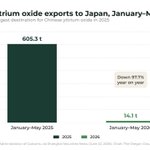
China Restricting Rare Earth Exports to Japan = China Restricting Supply to the U.S. $MP $USAR $UUUU $AREC
How? The answer is simple.
U.S. defense contractors also rely on Japanese-manufactured components containing yttrium, a critical rare earth used in jet engines, aerospace applications, and semiconductor manufacturing.
Japanese government officials and trading executives are now warning that severe supply shortages could emerge as early as the end of 2026 unless China eases its export restrictions or the U.S. and its allies secure alternative supplies.
This is why domestic rare earth production, separation, and refining are so important.
China doesn’t need to restrict exports directly to the United States to disrupt American supply chains. Restricting materials flowing to key U.S. allies can have downstream consequences for American defense and manufacturing.
NEWS: China Defends Rare Earth Export Restrictions on Japan as Yttrium Shortage Worsens $MP $USAR $UUUU $AREC
China isn’t backing down.
On October 21, Chinese Foreign Ministry spokesperson Mao Ning defended Beijing’s export restrictions on Japan, stating that the measures were intended to prevent Japan’s “remilitarization” and pursuit of nuclear weapons.
The statement follows a Financial Times report warning that Japan could exhaust its yttrium inventories within months, potentially disrupting aerospace, semiconductor, automotive, and defense manufacturing.
American defense and aerospace manufacturers also depend on Japanese components containing yttrium. China’s restrictions therefore extend beyond Japan, creating supply-chain pressure on the United States.
With Washington and Beijing negotiating over trade, technology, and critical minerals, Japan’s shortage adds another complication.
Beijing has not announced new restrictions today. However, its latest statement reinforces that rare-earth export controls remain closely tied to geopolitical and national security disputes.
Rare earths aren’t just commodities anymore. They’re strategic leverage.

#China has imposed export controls on #Japan in accordance with laws and regulations, with the aim of preventing Japan's "remilitarization" and attempts to acquire nuclear weapons, Chinese Foreign Ministry spokesperson Mao Ning said on Wednesday, responding to a Financial Times report that Japan had sought #US help in urging China to ease related rare-earth export restrictions amid a potential yttrium shortage. Mao said China's position on maintaining the stability and security of global critical mineral production and supply chains remains unchanged, and that all parties have a responsibility to play a constructive role in this regard.

cek retweeted

"...Beijing was also reluctant to increase critical mineral supplies, viewing them as its “most effective economic weapon”.
sc.mp/2p4ox?utm_source=twitt… via @scmpnews

The Great Rare Earth Disconnect: Prices Up 23%, Miners Down 28% zerohedge.com/commodities/gr…
