

Nothing ever posted is financial advice | Do your own due diligence | Only innovation prevents chaos. https://teapawt.net/t.co/kfXZOyo0E7
Earth
Joined July 2024
- Tweets2.1K
- Following274
- Followers1.5K
- Likes1.9K





Pinned Tweet
$VSTM reported that VS-7375, an oral non-covalent KRAS G12D ON/OFF inhibitor, reached a confirmed ORR of 9 of 22 (41%) at 900 mg in 2L+ mPDAC. How might this ORR translate into survival, and how does VS-7375 compare with $RVMD's daraxonrasib and zoldonrasib?
Link in comments (free, as always).
Disclosure: I am long $VSTM. No position in $RVMD. This is not financial advice. Do your own research.


Chaotropy retweeted

The European Commission has granted marketing authorization for our oral RAS(ON) multi-selective inhibitor for previously treated metastatic pancreatic cancer.
Read more: revmed.com/media/news/13736/…
#ForMediaOnly


Yes, the placebo rate in HS trials has risen in recent years (better SOC?). But a high placebo rate lifts the tibulizumab arms just as much as the placebo arm.
Randomization should give every arm the same background rate. With no relevant delta at either dose and no dose response, I do not see a “beast” in the placebo arm. Tibulizumab just does not work in HS.
Disclosure: I hold no position, long or short, in $ZURA. This is not financial advice. Do your own research.

That’s a miss for $ZURA! HS placebo has grown into a real beast. Onto SSc soon then PMR after that. No need to dive into the SSc setup here, because I already wrote about that catalyst in the original document - check there for my takes on that.
That’s 2/3 on pitches! Bummer and of course a big money loser for me, but that’s part of the game. Finding setups with huge potential upside skew means you have to go for stuff that the market thinks is very unlikely to work, thus pricing it cheaply. This time the market was right!
As discussed before, win or lose, the next stop is X hiatus. I’ll stick around for a few days so the “I told you so’s” can take their shots, but a nice break from the noise and distractions is certainly in store.
1
11
1,921
$ZURA. All endpoints clearly missed. Tibulizumab was more or less inert in HS.
Blaming high placebo rates is pointless when there is no relevant delta. The drug just does not work.
What did I learn? No matter how good a chain of PK/PD arguments and cross-trial comparisons looks, I will never again touch anything without existing clinical data in the indication of interest. Actually no surprise, but drugs do not work like cards in a board game where you add up stats.
Didn't expect such a disastrous result. But that's biotech, sometimes you lose, sometimes others win.
Disclosure: I just sold my total position in $ZURA. This is not financial advice. Do your own research.
Did not want to miss a different perspective, so I bought a monthly subscription to @hannibalspeaks' Substack to read his paywalled article on $ZURA.
The article asks an interesting question. What placebo-adjusted HiSCR75 delta would TibuSHIELD need to report to prove that the BAFF arm of tibulizumab adds anything to IL-17A blockade? I come back to whether that is the right frame at the end, but let's first follow the argument.
The first part estimates what tibulizumab's IL-17A arm alone would do. Ixekizumab has never been tested in a placebo-controlled trial in HS, so Hannibal extrapolates its HS delta from a linear regression of HiSCR75 against PASI-90 over four data points, checked with a second linear regression against ACR50 in psoriatic arthritis (which counts bimekizumab twice). The two regressions give an oddly precise corridor for the delta of 13 to 14.6 points.
In principle I kind of like this approach, but it rests on a wrong assumption in my opinion. Tibulizumab is not simply ixekizumab plus tabalumab. The IL-17A arm is an scFv on a larger bispecific with its own dosing, PK and tissue penetration, and it has not been shown that it blocks IL-17A in HS lesions the way ixekizumab does at its label dose. So ixekizumab may be a weaker proxy than was assumed for these regressions.
The second part of the argument is based on phase 2 inflation, a well-documented phenomenon in drug development. In the five HS phase 2/3 pairs Hannibal tabulates, phase 2 deltas ran about twice the phase 3 deltas. He feeds this into a Monte Carlo simulation (good idea, MC is often very useful) and gets a very optimistic result, a most likely phase 2 delta in the twenties assuming that only IL-17A works. From this he concludes that an additional BAFF effect would only become statistically separable above a delta of 35 from a frequentist standpoint.
By the way, I do not get the 35. By my reading of his histogram, about 15% of his IL-17A-only runs land above 35, which would be p = 0.15 on the right tail rather than 0.05.
Another problem is that Hannibal correctly stresses how noisy results of trials in HS are and then anchors his simulation on a point estimate regressed from four of exactly those noisy readouts. The simulation treats this estimate as exact, and it ignores the spread of the inflation factor (1.59 to 2.62). So his conclusions rest on far shakier ground than his quite confident tone suggests.
Now back to the main argument. Does it matter whether we ever get clean statistical evidence that the BAFF arm contributes on its own? Probably not, and I very much doubt this trial could deliver such evidence anyway.
Sabat et al. reported that lesional BAFF in HS comes mainly from neutrophils, and IL-17 drives neutrophil recruitment in HS. If that holds, IL-17A blockade alone should already lower lesional BAFF, so the two arms would overlap rather than act independently and no realistic delta could cleanly credit the BAFF half.
Tibulizumab will be judged on its total delta against placebo anyway. If it hypothetically ends phase 3 at >20 points, will anyone care which arm of the antibody did the work?
While disclosing that he is long, Hannibal assigns BAFF at best a 10% chance of adding anything. So his trade is a bet that the market will misread a potentially inflated phase 2 result. Personally, I would not bet on a setting like this while not believing in the drug tested.
Did I update my priors after reading? Not really. Nobody knows from the available data how TibuSHIELD will read out and no simulation can decrease the inherently high risk here.
The main risk remains a surprisingly high placebo rate in my opinion, with or without a BAFF effect. It was still an interesting read with an original analysis, resting on a model far less solid than its confident tone suggests.
Disclosure: I am long $ZURA. This is not financial advice. Do your own research.


Recurring bearish sentiment, like right now, is the reason why I doubt a dot-com-style bubble can form. There are certainly forces pushing toward an excessive AI bubble, and yes, we have seen some craziness. But at least once a year, the AI trade sells off for changing reasons, so far mostly unjustified ones in hindsight.
How long did $AMZN, a rising star of the dot-com bubble, need to reach the revenue of $ANT? The dot-com pipe dreams were built on anticipated demand, while AI demand is right here, right now and growing. Back in 2002, an estimated 90% of the fiber laid was dark. Today, every major AI company lists not getting enough compute as a risk.
I hold no position in $AMZN or $ANT. This is not financial advice.
1
633


Chaotropy retweeted

Palisade Bio Announces First Patient Dosed in Global Phase 2b ASCENTRA-UC Study Evaluating Once-Daily Oral PALI-2108 for the Treatment of Ulcerative Colitis
bit.ly/4dXWZfC
$PALI #UlcerativeColitis #Crohnsdisease #IBD #GIHealth

In March I tried to predict $ELTX's AMPLIFY-7P readout with a Monte Carlo simulation. This obviously failed, the trial missed its primary DFS endpoint (HR 0.85).
Nevertheless, some of my assumptions were quite accurate. I estimated the median DFS in the observation arm to be between 16 and 22 months, and it reached 21.2 months, while the trial design assumed 7 months.
Now @EileenMOReilly presented an interesting pre-specified subgroup analysis at ESMO in Madrid. It turns out that the vaccine (camupepimut) arm carried more ctDNA positive patients at baseline (20.8% vs. 12.5%), a factor that was associated with a roughly 6-fold higher recurrence risk.
Splitting by ctDNA status removes that imbalance and results in HRs of 0.51 and 0.57 for the ctDNA negative and ctDNA positive subgroups. So did the trial fail due to some kind of Simpson’s paradox from an unlucky randomization?
I would be cautious here. If we add up those subgroups we get to 119 patients while the study enrolled 144, meaning that 25 of 144 patients have no evaluable baseline ctDNA result and are left out.
Please correct me if I made a mistake, but as far as I can reconstruct it from the event counts, that is 14 vaccine patients with 9 events (64%) vs. 11 observation patients with 5 events (45%). So it seems that the share of patients that was dropped is the share where the vaccine did worse.
The subgroup p-values come from Wilcoxon tests, which weight early events, where the vaccine looks best, while the primary endpoint used the log-rank test.
The 95% confidence intervals of all three subgroup HRs include 1 (ctDNA negative 0.25 to 1.02, ctDNA positive 0.22 to 1.48, no prior radiation 0.33 to 1.03). The ctDNA positive HR rests on 6 observation patients who all had an event, with a median DFS of 1.9 months.
At least twelve subgroups were tested without multiplicity adjustment. Wouldn’t applying a Benjamini-Hochberg correction be more rigorous here?
Don’t get me wrong, I really like this off-the-shelf 7P KRAS vaccine approach and I really "want it to work". Looking at the results I am even tempted to say that camupepimut has some effect. But that does not change my view that camupepimut was probably not handled in the right way.
I think the cardinal mistake was to try camupepimut without a checkpoint inhibitor in the first place. The Nature Medicine paper itself blames the failure of checkpoint inhibitors in PDAC partly on the lack of tumor-specific T cells, which is exactly what an efficient vaccine would supply. In hindsight I cannot understand why such a vaccine was tested as a monotherapy in one of the hardest to treat cancers. Of course this is an easy critique after the fact.
This subgroup analysis does not change my mind, the primary readout was a weak signal that there is something at work (the post hoc R0 subgroup, HR 0.65), so nothing new here.
What I want is that the management changes course, stops this monotherapy approach and continues camupepimut in combination with checkpoint inhibition in the adjuvant setting, which the paper so far lists only as an option for phase 3.
So I would wish for a two-arm phase 3 in the adjuvant setting, camupepimut plus checkpoint inhibition vs. observation. Checkpoint inhibition alone has failed in PDAC, so observation is probably the right comparator. That readout would be years away (especially if the combination works).
$ELTX plans a phase 1 of camupepimut plus a RAS inhibitor, with or without anti-PD-1, in metastatic PDAC. The company cites a few complete responses in metastatic patients who received checkpoint inhibition after camupepimut as support, although these responses followed checkpoint inhibition and not a RAS inhibitor. An ORR readout could be a closer catalyst than an adjuvant phase 3, but RAS inhibitors already produce responses on their own, so an uncontrolled ORR may say little about what camupepimut adds.
Nevertheless, the cash runway is tight, $ELTX needs to raise money which will likely substantially dilute shareholders.
Disclosure: I started a (very small) position in $ELTX again, so I am long. $ELTX has a very short financial runway, meaning the risk of total loss of principal is very high. This is not financial advice.
Do your own research. I compiled the data, facts and interpretations in this post to the best of my knowledge, but they may contain errors, and I give no guarantee of their accuracy.
Just published my new article “Monte Carlo Simulation Of @ElicioTx's Phase II AMPLIFY-7P Study Favors Vaccine Efficacy” (free link in comments). $ELTX
I built a Monte Carlo simulation to model the delayed and ongoing AMPLIFY-7P trial using informed estimates and incorporating all publicly available information. Looking forward to your feedback!

Wanted to spend as much time as possible with the baby on a Saturday, but no, @A_May_MD had to put out an addendum to his Google Doc on $ZURA's tibulizumab. Adam, I hope for your sake that you never meet my wife!
Anyway, I worked through the addendum when the baby finally slept:
1.) Tibulizumab’s IL17A affinity: On a log scale, the 14 pM reported for tibulizumab sits between the 2 to 3 pM of Taltz and Bimzelx and the 129 pM of Cosentyx. I do not think a strict affinity ranking holds at the exposure I expect, but yes, 14 pM is a modest step down from the parent (the four values come from different papers and labs, so the “real” gap may be different). Adam’s plateau argument sounds plausible to me. Cosentyx works in HS with a 40-fold weaker IL17AA affinity than Bimzelx, and its HiSCR50 delta is roughly half of Bimzelx’s, so the affinity-to-efficacy curve should flatten somewhere between 129 and 3 pM.
The uncertainty that matters more in my opinion is tissue penetration into abscesses and tunnels. The bispecific antibody tibulizumab weighs about 200 kDa, Taltz, Bimzelx and Cosentyx about 150 kDa each, so the larger size could decrease exposure in inflamed tissue.
2.) Izokibep: Adam’s conclusion holds in my opinion, izokibep and Cosentyx both leave the IL17A/F heterodimer largely untouched. Adam writes that izokibep binds A/F tightly but does not block it. The mAbs 2023 paper reports weak binding instead, 6.9 nM for A/F against 0.3 pM for IL17AA, because only one of its two IL17A-binding domains can engage the heterodimer. That is about 20,000 times weaker, and weaker than Cosentyx (2.4 nM in Adam’s table). For Cosentyx, Novartis’s own review reports a 24-fold lower potency against A/F than against AA (IC50 3.3 vs. 0.14 nM) and concludes that “only limited binding to IL-17AF is likely” at concentrations achieved during therapy (Kolbinger et al., Pharmacol Ther 2022).
However, Adam’s 720-fold IC90 gap between Taltz and Cosentyx needs a caveat. The Cosentyx value in UCB’s table is 65,535 ng/mL, exactly 2^16 minus 1 and 125 times its own IC50, while every other IC90 in that table sits 2 to 21 times above its IC50. That could be a software ceiling or an extrapolation rather than a measurement. The IC50 gap in the same table is about 12-fold.
How much does A/F matter? In psoriatic plaques the heterodimer was measured at about 117 pg/mL vs. about 10 pg/mL for IL17A, 17-fold higher than in non-lesional skin, while IL17F (317 vs. 163 pg/mL) was not significantly elevated (same review, the heterodimer values are unpublished Novartis data). With intermediate receptor potency and tenfold the abundance of IL17A, A/F may carry a large share of the IL17 signal. That makes tibulizumab’s 90 pM for A/F vs. 2,400 pM for Cosentyx the number to watch (psoriasis data, no comparable heterodimer measurement exists for HS as far as I know). One thing cuts the other way. At week 16, izokibep’s HiSCR75 delta (37% vs. 20%) sat inside the Bimzelx phase 3 range. If AA alone gets you that far, tibulizumab’s IL17 arm should be fine either way.
3.) BAFF effect: Great point, the Sjögren’s poster shows B cell counts falling at the higher doses well before day 112. Adam adds that BAFF withdrawal changes B cell function within hours, before counts fall. That may be so, but whether it moves HiSCR by week 16 is unknown, and for a mechanism that works largely by attrition 24 weeks would have been safer. Nevertheless, BE HEARD, SUNSHINE/SUNRISE and VELA read out at week 16, PIONEER, STOP-HS and the izokibep phase 3 at week 12, and as far as I can tell no pivotal HS program has kept patients on placebo beyond week 16. HS responses deepen for months with every mechanism so far (izokibep’s HiSCR75 went from 33% at week 12 to 37% at week 16 and 40% at week 32), so a later readout would have flattered tibulizumab too, with or without an effect on B cells, at the price of longer placebo exposure and a later catalyst. The open-label extension to week 32 is where a slow BAFF effect would show.
4.) Dose: I agree. Target engagement plateaued at 100 mg every 4 weeks in the Sjögren’s phase 1, the 300 mg arm sits 3x above that, and Bimzelx’s every-4-weeks arm did about as well as its every-2-weeks arm at week 16 in BE HEARD. If TibuSHIELD shows a dose response, a 300 mg every-2-weeks induction would be available for phase 3.
That all said, it is almost boring how much I just echo Adam here. But most things have already been said. A large part of this thesis rests on the claim that IL17A matters much more than IL17F, but we do not know that.
So we have a larger and thus probably less tissue penetrant bispecific antibody that has a quite high affinity for a well described target (IL17A) while leaving another potentially relevant target (IL17F) untouched, plus a wild card BAFF mechanism, which has a biologic rationale but only thin data to support it in HS. This is a very risky setup that could easily go wrong and lead to a permanent loss of invested capital!
Adam could have pitched something safer, but he decided to take this risk. At the same time he again found a very interesting drug candidate to discuss, which I really enjoy.
Nobody knows if tibulizumab works in HS, and it could easily fail, as Adam pointed out. This is a chain of assumptions, arguments based on biology, lab measurements and cross-trial comparisons. At the end of the day this could all be a house of cards, and tibulizumab could fail or end up not competitive at all.
There are always more ways to be wrong than to be right in biotech, as I have learned the hard way.
Disclosure: I am long $ZURA. I hold no position in any other company mentioned in this post. This is not financial advice. Do your own research. I compiled the data, facts and interpretations in this post to the best of my knowledge, but they may contain errors, and I give no guarantee of their accuracy.
$ZURA Pitch Addendum:
This is the first time for me doing this - adding a section discussing some feedback on the pitch at the very bottom/end of the pitch document. The main reason I share these is to get my thoughts out there so that I can field feedback. So, why not update the document to dig deeper into the discussions that the initial diligence triggers?
Scroll to the bottom if you want to read some updated thoughts based on the $ZURA feedback to date, or just ctrl+F "Pitch Addendum"
docs.google.com/document/d/1…
Just finished reading @A_May_MD's pitch for $ZURA's tibulizumab. First I have to say the Google Doc is a fantastic read, no matter whether you are into biotech investing or just interested in autoimmune disease.
Hidradenitis suppurativa (HS), often still called acne inversa, is a chronic inflammatory skin disease with recurrent painful abscesses and draining tunnels in the armpits, groin and buttocks.
HS is quite common and probably underdiagnosed. I am not a dermatologist but a resident in general surgery, and even I sometimes see patients with diagnosed or suspected HS and painful abscesses in our ER. I would not underestimate how common this condition is. Hence the TAM might grow if an effective therapy becomes available.
$ZURA's tibulizumab is a bispecific anti-IL17A/anti-BAFF antibody, a fusion of Taltz (ixekizumab, Lilly's IL17A antibody) and the anti-BAFF antibody tabalumab. The approved IL17 drugs in HS are Cosentyx (secukinumab, IL17A only, modest efficacy) and Bimzelx (bimekizumab, IL17A and IL17F, the best phase 3 data in HS so far).
According to Adam, the bear case for $ZURA is that tibulizumab blocks IL17A only and will therefore not beat Cosentyx.
Adam argues that IL17A binds the shared receptor subunit IL17RA at least ~100 times more tightly than IL17F (Kd ~1 nM for IL17A), so IL17A carries most of the signal. The IL17A/F heterodimer, which tibulizumab can also neutralize, sits in between, so only the IL17F homodimer escapes. In his reading, Bimzelx beat Cosentyx (cross-trial comparison in HS, no head-to-head!) not because of IL17F but because of its much higher affinity for IL17A (~3.2 pM vs. ~129 pM).
However, Adam's affinity argument does not weigh how much of each cytokine is present. IL17F is elevated alongside IL17A in lesional HS skin and especially in dermal tunnels (Navrazhina et al., J Allergy Clin Immunol 2021). HS type 17 T cells also express more IL17F than their psoriasis counterparts (Kim et al., J Allergy Clin Immunol 2023). Hence the clinical data may not be sufficient to tell whether Bimzelx's edge comes from IL17F blockade or from IL17A affinity and exposure.
In psoriasis, higher efficacy was reported for Bimzelx than for Taltz, which seems to contradict Adam's argument, because Taltz binds IL17A roughly as tightly as Bimzelx (~1.8 pM vs. ~3.2 pM). Adam's explanation is that Taltz was underdosed in its psoriasis trials.
Bimzelx is administered at roughly twice the Taltz dose per week in both induction and maintenance (320 mg every 4 weeks, then every 8 weeks, vs. 80 mg every 2 weeks, then every 4 weeks) and has the longer half-life (23 vs. 13 days). When Lilly kept Taltz at 80 mg every 2 weeks for a full year in the IXORA-P trial, 60% of patients reached PASI 100 at week 52, which approaches the one-year rates Bimzelx reported in its phase 3 trials (there is no head-to-head trial).
Adam argues that $ZURA dosed accordingly in its phase 2 in HS (TibuSHIELD, 247 patients, readout expected in Q4). The higher dose arm gets 300 mg every 4 weeks after three loading doses, ~3.75 times the Taltz maintenance dose. Tibulizumab also has a longer half-life (~27 vs. ~13 days), so exposure is higher.
One more dataset supports Adam, although he does not mention it. Izokibep, a pure IL17A blocker dosed at 160 mg weekly, reached a 17-point HiSCR75 delta at week 16 in its HS phase 3 (37% vs. 20%), inside the range of the two Bimzelx phase 3 trials (15.5 and 19.5 points for the arms dosed every 2 weeks).
The wild card is what tibulizumab's second target BAFF could add here. BAFF is a survival signal for B cells. Blocking it thins the pool of transitional and naive B cells over months, while memory B cells and long-lived plasma cells are largely spared.
There is a biologic rationale for targeting B cells in HS, since B cells accumulate in HS lesions and neutrophil-derived BAFF is elevated in them (Sabat et al., J Allergy Clin Immunol 2023), but the clinical data supporting a potential effect consists of one case report, one small phase 2 and one small cohort.
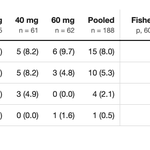
In the case report, the HS of a patient resolved on rituximab, which he received for antibody-mediated rejection of his kidney transplant. In the phase 2 of the BTK inhibitor remibrutinib in 77 HS patients, 73% at 25 mg twice daily and 49% at 100 mg twice daily reached a simplified HiSCR50 at week 16 vs. 35% on pooled placebo (caveat: no dose response, the lower dose did better!). Novartis now runs two phase 3 trials with remibrutinib in HS.
A 31-patient cohort of the anti-BAFF-R antibody ianalumab in the same Novartis platform trial showed some effect in HS at 16 weeks (simplified HiSCR50 52% vs. 38% on pooled placebo), but Novartis discontinued it. Ianalumab binds the BAFF receptor on B cells and depletes them directly, while tibulizumab only cuts off BAFF (their survival signal), which should work more slowly. So even if BAFF blockade works on B cells in HS as expected, 16 weeks might be too short to see a B cell effect.
Nevertheless, $ZURA is a risky bet and can result in a permanent loss of capital (nothing new in clinical-stage biotech)!
Disclosure: I am long $ZURA. I hold no position in any other company mentioned in this post. I compiled the data, facts and interpretations in this post to the best of my knowledge, but they may contain errors, and I give no guarantee of their accuracy. This is not financial advice. Do your own research.
448 days since my last pitch ($ABVX), it’s now finally time for my next one: $ZURA (Zura Bio).
Like with the $NKTR and $ABVX pitches before this, I will post a general outline of my research on $ZURA as a thread here. However, for those looking to really get into the weeds, there is a Google Doc link to the full length pitch attached below.
Let’s dig in.
docs.google.com/document/d/1…
Chaotropy retweeted

Today we’re presenting late-breaking results from our Phase 2 AMPLIFY-7P study evaluating camupepimut (ELI-002 7P) in patients with resected pancreatic cancer at #ESMO26, as well as in a Nature Medicine publication. Read more about the study results here: bit.ly/4snQBEr
