

Senior agent engineer.
Joined February 2008
- Tweets2.8K
- Following3.1K
- Followers457
- Likes4.8K
$48 and about 2 hours on one 8XH100 node. That's what the nanochat README says it takes to train a GPT-2 capability LLM, a model that cost around $43,000 to train in 2019. On a spot instance it puts the bill closer to $15.
Why the code is worth reading:
1. One dial, --depth, sets the model size and the other hyperparameters get derived for you
2. Tokenizer, pretraining, finetuning, evals and inference all sit in one small harness
3. The GPT-2 speedrun leaderboard went from 3.04 hours in January to 1.65 in March
59.6K GitHub stars. The leaderboard only times pretraining, so the cheap part is the part everyone is racing on

8
22 seconds and $0.0064 per task. That's the BU Ultrafast median over 12,238 real runs, and it's slower than the 14.4s in the launch clip. The fleet number is the one to plan around.
Switching is one field:
1. POST /api/v4/runs with "model": "bu-ultrafast"
2. Need more reasoning per step, send "bu-fast", same agent
3. Leave model out and you get the default GPT-6 Luna agent, 79s and $0.0098 median
The open source library behind it sits at 119.7K GitHub stars, but this preset is Browser Use Cloud only, US plans, free tier included. It bills the LLM on OpenAI's priority tier at 2x standard rates, and browser plus proxy are charged on top. Those two lines decide whether it's actually cheaper for AI agents doing your workload

1
2
17
60 command names in one CLI, and the loop never matches pixels. agent-desktop reads the OS accessibility tree instead.
How an agent drives it:
1. agent-desktop snapshot --app Finder -i returns JSON with a ref for every element
2. agent-desktop click @s8f3k2p9:e8 acts on that ref
3. Snapshot again to verify. If the UI changed, you get STALE_REF instead of a click on the wrong row
It covers macOS and Windows, Linux goes through AT-SPI, and actions run headless by default. Apache-2.0, 3.1K stars, from Vercel Labs. On Linux, mouse input still needs X11 and --headed, so Wayland is the rough edge.

13
123 MB peak memory for 100 pages, against 2 GB for headless Chrome. that's the table at the top of Lightpanda's README.
it's an open source headless browser for AI agents, written in Zig, with no rendering engine at all:
1. V8 for JavaScript, html5ever for parsing
2. lightpanda serve opens a CDP server on 9222, so Playwright and Puppeteer connect as usual
3. lightpanda mcp exposes it as an MCP server over stdio
4. lightpanda mcp --port 9223 gives every agent its own page, cookies and session
37.8K stars on GitHub, AGPL-3.0. there's no visual layout, so agents that reason over screenshots still want Chromium

1
14
ChatGPT Pro now comes with OpenAI API credits that match the tier: 100, 200 or 500 dollars a month.
1. Business gets 20 per Standard seat and 100 per Premium, capped at 500 per workspace
2. the sub has to be paid and at least 7 days old, and you must own the API org you link
3. one subscription maps to one API org
4. unused credits die with the billing cycle
it covers the Responses API plus the Agents and Decisions APIs. Codex through API keys is out, Codex limits don't move, Plus gets nothing. fine for side agents, not a reason to upgrade

14
138K stars on GitHub, and Graphify's README still leads with one number: 71.5x fewer tokens per query than reading the raw files.
1. uv tool install graphifyy (two y's)
2. graphify install - copies the skill into ~/.claude/skills and registers it in /CLAUDE.md
3. /graphify . inside Claude Code
4. /graphify query "how does auth reach the database"
code gets parsed locally with tree-sitter and each edge is tagged EXTRACTED or INFERRED. Codex works too with --platform codex. the INFERRED edges are where I'd look before trusting an answer

1
15
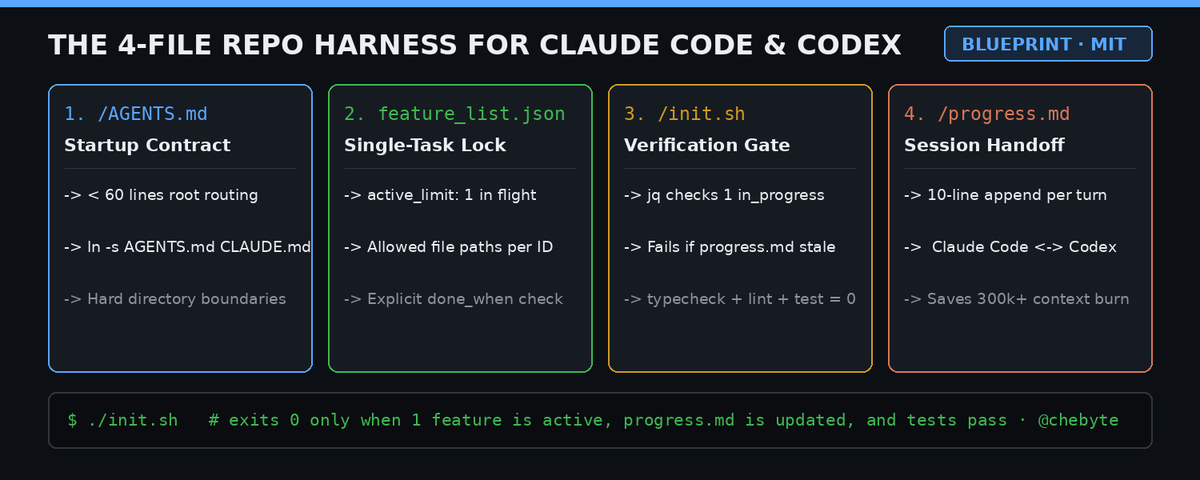
I wrote the step-by-step blueprint for turning any repo into a 4-file harness for Claude Code and Codex:
1. /AGENTS_md startup contract (<60 lines)
2. feature_list_json scope lock
3. /init_sh test gate
4. /progress_md session handoff
Copy-paste guide below
teapawt.net/chebyte/status/2115634…


2
14

Liquid AI shipped LFM3: six open-weight models (text, audio, vision, omni) on a ~1.7B base.
→ text model: 256K context, ~1 GB at 4-bit
→ 38.4 vs 28.9 over Qwen3.5-9B on WebArena-Verified, per Liquid
→ Ollama and llama.cpp day one
1 GB, I'd just leave it running

1
34
Quillwork makes an agent's Word edits land as tracked changes, signed by the agent.
→ reads anchored lines, sends small JSON edits
→ untouched .docx bytes stay as they were
→ accept or reject in Word's Review pane
it's alpha. I'd still take a redline over a regenerated file

14
