

Power research with onchain revenue sharing. 🧪 Invented by @Neuralink. 0x66618daa2babd3011a10124341b35df4995c0946
🧑🔬
Joined October 2026
- Tweets142
- Following7
- Followers107
- Likes3





Pinned Tweet
It’s already been added to the sections. Please read Section 4.
chemioso.com/#studio
rcsb.org/structure/22PD
We are now testing the drug candidates with the lowest Gibbs free energy. This is supported by BeamTx’s Neuralink Protein Database.

For anyone getting into biology, please consider taking airborne disease resistance more seriously.
It's a super important area of medicine that is a huge cause of death and sickness but easily gets forgotten. We're likely to get many more airborne plagues in the future due to the combination of not just extremely dense and interconnected society (including city and farm animals), but also accidents from bio research and offensive biotech (both from random people and from secret government programs that can easily get themselves exempted from safety restrictions), all enhanced by powerful AI.
Right now, this area is getting way less love than longevity research (which continues to be super important!), but it's an area where there are lots of unclaimed wins that we know exactly how to do (but are not yet doing) with present-day tech:
* early detection
* passive universal testing
* filtration/ventilation/UVC
* better vaccines (including making them open source and open science)
* cryptography to make all of the above privacy-preserving
We can have China-level pandemic resistance with Sweden-level limited intrusion into people's lives, and then go even further. We just have to actually do the work for it.
That paper in your reading list could become a concrete next step.
Choose one finding, name the unresolved question, and define a task with clear inputs and an assessable output.
Which paper has changed what you decided to investigate next?
8
9
84
The source reported a finding. You drew an interpretation. Then you proposed a next step.
All three belong in research notes, but readers should be able to tell them apart.
Where do you draw that line in your own writing?


2
2
31
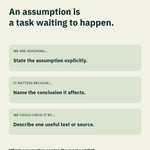
Which assumption is carrying your project?
Write it down, name the conclusion that depends on it, and identify one way to check it.
Sometimes the most useful next task is the one that tests what everyone has been taking for granted.

22
A compound search returned something unexpected. Before moving on, check the name, identifier and structure.
Charge, form and stereochemistry can matter to the question you are asking.
What is your first check when a molecular lookup looks wrong?
2
2
28
Two papers use the same word. Are they measuring the same thing?
Check the definition, the measurement and the scope before treating the results as comparable.
Which term in your field causes the most confusion?

13
Someone has one minute to understand your research project.
Can they find the question, current status and a useful place to start?
A clear entry point makes the rest easier to explore. What do you look for first when opening someone else’s work?
4
2
84
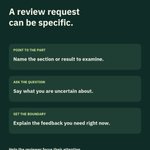
“Any feedback?” gives a reviewer a very wide brief.
Point to a section and ask one answerable question about the method, evidence or limits.
What is the most useful review question you have received?


4
2
54
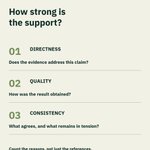
Ten references can still leave a claim weakly supported.
Ask whether the evidence is direct, how it was produced, and where the results agree or conflict.
What makes a source persuasive to you beyond the title and citation count?

23
A distance without its structure, atom selection and units is only part of the story.
Keep those details beside the measurement, then explain what the comparison does and does not show.
What context do you want before trusting a molecular measurement?
1
1
41
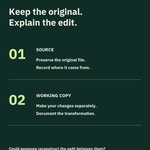
You cleaned the file. Can you still get back to the original?
Keep a source copy and a short record of what changed between input and output. Your future collaborator should not have to guess.
Which transformation do you always document?

15
“We welcome contributors” is an invitation. A clear task is a way in.
Share the question, expected output and review criteria, then respond when someone helps.
What would make you say yes to a research collaboration?
5
5
106
A number without its definition, conditions and uncertainty is easy to misread.
Before comparing two values, check that the units, methods and questions are actually comparable.
What context do you look for first?


36
“Updated the project” tells your collaborator very little.
Try: what changed, why it changed, and which conclusion or next step needs another look.
What makes a change log useful when you return to a project?

34
An AI answer can sound convincing and still need correction.
Choose one claim. Open its source. Find the supporting passage. Then decide whether to keep, narrow or remove it from your note.
Which claim would you check first?
1
2
54
Before checking the result, write down what would make you reconsider your explanation.
It is easier to notice an inconvenient finding when you have already decided what to look for.
What evidence would change your mind about your current research question?

10
The output changed. What changed in the setup?
Keep inputs, settings and results together so you can investigate the difference without reconstructing the whole session.
Which detail is easiest to forget when comparing two runs?
10
The paper is saved. Could you repeat the search that found it?
Keep the query, database, filters and date, plus a short reason for including or excluding a result.
What do you wish you had recorded in your last literature search?


1
1
40
Before opening another tab, decide what would let you stop.
An answered question? A missing input? A check that would no longer change your decision?
What tells you a research task is finished for today?

1
1
11
Can someone follow your conclusion back to the result that supports it?
A link helps. A clear connection between claim, evidence and method helps more.
Where does that trail usually break when you read research?
12