

Chill labs: We scale Web3 and AI brands with trusted KOLs, engaged communities, and powerful narratives that turn ideas into global impact.
Web3 & AI Marketing Agency
Joined January 2025
- Tweets56
- Following2
- Followers750
- Likes326






When launching KOL campaigns, many projects tend to treat every influencer as a direct acquisition channel expected to "drive registrations, deposits, and trades."
The typical result? High exposure, mediocre conversions, and the ultimate conclusion that "KOL marketing doesn’t work."
However, the real issue usually isn't the influencers' lack of capability, but rather the brand's failure to distinguish the specific roles different KOLs play across the marketing funnel.
KOLs can generally be categorized into four types:
1. Awareness KOLs
Their primary mission is to expand brand exposure, ensuring more users see and remember the project.
Common formats include TikTok, Instagram Reels, major X (Twitter) accounts, short videos, and meme pages.
When evaluating these influencers, you should look at reach, views, CPM, brand search growth, and follower growth—not immediate registrations or deposits.
2. Narrative KOLs
They are responsible for explaining why the product matters and why it deserves attention right now.
Common formats include X long-reads, deep-dive YouTube videos, podcasts, newsletters, and founder interviews. Metrics for success here should be watch time, bookmarks/saves, comment quality, community joins, and the depth of discussion.
Even if the CPM is higher, their value lies in helping users truly understand the product and build brand alignment.
3. Acquisition KOLs
Their job is to push users to complete registrations, KYC, wallet connections, first-time deposits, or trades.
Typical types include micro-influencers in niche verticals, affiliates, Telegram group admins, and high-conversion video creators.
For these KOLs, the focus must be on CPA (Cost Per Acquisition), registration rates, KYC completion rates, and first-time deposit rates, comparing these metrics directly against paid advertising costs.
4. Trust KOLs
Their role is to lower the user's perception of risk regarding the product. Financial educators, analysts, security experts, compliance professionals, and industry veterans fall into this category.
Evaluation should focus on user quality, conversion rates, deposit rates, retention, LTV (Lifetime Value), and how effectively they alleviate user concerns regarding security and compliance.
A complete, well-rounded KOL campaign shouldn't rely on just one type of influencer. Instead, it should form a cohesive funnel:
Awareness KOLs get you noticed, Narrative KOLs get you understood, Trust KOLs get you trusted, and Acquisition KOLs drive the final action.
Therefore, you shouldn't judge mega-influencers solely by registrations, analyze deep-dive content purely through CPM, or evaluate affiliates based only on view counts.
What truly needs optimizing in KOL marketing is not just the creator list, but the division of roles, content synergy, and the conversion pathway.
More often than not, it’s not that KOL marketing is ineffective—it’s that brands are assigning the wrong tasks from the very start.

Stablecoin supply only tells us where capital sits.
How USDC is used may tell us what a blockchain’s economy is actually built around.
CoinGecko’s data reveals several very different types of onchain economies:
Of Ethereum’s classified USDC, 68% sits on centralized exchanges, suggesting that the network functions largely as a settlement and capital-movement layer for institutions.
On Base, roughly 85% is deployed across lending protocols and DEXs, reflecting a distinctly DeFi-native economy.
On BNB Chain, 88.1% remains on centralized exchanges, showing how closely its onchain capital is tied to trading platforms.
Arbitrum has a more balanced distribution, with lending, exchanges, DEXs, custody services, and yield strategies all playing meaningful roles.
Polygon even shows notable payment and casino activity, pointing toward a more consumer- and application-oriented capital structure.
This raises a more important question than “Which chain has the most stablecoins?”
Should a blockchain’s value be measured by how much capital it attracts—or by what that capital does after it arrives?
A large stablecoin supply does not necessarily mean a thriving onchain economy.
If most of the money simply remains on exchanges or sits idle in wallets, it may represent a gateway for liquidity without necessarily supporting a self-sustaining onchain economy.
Conversely, a higher proportion of capital deployed in DeFi is not automatically healthier. Repeated lending, collateralization, and market-making may indicate greater capital efficiency—but it may also mean that the same liquidity is being recycled and counted across multiple protocol layers.
USDC distribution, therefore, should not be treated as a simple blockchain ranking. It is better understood as an economic profile of each network:
Ethereum: settlement and institutional infrastructure
Base: DeFi capital deployment
BNB Chain: centralized trading gateway
Arbitrum: diversified financial marketplace
Polygon: payments and application-driven activity
However, there is an important limitation: between 83.1% and 91.8% of USDC on each chain remains in unclassified externally owned accounts.
A consistent classification methodology makes relative cross-chain comparisons useful, but it does not prove that the small classified portion fully represents each network. The data is better used to form hypotheses than to declare definitive conclusions.
The real question may not be, “Which chain holds the most USDC?”
It may be:
Once capital enters a blockchain, does it wait, trade, lend, pay—or generate new economic activity?
Capital stock determines how large a blockchain appears. Capital use reveals what it actually is.


Crypto exchanges are rapidly pushing beyond the boundaries of digital assets.
In just 17 months, major exchanges have listed as many as 358 tokenized traditional financial products across both spot and perpetual futures markets.
Exchanges are no longer limited to crypto-native assets like BTC, ETH, or SOL; instead, they are gradually evolving into on-chain trading venues for real-world assets (RWAs), covering equities, ETFs, commodities, foreign exchange, pre-IPO equity, and stock-based perpetual contracts.
Since early 2025, improving regulatory conditions, an expanding issuer base, and more mature distribution infrastructure have collectively accelerated this shift.
At present, RWA products mainly fall into two categories: spot and perpetual futures.
Spot RWAs represent direct ownership of tokenized assets, such as tokenized shares of Nvidia. Perpetual contracts, by contrast, only track the price of underlying assets like Nvidia, Tesla, SpaceX, or gold.
Users do not actually hold the underlying assets but can gain leveraged exposure, short positions, and 24/7 trading access.
On average, each exchange has listed around 75 RWA perpetual contracts and 37 spot products, indicating stronger demand for flexible, high-leverage price exposure.
Trading data further shows that user demand is growing faster than product listings. Monthly trading volume of RWA perpetual contracts surged from $230 million to $347 billion.
In 2026, exchanges processed $1.32 trillion in traditional finance perpetual trading volume, compared to just $104.2 billion in 2025.
Since surpassing spot RWAs in November 2025, perpetual contract volume has grown to more than eight times that of spot.
Over the past 17 months alone, Binance, MEXC, and Hyperliquid accounted for nearly $1.1 trillion in combined related trading volume.
Tokenized equities are also expanding rapidly. In less than a year, monthly trading volume increased from $831 million to $34 billion, with Nvidia-related products once seeing a 17x spike in a single month.
However, tokenized equities still account for less than 1% of traditional stock trading volume, indicating that despite rapid growth, the market remains in an early stage.
Meanwhile, pre-IPO trading is also moving on-chain. Users can trade price expectations of companies like SpaceX, OpenAI, and Anthropic via perpetual contracts before they go public.
Among them, SpaceX alone reached $305 million in monthly volume, and these three companies together accounted for 95.6% of all pre-IPO trading activity.
Notably, SpaceX contract closing prices deviated by only 4.7% from its IPO opening price, suggesting that on-chain markets are increasingly effective at price discovery.
Overall, crypto exchanges are no longer competing solely for crypto asset liquidity; they are positioning themselves as the infrastructure layer for tokenized traditional assets.
The real force driving this transformation is the sustained global demand for 24/7 trading, leverage tools, and low-barrier exposure to financial assets.

The Web3 conference calendar for the second half of 2026 has been fully compiled.
From IVS Kyoto in July to Bitcoin MENA in December, it covers nearly all major ecosystem conference touchpoints.
If you are working on projects, marketing campaigns, BD, or content, this chart can serve as a practical schedule reference.

2026 Crypto Industry Dead Projects List
According to data from RootData, 70 crypto projects have been recorded as closed since the beginning of 2026, including Loopring, Everclear, Goldfinch, Botanix, NFTfi, DL News, among others.
Among them, the exit of Loopring is particularly iconic—as one of the early pioneers of Layer 2 DEXs, its shutdown serves as a defining footnote for an entire past cycle.
The reality of this bear market is becoming increasingly clear: it is not that "narratives have vanished," but rather that projects incapable of generating cash flow and retaining value are undergoing a centralized shakeout.
When a project lacks revenue support, fails to validate its Product-Market Fit (PMF), and can no longer sustain user engagement even with airdrop expectations, its lifecycle will be significantly compressed.
The market is entering a more brutal yet realistic phase: it no longer pays for mere stories, but only for sustainable demand.

The Philippine market has huge potential🫡

Just back from the Philippines. One of the most exciting digital asset markets in SEA right now, jumping to 4th globally in TRM Labs' Country Crypto Adoption Index.
Their regulators get it. Collaborative, forward-thinking, focused on outcomes: consumer protection, innovation, growth. Rare combo.
Met great people at the Department of Finance including Secretary Frederick Go, the SEC’s Chairman Francis Lim, and the BlockShoals team. Real conversations about where the industry is heading.
Big one: the SEC's PhiliFintech Innovation Office just gave BlockShoals in-principle approval under StratBox. This is what good regulation looks like. Build pathways, not walls. Programs like that signal that the Philippines is serious. Confidence attracts capital. Capital funds innovation. Flywheel starts here.
Bullish on the Philippines. And crypto - buying the dip. More soon. 🇵🇭


Many people misunderstand the crypto neobank category.
What they see is a crypto card that can be used for everyday spending. But the viability of the business is not determined by the card itself. It is determined by the settlement layer underneath.
In terms of payment experience alone, traditional cards still have the advantage. Visa and Mastercard have spent decades building merchant networks, fraud protection systems, and payment processor relationships that new entrants cannot quickly replicate.
What truly differentiates crypto neobanks is stablecoins.
Traditional payments involve multiple stages, including authorization, clearing, funding, and settlement. They also depend on banking hours and pre-funded accounts.
Stablecoins allow issuers to move funds 24/7, reconcile balances faster, and reduce the amount of capital sitting idle between settlement cycles.
Observable onchain crypto card volume has now reached $10.04 billion, with five distinct categories emerging:
- Full-stack issuers such as Rain
- Exchange-backed cards from Coinbase and Bybit
- DeFi-native cards from Etherfi and MetaMask
- Stablecoin-native neobanks such as Plasma and RedotPay
- Remittance-focused products such as Felix Pago
Each company is building a different moat.
Rain provides issuance infrastructure to multiple crypto applications. Coinbase uses its existing users, custody services, and fiat rails to expand into everyday spending. RedotPay targets emerging markets where banking infrastructure remains weak, addressing demand for dollar access and cross-border money movement.
However, Visa and Mastercard are also expanding into the stablecoin settlement layer.
Stablecoins may become part of the financial infrastructure of the future, but that does not mean stablecoin-native companies will necessarily capture most of the value.
Many crypto neobanks will likely disappear. The survivors will be those that either control distribution or solve regional problems that traditional banks continue to overlook.
The card was never the moat.
The company that controls the settlement layer underneath is more likely to win.

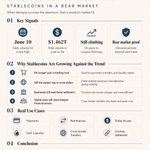
Bear markets reveal which crypto products people actually need.
While speculative activity has slowed, stablecoin usage is moving in the opposite direction. Daily volume reached a new high on June 10, and June has already recorded $1.462 trillion in total volume—putting it on pace to surpass February.
The reason is simple: stablecoins are no longer just a trading tool.
They have become infrastructure for payments, remittances, dollar access, DeFi liquidity, cross-border transfers, and onchain settlement.
Most crypto sectors perform best when attention and prices are rising. Stablecoins remain useful even when neither is happening.
People still need to move dollars. Businesses still want faster settlement. Global users still need cheaper access to financial rails.
When demand survives the downturn, that is more than a compelling narrative. That is product-market fit.

RWA is one of the few sectors that has continued to grow this year.
The on-chain RWA market is currently around $32B, up roughly 300% over the past year. More importantly, much of this growth took place during one of the weakest periods in the crypto market.
This suggests that RWA demand may not be driven purely by market sentiment.
The more important question is where that demand is coming from.
Rather than looking at RWA as a single category, it may be more useful to view it as a set of financial access experiments:
Tokenized funds are testing institutional-grade on-chain allocation.
Tokenized commodities are testing whether assets like gold can move more efficiently through crypto rails.
Tokenized equities are testing whether global users can access stock-linked exposure with fewer constraints than traditional brokerage systems.
Among these, tokenized equities remain early, but they may become one of the more user-facing RWA applications.
For many users outside the US, access to US equities is still shaped by local brokerage availability, account approval, funding rails, trading hours, and regional restrictions.
Tokenized equities attempt to create a new access layer through crypto-native infrastructure.
The key variables to monitor are:
→ Asset backing
→ Issuer transparency
→ Liquidity depth
→ Regulatory structure
→ User accessibility
RWA should not be evaluated only as a crypto narrative.
It is also a distribution problem: how real-world financial assets can become easier to access, trade, and integrate with on-chain products.
If infrastructure and compliance continue to mature, tokenized equities could become one of the clearest bridges between traditional markets and on-chain finance.

Crypto’s opportunities are moving from on-chain narratives into real business use cases.
After looking through what Crypto VCs are paying attention to recently, I noticed a clear shift:
They are no longer buying into “grand narratives” alone.
In the past, many projects talked about new L1s, NFTs, gaming, social, and token economics. But now VCs care more about one question:
Can you actually plug into real-world workflows?
The most frequently mentioned directions seem to fall into four categories:
1️⃣ Crypto x AI
The point is not simply building an “AI + Crypto” concept. If AI Agents can eventually pay, trade, subscribe to services, and call data on behalf of humans, they will need wallets, identity, payments, and verifiable execution.
2️⃣ Stablecoin Payments
Stablecoins are no longer just tools inside exchanges. They are moving into real scenarios such as cross-border payments, enterprise settlement, and merchant payments.
3️⃣ RWA and On-chain Capital Markets
The key is not the act of “putting assets on-chain.” The real question is whether tokenization can improve asset liquidity, transparency, and capital efficiency.
4️⃣ Prediction Markets
Their value is not just betting. It is about turning distributed information into probabilities that can be traded, verified, and settled.
So to me, the core of the next Crypto cycle is this:
Who can become the infrastructure layer for real financial workflows, the AI agent economy, and information pricing systems?

Influencer marketing is here to stay.
Here are 5 reasons why ↓
- It is no longer a one-time test; it is part of the main strategy.
- Good KOLs bring real trust and attention that standard ads just cannot buy.
- A great influencer keeps driving results throughout a campaign, not just on day one.
- Smart teams combine influencers with Google search, paid ads, and news articles.
- It is shifting from a quick shoutout to a permanent way to get real users.
Influencer marketing still matters, but the strongest teams are no longer using it alone

A recurring post-mortem narrative echoes across the Web3 growth ecosystem every single day: “We deployed a six-figure budget into a macro-KOL campaign, yet recorded near-zero user onboarding, sign-ups, or TVL growth. The Web3 creator economy must be entirely inflated by bot traffic.”
However, analyzing the mechanics behind these failed rollouts reveals a different truth: Most Web3 teams do not have a influencer problem; they have a campaign architecture problem.
Influencers frequently become the scapegoat simply because they represent the most visible and front-facing layer of the marketing funnel. When a post goes live but on-chain conversion metrics stagnate, executive leadership inevitably questions the marketing team's ROI, culminating in a flawed, generalized conclusion: “KOL marketing is ineffective for our product vertical.”
To ensure growth initiatives do not fall into this trap, teams must navigate and eliminate four fundamental structural flaws:
1️⃣ Treating Creators as Generic Distribution Nodes
Many projects allocate substantial capital to secure prime slots with top-tier alpha creators, only to mandate the distribution of a generic, pre-scripted PR copy. Consequently, audiences witness dozens of coordinated accounts posting identical screenshots alongside identical captions, such as: "Excited to see what this team is building," or "This will shift the DeFi paradigm."
In doing so, teams are purchasing a high-trust ecosystem but utilizing it as an expensive banner ad slot. When a campaign degrades into highly synchronized, low-context promotion, sophisticated Web3 audiences immediately tune out the noise.
2️⃣ Mistaking a Deployment Calendar for a Marketing Strategy
A common misconception is that a spreadsheet tracking creators, publication dates, and captions constitutes a growth strategy. In reality, it is merely a deployment schedule.
Modern Web3 participants are highly risk-aversive, particularly regarding asset security and capital allocation. Users will not bridge, stake, mint, or deposit capital into an unverified protocol based on a single promotional post. True growth marketing requires designing a comprehensive "Trust Architecture." The objective is to orchestrate a market narrative where different segments of the ecosystem organically arrive at the same conclusion from distinct analytical angles.
3️⃣ Operating Under the Illusion of a Unified "Crypto Audience"
Treating the entire Web3 ecosystem as a homogenous target demographic is a fatal positioning error.
Airdrop farmers, high-frequency perp traders, DeFi power users, core infrastructure builders, and memecoin speculators may share overlapping social graphs, but their risk appetites, value drivers, and product evaluation frameworks are worlds apart.
Utilizing a macro-crypto creator to scale an institutional-grade RWA infrastructure protocol will yield high vanity impressions but zero meaningful conversion. Growth teams must buy tailored context, not just broad reach.
4️⃣ Relying on Vanity Metrics for Capital Allocation
Influencer procurement is still largely driven by surface-level metrics: follower counts, average impressions, and subjective alignment. This approach fails to perform deep due diligence on the underlying network effects.
Before deploying capital, growth teams must audit the creator’s active community engagement:
What are the core geographic locations of the engaging audience?
What is the qualitative nature of the replies and quote tweets?
Are verifiable ecosystem builders, fund managers, and power users actively participating in the commentary?
When partnering with a creator, you are not buying their aggregate followers; you are buying friction-free access to a specific, pre-validated network context.
💡 The Strategic Imperative
Ultimately, Web3 influencer campaigns fail when growth marketers attempt to purchase raw attention while expecting immediate consumer trust.
Trust cannot be engineered through an isolated promotional placement. It is built through sustained relevance, logical repetition, and an uncompromised user conversion flow. The mandate for Web3 growth professionals is not to amplify the volume of coordinated social posts, but to systematically engineer the architecture that transitions an audience from Awareness to Conviction, and ultimately to On-chain Action.
For further insights on Web3 growth frameworks and data-driven marketing architecture, connect with us or subscribe to our research notes.
#Web3Growth #CryptoMarketing #InfluencerStrategy

Crypto Exchanges: Expanding Beyond Just Crypto! 🤯
Historically, our assets have been completely fragmented.
You’d keep your BTC/SOL on Binance, but then have to jump over to a traditional broker just to buy Nvidia or US stock ETFs. Moving funds back and forth meant getting eaten alive by fees on both ends. 😭
But the giants like Binance (along with OKX, Coinbase, etc.) have finally seen the light! They no longer want to be just your "gateway to crypto"—they are coming for your entire wallet.
Why This Upgrade Is an Absolute Game-Changer 👇
1️⃣ One App for Global Assets: Hold your Bitcoin and stablecoins right alongside your Nvidia shares, buying both seamlessly in one place.
2️⃣ 24/7 Liquidity: By "tokenizing" US stocks via RWA (Real-World Assets), you get the crypto world's signature global access and fractional ownership. No more waiting for the opening bell!
3️⃣ Smooth Sailing Through Bulls and Bears: Trade crypto when the coin market is hot; pivot to stocks when the equity market is booming. Your capital stays in the exact same ecosystem, eliminating the need to constantly withdraw and deposit.
Traditional finance giants (BlackRock, JPMorgan) are already aggressively expanding into blockchain RWAs. Now, even Binance is stepping onto the field to build the "operating system for global investing."
Over the next decade, the exchange war won't be about who has the most 100x meme coins or the highest leverage. The true winner will be whoever becomes the ultimate destination for your capital.
⚠️ The Bottom Line: While there are massive hurdles ahead—like securities compliance and cross-border regulation—the convergence of Traditional Finance (TradFi) and Crypto Finance (CeFi/DeFi) is officially unstoppable!


Prediction markets wanted to be "truth machines" but our gambling instincts turned them into a multi-billion dollar sports book (STEM markets are only 1.2% of volume).
The only way out is replacing human bettors with AI Agents. Rational, dirt-cheap, and infinitely scalable. The future of Info Finance is AI fighting AI for the truth.


A lot of exchanges still approach MENA like a traffic-buying market.
But the region behaves much more like a relationship-driven financial market.
Users in MENA are generally more cautious about where they store capital, which means local trust, offline reputation, regional communities, and strategic partnerships often matter more than aggressive incentive campaigns.
The exchanges gaining traction in MENA are usually not the loudest ones — they’re the ones building long-term credibility in the region.

Great influencer campaigns don’t start with “Who has the biggest audience?”
They start with:
· Strategic fit
· Clear CTA
· Great post-click experience
· Follow-up systems
Most brands focus only on the shoutout.
But attention without conversion infrastructure is just noise.
Shoutouts fade. Systems scale.
X is turning influencer marketing into infrastructure.
Their new Creator Connect product is essentially:
using AI to automatically match brands with the most suitable creators based on:
• Campaign goals
• Audience interests
• Real-time trends
And handling the full process:
creator sourcing → outreach → content → distribution.
At the end of the day, everyone is building on top of platforms.
Respect the platform. Respect the ecosystem.


How We Grow Telegram/Discord Communities From 0 to 1,000 Members 🧵
Most Web3 communities don’t die because the project is bad. They die because the launch sequence is wrong.
We’ve helped 30+ projects bootstrap Telegram & Discord communities, and after making every mistake possible, this is the framework we consistently use now:
The biggest mistake most projects make is opening the group too early. They create a Telegram or Discord, invite 100 people, nobody talks, spam starts appearing, and the whole thing instantly feels dead.
New users join, see silence, lose interest, and leave. Dead communities create more dead communities.
The correct order is the opposite:
❌ Open group → Invite people → Hope it becomes active
✅ Build momentum first → Open community → Guide conversations from day one
Step one is seed users — usually no more than 20–50 people. These are not random users. They come from:
• Core followers from KOLs
• Friends in the industry
• Early users genuinely interested in the project
Their only job is to make the community feel alive.
During the first week, consistency matters more than “big news.” We usually create a daily activity rhythm for clients:
📌 Morning: Post a discussion question (“What’s the biggest issue with L1s today?”)
📌 Afternoon: Share a small project update
📌 Evening: Preview what’s coming tomorrow
You don’t need constant announcements. You need presence.
The next mistake projects make is using KOLs incorrectly.
We don’t tell KOLs to post:
“Join this community now!”
Instead, we structure posts like: “Just saw an interesting discussion about XXX in this Discord…”
Then attach the invite link.
This changes everything. Users join out of curiosity instead of obligation, and retention becomes significantly higher.
Another important detail: new members should never enter a community with “nothing to do.”
The first interaction matters.
We usually make users:
• Introduce themselves
• Complete a small task (follow Twitter, repost content, etc.)
• Receive an identity tag like “Early Member” or “Genesis Explorer”
Once people receive identity and status, they naturally become more engaged and protective of the community.
After the foundation becomes stable, we move into growth loops.
Simple referral mechanics work surprisingly well:
Invite 3 friends → earn points / whitelist spots / exclusive roles
At this stage, growth slowly stops depending on the project team and starts becoming community-driven.
We used this exact framework to help a public chain project bootstrap its Discord from zero into a highly active community:
• 15,000+ Twitter followers gained
• 300%+ increase in community activity
• Massive organic discussions inside the group
• 30,000+ website visits on launch day
The key isn’t always budget.
The key is getting the sequence right.
Quick summary of the framework:
1️⃣ Start with 20–50 seed users
2️⃣ Maintain daily activity during week one
3️⃣ Use KOLs to drive curiosity, not hard ads
4️⃣ Give new users identity immediately
5️⃣ Use lightweight incentives to trigger referrals
Communities rarely fail because of the project itself.
Most fail because the first week was handled incorrectly.
We’re currently helping Web3 projects scale global communities across Telegram, Discord, and Twitter.
Feel free to DM if you’re working on community growth. 🔁
