




Today's Treasury rally may be signaling something far more consequential than a recession still somewhere on the horizon. The economy has already been deteriorating beneath headline statistics, and a recession may well be underway before official data recognize it.

The 10 Year Treasury Is Looking Beyond Inflation And Seeing Something Much Worse
The U.S. 10 year Treasury yield plunged roughly 18 basis points to 4.965%. The story is not just the size of the move. It is what rallied alongside bonds, what sold off, and where investors were buying.
The Signal Inside The Yield Curve
The strongest declines were in 5 and 7 year maturities, down about 19 basis points, versus 14 at 30 years and fewer than 5 at 3 months. Buying is concentrated in intermediate debt, suggesting a reassessment of future growth and monetary policy rather than simply imminent Fed cuts. The 30 year yield remains above 5.3%, showing that long term fiscal and inflation risks have not disappeared.
Meanwhile Brent crude is above $112 and rising more than 3%. In a straightforward inflation scare, rising energy prices normally pressure yields higher. Instead Treasury yields are plunging. Investors may be putting greater weight on what expensive energy and restrictive credit eventually do to demand, margins and investment.
What Other Assets Reveal
The Nasdaq fell roughly 2.5% and semiconductors suffered even larger losses. Yet the equal weight S&P 500 was modestly positive, utilities and staples rallied, and regional banks strengthened. This is not broad liquidation. It is a concentrated retreat from growth exposures, especially the AI investment cycle, while other assets benefit from lower yields.
Meta’s credit default swap spread reached roughly 115 basis points as investors questioned the returns on enormous AI capital expenditures. But investment grade and high yield bond prices were still positive. That suggests selective financing concerns, not yet a systemwide credit freeze. Falling Treasury yields can also conceal widening credit spreads, so rising corporate bond prices are not necessarily evidence of improving credit quality.
Gold fell more than 2%, silver nearly 5%, and Bitcoin roughly 4% while the dollar edged lower. This is not a universal rush into safe havens or proof of a dollar shortage. Yen strength coincided with a sharp narrowing in the U.S. versus Japan 2 year yield differential. Canada and Australia also rallied, but far less than Treasuries, suggesting the strongest repricing is U.S. centered.
What Happens Next
Investors are beginning to favor the certainty of Treasury cash flows over growth assumptions tied to an increasingly expensive AI buildout. Persistent oil disruptions and restrictive financing intensify the danger that expected corporate returns disappoint.
Today’s Treasury rally may be signaling something far more consequential than a recession still somewhere on the horizon. The economy has already been deteriorating beneath headline statistics, and a recession may well be underway before official data recognize it. If Treasury yields continue falling while corporate credit spreads widen, hiring weakens and investment contracts, it would suggest that existing economic deterioration is spreading into a broader financial and credit contraction.
The more significant warning is that investors may be shifting their attention from persistent inflation toward the cumulative economic damage caused by restrictive monetary policy, deteriorating credit conditions and an enduring global energy shock. By the time that deterioration becomes unmistakable in official economic data, the contraction may already have developed enough momentum that monetary easing cannot easily reverse it.


Don't Leave Home Without It?
@AmericanExpress cutting 5% of its headcount globally as CEO Steve Squeri seeks to keep a lid on the company's rising costs. Squeri told @BloombergTV that the company has 78,000 employees, meaning the move will affect about 3,500 jobs.
The Weekly Quill
Sportscasting Standards — The Ql Research
Commercial Real Estate Update
#federalreserve #interestrates #dimartinobooth #economy

I believe my hometown of San Antonio has a much better view. They even say a river runs through it.

Up for a chill afternoon at the community pool? The noise, natural gas odor and awesome view guarantee a good time.
@TravisREMindset
@UnicusResearch

A sudden stop in activity that continued into October @PulteHomes w/traffic down 14% YoY
"I fully appreciate that this isn't a very upbeat message for an earnings call, but it's important to acknowledge the change in the market conditions over the past 30-45 days."
@NewsLambert
Al will change something! But it's more likely to
"just" be tacking an extra trillion onto the $16
trillion corporate debt market. Whee!

All bets are off if sellers finally capitulate. And I mean FINALLY. All those bidding wars (remember those?) created the most stubborn home sellers in history. And no, it wasn't just golden handcuffs of ultra-low mortgage rates. Otherwise HELOCs wouldn't be flying off the shelves

With wages having fully round-tripped as if the pandemic-era surge had never occurred, a question:
Should wage inflation be factored into monetary policymaking? Does the size of a worker's paycheck affect what he/she can/ cannot buy & how much they can pay for things?
@SoberLook

Via @AdamJJosephson on @Delta miss & cut came even as it's among consumer-related companies benefiting most from the K-shaped economy. Its premium cabin revenue continues to grow rapidly, well in excess of its main cabin revenue, such that the former is now higher than the latter

The Weekly Quill - Peace in the Valley Between the Rich & the Poor
Read NOW
na2.hubs.ly/H08hktdO
#dimartinobooth #economy #interestrates #federalreserve

Mom worked @SocialSecurity 37 years, mostly turning down disability claimants. UK is worse!
"Among those who got new cars (collecting disability) last year-40 people whose primary medical condition was tennis elbow, 50 w/wheat intolerance & 320 w/dyslexia"

ICYMI for those who said this would/could never happen. The part that bites, though, is what's to come
The truth is, the pendulum will swing back as uncontrollably as it did when it was swinging violently in the opposite extreme in the good old days of forever mortgage moratoria

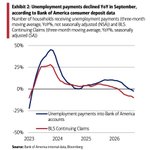
This @BankofAmerica chart reassuring until you factor in GIG. Only 1-in-4 unemployed
COLLECTING benefits.
Through different prism @philippadunne if same % of unemployed in 1990-2007 were collecting today initial claims would be 330k, not 204k & continuing claims, 2.4M, not 1.7M.

DiMartino Booth joins Andy Wang of Inspired Money — Why Index Funds Won't Let the Market Crash
na2.hubs.ly/H089tnSO
#federalreserve #interestrates #dimartinobooth


