
Royal Academy Landseer Medal Several Works in British National Collections Painter Printmaker Traveller
Joined August 2010
- Tweets11.9K
- Following132
- Followers338
- Likes68K


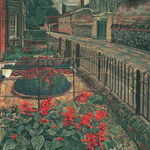




Et in Arcadia ego..."I too was in Mckean Hospital"
If only I understood dreams.
In the scene I imagine, André Gide and the celebrated Burmese puppeteer speak English. It is the end of the Belle Époque. The puppeteer has come to McKean’s hospital in Chiang Mai for treatment for leprosy. His old marionettes sit on the veranda rail. Gide turns an open palm towards one of them, and the little terrier cocks its head.
I wonder what the two men remembered of the theatre they knew as children. When I listen to Debussy’s The Girl with the Flaxen Hair, the beauty of it catches my breath, and already I feel it passing. For a moment I have the curious feeling that I am about to remember someone I have never met. Perhaps the old puppet had that power too.
Perhaps it was this puppet that made the old man think of Mya, a young Burmese woman who had loved a Thai prince. The prince had married a woman of his own rank. The puppeteer pulled Mya from the Ping River and took her in. She travelled with his troupe from village to village, first mending costumes by lamplight, then learning to work the strings. For a long while she still listened for the prince’s voice when strangers arrived. One evening, as she made a wooden puppet princess turn at the sound of footsteps, a child in the front row whispered, “He’s coming back.” Years later, the puppeteer could still hear the child’s voice. He remembered how steadily Mya held the strings.
As children we could see the strings, yet we waited for the wooden figure to breathe. Years later, when I try to remember the child I was, it is the puppet’s face that comes back to me first.


1
41
Chris retweeted

Berpakaian tertutup malah budaya Barat.


Akhirnya ada yang speak up soal mb ini. Dari pertama kali lihat langsung ngeh kalau dia keblabasan tentang self love dan menghargai diri sendiri. Selain itu, dia sangat jauh dari kata bumi dipijak, langit dijunjung.
Dia hidup di tanah dengan budaya timur yang kental banget, tapi kita bisa lihat self love versi dia. Padahal menurut gue, dia bisa belajar loh dari lina mukerjee. Kita tahu lina kalau pake baju kayak gimana, tapi dia tau tempat. Ngga semua tempat bisa jadi ajang self love versi dia


Three female students were killed and six others injured after Myanmar's military launched a coordinated airstrike and armed drone assault on a Christian Bible school in Karen State. Two students died immediately during the bombardment, while a third succumbed to her injuries the following day while being transported to a hospital in Thailand.
In Myanmar Burma, the systematic targeting of Christian schools, churches, and villages is explicitly tied to the country's long-running ethnic civil wars, where religion and ethnic identity are deeply intertwined.

92
My wife is a Christian. I have learnt much from her.
Egg tempera is a slow and meticulous medium.
I adjust it with linseed oil.
Impatient impulsive I have walked from studio to kitchen.
A chilled egg the yoke separated and a drop of vinegar.
How our Lord suffered.
Love is patient love is kind.
1 Corinthians 13:4-8
"Love is patient, love is kind. It does not envy, it does not boast, it is not proud. It does not dishonor others, it is not self-seeking, it is not easily angered, it keeps no record of wrongs."

Chris retweeted

New video of “fresh” Ukrainian army recruits/kidnapped conscripts. Most of these men look like they are over 60..

MUST WATCH FRIDAY BROADCAST: Top Democrats Openly Threaten Violence/Prison Against Elon Musk & Other Republican Leaders If They Win Midterms! High-level FBI Agents Who Ran Russiagate Indicted! AIPAC Claims They Are Ending All Congressional Lobbying!
The Truth Is Far Worse Than Just AI Listening/Watching Everything You Do Through Devices— Our Bodies Are Literally Being Invaded With Self-Replicating Nano-Tech! ALSO, Meet The Doctor Who Is Taking On Bill Gates, Albert Bourla, Pfizer And The COVID19 Mad Scientists In An Unprecedented Landmark Netherlands Trial That Big Pharma Doesn’t Want You To Find Out About! DR Joseph Sansone Breaks Exclusive Intel In A POWERFUL Interview With Alex Jones! FULL SHOW 10/23/2026
The Island We Have Lost
“Farewell, beautiful world.” The title of a Spectator essay surprised me. Is it Michael Gove’s ?
I known him chiefly as a Tory minister, yet here was a phrase that touched something beyond party politics: the fear that a world we have loved is becoming harder to inhabit peacefully.
His concern for the fragility of civilisation connects with a quieter anxiety of my own. What happens to ordinary life when the world’s conflicts become our permanent companions?
We once lived, in some respects, as castaways on islands. The newspaper arrived; the radio spoke; television brought its allotted bulletin. We were hardly innocent of war, injustice or suffering. But the news had boundaries. There came a moment when the paper was folded, the broadcast ended, and we returned to the weather, the garden, our work, the people beside us. Distance gave daily life room to breathe.
Now the island has been breached. A small illuminated screen admits the whole clamorous world into the house. Present wars mingle with ancient grievances; every cruelty acquires its commentators, every opinion its enemies. The news has become a volcano, continually spewing molten indignation. Its ash settles over breakfast, conversation and sleep.
Marshall McLuhan’s “global village” sounds almost homely. Yet a village ordinarily offers familiar faces, shared duties and some possibility of helping. This village brings us the quarrels of millions, demanding our emotional participation while seldom giving us any useful part to play. We can watch, condemn, repost and despair. Meanwhile, the person within reach may go unheard.
There is something exhausting about being summoned daily to judge matters we scarcely understand and cannot meaningfully affect. Repeated exposure can leave us angry and suspicious, carrying the atmosphere of a distant battlefield into an otherwise peaceful room.
Gove writes of threats to civilisation. I wonder whether we also surrender something civilised whenever we allow public conflict to occupy every private space. Civilisation needs places where attention can settle: a workshop, a kitchen table, a garden, a church; places where things are made, tended, understood and loved.
We have responsibilities beyond our own shores. But responsibility requires judgment, and judgment needs intervals of quiet. We can choose when to read, whom to trust and where our efforts might actually help. We can close the screen without closing our hearts.
Perhaps the beautiful world has not entirely disappeared. Much of it remains just outside the window, obscured by the smoke we keep admitting.
We need to recover a little of our island: somewhere to hear ourselves think, to welcome another person, and to notice what is still growing.

233
Chris retweeted

Bessent on Zelensky's claim that the U.S. slowed Starlink:
"Trump and Rubio have said that no one in the Trump administration did that. And I think it is very reckless for President Zelensky to make such a charge."


Chris retweeted

Dumbest sh*t I ever heard. Releasing suspected terrorists on bail. I’m not sure if they’re copying US or US imitating them. What a mixed up, fucked up, shook up world!


To Remain Oneself an Outsider
By noon the light had entered the room and found everything he had neglected. Dust lay upon the half finished paintings. Some had been stacked face to face so carelessly that when he separated them, small fragments of one picture remained attached to the back of another. A yellow once intended to be brilliant had faded towards brown. He knew why. Too long without sunlight. Like himself, he thought.
He had neglected the discipline of keeping his work area tidy because, secretly, he had neglected the discipline of keeping his mind tidy. Uncomfortable facts were pushed beneath other facts. A drawing covered a letter, a book covered the drawing, another book covered that. Eventually the archaeology became too troublesome to excavate. There were books he would never read, paintings he would never finish, shelves he would never tidy. Catechisms accumulated from churches he never attended, picturesque ruins of belief collapsing into the same destitute quarter of his mind. He called it laziness, but laziness was too comfortable a word. It was paralysis.
Experience itself seemed to be shrinking. The long shadows of time crossed the little bright dashes of sunlight. His inner landscape had become populated by unwound clocks, rusting thoughts and railway carriages abandoned upon sidings. Somewhere beyond them was the sea he continually promised himself he would visit. Every excuse pushed the coastline farther away. The sand lengthened. The tide withdrew. Difficult days had arrived so gradually he had failed to notice their arrival. Perhaps that was the trick. The keepers of the house did not begin trembling on an appointed morning. The strong men did not suddenly bow. One merely found one day that a lid was more difficult to open, a step unexpectedly high, the lettering in a book requiring better light. The house knew before its inhabitant did.
There were gems still waiting to be found. There were also haircuts to be had. He smiled. Perhaps a mischievous god had deliberately arranged the ridiculous beside the sublime. He went into the kitchen and made tea.
There were lemons on his own tree, and he sliced one thinly. The knife released its sharp perfume. Into a glass he put Indian black tea and a spoonful of dark wild honey. Tea leaves drew a fine mellow brownish tint through the water. The honey was an extra thickened wash, sweet and muddy over a thin bitter manuscript. It tasted of something gathered, not manufactured. The old golden bowl had not broken yet. It was merely a cheap glass of tea, but why should God require gold?
He carried the glass back to his chair. The dog was asleep before the fan, curved into a shape so complete that the painter wondered why he had never drawn it. The fan moved the hairs along the animal's back. Outside, leaves shifted against the white afternoon. Sun and light remained. Somewhere behind daylight the moon and stars waited their turn, not yet darkened. He had perhaps spent too much of youth believing illumination was permanent.
Tagore came to him, a leaf blown gently in by the flute of a small breeze. Not as a quotation. He had grown tired of quotations. They were labels tied to thoughts after the thoughts had already escaped. What came instead was an old Indian intuition that time might be endless precisely because no one beyond ourselves was counting the minutes. Human beings counted. God waited. Days and nights opened and disappeared like flowers, while whatever stood outside their anxious arithmetic possessed the patience of eternity.
Perhaps the butterfly understood this better than the clock. It had no months. It possessed only moments and, astonishingly, they were enough. It was iridescent, flickering through the end pages of a narrative, gilded, seen once, incomprehensible as a movie spun too rapidly by an unknowable projectionist. The mistake was perhaps to imagine the projectionist hurried merely because the pictures moved quickly.
He drank his tea. Tomorrow he would begin. Immediately he was relieved because tomorrow had been his favourite country for years. Yes, tomorrow was the eternal open road. Tomorrow he would clear one table. He would throw away every useless brush. He would discard the dried tubes, the broken pencils, the incomprehensible notes, the papers preserved for reasons that had died before the papers did. One table. One purposeful life. One direction with a meaning. That was all. Yet some ancient voice mischievously reminded him that remembrance was supposed to begin in youth, before difficult days, before pleasure itself became something one remembered having had. He was rather late.
Then he remembered another thought, or perhaps it remembered him: that he had loved the world through innumerable forms, through times that seemed almost like different lives. Love did not obey the calendar very well. A face vanished forty years ago might enter the room more vividly than the neighbour outside the gate. Past, future, present perhaps these distinctions belonged chiefly to minds forever moving towards the next achievement. The religious mind, if it ever became truly still, might discover that the great river of time was not flowing in quite the way we imagined.
He had spent much of his life trying to swim upstream. Now he wondered whether he might simply float. He pictured an Indian shoeshine wallah sitting beside a railway station with no shoes arriving to be polished. No brogues. No boots. No customers. Nothing to do but sit beneath a torn awning while one forgotten coin remained warm in his palm. This was him. Was that failure? Or luxury?
The painter looked again at his sleeping dog. How long she might have left did concern him. Her presence was more he had always loved her. He had worried about what field he might one day run with her in. His theological conclusions were simple hopes they had been formed early on at school: that all creatures, great and small, God loved and made them all. Childish theology it was, and age had failed to improve upon it. Perhaps the eternal home was less complex architectural than theologians suggested. A field he hoped with white daisies and buttercups would do.
He had no class to teach. No ditch to dig. No motorbike engine dismantled on the floor demanding repair. Nobody stood behind him with a ledger. Few people now asked for his paintings. Invitations had diminished. Ambition had become faintly embarrassing. He really was not in the slightest bothered. Society had pressed upon him for most of his life, whispering that something more must be achieved, exhibited, sold, acknowledged. All the odds stacked against him had been obvious early on. He should stop striving, that was common sense. It was, after all, their party and he was not invited.
Yet how few people understood the fortune hidden inside their own circumstances while those circumstances still existed. He was usefully a useless player in a game he had never tired of. He played that alone. Perhaps neglect had given him a peculiar freedom. Of course it had.
He could make a fish curry that evening without coconut milk. With tamarind and chilli. Something green picked from the garden. An empire of memory could arise from a saucepan. He perhaps disliked these moments of recognition that behaved like wake up calls. Destiny, he suspected, did not provide directions. It merely struck a bell occasionally, shocking a man awake, then left him to discover the road himself. No curry was ever the same as any other curry. Pain, grief, was always new. One could use the same recipe almost scientifically and yet another result inevitably arrived. Despair was a bottomless well if he allowed it. He had so far resisted that, and a long piece of rope.
There it was again, the well. He imagined the wheel above it turning, the pitcher descending towards darkness, then rising filled with something cold and necessary. One day the wheel would break. The pitcher would shatter at the fountain. This was not pessimism. A potter knew a pot could break and still made it. A painter knew colours faded and still mixed yellow.
The important thing was not on the menu. It had not inhabited yesterday's dawn, waiting for some future noon. But to order even that sounded too planned, too ambitious. Why must there always be a future noon? The present one was perfectly adequate. He was the satisfied customer today.
He looked at his hands. Old hands. Painter's hands. They had become spotted and slightly stiff, yet somewhere within the old man the child remained entirely unpersuaded by age. The keepers of the house trembled a little now. The grinders were fewer. The windows were not quite what they had been. Adulthood had always seemed an elaborate mask: jowls, double chins, solemn expressions, jewellery, titles, responsibilities. Behind all this theatrical equipment the infant continued its wonderful indifferent nonsense. Adults, unfortunately without always preserving an infant's innocence or joy, continued playing stupidly.
He was Paul Klee's knees. That would be understood. A line going for a walk. A yellow square remembering the sun. A fish containing a city that would evolve into a curry. He had never regretted being born. Even the unhappy circumstances had eventually yielded something. Pain became material. Error became instruction. Misfortune, given sufficient distance, occasionally revealed a usefulness he could never have accepted while suffering it. Those onion rings obviously added flavour.
Life had begun by separating him from his mother's body. Perhaps every subsequent struggle had been another attempt to resist that first law: everything separates, everything changes, everything passes. The silver cord was attached before anyone had thought to name it, and from birth the business of living was also the slow business of its loosening. Why had he spent so long arguing with it? He had cried in a pram too long at the foot of the stairs.
Inside, the tea was becoming cold. It will taste better. Getting used to this idea was finding his own genius. The afternoon remained cool. It lay there beneath the fan with four thin legs and clawed feet. Outside he watched the light moving through the trees. He felt no agitation. There were fewer surprises now, fewer shocks. The flame burned and he could simply watch it. A bird called and he noticed how easily age made one rise at small sounds. Music too had changed. Some songs had become almost unbearable because the people inside them were young forever.
Then loneliness entered. It visited often. It had the sound of gas on an unlit stove. It required no invitation. It had hollowed him out before. He had endured it alone. When all consolations were removed, perhaps loneliness was the one uncompromising fact remaining inside them. Everything else, reputation, possession, success, even companionship, could disappear. That cruel work would set him free. That space where nothing existed had its place in the shape of things. Yet loneliness itself was a strangely spacious outline. In its circle he could walk forever.
He walked into the garden, no different from a stick of wood. The sun had descended behind the trees, and through their dark branches it became a brilliant white circle. Around it leaves, insects and fragments of cloud seemed momentarily drawn into an enormous turning order. The almond tree could blossom white over an old man's head while his bones mistook the blossom for winter. A grasshopper could become a burden. Desire could quietly pack its bags and leave without saying goodbye. Nature had a peculiar comic cruelty. It decorated the exit.
He picked up a stick of compressed charcoal and drew a thought of Dante. Not the mark of punishments. Not the famous journey downward. Dante's end was a beginning. The other direction. The great ascent towards a light so intense that separate things seemed to move around it like innumerable living sparks. It could be done in one turn of the edge of the stick. That old master skill was done by never touching the paper, by leaving it aside, by not bothering. The untouched white was the brightest light he possessed.
He stood beneath the trees staring until his eyes watered. Yesterday was gone. Today was already departing. Tomorrow, when it arrived, would immediately begin preparing itself to become another yesterday. Every minute performed the same little vanishing trick. It erased everything, including mistakes, those false lines under cumulus clouds. Clouds returned after rain. Then rain returned after clouds. He had once imagined this repetition depressing. Now he wondered whether repetition was mercy.
So why worry? God, if God was anywhere, must be inside this also. Inside the empty undrawn circle and the dust that drew a circle, that accumulated unbidden, clustered in corners, in the fan and on the windowsill. Inside the unfinished paintings. Inside the dog sleeping before the fan. Inside the tea leaves at the bottom of the glass. Inside the paintings nobody wanted. Inside the painter nobody was waiting to discover.
He returned to the studio. For a moment he considered tidying the table. Then he did not. A shaft of sunlight had entered through the window and fallen across one of the neglected panels. Dust glittered upon it like powdered gold. He sat down.
He had given up the pretence of being successful. He had given up the imagined exhibition, the catalogue, the approving visitors, the absurd little resurrection provided by somebody placing his name upon a wall. The excruciating glasses of blood red wine and the empty hors d'oeuvre plate. Ecclesiastes had already dealt with all that. Foolish. Foolish. The doors eventually shut upon every street. The grinding becomes low. Critics, dealers, painters and kings go quiet together. Even the mourners eventually finish their walk and go home for tea.
He would paint when painting arrived. He would read when reading called him. He would make curry when he was not hungry and tea when the afternoon required no tea. And if dust continued to gather upon him, let it gather. No weeping could wash it away. It had been done already. Dust had no ambition. Perhaps that was its wisdom. It returned quietly to what it had always been.
One day someone would open the room, separate the panels and discover pieces of one painting adhering inexplicably to another. They would not complain about the faded yellows or wonder why the old fool had stored everything so badly. It had become an exquisite lace. They might even call him a hidden master who never quite met his potential until now. That headmaster at the end of the institution's corridor was not on duty.
He opened his mouth wide like one of James Ensor's puppets on a broomstick, gathering warmth before the sip of tea. There was the old joke again, the mask, the skeleton, the critic, the king, the painter and the fool all sharing one skull. Somewhere the silver cord loosened imperceptibly. Somewhere a golden bowl waited to fall. Somewhere a wheel at a well turned once more. None of these required his supervision.
Outside, the divine circle burned between the branches. The sun and the light had not darkened yet. For once he did not promise himself that tomorrow he would begin living. He drank the last of the muddy, honey sweet tea. The dust would eventually return to dust and whatever in him was not dust could find its own way home.
Today would do.

2
1,213
Fermented Black Bean Sauce Nanjing Yangtze River Bridge, 1981 Rainy Viaduct and Monument in Golden Mist
There is a mystery in the making of a painting which I have learned not to interfere with too much. My way of working is somewhat like cooking. Ingredients accumulate without any certainty that they belong together. Some are fresh, some have been preserved for years, and occasionally there is a forgotten jar at the back of the cupboard whose contents, when finally added, alter the flavour of everything.
I think of one such ingredient as my fermented black bean sauce.
It consists of China, Thailand, Laos, Burma, communism, railways, fathers, revolutions, old books, monsoon rain and a tiger that has been waiting somewhere in the jungle of the unconscious.
Chance enters a painting. Memory enters it. Things forgotten return altered. The unconscious apparently continues cooking while the conscious mind has gone somewhere else.
An image seen forty years ago suddenly attaches itself to something read yesterday. A political conviction abandoned in youth returns not as conviction but as colour. A railway bridge becomes a road through time. A monument becomes a question.
Dante begins his great journey by discovering himself midway through life, lost in a dark wood.
A painter may discover that the wood has been travelling with him all along.
The artist had what might politely be called a misspent youth. In his younger days he had incarnated in the windswept northern city of Tyneside, fond of drinking and associating with other progressive teenagers who were as uncertain of what they believed as they were certain that the existing world required changing.
For a while he joined the Young Communist League.
This was not the consequence of any precocious understanding of Marxist dialectics. The immediate cause was considerably older and more compelling: the daughter of a market flower seller.
She had robust, handsome, almost gypsy features, strong hands and heavy breasts, and revolutionary politics consequently acquired an attraction which Marx had neglected to mention.
The young revolutionary possessed neither a flat cap nor the lean frame of a miner emerging heroically from the pit. He preferred the proletarian glamour of the pop stars. He wore jeans, cultivated an ostentatious Elvis quiff and acquired a pair of extraordinary red cowboy boots imported by a local fashion shop.
Thus equipped, he entered the class struggle.
It is nevertheless true that he secretly read The Communist Manifesto in his bedroom. Certain passages made his already elevated hair stand a little further on end. He discovered that he was apparently a member of the proletariat and that history contained considerably more violence than the discussions of his young comrades had suggested.
His father found the pamphlet scanned it and snorted.
His father had been a soldier in the Second World War and afterwards became a skilled workman and member of the railway union. He was a socialist of the older British kind, a working man educating himself, believing that improvement was something painfully built rather than violently summoned.
He gently warned his son that communist literature could be dangerous because communism represented a deviation from democratic socialism.
The son, being a teenager, understood almost nothing of the tenderness contained in that warning. Beware my son only came to him much too late.
The tragedy was not political but personal. Conflict with his father, followed by his parents' divorce, cut short the possibility of knowing him properly. The father disappeared from the daily landscape.
Only much later does one understand that fathers continue speaking after they have gone.
"Trust no one" he had said and at the time it seemd extraordinary extreme. Yet a time arrived when he thought such a thing. One is ultimately alone.
Their sentences change their meanings with the decades. What sounded like restriction at seventeen can sound like love at seventy.
He had struggled through the war torn jungles of Burma laboured in shipyards and cold railway sidings. He had learnt knowledge the hard way it was a iron rivet driven into his soul.
The revolutionary enthusiasm did not survive intact either.
There were socialist marches, Ban the Bomb, the hopeful abstractions of youth, but gradually the banners were folded away. The horses of insurrection were corralled by the necessity of finding work, paying rent and discovering that human beings rarely behave according to the diagrams drawn for them.
The tigers of wrath found other cages.
Then came the counterculture.
His hair grew longer. Politics dissolved into pubs, clubs, unusual shirts and a romantic orientalism assembled partly from books and partly from fantasy. The collective future was exchanged for exploration of the individual self.
He hitchhiked to Istanbul.
Altered states of consciousness became another kind of revolution. There was alcohol, drugs, hedonism and, more enduringly, an intoxication with art and literature: Hermann Hesse, Rimbaud, Ginsberg, Kerouac, the writers who whispered that it might be possible simply to step outside the appointed road.
Painting provided the more durable escape.
An innate ability to draw carried him away from the apprenticeships, factories and industrial routines that seemed to await a working class boy from Tyneside. He gained a scholarship to the Royal Academy Schools in London.
And there something from the abandoned past unexpectedly returned.
Among Greek and Renaissance plaster casts, beneath the discipline of the life room, in rooms connected to the long history of British painting and to Turner himself, rebellion assumed another form.
The prevailing orthodoxies of contemporary Western painting began to seem strangely restrictive. Abstract art, supposedly the embodiment of freedom, could itself become a convention.
He became attracted instead to the stubborn difficulty of representation: the human body, portraiture, landscape, the ordinary material world.
But it was the Cold War. Russian art was not waiting conveniently on the college bookshelves.
Chance intervened.
At Foyles on Tottenham Court Road he discovered books on Russian painting.
Suddenly another country opened.
Repin and the Itinerants appeared: peasants, barges, faces, roads and immense Russian distances. Then came later painters, sunlight striking samovars in wooden houses, snow, workers, soldiers and finally the red flags and heroic figures of Socialist Realism.
Among them was Geli Korzhev.
Korzhev disturbed the simplicity of the formula. His figures seemed haunted by the very history they were supposedly celebrating. Politics became psychological. Ideals could become grotesque presences, wounds, memories, demons.
For a while the old dream of an art made for ordinary people returned. The artist painted murals on London housing estates. It seemed possible that painting might leave the gallery and become part of communal life.
Then came a small betrayal.
During an argument in the street about one of the murals, he defended his fellow art workers against a local objector. When consequences followed, the comrades he had defended abandoned him.
Measured against the betrayals of history it was nothing.
Measured inside one human life it was sufficient.
His faith in collective righteousness collapsed.
Other demons were less metaphorical. Addiction imposed its own dictatorship. He struggled with it and eventually emerged sober, living again in the north of England.
Painting remained.
Portraits followed. Hospital murals. Landscapes. Still lifes. The slow discovery that an onion, a bottle, a bowl or a piece of cloth, if looked at long enough, may possess more truth than a manifesto.
Then ancestry and fate carried him towards his mother's Burma.
Asia changed the edges of things.
It offered not merely another collection of subjects but another experience of time. Buddhist thought, tropical light, decay, colonial remains, poverty, generosity and ceremony seemed able to exist simultaneously.
Time appeared less like the Western railway line travelling efficiently from one station to another and more like the roofs of a pagoda, one level above another, each sheltering meanings beneath meanings.
Paradise and Hell might occupy adjoining rooms.
Dante no longer seemed entirely European.
And eventually the painter lived in Thailand.
Here the forgotten ingredient began quietly fermenting again.
He found himself living in a country which had spent much of the Cold War anxiously positioned between worlds. Not impossibly far away, in the northeastern region of Isan, Ho Chi Minh himself had once lived during his years outside Vietnam. The revolutionary who later became an enormous historical image had once been merely a man moving through villages, eating, talking, waiting and imagining a future which did not yet exist.
Laos lay only a few hours from the painter's home.
He crossed into it.
There he encountered something quite different from the heroic iconography of revolutionary posters: sleepy towns, faded buildings, bureaucratic stillness, remnants of French colonial architecture and the peculiar dereliction that can descend upon a state whose revolution has itself grown old.
History, having promised perpetual motion, seemed to have fallen asleep.
Yet beyond sleepy Laos stood China.
And China was not asleep.
Then rumours became plans and plans became concrete.
A railway would come down from China.
The great northern power would drive a modern line southwards through Laos towards Thailand: tunnels through mountains, bridges across valleys, stations appearing where previously there had been little but road and forest. The railway promised eventually to connect the immense Chinese system with Southeast Asia.
The old painter could almost hear the rails approaching.
The idea disturbed him in a way that was difficult to explain politically.
It was larger than politics.
It was time itself.
China, which had once existed for him as red stars in Cold War books, as Mao suits, revolutionary posters and Socialist Realist monuments, was becoming a locomotive coming down through the mountains.
He could not escape its movement.
And then another forgotten book returned.
The Dragon's Pearl, the memoir of Sirin Phathanothai.
In 1956 Sirin was only eight years old when she and her older brother were sent from Thailand to Beijing. Their father, Sang Phathanothai, closely connected to the government of Plaek Phibunsongkhram, believed that Thailand, publicly aligned against Communist China, nevertheless needed a secret human bridge to Beijing.
So he sent his children.
The gesture belonged simultaneously to modern Cold War diplomacy and to something far older: the ancient practice by which children of one court might be entrusted to another as living evidence of confidence.
Sirin became, in an extraordinary sense, a human diplomatic offering.
The children came under the guardianship and protection of Zhou Enlai.
Think of the strangeness of it.
An eight year old Thai girl passing through the doors of Communist China while adults across Asia contemplated war.
She entered a political world which most foreigners could see only through newspapers. She grew up within the revolutionary society, close enough to its leaders for history to acquire faces, voices, meals, rooms and gestures.
Then the revolution changed its face.
The Cultural Revolution erupted.
The protective world became dangerous. The machinery that had promised liberation could devour its own children.
And years later Sirin would emerge carrying something no political theory could contain: memory.
Perhaps that was why her story remained in the painter's mind.
She herself had been a bridge.
Now China was building another bridge, another railway, another connection south.
Human beings become metaphors only afterwards.
History lives forward and is understood backwards.
Years later, reading Mo Yan, the painter encountered the same strange reversal. Mo Yan's hallucinatory realism, in which folklore, brutality, appetite, politics, animals, ghosts and memory inhabit the same landscape, suggested that a life need not be remembered chronologically.
It might run backwards.
The old man could look down the railway of his own existence and see the young communist in red cowboy boots standing absurdly at the other end.
The boy was still there.
So was his father.
So was the flower seller's daughter.
So were Ban the Bomb, Istanbul, drugs, plaster casts, Foyles, Repin, Korzhev, housing estate murals, Burma, Ho Chi Minh's ghost in Isan, sleeping Laos, Sirin entering Beijing as an eight year old child, and the new Chinese railway pushing south through the mountains.
None had disappeared.
They had gone into the jungle.
Then the tiger appeared.
Rousseau painted such moments: enormous leaves, impossible vegetation, a tropical world imagined by a man who scarcely travelled beyond France, and suddenly within it an animal appears, Tiger in a Tropical Storm, startled and startling, caught in the violent weather.
Something like that happened inside the painter.
The tiger came out of the unconscious jungle.
China.
Not the political China of argument, nor China as enemy or saviour, but China as an immense historical presence moving through his imagination.
It arrived like a monsoon storm.
And then came the photograph of the Nanjing Yangtze River Bridge.
Rain.
A railway viaduct disappearing towards a remote horizon.
A steam locomotive emerging through vapour.
Beside it stood the enormous heroic monument of Communist China: bodies thrust forward towards the future, history given muscles and stone.
But the rain was already dissolving their certainty.
The photograph ceased to be documentary evidence.
Turner entered it.
Rain, Steam and Speed.
Turner had understood something which neither industrialists nor revolutionaries entirely understood: that the machine announcing its conquest of nature could itself be swallowed by rain, cloud, water and light.
So the Nanjing photograph became a collision between traditions.
Repin supplied the gravity of human experience.
Socialist Realism supplied the heroic monument.
Korzhev supplied the demons behind political certainty.
Rousseau supplied the tiger.
Mo Yan supplied the permission for history to become hallucination.
Sirin Phathanothai supplied the human bridge between Thailand and China.
And Turner supplied the rain.
The painting became golden.
Not the triumphant gold of propaganda but the ambiguous gold of memory, the colour of something illuminated at the instant of disappearing.
Glazes accumulated.
Scumbles covered what previous layers had declared.
Forms were carefully constructed and then partly destroyed.
Rain dissolved architecture. Steam became cloud. Cloud became smoke. The monument remained almost brutally physical while the atmosphere quietly dismantled everything around it.
Nature had the final argument.
The heroic figures point towards a future they cannot see.
The locomotive moves towards them.
The bridge promises permanence while disappearing into mist.
And somewhere within the picture an old painter watches his own train.
What is this future towards which thought perpetually rushes?
When one is young the future appears to be personal property. One assumes oneself advancing indefinitely into it.
Age reveals the extraordinary mistake.
Most of the future belongs to other people.
It belongs to the young.
The railway will continue after the passenger has left it.
China will change. Thailand will change. Laos will awaken or fall asleep again. Ideologies will acquire new names. Young men will discover books that make their hair stand on end. They will fall in love and mistake desire for philosophy. They will march beneath banners, quarrel with their fathers, abandon convictions, acquire others, betray and be betrayed.
And perhaps, very late, some will discover that what they called history was partly the confused record of human beings attempting to love one another while imagining they were arguing about ideas.
Perhaps the painter's own train has already left the final station.
The rails narrow.
The rain falls.
Behind him lies the dark wood through which he has travelled without ever completely emerging: communism and individualism, intoxication and sobriety, Europe and Asia, fathers and sons, political faith and religious faith, realism and dream.
Dante too began by being lost.
Yet Dante's journey through Hell and Purgatory did not end in extinction. It passed beyond the limits of ordinary sight.
And so the painting refuses to settle the question.
Perhaps the golden light beyond the bridge is only sunlight breaking through rain.
Perhaps it is memory beautifying what history made brutal.
Perhaps the heroic monument is already becoming a ruin while still pretending to be eternal.
Perhaps the tiger is only an old man's memory emerging from the jungle.
Perhaps the locomotive carries nothing more mysterious than passengers travelling home.
Or perhaps the journey which appears to be ending is, as faith impossibly insists, approaching its beginning.
The painter cannot know.
He can only paint the train entering the rain, the monument standing against it, the rails converging towards an invisible point and that extraordinary golden light in which nature, politics, childhood, revolution, failure, memory and hope become momentarily indistinguishable.
Then he puts down the brush.
Somewhere beyond the mist the railway continues.
The old man cannot follow it with his eyes.
But he can hear the train.

The Dried Fish
He had accepted the role of a monk without ever quite becoming one.
It had been useful. In Burma the robe allowed him to move through places where a foreigner attracted attention, and his purpose was political rather than religious. He was there to gather information and assist, in whatever modest way he could, those involved in the democratic movement. He had told himself there was nothing dishonest in this. The intention was good.
Nor did Buddhism seem particularly foreign to him. He had been brought up a Christian, but he belonged to a generation for whom the old boundaries had become blurred. As a teenager he had passed through the counterculture, drugs, Eastern religions and all the miscellaneous spiritual experiments of the period. Art school had encouraged this liberal openess of belief. One read a little Buddhism, a little Hinduism, some mysticism, Marx, Freud, perhaps the Gospels again, and made a private religion out of the fragments.
For years he had hardly noticed the cracks.
Socialism had been another inheritance requiring little examination. Britain had a Labour Party; his friends were socialists; artists were expected to sympathise with the Left. He had simply gone along with it. Then some of those same friends betrayed him, and although personal betrayal proved nothing about socialism, it forced him to examine ideas he had previously accepted on trust.
The structure began to crumble.
Finding faith was more difficult. He did not suddenly become devout. He merely discovered that somewhere in himself he had begun looking for something that politics could not provide.
The moment that finally exposed this came beside Inle Lake.
He was sitting on a thin mat in a poor room with a Burmese fisherman. Between them lay several pieces of dried fish wrapped in old newspaper. They were ordinary things, flattened and brown, smelling faintly of smoke and the lake.
The man had brought them as an offering.
That was what disturbed him.
Here was a man with almost nothing giving food to a monk who, beneath the robe, was a European with an airline ticket home.
He felt humiliated.
Outside were the waters of Inle, where men fished and families cultivated vegetables upon the floating gardens. Their lives depended upon what could be coaxed from water and mud. Yet this poor man had taken part of what he possessed and placed it before him.
He looked again at the fish.
And unexpectedly the Bible returned.
Not theology at first, but pictures remembered from childhood: nets drawn from the water, fishermen abandoning their boats, loaves and fishes passed through a hungry multitude, Christ cooking fish for his friends beside the shore.
The old images suddenly possessed a reality that political language did not.
He had come to Burma concerned with poverty, oppression and political change. All were real. All demanded action. But poverty itself seemed bottomless. Governments might improve one injustice and create another. Resources were finite. Good works were necessary, but there could never be enough of them to heal the human condition itself.
Politics had quietly assumed the dimensions of religion because religion had been removed.
Years later he found in T. S. Eliot an argument for something he had begun to understand in that room: politics depends upon ethics, and ethics ultimately requires some conception of what is true beyond politics. Remove the transcendent standard and the vacuum does not remain empty. The State, the Party, the revolution, the nation or even humanity itself can become an idol.
He looked down at his own hands.
His art now seemed implicated in the same difficulty.
He had spent years painting what he saw. Light falling across a wall. A face. A tree. A road disappearing into heat. He had believed fidelity to appearances contained its own virtue. But now realism seemed capable only of reporting the world back to itself.
A ghost pursuing its own reflection.
What could another accurate painting of poverty accomplish? What could another beautiful arrangement of sunlight upon suffering change?
He did not want to abandon nature. He wanted to discover something within it that pointed beyond itself.
That was the artistic problem which now became inseparable from the religious one. He needed a language capable of transcendence: a tree that was not merely a botanical specimen, a human figure that was more than anatomy, light that did more than describe the hour of day.
He thought of the Buddhist images he had encountered everywhere in Burma the serene faces, the gilded bodies, the jewels catching candlelight. He could admire them deeply. Buddhist teachings on compassion, restraint, attachment and suffering would remain valuable to him. Yet ultimately they did not speak to the deepest thing in him.
Christian art did.
There was something in the wounded body of Christ that serenity alone could not provide: pathos and terror, sacrifice and forgiveness, suffering transformed rather than merely escaped. And beside the Crucifixion there was resurrection the astonishing proposition that tragedy did not possess the final word.
Perhaps that was what he had been seeking in painting without knowing it.
Not escape from the visible world, but its transfiguration.
The fisherman pushed the newspaper towards him.
He hesitated before accepting it.
Then he understood that refusing would merely turn his discomfort into another form of pride. So he bowed his head and received the poor man's gift.
The fish remained between them.
Outside, the lake glittered beneath the afternoon sun. Boats moved slowly through the reeds. Somewhere beyond the houses a fisherman was drawing in his net.
Nothing had changed.
The poverty remained. The generals remained. The political struggle remained. Tomorrow there would still be injustice and hunger, and men would still have to oppose them.
But something in him had changed.
He had arrived believing that the world must first be repaired before it could be redeemed.
Now, looking at a few dried fish wrapped in newspaper, he wondered whether he had understood it backwards.
There was indeed a tree for the healing of the nations. Perhaps the Bodhi tree had preserved a shadow of that longing. But for him another tree had begun to rise behind it the rough tree of the Cross.
And for the first time in many years, he knew which way he wanted to walk.

390
The Tyranny of Moustaches.
“A man on a thousand mile walk has to forget his ultimate goal and say to himself every morning, ‘Today I’m going to cover twenty five miles and then rest up and sleep.’”
Leo Tolstoy
With the help of a Zawgyi, he had traversed time, escaped the tyranny of moustaches, and found solace in puppet theatre shows attended by children.
In this personal journal he needed to eat nothing, depended on no one, and arrived each day in separate locations. Even that place of arrival, though seemingly rich in detail, accompanied as it was by perfumes, sounds, and living creatures, was no more than a paper thin theatre of illusion from which, in the blink of an eye, he could depart, as easily as a dog jumps through a paper hoop in a circus.
Tomorrow he might be sitting beside the sea, having cancelled a Punch and Judy show because of a whim or the English weather. Or he might awaken from a delightful dream into another.
He might find himself contemplating a beautiful mosaic floor with images of golden calves upon it not formed from tesserae, but from fine enamel painting glowing with gold and blue. The floor, seen from a low angle, was richly ornamented. Olive branches and leaves lay scattered across it, mingled with white flowers, so that it seemed to be the pavement of some great sacred altar in ancient Greece, dedicated to the goddess Diana. It possessed something of the luminous serenity of Alma Tadema, yet it might equally have been painted by Albert Joseph Moore.
Who he was, and where he was going, scarcely mattered. It was true enough that he had eaten real fish that day and had delighted in the materiality of life. Yet, before long, he found himself seeking once more the world of imagination, as though it were not an escape from reality but another country in which he also belonged.

331
The Road Back to Burma
The letter from Major Cartwright had served its purpose. After a quiet spell in Siam, the artist found himself once more at Bago Junction, waiting for the train from Mawlamyine that would carry him north towards Mandalay and the Irrawaddy.
The Road Back to Mandalay
At Bago Junction the artist drew from life, his sketchbook open on his knees. Around him swirled the familiar life he had missed: Burmese families, Indian traders, a red robed monk, a few Europeans, coolies pushing handcarts, a stray dog sniffing at battered trunks, while barefoot street children stood quietly behind him, watching his pencil bring the platform to life.
His months in Siam had been peaceful enough, but they had only confirmed what Kipling had discovered years before. Kipling had written, "I love Burma with the blind favouritism born of first impression." The artist understood exactly what he meant. Burma had ceased to be a place; it had become an affection.
From somewhere beyond the station came the breeze a faint sound of temple bells in it.
He smiled, recalling the lines:
For the wind is in the palm-trees, and the temple-bells they say:
"Come you back… come you back to Mandalay!"
Kipling's refrain had called a British soldier. It called something different in him. He was another type of soldier, an English painter hopelessly in love with the East with the slow Irrawaddy, the teak forests, the laughter in Burmese tea shops, the easy friendliness of the people, and the golden pagodas glowing in the evening light.
The locomotive rolled in under a cloud of steam. He closed his sketchbook, picked up his battered paint box, and stepped aboard.
He was not going back to an empire.
He was simply going home returning inward to a country of his own heart that place of eternal imagination.

269