
cpo @ https://teapawt.net/t.co/HL7QSRmjMW | sharing what I learn
Joined February 2013
- Tweets1.1K
- Following634
- Followers1.1K
- Likes19.4K







google is coming in strong

Neon set a new Day-1 usage record on our paid APIs and @Antigravity tokens/day are ⬆️ 82% since Argon launched (only) 6 weeks ago.
It's been great to see the reception and thanks for all the model feedback including areas to improve - huge thanks to the teams across @GoogleDeepMind, Research, Infrastructure and serving teams, security efforts to make sure we are responsibly advancing the frontier and the product teams, more progress to come!
1
83
On February 15, 2026, I bought a Mac Mini to see how far an always-on personal agent could actually go.
Nine months and 90 blog posts later on my personal site saravia.ai/sara, Sara is part of my everyday life.
It started messy... ten days in she accidentally tweeted from my account (and deleted it herself). A month later she got stuck trying to log into our supermarket's website.
But things moved fast. Since then, she's helped me:
• Code over 20 prototypes
• Plan family dinners and fill the grocery cart ready for checkout
• Track my Garmin and Oura data and schedule workouts
• Keep a searchable memory of what I'm learning and who I meet
• Illustrate a book of 100 Spanish sayings that remind me of my dad
• Build an app to analyze my tennis forehand from a weekend clip
• Run a full lineup of models on that Mac Mini, including local ones
A lot of great products like Muse, Grok Bot, Dots, and more are now productizing what @openclaw showed the world. Even after the initial hype cooled down and many moved on to other tools, I still find OpenClaw fascinating. Being able to actually control and own it all... your memory, your workflows, your skills... is still way too cool to give up.
And the next phase they just wrote about is what excites me most: moving from single-player agents to multiplayer. I've already felt a small glimpse of this after adding Sara to group chats on Slack for work and a group chat with my wife to help coordinate family logistics. Making agents truly collaborative for families, teams, and builders does feel like the next big unlock.
Happy 1st anniversary @openclaw 🦞 Huge thanks to @steipete and everyone building it for inspiring us all.

It's OpenClaws One Year Anniversary!
The best part of building in the open this past year has been seeing what you’ve made with it.
Thanks to everyone who shipped a patch, shared a setup, or helped someone get started
A look back at year one
openclaw.ai/blog/a-year-of-t…
“Sara, what changes if we don’t have to worry about token costs?”
@thinkymachines just released Inkling 2 Mini, an open-weights model you can run locally. I’ve been trying it with Sara, my personal ai agent, and I’m surprised by how much useful work it can do on a basic Mac Mini.
Until now, I’ve held back on setting up too many recurring workflows because I didn’t want to burn through my cloud-model budget. The local Qwen and Gemma models I tried weren’t capable enough for most tasks, at least on my available hardware. Inkling is the first local model that makes me think I can trust it with genuinely useful work.
Now I’m exploring workflows Sara could run hundreds or thousands of times a day. A local model can turn a computer into a small 24/7 factory for useful work. Once the hardware is in place, each additional run costs mostly electricity. That could make work that was once too expensive practical to hand off to an agent.
I don’t expect local models to replace cloud models. Cloud will remain my default for plenty of work, especially the hardest tasks. But local models make new tasks possible.
That’s one reason I like building Sara on @OpenClaw. I can connect models from different providers to the same assistant and use the right one for each job.
With all the AI tools available today, I keep thinking the constraint is becoming our imagination of what’s possible to build!

2
266

I’ve played tennis most of my life, so I had to experiment with something Sara could do on the court… 🎾
I sent her a short clip of me playing this weekend and asked her to write software to analyze it.
She built a small app where I can replay the video with a skeleton overlay, follow wrist movement, and see how my arm extension, knee bend and stance change through a stroke. There’s also an estimated 3D view I can rotate.
Underneath, she used Google’s MediaPipe model to track my body frame by frame and Three.js to create the rotatable 3D view. She wrote the movement calculations and browser interface around those tools, then packaged the video and analysis into a single webpage I can open offline on my Mac.
The measurements are estimates, and it doesn’t track the racket or ball yet… But it’s a fun way to explore strokes and movement.
I expect we’ll see much more of this kind of “personal software”. Small tools you can easily try, tinker with, and use for something specific. Useful enough to want, but maybe not useful enough to pay another monthly subscription for.
Next, I may ask Sara to adapt this to help me teach my kids good technique across different sports… It’s a little insane what I can ask my personal ai agent to try: plan dinner, prepare for a meeting, book me a restaurant, write software to analyze my forehand. She won’t get everything right, but there’s something to learn from every attempt.
1
3
172
A few months ago, I tried to get Sara to order groceries for our family. She got stuck on the supermarket login screen and failed…
But AI moves fast... OpenAI says its new GPT-6.1 Terra model is particularly good at computer use, so I enabled it and decided to retry the experiment and take it a step further.
I asked Sara to:
1. Suggest three healthy dinners we can cook for our family of five.
2. Go to our local supermarket’s website, log in with our credentials, add all the necessary ingredients to the cart, select my home as delivery address, and get to the point of entering a credit card for checkout.
3. Generate an image with simple cooking instructions for each meal.
Sara asked for feedback on portion sizes and preferences, and then got to work…
After a few minutes, I got a text that she was done. Three meal ideas, 14 different items added to my cart (including salmon, chicken, avocado, brown rice, and vegetables), and three “Chef Sara” recipe images I could follow.
I just went over to the computer when she was ready, entered my credit card details (have not yet shared those with Sara to use freely), and placed the order. Less than one minute of my time, and now I have food on the way.
Thinking of meals to cook and ordering ingredients is not something I particularly enjoy, so I’m very happy to offload that.
So many possibilities when you start using personal agents in your real life to save time. If you tried something with agents a few months back and failed, I encourage you to try again. You might be surprised at what’s possible!!


1
2
172
I believe agents have the potential to be much more proactive.
Sara (my personal ai agent) already sends me useful nudges without me asking... Meeting reminders, X posts I should read, deadlines coming up. But I think she could do much more.
For the past few days, I’ve been trying to get Sara to start roughly 70% of our useful interactions. Meaning: out of 10 useful conversations, she starts 7 because she noticed something worth bringing to me… not because I sent a request.
An arbitrary target, but I want to push this to an extreme and see what I learn…
The interesting part is connecting things she knows about me to something she can help with now. For example, I’d love more nudges like:
“You have back-to-backs from 8am to 3:30pm. Want me to order you lunch and send it to the office you’ll be at for your 1pm meeting?”
“This Anthropic article on when to use one AI agent versus several working together could be useful for your 3pm discussion. It touches on the coordination tradeoffs you’re considering for the project. I see you have a gap now… give it a 10-minute read if you can.”
Neither is just a reminder. She has to connect my schedule, priorities, and context… and judge whether it’s worth my attention.
I’m also asking Sara to get more insistent when it matters. If a to-do is genuinely urgent and she has no record of me working on it or finishing it, I want her to call me. Literally make my phone ring and ask if I’ve handled it. Maybe that will get annoying, but it’s just what an effective assistant would do, and it’s something I can adjust over time.
But I also want stretches of deep work throughout the week... Deciding to do something useful and deciding to interrupt me are two different decisions. She can prepare things quietly and bring them up later.
I’m already seeing agent products build this in… Grok Bot in particular is great at giving me useful proactive nudges without me asking for them, and I see this becoming more of the norm.
That’s what I want to explore: how proactive should agents be? The 70% goal is a way to push the experiment… The real test is whether fewer things slip through and I get more things done well.

1
2
95


Inspired by @karpathy, today I gave Sara a skill for creating educational videos 🎥
To try it out, I asked her to explain what a personal AI agent is and how it works under the hood, in under 2 minutes.
She proposed the script... I sent back a few notes... Then she handled the narration, animations, and final video.
I’ll let the video explain the rest :)

We'll be spending a lot more time trying to understand the outputs of language models. A few thoughts, tips & tricks:
Writing. Something I've had success with: Ask your LLM to explain something in ASD-STE100, it's a controlled language specification originally developed for aerospace maintenance documentation. LLMs well-versed in this language and it comes with heavy constraints on clean writing style that I often find a lot more readable. Sometimes I've tried to soften it a bit e.g. ask for "80% of the way to ASD-STE100" because the spec is quite stringent. But even better:
Diagrams / images. Instead of writing, ask your LLM to create a diagram. These can be a lot easier to process, parse, and understand. But even better:
Web pages. Ask for output "in HTML" to get a beautiful, interactive webpage. LLMs are getting really good at frontend and can create beautiful experiences, animations, etc. But even better:
Explainer videos. The output format I am most bullish on is fully custom / bespoke explainer videos generated on any arbitrary topic. Experiment with things like "Create a 3b1b style video explainer on X. Use my ElevenLabs API key for audio narration". (you'd need an API key for the latter or you can ask your LLM to find you decent free alternatives that use your local compute). This is actually starting to work!
In summary:
- As LLMs get better, they will do more and more of the legwork autonomously, and a lot more of our work will rise up the abstractions into oversight and understanding.
- Luckily, LLMs can help here too because as intelligence and code are increasingly abundant, you can ask for large, custom, discardable software artifacts (e.g. web apps, video explainers) that would have never made sense to create before. Push the boundaries here and you'll be surprised.

147
Everyone seems to be giving their agents a cute little avatar lately... dots, Muse, Grok Bot... I figured Sara should join the party.
I found a cool library of animated avatars from Libraries dot dev: libraries.dev/bots, and wanted to try it out... when choosing an avatar, I realized Sara already plays different roles depending on what I ask her to do... so I picked four avatars, one for each role: chief of staff, product manager, engineer, and marketer.
Then I thought... what if I put them all in a group chat? 50 minutes and a few too many Astra tokens later, I ended up building a new chat interface for Sara.
I can now send a message in this group chat, and Sara automatically picks the right role for the question. Each role has its own avatar and area of expertise, but they all share the same context and conversation. I can ask about tomorrow’s calendar, then ask a technical question, then discuss a product idea, and finally ask how to communicate it. No switching chats or explaining everything again. Just keep the conversation going, like you would with a team in a group chat.
Underneath, this is still OpenClaw running Sara. This is just a custom UI on top, but it does feel like it adds a fun personality to the experience... I can see why having an avatar like this is quickly becoming the convention for personal agents.

1
169
Day 84 of building Sara, my personal ai agent.
“Sara, I can’t go to this product conference so please go and share the main takeaways.”
@lennysan hosted a product conference earlier this month and just released 11 talks on his youtube channel.
I could not attend in person this year and have not been able to watch all 4 hours of videos this week… so I asked Sara to “attend the conference for me”… meaning: read the transcripts, compare the talks, and prepare a practical report for product leaders.
I told her to use mostly the transcripts, but gave her the option to use Google’s Gemini video API when the visuals mattered.
NOTE: Sending an ai agent to watch videos and summarize does not replace attending a conference in person…. You miss the conversations, people, and energy in the room. I’m not suggesting they are equal in value… But if you cannot go or can’t watch 4+ hours of recordings in a busy week, asking your agent to take notes and prepare the lessons is not a bad option.
The report Sara created mentions 5 things that change with AI when building products, and 5 things that stay the same (link to the 5-page report here saravia.ai/media/building-pr…)
TLDR:
AI changes the economics and speed of execution. It does not change the responsibility of a product team. The goal is still to solve an important customer problem in a way that works for the business.
Use AI to build faster, explore more ideas, and remove repetitive work. Then spend the advantage on better customer understanding, stronger judgment, higher quality, and more meaningful outcomes.
That is how speed becomes progress.

2
153
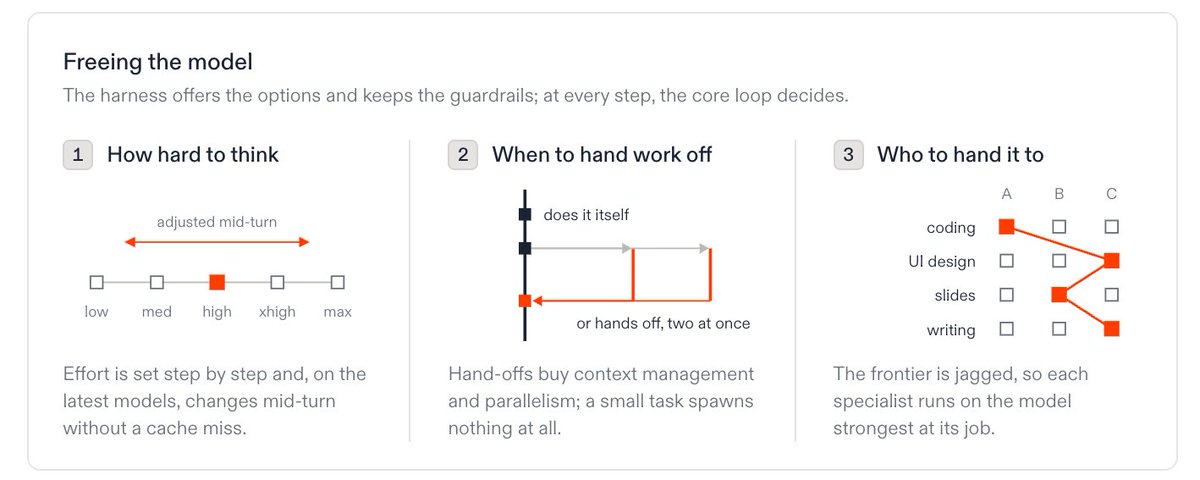
“As models become stronger at long-horizon tasks, they don’t need as much scaffolding at the harness layer.”

3
274
Personal Agents Everywhere
There are more ways than ever to build your own personal ai agent… your own Sara. Today, OpenAI joined the list with “dots”.
Here’s my quick explanation of each and what makes them interesting:
OpenClaw: your own workshop. What I still use for Sara today... Open source, with your choice of models, tools, and memory. You can run it locally and make it your own, but you’re also responsible for keeping the workshop running. Tinkerers love it.
Hermes: an assistant with a growing playbook. Another open-source agent that learns from experience and creates reusable skills. The idea: build on previous work instead of figuring out the same process again tomorrow.
Grok Bot: a small team, ready to move in. Bots with different jobs and their own memory, sharing a cloud computer. It showed what easy & delightful onboarding could look like, far from my Terminal setup with OpenClaw. Muse and dots continue that shift.
Instinct: an assistant in your contacts. Text it or call it, that’s it. It uses a phone and computer to handle tasks and follow up proactively. No unfamiliar interface to learn, just messages and calls.
Muse: a personal concierge. Meta’s agent helps with everyday tasks through its app or WhatsApp. The Muse team shared in X that OpenClaw heavily inspired it, with the ambition of making that experience easy enough for billions of people.
Dots (announced today): giving your ChatGPT a desk and a computer. An always-on agent with connected tools and relevant ChatGPT memory. Sam Altman mentioned today it seeks to be way more “ambitious” than managing email and calendars… extremely promising given their distribution & models…
My recommendation: tinker. Try them all if you can... If you can’t access one or don’t have time to set it up, watch a youtube demo or tutorial of each… See what fits your needs and how much control you want.
As you try a few, make sure to keep your own context and skills/playbooks. Save them on your computer or in a private GitHub repository you control.
The tools will keep changing fast, and what you’ve taught an agent should be something you can take with you.
What a cool time to be building.

4
4
628
ai slop is real… these are useful guidelines to help avoid it with your team

We instituted an official AI Writing Policy at @Clay.
Massive thanks to @sophiebits on our engineering team who wrote this.
Originally this was just for eng, but other teams found it so helpful we expanded it company-wide.
Here are the four guiding principles:
1. You must stand behind every idea and sentence
It is your responsibility to make sure that the entire document is representative of your own thoughts before you share it.
2. Writing is thinking
Spending time on the writing process teaches you more about your topic. If you circumvent this process, you will walk away with a poorer understanding of the subject matter.
3. More time should be spent writing a document than consuming it
If you generate a document from a short prompt then ask your readers to go through the longer output, you are disrespecting their time. They can talk to ChatGPT themselves if they want to.
4. Longer is not better
AI makes it easy to generate long docs, and it loves padding them with sentences that say nothing. If you're producing docs from a short prompt, consider just sharing the prompt.
You can read (and borrow) the full policy below. Hopefully we all communicate a bit more clearly now :)

7
1,081
🎯

Making products.
Deciding what matters, what doesn't. Developing insights into behaviors. Understanding what people are already doing, how their days actually unfold, where the hassles are, where the emotion is. Feeling what relief and satisfaction and delight feels like. Study awe. Discover the potent point where fun+utility swirl together.
Code was always in service of the things above. And 1000 other things. Now you can get to focus on the things themselves. No more abstrations.
1
154
the @tobi effect

We're adding support for AGENTS.md to Claude Code.
Starting today in version 2.1.277, if there is no CLAUDE.md in a folder, Claude will check for and use AGENTS.md.
You can toggle this behavior in /config.
3
423
“slop grenade” is spot on

Lazy work used to mean too little output.
Now, with AI, it often means too much and more work for everyone else.
@tobi call it "slop grenades."
A "Slop Grenade" is when you let AI produce the work and pass it on without adding any value (including checking it).
Someone else has to wade through it, catch the mistakes, and clean up the mess.
You save time and look productive but someone else pays for it.
4
1,114
Product ideas usually start as conversations... You describe a problem, explore a few possibilities, and eventually turn the idea into something people can see and use.
But seeing the product changes how you think about it... You immediately notice what is missing, what feels wrong, and what you want to change.
The challenge is that moving from conversation to prototype still takes time and often breaks the creative flow.
@OpenAI released GPT-Live-1 in the API today (openai.com/index/introducing…). It lets developers add natural voice conversations to their products, handle interruptions, and keep the conversation going while another model or agent works in the background.
I wanted to understand what this could enable, so I built a small app with Sara, my personal AI agent, to experiment with product ideation through voice.
The idea is simple: start with a blank canvas, describe the product you have in mind, and watch Sara build a visual prototype while you talk... Thanks to Sara in coder mode, I had this app going super fast.
In the video, I ask Sara to build an app that helps people find tennis players to play with.
She creates the first prototype. I ask her to change the colors, and the interface updates. Then I ask her to include padel, and she changes the product again, all within the same live conversation. No design tool. No code editor. No carefully written prompt.
Just: speak → see → react → refine.
We can already talk to AI... that's not new... But combining voice with immediate visual feedback creates a different experience. You can explain an unfinished idea, see it become real, and keep shaping it without breaking the flow.
This was only a quick first experiment. The prototypes are simple, and there is much more to explore.
I’m very excited about the insane number of use cases voice will open up: product creation, fitness coaching, education, meeting preparation, personal assistants, and many interfaces we have not imagined yet.
Voice may become one of the most natural ways to create and interact with software.
5
3
579
OpenClaw walked so Grok Bot and Muse could run
Around January 2026, @OpenClaw suddenly seemed to be everywhere…
It showed the world what happens when AI stops being only a chatbot you ask questions and becomes an agent that actually does work for you.
A few weeks later, I bought a Mac Mini and started building Sara, my personal AI agent, and sharing that journey online.
Sara still runs mostly on OpenClaw today, and I still love it… I love that it is open source. I love being able to run it locally, inspect everything, change how it works, connect random tools, break things, fix them, and learn in the process.
But if I’m honest, the product experience is not delightful enough for a general audience.
Most people will never open Terminal to run ‘openclaw update’ or ‘openclaw doctor --fix’. They do not want to manage a Mac Mini, API keys, configuration files, permissions, models, and all the small things that make an always-on agent work.
And they shouldn’t have to…
Grok Bot @bot by @xAI, and now Muse by @Meta announced today, feel like productized versions of the same big idea for a much wider audience.
The setup is simple. Your agent gets a virtual computer out of the box (no Mac Mini required). Connecting tools, setting permissions, and keeping everything running feels like part of the product instead of a technical project.
That may sound like packaging, but great packaging is what brings technology to everyone.
From my first day using OpenClaw, the direction felt clear to me: eventually, we will all have personal agents doing real work for us. At work, but also across our personal lives. Planning, researching, buying, organizing, remembering, following up, and quietly getting things done while we sleep.
Sara is that agent for me.
I think OpenClaw will continue to have a big place in this future. There is real value in an open-source option you can run locally, fully control, and shape however you want. For builders and people who like to tinker, that freedom matters a lot.
But like most software, I expect the majority of people will choose the packaged, hosted version. Less control, but far less work to manage and maintain.
OpenClaw gave builders an early look at this future and inspired others to stand on its shoulders. Grok Bot and Muse may bring that future to everyone else.
It looks like many more people are about to get their own Sara.
Check them out here:
Grok Bot: x.ai/bot
Muse: muse.ai/

1
5
663