

Plant pathologist working with DPIRD in the midwest of Western Australia. Views expressed are my own and not my employers
Geraldton, Western Australia
Joined March 2016
- Tweets721
- Following471
- Followers913
- Likes1.6K


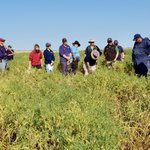
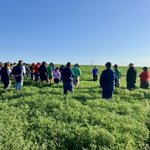
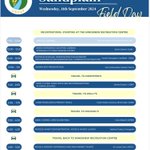


We have hay sample kits at DPIRD Geraldton for anyone wanting to get the free test for Annual ryegrass toxicity (ARGT)

Have your say on Annual Ryegrass Toxicity in WA 🚜 We're seeking input from producers to better understand where ARGT occurs, and where it doesn't.
✅5-7 minute survey ✅Livestock, cropping, dairy & hay enterprises ✅Free ARGT sampling kit
Survey 👉 sbrew.link/mVGsZmcr

Ciara Beard retweeted

Saprophyte staining can reduce visual hay quality, with the highest risk occurring when curing hay is rewetted after cutting. Read the latest #ProtectingWACrops newsletter for more information on saprophyte management.
sbrew.link/OFRtG5tw

Ciara Beard retweeted
Turnip yellows virus can cause more than 50% yield loss in canola 😮 DPIRD's Dr Benjamin Congdon explains why the timing of infection matters & how virus strains and crop varieties influence yield losses.
🎧 Hear more in the latest #GrainsConvo episode 👉 sbrew.link/rr9VgdxW
It’s concerning to see a lot of leaf rust on late maturing susceptible wheat varieties this year. Need to keep green bridge management in mind over summer if we get summer rain!
Leaf rust and powdery mildew recently detected in wheat from Yuna to Boyatup. Yellow spot, septoria nodorum blotch and glume blotch also reported. Report disease detections to #PestFactsWA and keep an eye out for stem rust in warmer weather. @GRDCWest sbrew.link/ROwP9hBK

Ciara Beard retweeted
The #PestFactsWA webinar recording is online. Learn about the latest WA climate outlook, spring and summer insect and plant disease management & the PestFacts WA service. Watch here 👉 sbrew.link/XOy2OZ0M
View the PowerPoint slides here 👉 sbrew.link/YDesk3eH
@GRDCWest

Ciara Beard retweeted
Severe cabbage aphid infestations are causing significant canola damage near Yuna and East Nabawa. Cabbage, turnip and green peach aphids have also been detected elsewhere in WA. Learn more in the latest #PestFactsWA newsletter 👉sbrew.link/vuiSBtDA
@GRDCWest

Ciara Beard retweeted
Experienced Annual Ryegrass Toxicity? Or never seen it on your farm?
Either way, your feedback is valuable!
Our new ARGT project is working to improve detection, surveillance and risk prediction across WA.
Survey 👉 forms.digital.wa.gov.au/form… and receive an ARGT sampling kit

Ciara Beard retweeted
Keep mice on the radar this harvest 🐭 Good on-farm hygiene, grain storage management and early monitoring can help reduce future mouse populations. Find practical mouse management resources and links to MouseAlert 👉 dpird.wa.gov.au/season2026

Timely for this time of year when considering patches in your crops
Latest Grains Convo 🎧 DPIRD Senior Research Scientist Sarah Collins discusses how to identify and diagnose nematode infestations, why early detection matters, and practical long-term management strategies to reduce yield losses. Listen now 👉 sbrew.link/j6QU9noz
Huge contrast this year in canola crops in Geraldton port zone at least. The crops that emerged on significant rainfall from cyclone Narelle in late March are dense, bulky canopy + flowered in July = the ones with Sclerotinia. This crop at Three Springs also has powdery mildew
Patches evident in lots of crops this year, investigate the cause before next season. While on farms for our soilborne disease research (SBDI) we are also conducting crop disease surveillance, #PestfactsWA reports & tracking disease incidence each year @DPIRDbroadacre @GRDCWest
Patchy growth reported in Scepter wheat near Yuna & Spartacus barley near Cuballing. Potential causes include rhizoctonia, take-all, root lesion nematodes & other soil constraints. Diagnosis can guide management decisions for 2027 #PestFactsWA @GRDCWest
sbrew.link/C3hYFms0

We are part of the national soilborne disease initiative (SBDI) program 3, in WA we (DPIRD) are researching disease management strategies for Sclerotinia, rhizoctonia, crown rot and nematodes in broadacre crops

Collaboration in action! Great to host @theGRDC SBDI National Coordinator Grant Hollaway for the WA #SBDI_P3 Field Day. Bringing together researchers, technical staff, DPIRD & AAGI biometricians and field operations to deliver robust science for grain growers. @DPIRDbroadacre


Ciara Beard retweeted
Growers and consultants - last spots available for Crop Insect & Disease Identification Workshop on 18-20 August in South Perth. Strengthen your ID skills and learn about integrated management approaches. @GRDCWest More info 👉 sbrew.link/PKVRQIE6

Basal (ground level) Sclerotinia in lupin crop near Yuna today, we at DPIRD are continuing research on this challenging pathogen as part of the Soilborne disease Initiative, a national research program funded by GRDC, with great collaboration from lupin growers
Ciara Beard retweeted
Ongoing wet conditions and dense canopies are increasing the risk of sclerotinia stem rot in lupins. Consider crop risk at flowering and review fungicide options carefully. Learn more with new SclerotiniaLM app & webinar on 30 Jul. #PestFactsWA @GRDCWest sbrew.link/JGJxLWkT

Ciara Beard retweeted
Russian wheat aphids (RWA) recently found in barley at Moora and Neridup and in wheat at Coomalbidgup. Growers are urged to monitor cereal crops from stem elongation for RWA and feeding damage. Learn more in the latest #PestFactsWA newsletter. @GRDCWest sbrew.link/hZIka7ed

Join me at the webinar, a great new tool assists in making fungicide decisions for lupin sclerotinia. Based on extensive field research across Australia including our decade of research from Geraldton WA and developed by the DPIRD disease modelling team @DPIRDbroadacre @GRDCWest
Webinar on management of Sclerotinia canopy infection disease in lupin and the new SclerotiniaLM app for improved disease management decisions.
Thursday 30 July 2026
1.00-1.30pm (AWST)
Register here 👉 sbrew.link/EiLFJKiV
@GRDC

Ciara Beard retweeted
Don’t rush into spraying - identify, assess, and monitor first 🔍🪴Latest Grains Convo explores how small, early decisions can have large impacts on final yield. DPIRD Senior Research Scientist Andrea Hills is the latest guest on Season 3. 🎧 Listen now 👉 sbrew.link/GdM5mZja
Ciara Beard retweeted
Don’t miss out on DPIRD’s 2026 Crop Insect & Disease Identification Workshop, running 18-20 August in South Perth. EOIs are open until Friday 24 July! Learn more in the latest #PestFactsWA newsletter. @GRDCWest sbrew.link/sY1C20QJ

Ciara Beard retweeted

Monitor mouse activity by counting active burrows or using chew cards where appropriate. 2 to 3 active burrows on avg per 10m x 10m are cause for concern prior to sowing. Burrows can be hidden under stubble. Info from @CSIRO @theGRDC Mouse Forecast March 2026

Rising mouse reports out of WA are a timely warning as seeding approaches.
Early signs matter. Monitoring paddocks now can make all the difference if numbers build quickly.
GPA podcast with CSIRO’s Steve Henry adds further insight.
More: grainproducers.com.au/post/r…
