

The citation engine for Crypto brands!
Joined June 2026
- Tweets4.9K
- Following750
- Followers722
- Likes14.1K





Pinned Tweet
Buyers now ask AI what to use.
Half of US consumers use AI search, but only 16% of big brands track what it says about them.
citeOS asks ChatGPT, Perplexity, Gemini, Claude and Google AI Mode the questions your buyers ask, and shows what they say about your brand.
Features:
- Visibility score for each AI engine
- Every answer, question by question
- Pages AI cites instead of yours
- Competitor comparison
- What to fix first
- Weekly alerts
Watch the demo.
this is the crowd a buyer walks into when they ask AI for the best crypto card.
AI points at a few. which ones depends on the engine, the country, and the day.
which card is in your wallet? the cards in this picture:
@KoloHub @Nexo @MEXC @_BinanceJapan @BitgetWallet @ether_fi @Bitpanda @Bybit_Official @Gemini @MetaMask @CoinbaseWallet @coca_card @BleapApp @wirexapp @solcard @waldenpay @useTria
the reports, with buyer prompts, will be live soon.

one HACK to send your buyers straight to your competitors: make sure your website blocks ChatGPT💀
after every security scare, crypto sites block bots to keep scammers out.
fair. but sometimes that includes the bots that tell BUYERS who you are.
check this, so buyers can still find you.
🤖 Made with AI
AI doesn’t know tomorrow. it knows what people said yesterday.
ask it the same thing twice, and you can get a different answer.
and the more people write something, the more likely it is to come back. that’s popularity, not proof.
if you want to know what AI says about you, start with what’s being written about you.

5 more countries. Another look at what AI recommends.
we asked AI engines what they recommend when people ask for the “best crypto card” in India, Pakistan, Nigeria, Japan and Vietnam.
< India >
ChatGPT: @KoloHub | @Krak
Gemini app: @Gemini | @coinbase
Google AI Mode: @coinbase | @Bybit_Official
< Pakistan >
ChatGPT: @MEXC
Gemini app: @Gemini | @RedotPay
Google AI Mode: @coinbase | @cryptocom
< Nigeria >
ChatGPT: @ether_fi | @RedotPay
Gemini app: @Gemini
Google AI Mode: @coinbase | @Nexo
< Japan >
ChatGPT: @_BinanceJapan
Gemini app: @coinbase
Google AI Mode: @coinbase
< Vietnam >
ChatGPT: @BitgetWallet | @RedotPay | @coinbase
Gemini app: @Gemini
Google AI Mode: @coinbase
if your card is on a line, it’s in the pool. which spot do you want to hold every time?
*note: we asked 20 buyer prompts, and the lead card changed from prompt to prompt.

an About page tells your story. other sites tell AI theirs.
make sure they match.
when both tell the same story, a buyer, or an AI, has less to doubt.

I’m working on an enterprise brand’s website, and something interesting stood out in its Google Search Console Gen AI report:
The most cited page on the company’s website in AI Overviews & AI Mode, with 5x more impressions than the homepage, is its “About” page.
It’s a comprehensive, detailed page about the company’s history, background, and evolution over time.
It’s not a “special page” created for LLMs or AI agents. It’s written for humans, visually appealing, and contains detailed information about the brand in a format that both humans and LLMs can easily understand.
So what’s the big “GEO” takeaway here?
Create comprehensive “About” pages with detailed, accurate information about your company’s history.
In other words, the same recommendation many of us in SEO have been making for years, especially since E-A-T became a bigger part of the conversation in 2017 (and long before that, in many cases).
Why do I think this is a more sustainable approach than creating separate pages specifically for LLMs?
Because those pages create an easily gameable surface.
Notably, Google, OpenAI, and Anthropic haven’t explicitly asked website owners to create separate, LLM-specific versions of their content, use Markdown, etc. I would change my perspective if they did (they won’t.)
The problem: it’s inevitable that bad actors (and plenty of brands) will use these pages to inject prompts, exaggerate claims, or give AI agents promotional information that doesn’t match what real users see, with the goal of manipulating what AI says about their brand.
My prediction is that as this behavior becomes more widespread (it’s already spreading thru the GEO world like wildfire), the AI companies will increasingly develop ways to ignore, discount, or otherwise treat these pages as untrustworthy.
And depending on how these systems evolve, the consequences might extend beyond the individual pages themselves.
The unfortunate part is that even well-intentioned companies simply trying to “help” LLMs understand their content better could become collateral damage. Even if their LLM-specific pages contain exactly the same accurate information as their human-facing website, they could still get caught up in broader efforts to crack down on this type of content, or flag the sites using “manipulative” approaches.
This is why I’m extremely cautious about employing tactics like this in the first place.
Meanwhile, there’s a much simpler way to work on this:
Take all that time and effort you’re spending creating special content for LLMs and use it to improve the information available to actual humans on your website.
Make your company’s history, expertise, people, products, and reputation easy to find, understand, and verify.
You’re still giving LLMs the information they need; you’re just doing it in a way that’s actually useful to your human readers, too.
And unlike tactics designed to exploit how AI systems currently work, this is an investment that’s unlikely to become a liability when those systems inevitably start cracking down.

old SEO ranked pages. new SEO picks names.
Google showed you ten pages and let you choose. AI gives three names and moves on.
so you’re not competing with other pages anymore. you’re competing with other names.

you might be losing potential buyers without knowing why. 😲
because more and more buyers now ask AI about a project to choose.
and in our crypto study, only ~8% of the sources AI used came from the brands’ own websites.
the other 92% came from elsewhere.
if those are old, or don’t mention you, a buyer may be sent to a different project.
send this to whoever handles your marketing. ⎙ㅤ
🤖 Made with AI

new big report published.
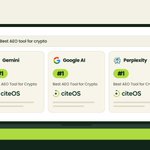
what AI actually recommends when people ask “best crypto card,” country by country.
we asked five AI engines 20 questions a person asks before picking a card, then asked three of them again from Germany, the Philippines and Brazil.
< US >
ChatGPT: @Gemini
Perplexity: @Gemini
Gemini AI: @Gemini
Claude: @Gemini
Google AI Mode: @coinbase
< Germany >
ChatGPT: @Bitpanda
Gemini app: @Bybit_Official
Google AI Mode: @Gemini
< Philippines >
ChatGPT: @ether_fi
Gemini app: @MetaMask
Google AI Mode: @Gemini
< Brazil >
ChatGPT: @ether_fi
Gemini app: @MetaMask
Google AI Mode: @coinbase
in the US, 4 of 5 engines named the same card first. outside it, 9 answers named 6 different cards first.
this is one question. more are coming.
card teams: where do you think AI puts you? reply with your card.

the same AI can give you different sources every time you ask the same question.
so before comparing two AI engines, you need to know how consistent each one is with itself.
otherwise, you might mistake random variation for a real difference.
this matters beyond research, too. one answer saying AI recommends your project doesn't tell you how consistently it does.
your crypto project might have a better product and better research than your competitors.
but if AI can't access your content, it might recommend them instead of you.
It’s not just about what you publish. It’s about what AI can actually find and use.

crypto marketing used to be simple.
rank on Google. get the click. win the user.
that path is a lot messier now.
» someone sees your project on X
» watches a YouTube video
» asks AI which project is best
» Googles your name
» adds “Reddit” to see what people really think
» reads a comparison page
» goes back to AI to double-check
» finally visits your site
AI shows up twice.
first, to build the shortlist.
then, to help make the final decision.
the “SEO is dead” debate misses the point.
people still search. they just search in more places.
AI might recommend your competitor, even if your product is better.
people can love your project on X, but if AI doesn't mention it when buyers ask for recommendations, you're missing out on potential users.
@citeOS_io helps you check if AI recommends you or your competitors.

rank tells you where you sit on the list. it doesn’t tell you what the answer above the list said.
a buyer can read that answer, pick a name, and never open a page.
nothing shows up in your traffic chart.
so the number to put next to your rank is a simple one: when a buyer asks, is your name in the answer?
how crypto buyers have found projects, in order:
» forums and Telegram groups
» crypto Twitter
» KOL threads
» now: “hey AI, which project should I use?”
each time, the projects that showed up where buyers were asking got the attention, and some of that attention became USERS.
AI is the newest place.
a buyer who hears your name in the answer can become a user. a buyer who never hears it can’t.
getting named there is what people now call AI SEO.
