
Data-driven insights on China’s tech breakthroughs, consumer trends, and market intelligence.
Joined September 2009
- Tweets11.1K
- Following3.2K
- Followers8.5K
- Likes1.4K



Any Chinese AI founder pitching a 2027 fundraise should assume investors have read the Markethon results.
A 13 year old with a working idea and a Douyin channel behind her already made the case.
Read the full article for free: ciw.news/p/chinas-markethon-…


A 13 year old just outsold adult AI founders in Hangzhou.
Her edge was not code.
It was her mother's Douyin channel.
Hangzhou held an AI hackathon with no judges.
50+ teams. 48 hours. One rule.
Whoever nets the most revenue wins.
Organizers call it Markethon (卖客松).
Zhu Shuhan, 13, from Shanghai, placed third.
Her product watches kids do homework and reminds them when they drift off.
She built it in under a week using natural-language prompts to an LLM.
She has almost no formal programming background.
The numbers.
Roughly 90 orders.
RMB 18,000+ in net revenue.
3 days.
Average price ≈ RMB 200 per sale.
Her original plan was RMB 99.
Warm audiences pay premium prices. Paid acquisition rarely gets there.
Why the format matters.
Chinese AI product building has commoditized.
Cursor. Windsurf. DeepSeek. Qwen. Kimi.
Any competent user can ship a working app in days.
The scarce input is the channel to a paying audience.
The demand side has flipped too.
Chinese AI does not lack users.
DeepSeek, Doubao, and Kimi built large domestic audiences across 2025 and 2026.
Aggregate attention is not the problem.
The specific attention of the right customer segment is.
For enterprise buyers evaluating Chinese AI vendors.
Demo day polish is a weak signal of durability.
The stronger signal is customer acquisition capability.
Two questions to ask on every diligence call:
How did you acquire your first 100 paying customers?
What share of your pipeline came through owned channels last quarter?
Clear answers separate real businesses from wrappers.

A 13 year old just outsold adult AI founders in Hangzhou.
Her edge was not code.
It was her mother's Douyin channel.
Hangzhou held an AI hackathon with no judges.
50+ teams. 48 hours. One rule.
Whoever nets the most revenue wins.
Organizers call it Markethon (卖客松).
Zhu Shuhan, 13, from Shanghai, placed third.
Her product watches kids do homework and reminds them when they drift off.
She built it in under a week using natural-language prompts to an LLM.
She has almost no formal programming background.
The numbers.
Roughly 90 orders.
RMB 18,000+ in net revenue.
3 days.
Average price ≈ RMB 200 per sale.
Her original plan was RMB 99.
Warm audiences pay premium prices. Paid acquisition rarely gets there.
Why the format matters.
Chinese AI product building has commoditized.
Cursor. Windsurf. DeepSeek. Qwen. Kimi.
Any competent user can ship a working app in days.
The scarce input is the channel to a paying audience.
The demand side has flipped too.
Chinese AI does not lack users.
DeepSeek, Doubao, and Kimi built large domestic audiences across 2025 and 2026.
Aggregate attention is not the problem.
The specific attention of the right customer segment is.
For enterprise buyers evaluating Chinese AI vendors.
Demo day polish is a weak signal of durability.
The stronger signal is customer acquisition capability.
Two questions to ask on every diligence call:
How did you acquire your first 100 paying customers?
What share of your pipeline came through owned channels last quarter?
Clear answers separate real businesses from wrappers.
DeepSeek's API business runs at 82.9% gross margin (The Information).
Revenue.
RMB 475M (~$70M) in the first 7 months of 2026.
Roughly 10x all of 2025.
Losses.
RMB 715M net loss Jan-Jul.
Full-year 2025 loss was RMB 935M.
Run-rate improvement looks thin.
Until August.
Pricing.
V4-Pro output token pricing lifted this month.
Peak: $3.96 per million.
Off-peak: $1.98.
Old rate: $0.87.
A 4.5x hike, executed after developer lock-in.
The round.
RMB 50B raise underway at RMB 500B valuation.
Weeks after closing the first RMB 50B round in June.
Bankers already engaged for a 2027 listing.
The gap worth watching.
Reported annualized revenue: $400-500M.
Cumulative 7-month print: $70M.
Growth is exponential and heavily back-loaded. The real test comes when the August repricing lands in the numbers.
The moat is not V4-Pro.
V4-Flash is where developers land.
The flagship monetizes an audience that arrived through the lightweight tier.
Which is why the price hike stuck.
Where are you modeling DeepSeek's monetization ceiling?
Follow @ciwbrief for more updates.

Real actors vs. AI actors in China:
ciw.news/p/china-actors-ai-l…

The Western narrative on China and AI actors is wrong.
They didn't reject AI. They set terms.
Q1 2026 supply: 122,000 of 128,000 micro-drama titles were AI-generated.
95% of supply by title count.
Now demand.
Live-action ran at 1/50 the volume during Spring Festival.
It drew 25x the playback.
By April, Douyin's AI drama output ran 13x live-action.
None of it registered in engagement metrics.
Southern Daily called it "digital dust."
If you're modeling AI's replacement of human performers on supply-side headlines, you're pricing the wrong variable.
The audience already voted
Which brings us to the licensing race.
On 20 April, iQiyi's CEO put 117 artists on a slide and claimed AI could take an actor from 4 productions a year to 14.
By that afternoon, Zhang Ruoyun, Yu Hewei, and Li Yitong had denied signing.
The library was walked back to "willingness to discuss."
The contest isn't whether AI enters film.
The contest is who writes the licence.
Wang Zuxian, 22 years off screen, licensed her age-20 likeness to Netease's Tianxia.
One IP.
Image only.
No voice, no name, no events.
Model destruction on contract expiry.
Qi Wei, 41, actively working, opened her twin "Han Qingxia" on 6 August.
Multi-scenario. AI comic dramas, virtual livestreams, interactive content.
Base fee plus revenue share. Producer credit. Final review.
First serving mainland star to set these terms herself
That's the template at the top.
At the bottom, some producers pay RMB 100 to 500 for lifetime likeness authorization from newcomers.
Full facial data. Perpetual AI modeling rights. Cross-platform resale.
For less than the cost of a meal.
Regulation arrived in the same window.
From 1 April 2026, every AI micro-drama files before publishing.
Above RMB 800K in budget, national authority reviews.
Every episode carries a visible AI label. Platforms bear compliance.
Three clauses remain unresolved in every public deal.
Retraining rights.
Model destruction on expiry.
Downstream revenue split.
A licence isn't a product. It's a set of clauses.
The ones nobody has published yet are the ones that matter most.
Which one decides the next five years.
Retraining scope. Revenue split. Model destruction.
Pick one.

The Western narrative on China and AI actors is wrong.
They didn't reject AI. They set terms.
Q1 2026 supply: 122,000 of 128,000 micro-drama titles were AI-generated.
95% of supply by title count.
Now demand.
Live-action ran at 1/50 the volume during Spring Festival.
It drew 25x the playback.
By April, Douyin's AI drama output ran 13x live-action.
None of it registered in engagement metrics.
Southern Daily called it "digital dust."
If you're modeling AI's replacement of human performers on supply-side headlines, you're pricing the wrong variable.
The audience already voted
Which brings us to the licensing race.
On 20 April, iQiyi's CEO put 117 artists on a slide and claimed AI could take an actor from 4 productions a year to 14.
By that afternoon, Zhang Ruoyun, Yu Hewei, and Li Yitong had denied signing.
The library was walked back to "willingness to discuss."
The contest isn't whether AI enters film.
The contest is who writes the licence.
Wang Zuxian, 22 years off screen, licensed her age-20 likeness to Netease's Tianxia.
One IP.
Image only.
No voice, no name, no events.
Model destruction on contract expiry.
Qi Wei, 41, actively working, opened her twin "Han Qingxia" on 6 August.
Multi-scenario. AI comic dramas, virtual livestreams, interactive content.
Base fee plus revenue share. Producer credit. Final review.
First serving mainland star to set these terms herself
That's the template at the top.
At the bottom, some producers pay RMB 100 to 500 for lifetime likeness authorization from newcomers.
Full facial data. Perpetual AI modeling rights. Cross-platform resale.
For less than the cost of a meal.
Regulation arrived in the same window.
From 1 April 2026, every AI micro-drama files before publishing.
Above RMB 800K in budget, national authority reviews.
Every episode carries a visible AI label. Platforms bear compliance.
Three clauses remain unresolved in every public deal.
Retraining rights.
Model destruction on expiry.
Downstream revenue split.
A licence isn't a product. It's a set of clauses.
The ones nobody has published yet are the ones that matter most.
Which one decides the next five years.
Retraining scope. Revenue split. Model destruction.
Pick one.
Tencent's Q2 quantified its AI bet.
RMB10.5B in new AI product losses in Q2 alone.
Up from RMB8.8B in Q1.
Capex +176% YoY to RMB52.8B.
Net cash halved from RMB146.9B to RMB58.2B in one quarter.
But the disclosure that matters most sits underneath the numbers.
On the earnings call, Bernstein's Robin Zhu asked when the capex would generate returns.
Management's answer: it already can.
James Mitchell said Tencent could recover depreciation "almost immediately" by renting infrastructure to third parties. Martin Lau went further. Offers already in hand would generate "more than 30 percent profit" over Tencent's own cost from just months ago.
Tencent is choosing to absorb the RMB10.5B loss rather than take that 30%+ margin.
That is a revealed preference for owning the intelligence and application layers, not a failure of monetization at the infrastructure layer.
The internal capital has narrowed too. Mitchell said the RMB8B in Q1 spend and the RMB10.5B in Q2 flowed to very different products. After WorkBuddy broke out on the Analysys leadership metric, budget was aggressively shifted toward it. Other products were deprioritized.
Q3 and Q4 now carry three cleaner tests:
• Whether Hy3 token growth converts to Tencent Cloud revenue
• Whether WorkBuddy's usage lead becomes enterprise contract value
• Whether the RMB10.5B drag stops widening
The envelope is defined. The conversion has a deadline.
Full analysis in reply ↓

China's film industry is shrinking.
Everyone blames AI.
The hiring data disagrees.
AI editor postings: +179% YoY in June.
Traditional editor postings: +7%.
(People's Daily)
One visual effects studio cut 20% of staff this year.
The practitioner who described it blamed a multi-year project drought.
Not AI.
The winter started before the tools worked.
Something else changed instead.
Reaching a director's chair used to take a decade of assistant work.
The ladder trained people and screened them.
Both functions are gone.
What replaced them gets issued at AI film festivals.
At the one held in Cannes this April, the model vendor was the official technology partner.
It co-produced student films that circulated through the same circuit.
Its name sits on one of the prizes.
Nearly 2,000 Chinese entries competed for 25 slots.
China's top media school cut 16 majors last year. Photography went first.
From 2027 it admits directors on test scores alone.
If you underwrite AI-native content, tool access is not a moat.
Every competitor holds the same subscription.
Over the next 5 years, which controls more value: the model vendors, or the platforms distributing what the models make?

Full analysis: ciw.news/p/china-ai-film-ind…
Follow @ChinaInnovWatch for weekly China tech intelligence.

Full analysis: MCP architecture breakdown, cannibalization data test, and three signals to watch through Q1 2027: ciw.news/p/wechats-xiaowei-a… @ChinaInnovWatch for weekly China tech intelligence.

WeChat just launched Xiaowei, its native AI agent.
Chinese commentary immediately called it a slow demolition of WeChat's ad toll booth.
The Q1 2026 numbers say the opposite:
———
Marketing services revenue grew 20% YoY to RMB 38.2B in Q1 2026.
Accelerating from 17% in Q4 2025.
Video Accounts ad load holds at 4-5%. Monetization headroom inside existing surfaces is substantial.
Xiaowei is in closed beta. Public rollout targets Q3 2026.
An agent in closed beta cannot materially dilute browsing volume in FY 2026.
The cannibalization thesis is directionally coherent on a five-year view.
For the next four quarters, the data shows acceleration.
(Tencent Q1 2026)
———
Xiaowei is not offense against ads. It is defense against Doubao.
ByteDance's Doubao operates through screen recognition and simulated clicks on third-party apps.
If external agents become the default access layer for WeChat's services, mini-programs get scraped and rerouted.
Tencent captures neither the intent, the ranking, nor the transaction.
Xiaowei's answer: build the agent inside WeChat, not as a standalone app.
Keep it where the payment stack and merchant relationships already sit.
The 13 launch partners — JD.com, Meituan, Ctrip, KFC, Dewu — connect through Model Context Protocol wrappers.
Merchants opt in. Merchants control what capabilities and data get exposed.
Doubao faced merchant pushback for its scraping approach.
Xiaowei sidesteps the conflict by making cooperation opt-in and revocable.
(Pandaily)
———
The MCP architecture has a consequence most commentary misses.
Merchants define the API surface Xiaowei calls.
Tencent cannot pull richer data or reroute user intent beyond what each merchant chooses to expose.
The extraction ceiling is structurally low.
Which paradoxically protects the merchant trust that makes the platform work.
The AI drag is visible and manageable.
Non-IFRS operating profit excluding new AI products: RMB 84.4B.
Including new AI products: RMB 75.6B.
The gap — RMB 8.8B — is the quarterly cost of the AI build.
Free cash flow: RMB 56.7B. Up 20% YoY.
Cash generation is 6x the current AI drag. Tencent can self-fund Xiaowei's compute for years.
———
The cannibalization narrative mistakes long-run risk for near-term dynamic.
Advertising is expanding faster than any plausible agent-era erosion.
The cash that funds Xiaowei's compute burn expands with it.
One falsification test makes this clean:
A Xiaowei-specific merchant commission structure inside the mini-program ecosystem within 12 months would prove the aggressive read right.
The current architecture and financials point elsewhere.
Xiaowei's near-term revenue is not the point.
The point is whether it stops a competitor from turning WeChat's ecosystem into commodity infrastructure.
WeChat just launched Xiaowei, its native AI agent.
Chinese commentary immediately called it a slow demolition of WeChat's ad toll booth.
The Q1 2026 numbers say the opposite:
———
Marketing services revenue grew 20% YoY to RMB 38.2B in Q1 2026.
Accelerating from 17% in Q4 2025.
Video Accounts ad load holds at 4-5%. Monetization headroom inside existing surfaces is substantial.
Xiaowei is in closed beta. Public rollout targets Q3 2026.
An agent in closed beta cannot materially dilute browsing volume in FY 2026.
The cannibalization thesis is directionally coherent on a five-year view.
For the next four quarters, the data shows acceleration.
(Tencent Q1 2026)
———
Xiaowei is not offense against ads. It is defense against Doubao.
ByteDance's Doubao operates through screen recognition and simulated clicks on third-party apps.
If external agents become the default access layer for WeChat's services, mini-programs get scraped and rerouted.
Tencent captures neither the intent, the ranking, nor the transaction.
Xiaowei's answer: build the agent inside WeChat, not as a standalone app.
Keep it where the payment stack and merchant relationships already sit.
The 13 launch partners — JD.com, Meituan, Ctrip, KFC, Dewu — connect through Model Context Protocol wrappers.
Merchants opt in. Merchants control what capabilities and data get exposed.
Doubao faced merchant pushback for its scraping approach.
Xiaowei sidesteps the conflict by making cooperation opt-in and revocable.
(Pandaily)
———
The MCP architecture has a consequence most commentary misses.
Merchants define the API surface Xiaowei calls.
Tencent cannot pull richer data or reroute user intent beyond what each merchant chooses to expose.
The extraction ceiling is structurally low.
Which paradoxically protects the merchant trust that makes the platform work.
The AI drag is visible and manageable.
Non-IFRS operating profit excluding new AI products: RMB 84.4B.
Including new AI products: RMB 75.6B.
The gap — RMB 8.8B — is the quarterly cost of the AI build.
Free cash flow: RMB 56.7B. Up 20% YoY.
Cash generation is 6x the current AI drag. Tencent can self-fund Xiaowei's compute for years.
———
The cannibalization narrative mistakes long-run risk for near-term dynamic.
Advertising is expanding faster than any plausible agent-era erosion.
The cash that funds Xiaowei's compute burn expands with it.
One falsification test makes this clean:
A Xiaowei-specific merchant commission structure inside the mini-program ecosystem within 12 months would prove the aggressive read right.
The current architecture and financials point elsewhere.
Xiaowei's near-term revenue is not the point.
The point is whether it stops a competitor from turning WeChat's ecosystem into commodity infrastructure.

Read more on AI shopping war in China here: ciw.news/p/chinas-618-ai-sho…
Four platforms went live with AI commerce features in Q1-Q2 2026, converging on China’s second-largest shopping festival
Hands-on testing reveals two product philosophies: conversational discovery versus chat-wrapped shelf search
The decisive moat is content-to-commerce loop data, not model capability. Only Doubao has it
JD AI Gou recommended products with features they do not have. The accuracy problem nobody is pricing in
Xiaohongshu is the only credible challenger, if it can convert content depth into transaction gravity

Alibaba and ByteDance have closed China's AI shopping loop before 618.
Qwen can search, compare, and place Taobao orders inside one conversation.
Doubao can return a purchase page from a single question.
Both products hit the same wall immediately:
———
AI shopping recommendations depend on trust.
Users ask an assistant because they expect a better answer than keyword search — which has been shaped for years by sponsored placement and merchant bidding.
Paid ranking works in the opposite direction.
China's e-commerce ad systems are built on auction logic. Merchants pay for visibility. Platforms monetize that visibility.
Alibaba's customer management revenue — the core of its China e-commerce business — grew 8% like-for-like in FY2026.
Any serious shift toward AI-mediated recommendations pressures the most profitable engine Alibaba has.
Alibaba's China E-commerce adjusted EBITA fell 40% YoY to RMB24B in March 2026.
That weakened base is now funding Qwen user acquisition, quick commerce expansion, and the AI push simultaneously.
Alibaba is funding the AI layer from a weaker commerce core.
The AI layer, if it works as promised, reduces the value of the advertising revenue that core depends on.
———
The conflict may be resolved before users notice it.
Generative Engine Optimization (GEO) works by shaping the external content AI models retrieve before generating answers.
The goal: raise the probability a brand appears when an AI assistant is asked what to buy.
The important part is where the influence happens.
GEO does not require the platform to sell ad inventory.
It acts on the input layer, before the model produces a response.
China's GEO market grew 215% YoY in Q2 2025.
Service providers charge merchants RMB 2,980 to RMB 16,980 annually. Pricing scales with "compute intensity" of brand insertion.
The user does not see the transaction.
(iResearch via Jiemian, TMTPost)
China's regulatory framework covers algorithm recommendations, generative AI, and AI labelling.
One gap remains: paid inclusion inside AI-generated shopping recommendations has no disclosure regime yet.
That is the opening GEO is built to exploit.
Alibaba and ByteDance have closed China's AI shopping loop before 618.
Qwen can search, compare, and place Taobao orders inside one conversation.
Doubao can return a purchase page from a single question.
Both products hit the same wall immediately:
———
AI shopping recommendations depend on trust.
Users ask an assistant because they expect a better answer than keyword search — which has been shaped for years by sponsored placement and merchant bidding.
Paid ranking works in the opposite direction.
China's e-commerce ad systems are built on auction logic. Merchants pay for visibility. Platforms monetize that visibility.
Alibaba's customer management revenue — the core of its China e-commerce business — grew 8% like-for-like in FY2026.
Any serious shift toward AI-mediated recommendations pressures the most profitable engine Alibaba has.
Alibaba's China E-commerce adjusted EBITA fell 40% YoY to RMB24B in March 2026.
That weakened base is now funding Qwen user acquisition, quick commerce expansion, and the AI push simultaneously.
Alibaba is funding the AI layer from a weaker commerce core.
The AI layer, if it works as promised, reduces the value of the advertising revenue that core depends on.
———
The conflict may be resolved before users notice it.
Generative Engine Optimization (GEO) works by shaping the external content AI models retrieve before generating answers.
The goal: raise the probability a brand appears when an AI assistant is asked what to buy.
The important part is where the influence happens.
GEO does not require the platform to sell ad inventory.
It acts on the input layer, before the model produces a response.
China's GEO market grew 215% YoY in Q2 2025.
Service providers charge merchants RMB 2,980 to RMB 16,980 annually. Pricing scales with "compute intensity" of brand insertion.
The user does not see the transaction.
(iResearch via Jiemian, TMTPost)
China's regulatory framework covers algorithm recommendations, generative AI, and AI labelling.
One gap remains: paid inclusion inside AI-generated shopping recommendations has no disclosure regime yet.
That is the opening GEO is built to exploit.
12 months ago, Tencent was the AI also-ran.
Kimi, Qwen, and Ernie dominated coverage of China's LLM race.
Q1 2026 results just rewrote that narrative:
Hy3 preview accumulated 7.7 trillion tokens on OpenRouter between April 23 and May 12.
The next closest: Kimi K2.6 at 5.0 trillion.
Claude Sonnet 4.6: 4.0 trillion.
DeepSeek V3.2: 2.7 trillion.
Hy3's lead over Kimi is 54% by cumulative token count.
OpenRouter routes developer traffic across multiple providers — token usage is developer adoption, not a self-reported benchmark.
The model team was rebuilt from scratch over six months. Pre-training, reinforcement learning, and evaluation systems all rebuilt. Evaluation criteria shifted away from gamed benchmarks toward PhD qualifying exams from Tsinghua and Princeton.
Hy3 is already deployed across 131 internal Tencent products. No external provider can replicate that feedback loop at this scale within one company.
———
For the first time, Tencent carved out "new AI products" as a separate cost center. The margin arithmetic is now visible.
Operating profit excluding new AI products: RMB84.4B. Up 17% YoY. Margin: 43.0%.
Operating profit including new AI products: RMB75.6B. Up 9% YoY. Margin: 38.5%.
The gap: 4.5 percentage points. That is the quarterly cost of Tencent's AI build, expressed as forgone operating profit.
Free cash flow grew 20% YoY to RMB56.7B. Net cash rose 63% YoY to RMB146.9B.
The core business generates enough cash to fund the AI build and run share buybacks simultaneously.
The 4.5ppt drag is a floor, not a ceiling. The larger Hy model is in development. Agent monetization is early. Infrastructure investment is ongoing.
———
WorkBuddy leads China in productivity AI agents by DAU.
Among paying users: 80%+ retention.
80%+ at this stage of the adoption cycle means dependency formation is underway. Users who pay and stay are building workflows around the tool.
Marketing services grew 20% YoY to RMB38.2B. Accelerating from 17% in Q4 2025.
AIM+ powered approximately 30% of total advertiser spending in Q1 2026.
The self-funding loop is now active: better models improve ad targeting, ad revenue funds model development.
———
Three Chinese tech giants. Three distinct AI architectures.
Alibaba: cloud-infrastructure-first. Qwen drives enterprise cloud migration.
Baidu: vertical-first. Ernie embedded into search, autonomous driving, maps.
Tencent: distribution-layer-first. Agents run on Weixin, QQ, WeCom — surfaces 1.43B users already use.
Users don't learn a new interface. The AI comes to them.
The architecture that actually scales isn't the one building the best model.
It's the one distributing AI through 1.43B users who never have to change their behavior.
AIM+ already powers 30% of Tencent's ad spend. If that reaches 50% by Q4 2026, the self-funding loop accelerates beyond what investors currently model. Too aggressive or too conservative?
Visit CIW News and read complete update for free.

Top AI apps in China:
Doubao has 34.49M monthly active AI users in China.
Baidu's Wenxin has 0.48M.
Same country. Same market. 72x apart:
The top 3 are in a different league from everything below:
Doubao (ByteDance): 34.49M
Qianwen (Alibaba): 16.57M
DeepSeek: 12.72M
Then a cliff.
Yuanbao (Tencent): 5.73M
Everyone else: under 3M.
Two things stand out beyond the MAU rankings.
First, ByteDance has two apps in the top 6. Doubao at #1. Doubao Love Learning at #6. Combined: ~36M MAU.
No other company comes close across multiple products.
Second, the category breakdown tells a different story than Western AI charts.
AI Social Interaction appears three times (Lovekey, Miaomiao, Xingye).
AI Professional Consulting appears twice (Ant Aifei, Xiaohe AI Doctor).
China's AI native app market is not just an assistant race.
Baidu built its entire AI investment thesis around being China's leading AI company.
The consumer app data does not support that position.
ByteDance won China's AI assistant market. The question now is whether Alibaba or DeepSeek closes the gap or whether the top 3 is already locked in.
Find out more: ciw.news/p/china-mobile-inte…

Duolingo grew 1,727.9% YoY in China's social networking rankings.
Read that again.
Everything else in this chart is normal. That number is not:
WeChat: 113.37M MAU. Up 3.6% YoY.
QQ: 62.12M MAU. Down 1.6%.
RedNote/Xiaohongshu: 24.53M MAU. Fastest-growing among the top 4 at +4.2%.
Below the top 4, the chart splits cleanly into winners and losers.
Declining:
OPPO Community: -19.7%.
Baidu Tieba: -13.6%.
MOMO: -12.4%.
Zhihu: -7.1%.
Growing:
Duolingo: +1,727.9%.
Qiandao: +36.9%.
Pengyou: +10.3%.
Forum-style and older community apps are losing users consistently.
A language learning app most analysts aren't tracking in China just posted the strongest growth number in the entire social networking category.
Click the link in the profile to find out more.

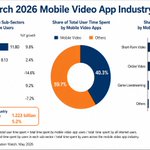
79.1% of China's mobile video time goes to short-form.
Nearly 4 in 5 minutes.
Douyin and Kuaishou aren't competing for the top spot anymore. They are the category.
The real signal is in what's declining:
aggregated video down 14.6% YoY.
These were the multi-platform hubs,
the catalogues.
Users chose the feed over the library,
consistently,
at scale.
Mobile video now takes 40.3% of all China internet time. Not video time. All of it.
What puts a dent in short-form's grip on attention? Genuinely asking. @ciwbrief
#chinatech
🤖 Made with AI


