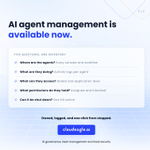
A platform that helps enterprises manage SaaS, AI, and identities by enforcing access controls, optimizing spend, and reducing security risk.

US
Joined September 2020
Three things we keep seeing in month-one AI invoices from new customers: The bill is almost always bigger than the owner expected. Nobody can tell you who the top three users are. The spike always lands in the week before quarter close. Writing this up properly later. Noting it here first.
14
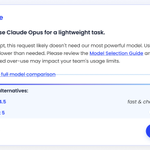
The AI governance conversation got stuck on “who’s allowed to use ChatGPT.” That part’s easy. The hard part is who owns the service account that got provisioned last Tuesday, which model your Opus subscription is actually billing at, and why a single prompt classifier is now the thing standing between a $600 call and a $75 one. Governance is a budget problem now, not just an access problem.
24
Nearly three-quarters of companies will run agentic AI within two years. One in five has a governance model for it. Most teams treat governance as one initiative. It is three: usage, policy, and identity. Each needs a different method. Friction does not come from the rules. It comes from uncertainty. Teams route around policies they do not understand, and security finds the tool after it is already in use. More rules make both worse.
1
31
Nidhi Jain on which method belongs to each of the three, and the one most teams skip: lnkd.in/gKfcCgDs
15
Your AI governance stack is missing the one thing your board will ask for: proof. If you can’t answer what tokens were consumed, what data was pasted, and what each account cost, you have a governance gap. This article helps you close it:
1
135
The UK’s data regulator said on 8 October it is examining whether foundation models themselves contain personal data. If you have been relying on the vendor’s DPA to cover what employees put into AI tools, that position just got weaker. Right now, somewhere in your company, someone is pasting a customer record into a chat window. They are closing a ticket faster, summarizing a contract, cleaning up a spreadsheet. That session never touches SSO. It produces no file, so DLP has nothing to inspect. Your firewall and CASB log a domain and a TLS handshake. By the time anything in your stack could react, the data has left. And it does not come back. No mechanism reaches inside a third party’s model and removes one person’s record. Whatever went in last quarter is already gone. The only part you still control is next quarter. Which is why the control has to sit at the keystroke. Secure Browsing catches PII, financial data, credentials, and health information as they are typed, applied by role and department. If an erasure request landed tomorrow, could you say what has gone into AI tools? If the answer is no, the gap is probably not where you think it is. Here’s which of your existing controls can see an AI session, and which never could: cloudeagle.ai/blogs/ai-usage…
44
Most enterprise AI invoices can’t be audited. The bill arrives as one line. Who used what, which model, which project? None of it reconciles to the total. This is what AI governance looks like without usage control. 🧵
1
39
Admins set spend limits. Limit-increase requests route through an approval process. Unused licenses get harvested without manual tracking. Any API key burning tokens outside a known project gets flagged, so a rogue key gets caught before the invoice does.
1
8
What changes for the people reading the invoice: - Spend ties back to the team and project that drove it, so ROI shows up next to cost. - Approvals for more access get grounded in what someone actually used, not what their manager thinks they need. - Adoption stays visible as it grows, so budget never gets surprised by headcount nobody tracked. Full detail on how each layer works → cloudeagle.ai/product/ai-gov…
4
CloudEagle.ai is now on Google Cloud Marketplace. GCP customers can buy AI governance through the Google Cloud account they already have. Terms are already in Legal’s accepted list, and it lands on the Google Cloud invoice Finance already reconciles. Eligible purchases count toward an existing Google Cloud commitment, so governance draws on budget that’s already approved. Procurement that used to take a quarter runs in days, and security sees every AI tool in use, sanctioned or shadow, weeks sooner. Once it’s in: → Discover every AI app and agent, assign each agent a human owner, kill rogue ones with a switch → Block sensitive data in the browser before it reaches an unapproved AI tool → Review non-human identities the same way you review employees → See AI usage, token consumption, and spend by team and user Custom Private Offers available. Listing → console.cloud.google.com/mar…
59
Finance pro-rates the $412K by headcount, or by who argued hardest for budget last quarter. That estimate becomes the number next quarter gets planned against, including which teams get cut and which get doubled. The practice held up while AI was an experiment. Once the spend is committed, it gets defended line by line, and a total has no lines.
22
One of your AI jobs is running at 8× the cost the work requires. You cannot see which one. The invoice comes back as one total. It does not say which model or which job. So the premium tier stays on, the overspend gets baselined, and next year’s budget locks it in. If you cannot name the job on the expensive model, you cannot cut it.
1
25
The premium tier does not step down on its own. It stays on until someone can name the job, and the next invoice baselines it. See the workload, the model, and the cost in one view: cloudeagle.ai/product/ai-gov…
16