

A Solana-compatible chain where a neural network runs inside one transaction.
Joined November 2026
- Tweets261
- Following2
- Followers198
- Likes110




Pinned Tweet
COGITO: a Solana-compatible chain where a small neural network runs inside one transaction.
Draw a digit and the chain answers, with the compute units on the transaction.
cogito.run/think
When COGITO's digit network misses, the right digit is usually its second choice. Of the 199 MNIST test digits it reads wrong, 145 have the right digit as the second largest output. Counting the top two, 9,946 of 10,000 are covered, and counting the top three, 9,982.
You can read all ten digit outputs from the Program data line of your own thought, so the second choice is there to see; we ran the test set at 23:16 UTC Nov 26.

4
105
fetch_mnist.sh in COGITO's public repository downloads MNIST's four files and checks each against a SHA-256 written in the script before anything uses them. If one byte differs, sha256sum -c fails and the script stops, because it runs with set -e.
The line for the test images file starts 8d422c7b, so you can check your own copy with sha256sum against it.

4
126
Each hidden value in COGITO's digit network is clamped to 0..255 so it fits in one byte, and on MNIST's test digits the clamp almost never bites. Of 1,280,000 hidden values, 774 reached 255, in 684 of the 10,000 digits, and the largest before the clamp was 432.
Run without the clamp, the network still reads 9,801 right, the same as with it; we ran both at 19:40 UTC Nov 26 with weights from the public repository, so you can rerun it.

Which rows of a digit does COGITO's digit network lean on most? Blank the top four rows of the 16 by 16 grid and MNIST's test digits are still read right 8,923 times of 10,000, and blank the bottom four and it is 9,110.
Blank rows 5 to 8 instead and it falls to 3,451, and rows 9 to 12 to 3,717, so the middle of your drawing carries most of what it reads. We ran it at 19:40 UTC Nov 26 with the public reference arithmetic.

2
7
130
Before you burn solana:Cogito6Ss5vhwAqjkrB5jVRr3GXwtmseJqZm9CyUy4di for gas, read three fields at cogito.run/api/burn. state is one of not-open, open, paused, closing or closed, pausedSince gives the time a pause began, and closeSlot, once set, gives the Solana slot from which burns are no longer credited.
Read at 19:40 UTC Nov 26, they answered state open, pausedSince null and closeSlot null, so no pause and no closing slot were set.

4
92
A new COGITO node does not have to replay the chain from its first block. At 19:39 UTC Nov 26, getHighestSnapshotSlot on rpc.cogito.run answered full 3,240,754 and incremental 3,242,754, while getSlot answered 3,243,008.
A full snapshot holds every account as of its slot and an incremental one holds what changed after it, so you load both and replay only the blocks since.

3
91
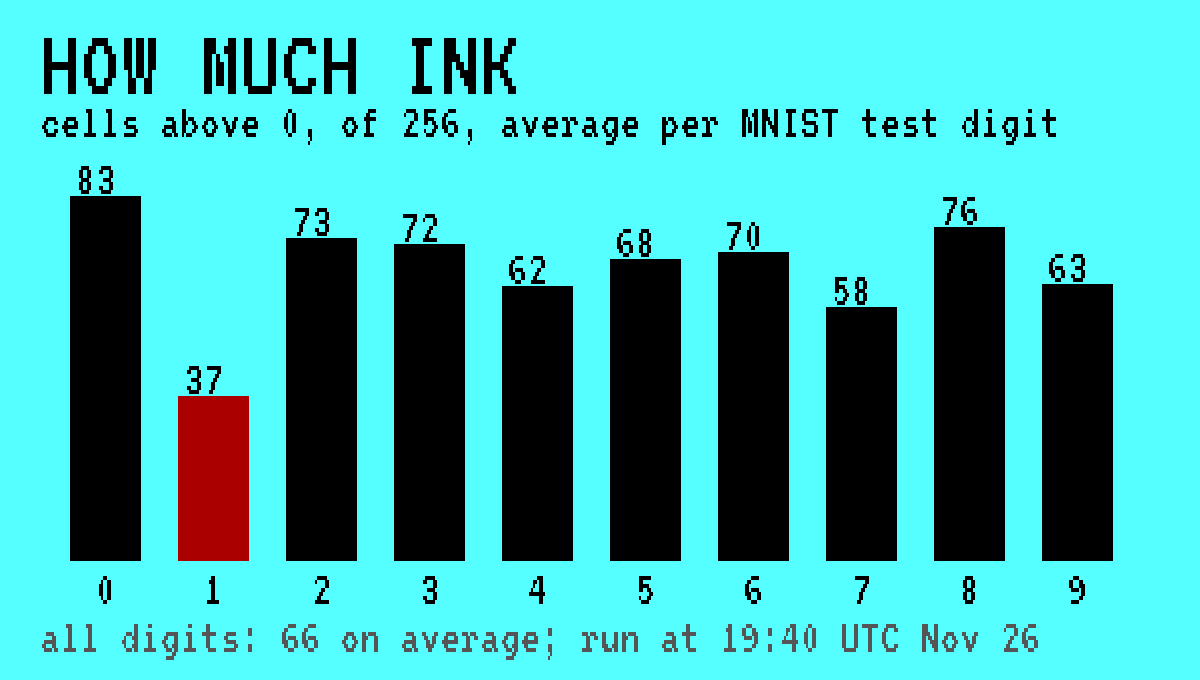
How much of the grid does a digit fill? On average an MNIST test digit lights 66 of the 256 cells COGITO's digit network reads, after preprocess.py from the public repository. A 1 lights 37 on average and a 0 lights 83, the most of any digit.
So a thin, short stroke gives the network little to go on, and you can count the cells of your own drawing the same way; we ran it at 19:40 UTC Nov 26.
Your pen width matters to COGITO's digit network. MNIST's test digits, read right 9,801 times of 10,000, drop to 8,293 when every stroke is made one cell thicker on the 16 by 16 grid, and to 5,566 when one cell thinner.
We ran both at 16:41 UTC Nov 26 with the public reference arithmetic, so draw with a stroke close to MNIST's own.

7
165
How sure is COGITO's digit network when it answers? The gap between its largest digit output and the second is a median of 3,149 when it reads a test digit right, and 363 when it is wrong.
Of the 5,000 MNIST test digits with the widest gap, 4,999 were right; of the 1,000 with the narrowest, 817. You can read both outputs from the Program data line of your own thought; we ran the test set at 16:41 UTC Nov 26.

6
173
COGITO's digit network was trained by train.py in the public repository with seed 714: 16 passes over the training digits, batches of 256, the Adam update, and a learning rate of 0.003 that falls along a cosine to 0.
train-log.json records each of those settings, so you can run it again with the same seed.

1
5
103
COGITO's digit network needs the digit where it expects it. Moved right by one cell of the 16 by 16 grid, MNIST's test digits are still read right 9,736 times of 10,000; by two cells 9,233, by three 6,305 and by four only 2,949.
So preprocess.py in the public repository centers the ink by its weight on the grid before a digit becomes 256 bytes, and you can rerun the moves from it; ours ran at 16:41 UTC Nov 26.

The smallest burn COGITO credits is 1 COGITO, which is 1,000,000 base units and is credited as 1,000,000 lamports. A thought pays a fee of 5,000 lamports, as the one at slot 3,182,148 did, read at 16:41 UTC Nov 26, so that smallest burn covers the fees of 200 thoughts.
You burn on Solana from your own wallet and the same address is credited, and at that read cogito.run/api/burn answered state open.

This is what COGITO's digit network reads on average: each picture is the mean of every MNIST test digit of one kind, as the 256 bytes the network gets, 16 by 16 cells. We made it at 16:41 UTC Nov 26 with preprocess.py from the public repository.
Where a picture is bright, most writers put ink, and where it is blurred, they differ, so you can hold your own drawing up against it.

1
8
154
Most of the digit network's weights on COGITO are small. Of the 32,768 in its first layer, 22,064 lie between -10 and 10, 18,896 are negative, 11,988 positive and 1,884 are 0.
Only 8 reach the Int8 floor of -128 and none reaches 127, while the second layer's 2,048 stay between -44 and 28. You can count them from weights.bin in the public repository; we did at 03:46 UTC Nov 26.

7
121
Each COGITO mind is an ordinary ELF file, and readelf can open it. Built with gen_mind.py elf-vector from the public repository at 03:46 UTC Nov 26, digit-vector.so had two LOAD segments: read-only data at 0x0, holding the weights and vector descriptors, and code at 0x100000000, which is also the entry point.
readelf reports the machine as Linux BPF, CPU version 3, and the file's SHA-256 equals the one the README lists for the deployed program, so you can check it.

6
111
cogito.run/api/minds lists every mind on COGITO, and at 03:47 UTC Nov 26 it listed four programs in two pairs. The digit network and the benchmark program each have a vector program and a scalar twin, and each record names its twin and its program's compute units: 1,700 and 349,958 for the digit pair, 1,531 and 349,771 for the benchmark.
Both digit programs carry the same weights hash, so you can see on chain what the vector instructions save.

1
6
146
Most of COGITO's digit network stays quiet on any one digit. Of its 128 hidden units, a median of 16 come out above 0 on an MNIST test digit, never fewer than 5 and never more than 31.
46 of the 128 come out above 0 on none of the 10,000 test digits. We counted at 03:46 UTC Nov 26 with the same integer arithmetic as the public reference computation, and its outputs matched, so you can count them too.

After you burn solana:Cogito6Ss5vhwAqjkrB5jVRr3GXwtmseJqZm9CyUy4di for gas, you can look the burn up by its signature at cogito.run/api/burn/tx/<signature>, or every burn from your address at cogito.run/api/burn/owner/<address>. When nothing is found, the answer says NOT_SEEN and how far the watcher has read Solana mainnet.
At 03:46 UTC Nov 26 it had read up to Solana slot 473,999,289, so a burn in a later slot may simply not be read yet.

You can see COGITO's last hour in one call. cogito.run/api/status keeps a sample every quarter minute, and at 03:46 UTC Nov 26 it held 239 of them, from 02:46 UTC to 03:46 UTC, with slotsPerSec between 4.8 and 5.07.
Every one read voting 4 and skipRate 0, and cogito.run/status draws the same samples.

Every recent priority fee on COGITO was 0. At 00:31 UTC Nov 26, getRecentPrioritizationFees on rpc.cogito.run returned 150 entries, slots 2,639,656 to 2,898,837, and each one read 0.
So a thought goes out without one: the site sets only a compute unit limit, and you pay the base fee per signature.

6
124