

After 6 years, this is still one of the best introductions to #bitcoin for beginners to intermediates. Even useful to experts with some great insight. youtube.com/watch?v=Bhe61JaN…

7
Excited for #SSF Single Stock Futures from #CME, specifically inflows and how Gamma and GEX correlation will play out. Looks like #semis are of higher interest. $SBRKB should be a good watch, inversely

(Bloomberg) -- Investors will soon have another way to bet on the hottest stocks from Nvidia Corp. to SpaceX, without trading a single share.
CME Group Inc. will launch single-stock futures Monday, allowing investors to hedge or speculate on more than 50 of the largest US companies. The contracts, offering leverage without the complexity of options, will be cash-settled on the closing price of the stocks they’re tied to.
The world’s largest derivatives exchange is betting the rise of retail trading and today’s market environment of hot IPOs with limited share availability will make the single-stock futures — a tool that failed to gain traction in the US after its first first launch 24 years ago — a success this time around.
“This has the ability to bring in a lot of new traders to our ecosystem,” Tim McCourt, global head of equities, FX and alternative products at CME, said in a phone interview. The exchange is targeting retail traders, having lined up more than 35 retail intermediaries to help get the futures in front of them, and institutional investors like asset managers, for whom it’ll be a new tool to manage risk, he said.
Unlike options, single-stock futures provide leveraged exposure without requiring the knowledge of concepts like the Greeks — the variables that determine how changes in stock prices, volatility, time and interest rates impact the derivatives’ pricing.
One use case for futures will be to give investors long or short exposure to stocks where there is a shortage of inventory, as seen recently in SpaceX’s initial public offering. Investors who didn’t get allocated stock in a hot listing could potentially add exposure in a capital-efficient manner using futures.
Their simplicity over options should make them appealing to retail investors who tend to trade instruments they understand, according to Martin Franchi, CEO of NinjaTrader, a futures broker.
“There could be someone who’s perhaps too confused by all the Greeks and everything, and says this is just a simpler way,” he said. “With the retail participation in markets today, a lot of things are just going to be different about single-stock futures this time.”
The launch comes at a sensitive time for the exchange. The Iran war has given a tailwind to Intercontinental Exchange Inc.’s Brent oil complex over CME’s West Texas Intermediate futures franchise. Meanwhile, volume is flourishing on offshore derivatives exchanges like Hyperliquid Strategies Inc., while Kalshi Inc. and Polymarket are dominating the insurgent prediction markets.
Longer Hours
CME’s single-stock futures will be available to trade five days a week, 23 hours a day — longer that the normal 9:30 a.m. to 4 p.m. for equity markets. The quarterly contracts will come in two sizes: The larger ones — 55 of them will be introduced — will be based on 100 shares of stock, like typical options, while the 22 micro futures will be based on 10 shares. The latter ones will include Mag7 tech companies, along with 15 others such as Micron Technology Inc., Pfizer Inc. and Walmart Inc.
Futures are common on equity indexes and commodities globally, but for single stocks they’ve had a rocky history in the US. The contracts were banned for almost two decades, until an accord was signed in 2000 regulating their supervision and rules for their trading were approved in 2002. They finally launched later that year but never attracted enough interest, eventually disappearing in 2020.
Shortly after that, regulators lowered the minimum amount of money an investor may need to trade single-stock futures in a bid to help revive the market. CME had to receive approvals from both the Securities and Exchange Commission and Commodity Futures Trading Commission to launch the contracts.
“When we introduced them the first time, they failed miserably,” remarked CME Chairman and Chief Executive Officer Terry Duffy in the company’s quarterly earnings call on July 22. “The world has evolved since 2000.”
Thriving Indian Market
In markets like India, where futures on individual stocks are thriving, the contracts are used to take leveraged directional positions, hedge equity portfolios or exploit arbitrage opportunities. They are also the backbone of arbitrage funds, which buy the underlying shares and sell the futures to capture the premium between the two.
In Europe, financial institutions use single-stock futures to improve balance sheet efficiency, particularly around quarter-end and year-end regulatory reporting. They are also used to manage long positions and hedge short-position and net dividend risk, according to Jeremy Cohen, global head of Stellar Securities, a derivatives broker.
Like any financial instrument, the new contracts come with risks. Mat Cashman, principal for investor education at the Options Clearing Corp., points out that trading outside of normal hours — including during the volatile minutes after companies report earnings — can be choppy.
Then there are the commissions. Unlike in stock or options trading where many retail platforms charge no fees to traders but instead receive payment for order flow from market makers, retail traders in futures markets generally have to pay commissions.
In the end, what may be the key to making this product successful could simply come down to the firms facilitating the trading, according to Stuart Kaiser, head of US equity-trading strategy at Citigroup Inc.
“Retail has gotten into the habit of using call options to source their leverage — or levered ETFs,” he said. “For futures to break into that — it’ll probably have to come from a push from the discount brokers to offer that product and allow them to trade it.”

1
463
Charlsy retweeted

In a few years all high-bandwidth interconnects in data centers will be optical.
That's why photonics has become one of the most important AI infrastructure themes:
$SIVE Sivers Semiconductors +2290.36%
$IQE IQE +1088.21%
$SOl Soitec +455.58%
$AXTI AXT Inc +437.44%
$AAOI Applied Optoelectronics +371.06%
$AEHR Aehr Test Systems +328.79%
$OPTX Syntec Optics +303.10%
$ALRIB Riber +268.57%
$MRVL Marvell Technology +254.92%
$UMC United Microelectronics +249.87%
$AIXA Aixtron +248.64%
$LWLG Lightwave Logic +208.62%
$WOLF Wolfspeed +196.25%
$VIAV Viavi Solutions +193.30%


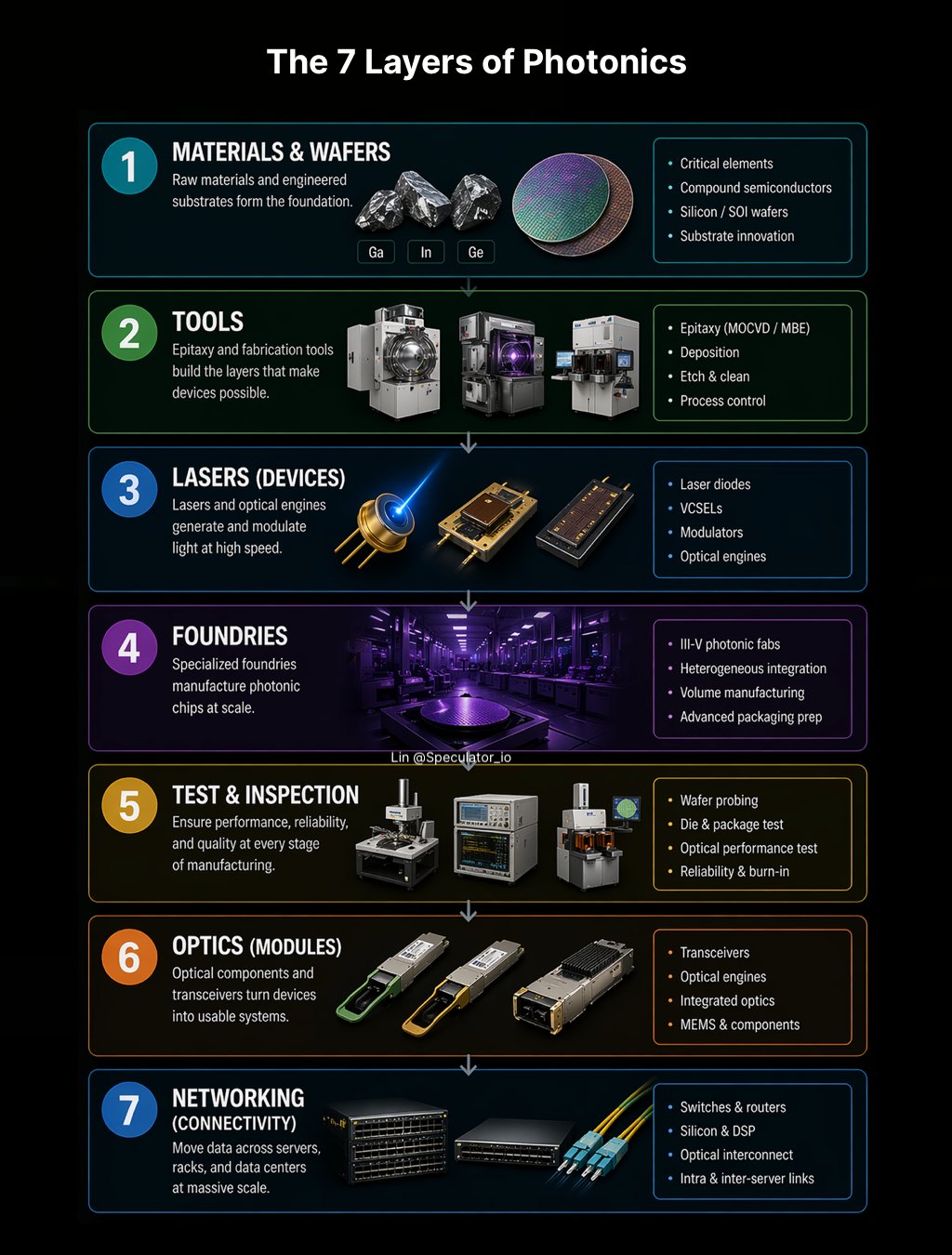
The 7 Layers of Photonics
1. Materials & Wafers: $AXTI $ALMU $TECK $IQE $LWLG $SOI $WOLF
2. Tools: $AIXA $ALRIB $VECO $LRCX $AMAT $SHMN $ONTO
3. Lasers: $SIVE $MTSI $HIMX $STM $LASR
4. Foundries: $TSEM $FN $XFAB $SANM $UMC $GFS
5. Testing: $AEHR $FORM $COHU $TER $VIAV $ASX $AMKR
6. Optics: $LITE $COHR $POET $MEMS $AAOI $OPTX $LPTH
7. Networking: $CRDO $MRVL $SMTC $CIEN $NOK $GLW $ALAB $ANET $AVGO
Insane $SMH options play cheddarflow.com/blog/smh-opt…

51
I'm thinking "Flying Car" strategy more than anything, and who's on the realistic short list for that: Tesla/SpaceX or BYD? Huawei? Apple?
We're what, 5 years out? 7? I don't care about Mars, I want regional flying public and private transportation.
468
Charlsy retweeted
SpaceX → Scheduled to go public on June 12th
OpenAI → Scheduled to go public as early as September
Anthropic → Scheduled to go public as early as November
The real frenzy starts once the most hyped companies go public.
Space: SpaceXai
Defense: Anduril
Al: OpenAl, Anthropic
Robotics: Figure Al, Apptronik
Fintech: Stripe, Revolut
Crypto: Kraken, Ripple,
Prediction Markets: Polymarket, Kalshi
Chips: Groq, Cerebras
Cloud: Databricks
We haven't seen anything yet...
