

Computational structural biology -- (glycobiology & immunology) | Space 🌌 | Outdoors & dog enthusiast. He/him
Seattle, WA
Joined February 2020
- Tweets193
- Following753
- Followers155
- Likes3.1K







Daniel Mattox retweeted

Excited to unveil Boltz-2, our new model capable not only of predicting structures but also binding affinities! Boltz-2 is the first AI model to approach the performance of FEP simulations while being more than 1000x faster! All open-sourced under MIT license! A thread… 🤗🚀
Daniel Mattox retweeted

Statement WWWWWWWin!!

ALT Kraken win graphic with a photo of Martin jones Kraken: 3 Bruins: 0
Daniel Mattox retweeted

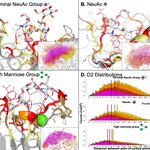
C-mannosylation of tryptophans is critical for receptor function and trafficking in metazoans, viruses, and malaria parasites. I am thrilled to finally present the structural basis of this mechanistic puzzle! Thank you @ethangbaus, Kosslab, @reymondgroup!
nature.com/articles/s41589-0…

Daniel Mattox retweeted

A pleasure and a privilege to be assessor again at #CASP15. A mix of spectacular success and the occasional intriguing failure. Looking forward to hearing from the predictors and discussing future directions. Thanks @AJSimpkin @rmk_ccp4 @shah_comp526 @DavidLMurphy3 Filo and Luc.


Daniel Mattox retweeted

Our preprint on OpenFold, our trainable reproduction of AlphaFold2, is finally up (biorxiv.org/cgi/content/shor…)! Since we open-sourced parameters in June, we've trained the model to high accuracy more than 50 times, on a variety of datasets. Here's what we learned (a lot) -> (1/19)


Daniel Mattox retweeted

BREAKING NEWS:
The Royal Swedish Academy of Sciences has decided to award the 2022 #NobelPrize in Chemistry to Carolyn R. Bertozzi, Morten Meldal and K. Barry Sharpless “for the development of click chemistry and bioorthogonal chemistry.”


Daniel Mattox retweeted

Preprint from Philip Bradley where he creates a version of AlphaFold to model TCR:peptide-MHC interactions. Benchmark is far from perfect, but the paper shows that deep learning-based structural modelling is a possible strategy to predict TCR specificity.
doi.org/10.1101/2022.08.05.5…

Daniel Mattox retweeted

1/6 Can #AlphaFold learn from + & - labeled data to predict peptide binding better? w/ Phil Bradley @JustasDauparas @minkbaek @Mohamad_Abedi David Baker we present joint structure prediction-classification fine-tuning of #AF2 to classify pMHC binding.@UWproteindesign @fredhutch

Daniel Mattox retweeted

May 5 is a national day of awareness for missing and murdered Indigenous women. For more than a year, reporters across @usatoday network have worked together to examine factors contributing to the crisis and how laws have largely failed to address it.#MMIW usatoday.com/in-depth/news/2…

Daniel Mattox retweeted

Hi Joe President, I have a question

Today's decision reaffirmed that states can't put in place laws that unduly burden a woman's right to make her own health care decisions—but the fight isn't over. As President, I'll codify Roe v. Wade and protect a woman’s constitutional right to choose.
medium.com/@JoeBiden/my-stat…

Daniel Mattox retweeted

Studying protein without its glycans is like studying a bird without a single feather; even the best-designed and performed study will never see it flying… Our review on developments and perspectives in high-hhroughput glycomics just got published. academic.oup.com/glycob/adva…


Daniel Mattox retweeted

Episode 40 | Help Is On The Way Mr. President
#PensForBiden
Daniel Mattox retweeted
Have you ever heard of a mysterious region called "killer immunoglobulin-like receptor (KIR)", which is critical for innate #immunity?🧐We analyzed this complex region by deep target sequencing and devising a new #bioinformatics tool @CellGenomics !
cell.com/cell-genomics/fullt…

Daniel Mattox retweeted

When I visited 3rd and Pine I met an undocumented immigrant struggling to find employment, a woman who survived domestic violence, and a man who has spent half his life selling drugs and merchandise on the sidewalk. These are the people of 3rd and Pine.
thestranger.com/slog/2022/03…

Daniel Mattox retweeted

Q379
A genetic condition that affects about 1 in 50,000 infants is added to newborn screening. The assay for the condition has 99.9% sensitivity and 99.9% specificity. An infant has a positive result. Based on this, what is the (approximate) chance the child has the condition?
15%0.01%
40%2%
15%98%
30%99.9%
924 votes • Final results