

Diversity and Distributions is an open access, international, biodiversity journal devoted to the advancement of conservation biogeography
Joined July 2019
- Tweets990
- Following184
- Followers2.3K
- Likes184





Pinned Tweet
Diversity and Distributions #journal is now on #bluesky!
Go follow our new account for daily pieces of new #Research!
bsky.app/profile/consbiog.bs…

🌿 How can #SDMs help conserve rare #plant species? A review of 61 studies shows how models can locate populations, reveal habitat needs and guide surveys, while highlighting the need to match applications to different forms of rarity.
🔗 doi.org/10.1111/ddi.70275

🌋 Which non-native species could invade the Canary Islands next? A horizon scan of 823 species identifies 94 species as environmental and 49 as socioeconomic priorities for prevention, showing that invasion risk differ across impact types.
🔗 doi.org/10.1111/ddi.70248

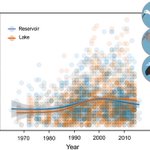
💧 Can reservoirs support #waterbird communities? A 20-year analysis across Spain finds higher functional diversity in #reservoirs than natural lakes, with piscivores and waders driving gains over time, highlighting their growing role in #conservation.
🔗 doi.org/10.1111/ddi.70267

🦀 New paper published! 🦀
“Global Patterns, Drivers and Conservation Gaps of Freshwater Crabs: From Species Richness to Phylogenetic Diversity”
doi.org/10.1111/ddi.70274

New paper published! 🗞️
🐺”Who's Afraid of the Big Bad Human? Multi-Scale Niche Partitioning Among Wolves And Mesocarnivores in a Human-Dominated Landscape”.
🔗 doi.org/10.1111/ddi.70257


🐦 Can protected area size buffer #climatechange impacts? In Finland, large PAs helped stabilise #bird populations, while small areas offered little protection against declines, highlighting the value of large reserves for #biodiversity conservation.
🔗 doi.org/10.1111/ddi.70240


🐧 Where will #penguins find suitable habitat in a warming world? Mapping priority areas for 12 species shows major shifts in suitable conditions and declining #MPA coverage, highlighting the need for climate-smart #conservation planning.
🔗 doi.org/10.1111/ddi.70233

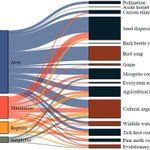
🌍 Which vertebrates sustain #NaturesContributionsToPeople across Europe? Mapping 860 species reveals that ≥25% of providers for every NCP are threatened, while agricultural intensification and direct exploitation erode provided #ecosystemservices
🔗 doi.org/10.1111/ddi.70210

🗞️New paper out!🗞️
Deciphering Darwin's Conundrum Through the Asteraeceae Family in an Oceanic Archipelago: A Phylogenomic-Functional Approach 🌼🧬
🔗 doi.org/10.1111/ddi.70232

🐺 What shapes wolf diversity across the Holarctic? Using 3D #morphometrics of 227 skulls, this study shows #wolf morphology reflects geography, prey availability and population history, while isolation and human impacts have driven distinctive forms.
🔗 doi.org/10.1111/ddi.70228

🔥 What are the hidden genetic impacts of #wildfires? A #macrogenetics framework across taxa shows the 2019–2020 Australian fires disproportionately burned areas rich in genetic diversity, revealing deeper biodiversity losses than previously recognised.
🔗 doi.org/10.1111/ddi.70208

🐢 How connected are #GreenTurtle populations worldwide? A global synthesis of 30 years of tracking data mapped sites and migratory links spanning >5000 km, revealing cross-border connectivity and the need for coordinated #conservation efforts.
🔗 doi.org/10.1111/ddi.70196

🌊 Can deep reefs rescue declining #kelp forests? Genetic analyses showed strong #connectivity between deep and shallow reefs in cool regions, but depth-specific adaptation at warm range edges may limit their role as #climaterefugia.
🔗 doi.org/10.1111/ddi.70178

🦭 Does environmental complexity shape behaviour? Across 5 sea lion species, environmental heterogeneity promoted greater #behaviouraldiversity, while low-productivity #habitats favoured specialist strategies.
🔗 doi.org/10.1111/ddi.70201


🦜 Can #SDMs and satellite #LiDAR improve conservation planning? In Peru, models for seven threatened species reveal key ecological corridors, gaps in protected-area coverage, and how GEDI data can support #connectivity and conservation.
🔗 doi.org/10.1111/ddi.70206


🔎 Can #citizenscience photos solve the identification gap?
Using trait-based analysis of >1000 storm petrels, this study distinguishes cryptic taxa and reveals unexpected movements, showing how public datasets can improve #speciesmonitoring.
🔗 doi.org/10.1111/ddi.70183

🌱 Do photosynthetic pathways shape invasion risk? In Hawaii, #C4 grasses show the greatest range expansion under #climatechange, especially at low elevations, while C3 groups decline or shift, highlighting pathway-based insights for #invasionscience.
🔗 doi.org/10.1111/ddi.70190

How well is freshwater #biodiversity represented in #ProtectedAreas? Employing species distribution modelling (#SDMs) and spatial prioritization analyses for 1313 fish species of Colombia, only 25,2% of suitable habitats overlap with existing PAs.
🔗 doi.org/10.1111/ddi.70168

🏔️ Are #ProtectedAreas effective in extreme #ecosystems? Across Tibet, stricter management and higher habitat heterogeneity boost mammal diversity, but medium-sized herbivores show high #defaunation, highlighting the need for tailored PA management.
🔗 doi.org/10.1111/ddi.70169

🗞️New data article out by @Martin_Ecology et al. presenting a set of new openly-available #EcologicalUnits (or zoning) layers for Europe at 100 m spatial grain for a 18 year time series.
doi.org/10.1111/ddi.70179
