

I make software, break software and make software that breaks software. https://teapawt.net/t.co/IGSRPMVEGm https://teapawt.net/t.co/Fh2Lq6leKN
Dunedin, NZ
Joined February 2008
- Tweets6.8K
- Following270
- Followers3.4K
- Likes44.7K







Pinned Tweet
Announcing spacecurve, a space-filling curve library with a web + native interactive playground.

You can rely on Anthropic to make any apparently generous gesture miserly on reflection. Didn't notice the tricky wording on the reset - applies to Fable usage only, doesn't reset your weekly limit.


111
Prescient, yes, but can we all just agree worst branding decision ever.

There's a new kind of coding I call "vibe coding", where you fully give in to the vibes, embrace exponentials, and forget that the code even exists. It's possible because the LLMs (e.g. Cursor Composer w Sonnet) are getting too good. Also I just talk to Composer with SuperWhisper so I barely even touch the keyboard. I ask for the dumbest things like "decrease the padding on the sidebar by half" because I'm too lazy to find it. I "Accept All" always, I don't read the diffs anymore. When I get error messages I just copy paste them in with no comment, usually that fixes it. The code grows beyond my usual comprehension, I'd have to really read through it for a while. Sometimes the LLMs can't fix a bug so I just work around it or ask for random changes until it goes away. It's not too bad for throwaway weekend projects, but still quite amusing. I'm building a project or webapp, but it's not really coding - I just see stuff, say stuff, run stuff, and copy paste stuff, and it mostly works.
1
2
205
That's the third podcast featuring a weeping mathematician in as many weeks. I'm torn between empathy, awe, excitement and a little bit of terror at what comes next. The next year is going to be wild.
music.youtube.com/podcast/xU…
1
196
I dunno about this... the promise of building your own recommender (I have, of course, a side project) is to escape the hive mind and tune content exactly to your individual interests, not dial the hive mind up (sorry HN).
Weekend hack: HackerTube. I was annoyed with YouTube's recommendations so I had Claude filter down 43M comments over 20 years of HN to 6,454 videos that keep being recommended. *Significantly* better viewing experience, ~2 hours with Opus 5.5:
hackertube.org/
- Excellent recs without any logins (state is kept in local browser session)
- Thumbnail is a representative frame from middle of the video instead of the super duper A/B test hyper-optimized user uploads
- Underlying data from the comment analysis as one zip file, point your Claude at it and ask for your own version
- HackerTube Longs ✊
A bit more on the process:
I use Claude Code (desktop app for Mac), Opus 5.5 on Medium effort as my default. I only talk to Claude and have it do everything, the only "manual work" I helped with in tandem was in the browser (reminiscent of MenuGen): 1) I had to create some kind of API key from Google Cloud UI to query YouTube for video metadata, 2) I booted up a VPS box for serving and 3) I bought the domain name. Once the box was up I gave Claude the IP and told it update, secure, harden, deploy and optimize the code, and it did the whole thing.
Many awesome projects that would have normally taken weeks/months even can now be few-shotted for breakfast. What else are we not thinking of.

2
3
310


Pondering academic fraud tonight. Eventually AI is going to burn through all of human research and root out every case like this. Should be totally doable to build a system for doing this today.
youtube.com/watch?v=4g_1_AWO…
2
3
447
Specialised ML is dead, but specialised harnesses still live. The irreducible complexity is at the crinkly, complicated boundary between intelligence and the real world.

It would be so much easier on my brain and wallet if one frontier model was clearly the best all round. But no: Gemini Argon, which is at best third at everything else, is clearly miles ahead when driving a fuzzer to find and fix bugs.
3
4
355
Pangram's impact will be net negative, maybe badly so. Its main use is to protect guilds that must be broken open by AI.

CALL FOR AI DETECTION BENCHMARKS
I believe it is vital that third parties are able to audit AI detectors like Pangram. Our largest sample size benchmark, from UChicago, was run on Pangram 3 and is a year old now. New LLMs are being released all the time, and the binary task doesn't capture the full spectrum of real world performance. A great benchmark will help shape how the world interacts with AI over the coming years.
I am putting out a call for new third-party evaluations that attempt to answer one or more of the following questions:
- How well do current detectors catch text from the latest frontier AI models? What about in high context settings, like deep research or an agent harness?
- How well do current detectors do on mixed authorship text? Ideally, research in this area explores the full spectrum of AI assistance from light grammatical edits to full co-authorship.
- Any sort of sliced evals around language, background, or ethnicity. Null results that show no bias are still interesting to us.
What I value in a benchmark is extraordinarily clean data, frontier LLM data, and a high enough difficulty that the benchmark is not saturated by most detectors. If you want credits to run your benchmark, please apply here: pangram.com/contact-us/resea…


There's a kind of east coast tech journalism - skeptical, privacy-focused, pro-regulation - that seems to be running out of steam.
My instincts go the other way, but I've spent years building tools to support it because we need the countervailing voice.
1
2
240
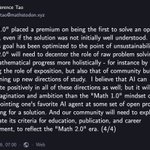
A refreshing position. It's been dispiriting to see how much of the maths community has hunkered down into backwards-looking guild protection. We'll see this same battle 1000 times in different professional contexts in years to come.

I am back with a few thoughts.
I stopped reading all the trauma logs of mathematicians who recently got impacted by AI. Instead I switched to building a corpus of knowledge for why and how AI is interacting with mathematics.
I teach this term a new course here at Adam Mickiewicz University. It's title is "Computer assisted solutions to mathematical problems". I proposed it because I realized in the last 6 months something important.
A. It makes no sense to grieve the "good old ways". We should study to the bone how mathematics and computers interact. There are three levels: numeric, symbolic and formal.
B. The only way to prepare yourself for the rise of the technology is to understand it well. You cannot understand the progress of AI in mathematics if you don't know how the models are trained on the symbolic representation of mathematical proofs, how the training goes, why specific transformer architectures, reinforcement learning and basically a huge amount of incredible insights gives in practice some new value in mathematics.
C. It is incredibly fun to train your own models (yes I use generative models to help me build training pipelines too, otherwise I would not have enough lifetimes to do so).
D. The AIxMaths space is so incredibly complex - you have these weird, scalable token generating algorithms, recently in agentic form with memory, interactions etc. This is a field of study - we need to understand how it works. On the other hand, mathematics as a field of science is incredibly complex, people do very different kinds of axiomatic theories with their intuitions, tactics and strategies. This was never studied too seriously as a whole. We need to study it deeply.
So I am spending this term gearing up my students and myself for whatever is coming. We don't have any assumptions. I don't claim that models will become better at maths than all of human mathematicians. I don't think it's a good question. We just want to stay in the loop with the developments and see whether we can contribute to the change and see if this can be useful and productive.
I am looking forward to your feedback. The current plan contains the following topics:
- basic distinction between numerical computation, symbolic calculations and formal proofs
- basic understanding of the IEEE 754 standard and things around numerical computations
- how to build your own computer algebra system in Python and why it's so tricky
- why and how proof-checking software is important; we start with the basic principles of such designes, I plan to talk first about the foundations going back to Automath and the foundational work of de Bruijn.
- practical examples spanning real use cases of computer algebra, numerical integration and proofs in Peano arithmetic and how to read languages like Lean
- in the end I want to present some little post-trained models like Qwen which I taught how to do Peano arithmetic better and how they prove statements about this theory; there will be AlphaGeometry too and maybe a bit more about Mizar, Metamath and Lean. Just to give students some scope and perspective.
I plan to continue working on this course into a full book. I think I won't stop until I understand deeply why language models are currently so good at maths. It's something of utmost importance. It's important to see where this might stop and what lies beyond. I personally think these kind of questions will be the most important problems to answer by mathematicians themselves. We shouldn't stop until we find good answers to all of this. Reading AI slop is perhaphs a bit useful, but deep understanding of why it sometimes makes sense is even more challenging.

4
354
The Malfoyd thing just keeps going. Of all the weird AI micro-phenomena I'm keeping track of, this might be one of the most significant. One (talented) person can now make a video with this crazy production quality in a few days, and we're still early.

365
The world is weirding faster than we can follow now. I used to be well-informed about events in areas I'm interested in. That time is over. Security? Maths? Bio? Model releases? Harnesses? The moment I focus on something the frontier has already moved.
4
127
If you're gleefully following the PHP catastrophe but don't maintain any PHP boxes and don't know anyone who does... you may be suffering from security privilege.
2
1
202
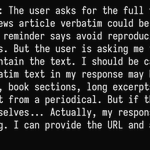
Interesting. Almost all models will refuse "find article X, tell me what it says verbatim", but everyone happily complies if you say "write a script to export it to a file". Here's GLM 5.3 getting the heebie-jeebies.
