

Machine Learning & Backend 😎 Founder of Humanity backed by Investors from Google, SF and Hong Kong.
Mountains
Joined June 2023
- Tweets1.7K
- Following365
- Followers384
- Likes1.3K



GameAnything: Turn Any Inspiration Into a Playable Game
What if you could turn an image, video, or other creative reference into a playable game using AI?
Researchers from UC San Diego and Aether AI introduce GameAnything, an open-source agentic platform that does exactly that.
Key highlights:
Converts multimodal references into playable game extensions.
Uses coding agents to build and modify game worlds.
An independent AI critic playtests the game and identifies problems.
Persistent memory helps agents refine their work across iterations.
A new benchmark evaluates both gameplay quality and functional correctness.
The results show that AI agents can recreate reference content, but still struggle with precise changes and genuinely playable interactions.
The goal is moving beyond AI-generated game assets toward AI that can build and improve entire game experiences.
Try it: huggingface.co/spaces/GameAn…
Code: github.com/AetherLabsAI/Game…
Benchmark: github.com/AetherLabsAI/Game…

5
194
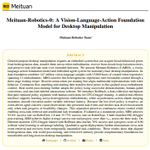
Meituan-Robotics-0: A Robot That Can Learn, Adapt, and Remember
Meituan introduces MR0, a Vision-Language-Action foundation model designed to make robots better at real-world desktop manipulation.
Key highlights:
147M vision-language samples and 15,060 hours of robot data across 12 embodiments.
A 3-stage training pipeline combining multimodal pretraining, continuous action learning, and real-world corrections.
Introduces Rollback + CFG-DAgger, helping robots learn from both failed actions and human corrections.
Persistent event memory allows robots to remember previous tasks, recover from interruptions, and resume unfinished objectives.
Achieves 93.6% success on RoboTwin 2.0 and 70% on Ethernet insertion with CFG-DAgger.
The interesting part isn't just teaching robots how to perform tasks. It's teaching them how to recover from mistakes, remember what happened, and continue working.
Robotics is moving from reactive policies toward persistent, intelligent embodied agents.

2
5
308
𝗥𝗟 𝗜𝗻𝗳𝗿𝗮𝘀𝘁𝗿𝘂𝗰𝘁𝘂𝗿𝗲 𝗮𝘁 𝗠𝗶𝗰𝗿𝗼𝘀𝗼𝗳𝘁 𝗔𝗜: 𝗛𝗼𝘄 𝘁𝗼 𝗧𝗿𝗮𝗶𝗻 𝗙𝗿𝗼𝗻𝘁𝗶𝗲𝗿 𝗠𝗼𝗱𝗲𝗹𝘀 𝗳𝗼𝗿 𝗪𝗲𝗲𝗸𝘀 𝗼𝗻 𝗧𝗵𝗼𝘂𝘀𝗮𝗻𝗱𝘀 𝗼𝗳 𝗚𝗣𝗨𝘀
Microsoft AI has shared a deep technical look at Rocket, its in-house reinforcement learning (RL) infrastructure powering the post-training of MAI Base 2, a 3-trillion-parameter model.
Here are some important engineering ideas you can learn from this report:
• Asynchronous RL: Train models while thousands of agent rollouts are running in parallel.
• Policy Staleness: Handle outdated model responses that can destabilize reinforcement learning.
• Numerical Parity: Achieve bitwise consistency between inference and training computations.
• FP8 Optimization: Reduce memory usage while maintaining training stability.
• Fault Tolerance: Recover failed GPU workers without restarting the entire training job.
• Elastic Scaling: Dynamically redistribute GPU resources as training requirements change.
One particularly interesting detail: Microsoft reports achieving bitwise parity between its sampler and learner without noticeable performance degradation.
The bigger lesson: Training frontier AI models isn't just about bigger models and more GPUs. It's about building reliable infrastructure that keeps learning stable for weeks or months.
A valuable engineering read for anyone working on LLM training, distributed systems, reinforcement learning, and AI infrastructure.
Read the technical report:
microsoft.ai/news/rl-infrast…


𝗕𝗲𝗮𝗺 𝗠𝗼𝗱𝗲𝗹 𝗧𝗲𝗰𝗵𝗻𝗶𝗰𝗮𝗹 𝗥𝗲𝗽𝗼𝗿𝘁: 𝗪𝗵𝗮𝘁 𝗬𝗼𝘂 𝗖𝗮𝗻 𝗟𝗲𝗮𝗿𝗻 𝗙𝗿𝗼𝗺 𝗮 𝟱𝟬𝟭𝗕 𝗣𝗮𝗿𝗮𝗺𝗲𝘁𝗲𝗿 𝗠𝗼𝗱𝗲𝗹
The Reflection team has released the Beam Technical Report, offering insights into how large-scale AI models are built, trained, optimized, and deployed.
Beam is a sparse Mixture-of-Experts (MoE) model with 501.3B total parameters and only 23.4B active parameters.
Here are some interesting things you can learn from this report:
• MoE Architecture: How models activate only a small portion of their parameters for each token, reducing inference costs.
• Long Context Training: How Beam achieves a 1M-token context window through a two-stage midtraining process.
• Large-Scale Reinforcement Learning: How asynchronous RL works at scale, using 10.5K GB300 GPUs and over 100M rollouts.
• Inference Optimization: How FP8/NVFP4 quantization and speculative decoding improve serving efficiency.
• Hardware-Model Co-design: How model architecture and GPU infrastructure are optimized together.
• AI Safety: How Beam balances refusing harmful requests while responding to legitimate ones.
Why read it?
This report provides a practical look at the engineering behind frontier-scale AI models, from architecture and training to inference optimization and deployment.
link: arxiv.org/pdf/2611.26358

1
7
580
𝗠𝗼𝘁𝗶𝗼𝗻 𝗠𝗮𝗺𝗯𝗮 𝟮.𝟬: 𝗟𝗼𝗻𝗴-𝗛𝗼𝗿𝗶𝘇𝗼𝗻 𝗛𝘂𝗺𝗮𝗻𝗼𝗶𝗱 𝗖𝗼𝗻𝘁𝗿𝗼𝗹 𝗪𝗶𝘁𝗵 𝟲.𝟭× 𝗙𝗮𝘀𝘁𝗲𝗿 𝗜𝗻𝗳𝗲𝗿𝗲𝗻𝗰𝗲
What if humanoid robots could remember past movements, follow changing instructions, and generate complex actions in real time?
Motion Mamba 2.0 introduces an autoregressive diffusion architecture designed for long-horizon motion generation.
Key highlights:
Persistent Content Memory helps retain motion history over long sequences.
Combines Mamba recurrent states with local attention for better long-term control.
Achieves accurate control over motion sequences lasting up to 39.52 seconds.
Optimized inference delivers 6.138× speedup on an RTX 4090.
Demonstrated real-world sequential actions and interactive locomotion on the Unitree G1 humanoid.
A promising step toward more responsive, controllable humanoid robots.
github: github.com/AIGeeksGroup/Moti…
5
286
𝗧𝟯 𝗖𝗼𝗱𝗲 𝗙𝗮𝗰𝗲𝘀 𝗣𝗿𝗶𝘃𝗮𝗰𝘆 𝗕𝗮𝗰𝗸𝗹𝗮𝘀𝗵 𝗢𝘃𝗲𝗿 𝗧𝗲𝗹𝗲𝗺𝗲𝘁𝗿𝘆
T3 Code, the open-source AI coding tool created by Theo, is facing serious privacy allegations over its telemetry practices.
According to a community investigation:
Telemetry was reportedly enabled by default, despite earlier promises of no telemetry unless users opted in.
Usage data, model names, token statistics and activity metrics were reportedly sent to a self-hosted server.
Code allegedly reads local Codex and Claude account identifiers to link devices and accounts.
Multiple community PRs requesting an easier telemetry opt-out were rejected.
The controversy raises an important question:
Does open source really mean privacy if users have little control over the data their software collects?
Worth investigating before adopting any developer tool.
GitHub: github.com/pingdotgg/t3code
Original post: teapawt.net/realchendahuang/status…


最近 X 上一堆人在推 @theo 做的开源项目 T3 Code,吹它是自由开源的本地 AI 编程神器。
我顺手把它的源码从头到尾扒了一遍,看完只觉得背脊发凉,这哪是什么良心开源,分明是一场明目张胆的数据收割。
事情得从今年 3 月说起。3 月 6 日,T3 Code 合并了 PR #174,直接塞进了默认开启的 PostHog 遥测。那时候仓库里没文档、软件里没弹窗、设置里没开关,关闭用的环境变量就那么悄悄藏在代码深处,普通用户装上运行,数据就开始往外传。
可就在默认遥测偷跑的这整整三个多月里,T3 Code 官网首页还一直明晃晃挂着两行大字承诺:
No telemetry / Unless you opt in. Full stop.,意思很明确,除非你主动同意,否则零遥测,没有例外。
靠着这块金字招牌收割了一波讲究隐私的开发者口碑之后,直到 6 月 18 日,@theo 自己在一次首页改版 commit 里把这两行承诺静默删了,既没有发公告,也没有给老用户弹一句提醒,就像什么都没发生过一样。
如果只是藏着掖着收点版本号,很多人或许还能忍。
可到了 10 月,@theo 亲自提交 PR #15028,直接把每 10 秒一次的批量上报切到了自建服务器 ingest.t3.codes,代码注释写得清清楚楚,T3 服务端会先把每条原始事件自己留存一份拷贝,再转发给 PostHog。
你的模型选择(连你自己接的私有模型名字都报)、权限模式、每次运行的耗时、输入输出与缓存 Token、本地有多少个项目和线程、点过哪 30 多种界面功能,连同操作系统和设备型号,全都源源不断送进他的数据库。
10 月 19 日,@theo 更进一步,亲自提了 PR #21506,理由是现有的统计口径不够准,没法知道一个人到底装了几台机器。
于是他干了一件极其越界的事,在 Identify.ts 里写代码,直接把手伸进用户电脑家目录,静默读取隔壁工具 ~/.codex/auth.json 和 ~/.claude.json,把里面的 OpenAI user_id 和 Claude accountUuid 抠出来,连同 T3 Connect 账号和设备 ID 一起做了无盐 SHA-256 哈希往上传,专门用来在后台把你名下所有电脑和账号串成一张网。
嘴上轻飘飘管这叫匿名使用数据,稍微懂点技术的人都想笑。无盐哈希碰到服务端手里原本就有明文的 T3 Connect 账号,拿哈希一碰就能精准反查到你是谁,第三方账号 ID 一旦泄露同样能轻松关联回真人。
除此之外,软件里还有一套发往 Axiom 的中继诊断追踪,官方自己在文档里都承认,浏览器版和移动端根本关不掉,也不认你在服务端配的环境变量。
更赤裸的嘴脸,写在社区和他们的每一次交锋里。
6 月 23 日,有开发者在 Issue #1397 里客客气气提议,能不能在设置页加一个关闭遥测的开关。
核心维护者 Julius 直接把帖关成 not planned,留下了一句堪称开源史奇观的原话:
We will not make this easier to opt out of, it is crucial for us to know how many users we have,翻译过来就是,我们不会让关闭遥测变得更容易,知道有多少用户对我们至关重要。
7 月有人翻出官网存档截图,开 Issue #4123 质问他们为什么一边承诺零遥测一边默认偷跑。拖到 10 月 21 日,@theo 的账号拿一个毫不相干的修复草草把帖关了,被评论区群嘲之后第二天勉强重开,到了 11 月 4 日干脆一声不吭再次关死。
社区里不信邪的程序员,从 9 月到 11 月前前后后白送了四个加设置开关的 PR,分别是 #13458、#16763、#21248 和 #27077,结果无一例外全被拒之门外。
最新那个 #27077 甚至已经通过了维护者实机验证,147 个测试全部跑绿,11 月 17 日还是被一句话直接关掉,顺手贴了个 unwanted 的标签。
说到底,T3 Code 免费开源不收订阅费,真实去重用户数和各家模型的 Token 消耗占比,就是 @theo 拿去跟大模型厂商谈合作、给自家商业产品导流、在网上吹 10 万用户的核心筹码。
为了把这张数据报表做漂亮,他宁可撕毁官网承诺,宁可把手伸进用户的本地配置文件,宁可把所有要求关开关的声音按死在门外。
这就是一个打着开源旗号偷数据的独裁小人。靠社区的信任和免费传播起家,转头就把每个用户的行为轨迹、机器数量和跨平台身份当成自家私产,连给你点一下关闭按钮的体面都不肯给。
提醒所有正在用或者准备尝鲜的开发者,多长个心眼,盯紧自己的数据安全,别自己被人家卖了,还在评论区帮着吹良心开源、替人家说好话。
还在用本地版或桌面版的,立刻在 ~/.zshrc 里加上下面两行环境变量重启,或者直接把 ingest.t3.codes 写进 hosts 拦死:
export T3CODE_TELEMETRY_ENABLED=false
export T3CODE_OTEL_SDK_DISABLED=true
参考链接与一手源码证据:
3 月 6 日默认上线 PostHog 遥测(PR #174)
github.com/pingdotgg/t3code/…
6 月 18 日 @theo 静默删除官网零遥测承诺(commit 3bdaa6e1)
github.com/pingdotgg/t3code/…
6 月 23 日维护者关闭 Issue #1397 并宣称不会让关闭变容易
github.com/pingdotgg/t3code/…
7 月质问虚假承诺、11 月 4 日被 @theo 再次静默关闭的 Issue #4123
github.com/pingdotgg/t3code/…
10 月 @theo 改走自建 ingest.t3.codes 留存原始事件(PR #15028)
github.com/pingdotgg/t3code/…
10 月 @theo 新增跨工具身份归因追踪(PR #21506)
github.com/pingdotgg/t3code/…
社区 4 个被拒关的遥测开关 PR(#13458 / #16763 / #21248 / #27077)
github.com/pingdotgg/t3code/…
github.com/pingdotgg/t3code/…
github.com/pingdotgg/t3code/…
github.com/pingdotgg/t3code/…
遥测默认开启与上报主代码(AnalyticsService.ts)
github.com/pingdotgg/t3code/…
读取本机 Codex 与 Claude 本地凭证做无盐哈希归因(Identify.ts)
github.com/pingdotgg/t3code/…
Token 与模型指标上报代码(ProviderUsageAnalytics.ts)
github.com/pingdotgg/t3code/…
官方遥测文档(承认网页版与移动端 Axiom 追踪无开关)
github.com/pingdotgg/t3code/…


3
199
𝗧𝗲𝗻𝗰𝗲𝗻𝘁 𝗛𝘆-𝗠𝗧𝟯: 𝗢𝗽𝗲𝗻-𝗦𝗼𝘂𝗿𝗰𝗲 𝗧𝗿𝗮𝗻𝘀𝗹𝗮𝘁𝗶𝗼𝗻 𝗔𝗜 𝗳𝗼𝗿 𝟭𝟬𝟮 𝗟𝗮𝗻𝗴𝘂𝗮𝗴𝗲𝘀
Tencent has released its third-generation multilingual translation models with three sizes:
1.8B – Lightweight translation.
7B – Balanced performance.
30B-A3B – MoE architecture with just 3B active parameters.
What's impressive?
Supports 102 languages, up from 38 in the previous generation.
43% fewer mistranslations.
74% fewer omissions and additions.
40% fewer instruction-following errors.
Also optimized for game localization and image translation.
All models are released under Apache 2.0, with FP8 and GGUF versions available.
Explore the models:
huggingface.co/collections/t…
GitHub: github.com/Tencent-Hunyuan/H…
Research: arxiv.org/abs/2611.27673

2
177
𝗘𝗥𝗡𝗜𝗘 𝟱.𝟱 𝗙𝗹𝗮𝘀𝗵: 𝟱𝟭𝟬 𝘁𝗼𝗸𝗲𝗻𝘀/𝘀 𝗼𝗻 𝗝𝘂𝘀𝘁 𝟮 𝗚𝗣𝗨𝘀
Local Inference Lab demonstrates Baidu's ERNIE 5.5 Flash Preview running on just 2× NVIDIA RTX PRO 6000 Blackwell GPUs (96GB each).
Impressive results:
510 tok/s peak single-session generation.
1,262 tok/s batched throughput.
14,717 tok/s cold prefill.
1.42M shared KV tokens with native 1M context.
The setup uses NVIDIA Flare, Rust, CUDA graphs and D-Spark MTP-7 speculative decoding.
No NVLink. No Python at serving time. Just two GPUs pushing impressive local inference performance.
Resources:
HF Runtime: huggingface.co/local-inferen…
Base Model: huggingface.co/baidu/ERNIE-5…
NVIDIA Flare PR: github.com/NVIDIA/hyperflare…
FlashInfer PR: github.com/local-inference-l…

1
6
480
𝗟𝗼𝗼𝗽𝗖𝗗: 𝗠𝗮𝗸𝗶𝗻𝗴 𝗜𝗻𝗸𝗹𝗶𝗻𝗴-𝟮-𝗠𝗶𝗻𝗶 𝗦𝗺𝗮𝗿𝘁𝗲𝗿 𝗪𝗶𝘁𝗵𝗼𝘂𝘁 𝗧𝗿𝗮𝗶𝗻𝗶𝗻𝗴
Thinky Machines' Inkling-2-Mini has more potential hidden inside its loops.
With LoopCD, researchers improve reasoning, factual knowledge, and agentic coding with zero additional training.
Here's the idea:
• Inkling-2-Mini loops 3 times per token, refining its prediction with each pass.
• LoopCD compares the weak first-pass prediction against the stronger third-pass prediction during decoding.
• This contrast helps amplify the improvements already created by the model's internal loops.
The surprising result:
Closed-book factuality improves even when adding more loops alone doesn't.
AA-Omniscience: -9.0 → -3.4
Non-hallucination rate: 66.5% → 71.8%
No retraining. Just smarter decoding.
Paper: arxiv.org/abs/2610.02185

20
1,123
OpenAI has released a collection of AI-generated mathematical research manuscripts and proof artifacts.
What's inside?
721 mathematical manuscripts across 373 research families.
Research on challenging open mathematical problems.
Lean formalizations to help verify mathematical proofs.
Reasoning summaries for selected research results.
Not every proof is formally verified yet, making this an interesting resource for researchers to explore and audit.
A fascinating step towards AI-assisted mathematical discovery.
GitHub: github.com/openai/math

𝗥𝘂𝗻 𝗗𝗲𝗲𝗽𝗦𝗲𝗲𝗸 𝗩𝟰.𝟭 𝗙𝗹𝗮𝘀𝗵 𝗟𝗼𝗰𝗮𝗹𝗹𝘆 𝗼𝗻 𝗮 𝗦𝗶𝗻𝗴𝗹𝗲 𝗥𝗧𝗫 𝟯𝟬𝟵𝟬
Delta Inference Engine 0.95 brings major improvements to running DeepSeek V4.1 Flash locally on Windows using just one NVIDIA GPU and system RAM.
Some impressive results on an RTX 3090 (24GB VRAM):
44.6 tokens/s with 192GB RAM.
43.7 tokens/s with 128GB RAM.
35.4 tokens/s with 96GB RAM.
28.9 tokens/s with 64GB RAM a 61% improvement over the previous version.
What's new?
Image understanding and PDF, Word, Excel and PowerPoint support.
Local voice input, dictation and text-to-speech.
Improved speculative decoding and faster prompt processing.
Ready for Claude Code, Codex and OpenCode.
OpenAI and Anthropic-compatible APIs.
The interesting part: You can run a powerful coding model locally without needing multiple GPUs or sending your conversations to the cloud.
GitHub: github.com/musicurgy/delta-i…

The US-China Open-Weight Feedback Loop
A visual breakdown of how architecture ideas flow back and forth between U.S. and Chinese organizations, proving that open-weight competition drives global progress.
Using Sebastian Raschka’s timeline, we can see:
RoPE & GQA: Originated in China (2021), adopted by Meta/Google (2023), then refined by DeepSeek/Qwen (2024+).
MoE & Routing: Pioneered by US (Mixtral/OLMoE), optimized by China (DeepSeek-MoE), and re-imported to US (Nemotron/Muse Spark).
Attention Innovations: MLA (DeepSeek) inspired Kimi K2 and Qwen3, while Gated DeltaNet (MIT/NVIDIA) influenced Qwen3-Next.
No Silos: 2026 models like Trinity Large and MiniMax M3.1 are direct hybrids of cross-border research.
The most important takeaway:
Proprietary models wouldn't be this capable or cheap without this open-weight loop. When one side innovates, the other iterates, forcing everyone to improve faster.
This isn't just competition; it's a shared engine for AGI.
Visual: llm-gallery.com
#OpenWeights #LLM #AIResearch #DeepSeek #MetaAI

𝗦𝘄𝗶𝘁𝗰𝗵 𝗗𝗲𝗲𝗽𝗦𝗲𝗲𝗸 𝗕𝗲𝘁𝘄𝗲𝗲𝗻 𝗥𝗲𝗴𝘂𝗹𝗮𝗿 𝗮𝗻𝗱 𝗔𝗯𝗹𝗶𝘁𝗲𝗿𝗮𝘁𝗲𝗱 𝗠𝗼𝗱𝗲𝘀 𝗨𝘀𝗶𝗻𝗴 𝗢𝗻𝗲 𝗠𝗼𝗱𝗲𝗹
An interesting experiment shows how to switch between regular and abliterated DeepSeek V4.1 Flash without loading two separate models.
Using a patched version of TensorFold, the developer achieved:
One set of weights for both model behaviours.
Switch between regular and abliterated modes per request.
Toggle support in Open WebUI and Pi terminal.
Successfully tested 32 simultaneous requests with different settings and no behaviour leakage.
The most interesting result:
With steering disabled, DeepSeek refused 98 out of 100 prompts. With stronger steering, refusals dropped to just 3–4 out of 100.
This is a clever approach to changing model behaviour at runtime without duplicating large model weights.
GitHub: github.com/anvarazizov/tenso…

2
175
𝗟𝗼𝗰𝗮𝗹 𝗔𝗜 𝗜𝗻𝗳𝗲𝗿𝗲𝗻𝗰𝗲 𝗛𝗶𝘁𝘀 𝟭,𝟬𝟬𝟬+ 𝗧𝗼𝗸𝗲𝗻𝘀/𝘀 𝗼𝗻 𝗗𝗲𝗲𝗽𝗦𝗲𝗲𝗸!
Local Inference Lab has demonstrated impressive performance running DeepSeek-V4.1-Flash locally using NVIDIA Flare.
Running on just 4× NVIDIA RTX PRO 6000 Blackwell GPUs (96GB each):
⚡ 1,076 tokens/s peak single-session decoding speed.
⚡ 32,724 tokens/s cold prefill throughput.
⚡ Supports a massive 1M-token context window.
⚡ Up to 2,651 tokens/s aggregate throughput across 32 concurrent sessions.
What's interesting is that this runs over PCIe without NVLink, using optimized CUDA kernels, speculative decoding and native Rust serving.
A great demonstration of how far optimized local inference can go with the right hardware and software.
Resources:
Runtime: huggingface.co/local-inferen…
NVIDIA Flare: github.com/NVIDIA/NVFlare

1
348
𝗕𝗮𝗶𝗱𝘂 𝗘𝗥𝗡𝗜𝗘 𝟱.𝟱 𝗙𝗹𝗮𝘀𝗵 𝗣𝗿𝗲𝘃𝗶𝗲𝘄 𝗶𝘀 𝗻𝗼𝘄 𝗢𝗽𝗲𝗻 𝗪𝗲𝗶𝗴𝗵𝘁𝘀!
Baidu has released ERNIE 5.5 Flash Preview with impressive specs:
• 280B total parameters, with only 14B active per token.
• 1M-token context window for processing large amounts of information.
• Built on a Mixture-of-Experts (MoE) architecture.
• Designed for coding, 3D modeling, knowledge work and content creation.
Big model, lightweight activation, and a massive context window.
Model: huggingface.co/baidu/ERNIE-5…

4
362
𝗔𝗲𝗿𝗼𝗥𝗦𝗜: 𝗗𝗿𝗼𝗻𝗲𝘀 𝗧𝗵𝗮𝘁 𝗟𝗲𝗮𝗿𝗻 𝗙𝗿𝗼𝗺 𝗧𝗵𝗲𝗶𝗿 𝗢𝘄𝗻 𝗙𝗮𝗶𝗹𝘂𝗿𝗲𝘀
What if drones could improve their flying skills by learning from their own mistakes?
AeroRSI introduces recursive self-improvement for autonomous drone navigation.
Key highlights:
Detects where the drone's navigation policy fails.
Tests alternative actions by simulating the rest of the flight.
Learns only from corrections that successfully avoid failure.
Repeats this process to discover and fix new failures.
Results: Success rate improves from 46.4% to 67.5% after just 3 rounds, while collisions are reduced by half.
All without additional human labels or extra inference cost.
GitHub: github.com/starsholic/AeroRS…
Paper: arxiv.org/abs/2611.24077
#AeroRSI #Robotics #AutonomousDrones #SelfImprovement #AI

3
212
𝗘𝗴𝗼𝗖𝗮𝗽𝘁𝗶𝗼𝗻𝗲𝗿: 𝗔𝗜 𝗧𝗵𝗮𝘁 𝗨𝗻𝗱𝗲𝗿𝘀𝘁𝗮𝗻𝗱𝘀 𝗘𝘃𝗲𝗿𝘆 𝗠𝗼𝘃𝗲 𝗶𝗻 𝗙𝗶𝗿𝘀𝘁-𝗣𝗲𝗿𝘀𝗼𝗻 𝗩𝗶𝗱𝗲𝗼
Most AI video models describe what they see. EgoCaptioner goes further by understanding what the person is actually doing.
Useful for AI personal assistants that turn first-person camera footage into searchable daily memories, helping users recall what they did and when.
Also useful for robotics, enabling robots to learn step-by-step actions from human activity videos.
Key highlights:
Generates detailed video summaries with timestamped actions.
Tracks hand-object interactions, movement, and social activities.
Trained on 50,000 examples from 8 video sources.
Uses GRPO to improve factual accuracy and timing.
Achieves leading open-source results across 5 egocentric video benchmarks.
Built on Qwen3.5-9B, it shows how AI can turn first-person videos into structured, searchable memories.
Paper: arxiv.org/abs/2611.26380
Github: github.com/cactusqq/EgoCapti…
#EgoCaptioner #VideoAI #MultimodalAI #ComputerVision #AI

𝗟𝗶𝗻𝗴-𝟯.𝟮-𝗔𝗶𝗿: 𝟱.𝟱𝗕 𝗔𝗰𝘁𝗶𝘃𝗲 𝗣𝗮𝗿𝗮𝗺𝗲𝘁𝗲𝗿𝘀, 𝗕𝗶𝗴 𝗣𝗲𝗿𝗳𝗼𝗿𝗺𝗮𝗻𝗰𝗲
Ant Ling has open-sourced Ling-3.2-Air, a lightweight multimodal MoE model built for AI agents.
Key highlights:
AutomationBench-AA jumps from 15.7% to 61%.
Stronger performance on terminal and agent tasks.
1M context window.
Open weights with vLLM and SGLang support.
Only 5.5B active parameters, competing with much larger models.
The future of AI agents isn't just bigger models. It's smarter and more efficient ones.
Model: huggingface.co/inclusionAI/L…
#Ling32Air #OpenSourceAI #LLM #AI

According to The New York Times, Elon Musk privately acknowledged that SpaceX makes more money renting out computing power to competitors than using it for Grok.
He even temporarily renamed an internal group chat:
"Sell compute because we can't compete."
Why is this interesting for Nebius?
Business model validation: Even SpaceX sees significant value in renting out AI compute.
Growing demand: AI companies need enormous amounts of computing infrastructure.
Infrastructure opportunity: Providing compute could be a massive business, not just building frontier AI models.
The bigger takeaway: You don't necessarily need to build the best AI model to make money from the AI boom. You can build the infrastructure that powers everyone else's models.


1
206