Blessed | Associate Professor | PhD | Univ Guelph, OAC Ridgetown Campus/Plant Ag | Cropping Systems | Farmer | Dad/G'Dad of 4/3 | [email protected]

Ridgetown, Ontario, Canada
Joined September 2010
Fungicide is often considered after hail injury to corn due to the plant health statements present on many fungicide labels coupled with the natural desire to take action following a hailstorm. An Overview of Hail Injury and Fungicide Use on Corn provides info to evaluate the potential benefits of fungicide application, and make the most profitable management decisions following hail injury in corn in upcoming growing seasons. Read more at cropprotectionnetwork.org/pu…. @MartinChilvers1 @AlbertTenuta @ISU_IPM @badgercropdoc @PurdueCorn @DaisyHAhumada @baldpathologist @MandyBish1 @travisfaske @NDSUExtension @cropdoc2 @UTcrops @PlantPathISU @ppp_trey @cropdoc08 #corn #fungicide
15
1
32
2,644
Dave Hooker retweeted
Would anyone in research have any leads on a used Lee Spider sprayer? USA friends? Cc: @Gur_sahib_singh
5
1
10
4,892
Dave Hooker retweeted
To whom it may concern: stop applying Jena experiment results to crop production. -Farmers use managed, intelligent species selection; mixtures must beat the best monocultures, not the average of all monocultures as ecology measures it. -Biodiversity benefits in ecological research take 3–5+ years to emerge in perennial systems; this tells us nothing about annual crops or cover crops. -Ecological research finds that biodiversity correlates with benefits, not what causes them, and without knowing the mechanism, farmers have no basis for action.
3
10
50
4,630
Dave Hooker retweeted
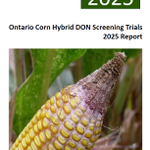
No one likes DON. The mycotoxin, that is. Hot off the press: the 2025 corn hybrid screening trial report. corn.gocrops.ca/ Use as one tool to manage the risk of DON mycotoxin in corn. Seed company volunteer entries. A collaborative effort that no one has ever seen. 😀 Download a pdf-or NEW this year-- sortable spreadsheets. Thank you to all sponsors: participating seed companies (@maizex, @CortevaCA, @DEKALB_Canada, @CROPLANseed, @NKSeedsCanada, @DeDellSeeds, @PRIDESeeds) @GrainFarmers @OMAFAinnovates @uofg Greenfield Ethanol @Ingredion @AlcoEnergyCA @OntarioPorkNews @ONAgBusAssoc @Seeds_Canada cc: @AlbertTenuta @Gur_sahib_singh @WheatPete
7
2
37
5,153
Proud of our MSc student #AidenDendooven presenting early results on revisiting Ontario P&K recs for corn & soybean at #CANVAS in SLC — @ASA_CSSA_SSSA. Thanks @GrainFarmers and @AgInnovationON for the support! 👉: scisoc.confex.com/scisoc/202…
1
1
19
1,077
FACT: The farmers who contact me most often make the most money. They aren’t wealthy because of what I am telling them. They have done well because they are constant learners and humble enough to get advice and feedback from others. AKA they are investing in themselves.
3
4
1
120
15,190
In farming, it’s easy to believe that more acres = more profit. “If I can spread my costs over more ground, I’ll make more money.” On paper, it makes sense. In reality, it’s a trap that has caught a lot of good operators off guard. 🧵
20
12
4
228
38,340
Excited to share I’ve completed my M.Sc. in Plant Ag at U of G in the NEO-Ag Group. After defending in January, I convocated in June. A huge thanks to @JoshNasielski and John Lauzon as well as committee member @cropdoc2 whose guidance shaped my time here.
5
2
1
40
2,693
Congratulations to Dr. Peter Sikkema on being named a 2025 Canadian Agriculture Hall of Fame inductee! 👏🌾 Nominated by Grain Farmers of Ontario, Dr. Sikkema is a world-class weed scientist whose work has transformed on-farm weed management across Ontario and beyond. His dedication to practical, research-based solutions has helped farmers reduce yield loss and improve profitability - a true champion of ag innovation. Dr. Sikkema joins fellow 2025 inductees: John Anderson, Dori Gingera-Beauchemin, Gaétan Desroches, Joe Hudson, and Dennis Laycraft.
4
15
2
85
4,703
Oh the difference a day makes! Heat & sunshine turned “yellow” corn into “green corn in 24 hrs. 📸 editing: @emily_marshy22
4
3
38
2,467
Cash crops, along with their well-managed residues, can match or even surpass the benefits of traditional cover crops. They effectively control erosion, scavenge nutrients, disrupt pest cycles, and enhance soil health. How? Biomass production. My latest: csanr.wsu.edu/cash-crops-and…
6
34
2
124
13,709
Cash crops, along with their well-managed residues, can match or even surpass the benefits of traditional cover crops. They effectively control erosion, scavenge nutrients, disrupt pest cycles, and enhance soil health. How do they do this? Biomass production. My latest: csanr.wsu.edu/cash-crops-and…
4
13
2
57
6,303
Strategies to quantify and reduce N2O emissions from crops focus on N fertilizer management. Here we show that ~40% of N2O emissions from the most extensive cropping system in North America (maize/soybean rot) occur during the unfertilized soybean phase rdcu.be/dY9Hf .
3
27
4
77
8,377
Honored to be invited to the @GrainFarmers semi-annual meeting and connect with Ontario producers and GFO staff. Grateful to be part of this hardworking community and excited to support producers through the @uofg research programs!
It was a full house today at the Grain Farmers of Ontario semi-annual meeting. Today’s agenda included: ✅ Workshop on storytelling with @VanceCrowe ✅ GFO Professorship in Field Crop Pathology with @Gur_sahib_singh ✅ Canadian political landscape overview with @brander and @LeeABoswell of Crestview ✅ Resolution session Thank you to all of our directors, delegates, and alternates who joined us today!
1
3
27
3,265
Innovation has to be proven; the new way should not be valued because it is novel, but because you have determined it is more valuable than the old.
3
2
38
2,990
Dr. Isabelle Aicklen joins OAC as the new Ontario Bean Growers Professor in Weed Management. Her research at Ridgetown will help Ontario’s bean growers tackle weed challenges while training the next generation of ag professionals. 🔗Learn more: uoguel.ph/82y28
2
19
1
46
4,248
Cover crop benefits are tied to cover crop biomass, but how much biomass do you need? Generally, more biomass is better, but thresholds differ for erosion control, soil benefits, and weed suppression. My latest... csanr.wsu.edu/cover-crop-ben…
10
16
3
104
28,353
My pleasure, always happy to chat about upcoming technology to these bright graduating students. It's great to have one of the best agriculture schools in Canada in our backyard.
1
1
711
I’m a scientist. Every time I hit "post," I hesitate. Not because I doubt the science. But because I know what’s coming. Outrage, accusations, and bad-faith attacks. People who don’t care about evidence will twist my words to fit their narrative. And sometimes, I think: Maybe I should just stay quiet. But silence is the enemy of progress. Fear is a powerful tool. It keeps people from speaking up. It allows misinformation to spread unchecked. But if we: → Stop explaining. → Stop correcting. → Stop pushing back. ↳ Who will fill that void? Not facts. Not reason. Not science. Right now, the loudest voices shape public perception. Not the best data. Not the most rigorous evidence. And that has real-world consequences. → It affects public policy. → It influences funding. → It determines what technologies we embrace or reject. The solution is clear:- 1. Scientists must step forward—even when it’s uncomfortable. 2. We need to challenge false narratives with facts, not fear. 3. Public discourse should be driven by evidence, not outrage. The world we want won’t be shaped by silence. It will be shaped by those willing to stand up for the evidence, no matter how loud the opposition gets.
59
116
14
711
30,750
Highlights of recent paper: 1. Compost (here) and manure benefit soils. How many times do we need to show this? 2. Soil health matters, but is not a major yield factor. Organic farming often shows better soil health but lower yields, -21% here. onlinelibrary.wiley.com/doi/…
9
21
1
76
8,147