

#blockchain explorer 🛸 🔗⬛🔗⬛🔗⬛🔗🟨 Hopin' in the cryptosphere via @mtpelerin $MPS Ucopist 🧬 $UCO @archethic 👾
- Tweets1.9K
- Following681
- Followers104
- Likes3.8K










ALT Ice cream on https://dpix.app/ 😆


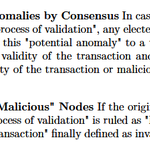
ALT Principle 9. Management of Anomalies by Consensus In case of inconsistency or disagreement on the validity of a "transaction in the process of validation", any elected node associated with the validation or storage process may then submit this "potential anomaly" to a validation pool (via a public election process) which must decide on the validity of the transaction and, if applicable, on the origin of the anomaly (network problem, ambiguity of the transaction or maliciousness characterized). Principle 10. Management of "Malicious" Nodes If the origin of the anomaly associated with the invalidity of a "transaction in the process of validation" is ruled as "Malicious", then the nodes associated with the validation of a "validated transaction" finally defined as invalid will be banned from the network

