

We combine public opinion research and rigorous policy analysis to help shape a new, progressive economic vision for a world fundamentally transformed by AI.
Joined May 2026
- Tweets45
- Following260
- Followers244
- Likes64




Pinned Tweet
Americans don't trust that the benefits of AI will be distributed. That's not a communications issue. It is a substantive issue.
Americans hear tech optimists talk about utopia, but all Americans know is a country in which the super wealthy rig the system. A country that cuts the social safety net to cut taxes for the wealthy.
One way for tech optimists to start earning some trust from Americans would be for those optimists to push -- in a real way -- for strengthening the U.S. social safety net.

Center for Shared AI Prosperity retweeted

Great discussion!

Jamie Keene and David Shor joined Politico's Decoded Podcast for today to discuss new polling and analysis from @csaiporg on a potential AI bubble and how voters feel about the risks/solutions.
Listen: politico.com/podcasts/the-de…
Read Jamie's write-up: blog.csaip.org/p/brakes-not-…
Our own advisor @davidshor and fellow Jamie Keene joined @politico's Decoded podcast this morning to talk about our newest polling on the AI bubble and how Americans feel about the solutions — and the risks. Take a listen 🎧: open.spotify.com/episode/5YJ…

And don't forget to read our write-up on the polling — Americans want brakes, not bailouts: blog.csaip.org/p/brakes-not-…

Center for Shared AI Prosperity retweeted

Excited to join the stunning group at @csaiporg and work on one of the biggest— and perhaps one day the biggest!—economic policy challenges of our time.

Big news from our team today 📣 We’re proud to welcome some of America’s best thinkers on economic equality and the impact of AI on our economy. Let’s get to work.
Roy Austin
@TomDavidsonX
@Brendan_Duke
@IndivarD
Robert Greenstein
@KarenKornbluh
@rdnayak
@JessicaBRiedl

Center for Shared AI Prosperity retweeted
Americans don't trust that the benefits of AI will be distributed. That's not a communications issue. It is a substantive issue.
Americans hear tech optimists talk about utopia, but all Americans know is a country in which the super wealthy rig the system. A country that cuts the social safety net to cut taxes for the wealthy.
One way for tech optimists to start earning some trust from Americans would be for those optimists to push -- in a real way -- for strengthening the U.S. social safety net.
Received some constructive criticism regarding my potentially incorrect usage of "the ick." Claude says I'm in the clear!


If this AI video gave you the ick, you are not alone!
Our polling shows that 65% of Americans feel negatively about AI that can hold a live video call with a face and voice that look and sound so human that about half of the people who talked to it for one minute believed they were on a call with a real person.

Center for Shared AI Prosperity retweeted
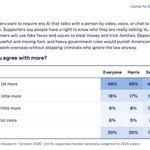
Americans seem eager for the government to require any AI that talks with a person by video, voice, or chat to clearly say it is not human.

If this AI video gave you the ick, you are not alone!
Our polling shows that 65% of Americans feel negatively about AI that can hold a live video call with a face and voice that look and sound so human that about half of the people who talked to it for one minute believed they were on a call with a real person.

Introducing Griffin, the first model to pass the video Turing test.
48% of people who talked to it live thought it was a real human. Previous systems have had a pass rate <3%. It is #1 on NVIDIA's benchmark for full-duplex AI video.
It’s the first Human Interaction Model (HIM).
Readers added context they thought people might want to know
The 48% figure and "video Turing test" claim are from Tavus's own study of 54 one-minute calls, not independently verified or using a standard protocol. Griffin-Lite leads NVIDIA's VideoFDB benchmark on their public leaderboard.
cellcog.ai/blog/tavus-gri…
research.nvidia.com/labs/amri/proj…
tech-ish.com/2026/10/02/tav…
Center for Shared AI Prosperity retweeted
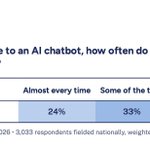
Most Americans are "please and thank you" AI users.
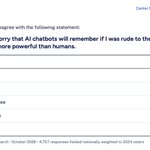
Some of them are worried about AI remembering if they were rude. Some of them worry that if they treat AI poorly, they will build bad habits that spill over to how they treat humans. Others think manners don't require a justification.

To understand how Americans think about AI's consciousness, we tried to get a sense of whether people think their treatment of AI is something AI could remember (and potentially act on later). The results:

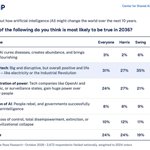
Great gut check! What do Americans not at The Curve think?
We polled them. The results:
Americans think it most likely than in 10 years AI is normal tech.
They think utopia is least likely.
39% of respondents think that in 2036, AI will have made life worse for people like them. 27% better. 34% not sure.
Do you find anything about these results surprising?


Center for Shared AI Prosperity retweeted
The development of AI-powered weapons systems makes Americans feel less safe. 2/3

Center for Shared AI Prosperity retweeted
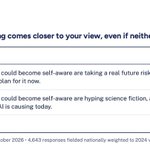
Americans told us they think experts who warn that AI could become self-aware are taking a real future risk seriously, and we should plan for it now. 2/3

Center for Shared AI Prosperity retweeted
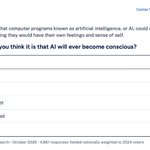
Of course, a limiting factor on this poll is that different people may define "conscious" differently.
So, we asked a more concrete question that gets to perhaps one element of conscious: are you worried AI will remember if you are mean to it?
The results:

44% of Americans we polled said that AI definitely or probably will become conscious.
(More poll results in the next tweets!)

Americans told us they think experts who warn that AI could become self-aware are taking a real future risk seriously, and we should plan for it now. 2/3