

Curious lurker
San Francisco, CA
Joined June 2023
- Tweets664
- Following555
- Followers1.7K
- Likes1.2K




Ani retweeted

Three main ways to do FP8 in LLM pretraining — and they differ in mainly one thing: how the scale is attached.
per-tensor vs blockwise vs MXFP8.
Why pretraining has so much structure here: forward + backward is 3 matmuls (Fprop, Dgrad, Wgrad) across 3 tensor roles (weights, activations, gradients). Each role wants its own scale layout — and that's where all the complexity lives.
The three recipes differ in how the scale is attached — granularity, dtype, layout:
— Per-tensor: one scale for the whole tensor. Simplest, least robust to outliers.
— Blockwise: 1×128 / 128×128 tiles, FP32 scales. The DeepSeek-V3 style.
— MXFP8: 1×32 blocks + E8M0 scale. Native on Blackwell.
One rule ties it all together: the scale must stay constant along the matmul's contracted dimension. That single constraint derives every tile geometry above — nothing here is arbitrary.
I drew every layout out, per recipe and per matmul, so the geometry is concrete instead of hand-wavy.
Full walkthrough in my blogpost (link in comments)!


Chinese contribution to open-source and open-science is unparalleled. I don't think we thank them enough!

We’re open-sourcing Unlimited OCR — built to read long documents in one pass.
With 3B total parameters and only 500M activated, Unlimited OCR sets new end-to-end SOTA results on OmniDocBench v1.5 and v1.6.
The key innovation is Reference Sliding Window Attention (R-SWA), inspired by how humans transcribe books: keeping the source, recent context, and next words in focus, while softly forgetting what’s no longer needed.
With constant KV Cache size and lower attention cost, Unlimited OCR can transcribe 40+ pages in a single forward pass — without losing context or slowing down.
Explore the model👇:
--GitHub: github.com/baidu/Unlimited-O…
--Hugging Face: huggingface.co/baidu/Unlimit…

1
135
I have learned so much from @JayAlammar from his posts and mainly from his youtube videos. I have no doubt that this course will be of the highest quality.
I still remember going over his "The Narrated Transformer Language Model" almost 5years back, this was one of the earliest videos on this topic that clicked for me. Ofcourse I had still not grasped how important Transformers were going to be in the long run.
I encourage you to check out his work. I can't wait to go through this particular course.

We're ecstatic to bring you "How Transformer LLMs Work" -- a free course with ~90 minutes of video, code, and crisp visuals and animations that explain the modern Transformer architecture, tokenizers, embeddings, and mixture-of-expert models.
@MaartenGr and I have developed a lot of the visual language over the last several years (tens of thousands of iterations for hundreds of figures) for the book. But to have an opportunity to collaborate with the legendary @AndrewYNg, we took them to the next level with animations and a concise narrative meant to enable technical learners to pick up an ML paper and understand the architecture description.
Link in comments
1
184
Incase you missed these hidden gems in the blog. This is the notes for Maths and LLM that she used to revise which ultimately led to 6 offers for AI research including OpenAI.
Insane high alpha material.


I'm joining OpenAI next week!🥹 The job search turned out to be really challenging but also super rewarding, so I wrote a small blog to share what I learned along the way and hopefully make the process a little less mysterious for the next person. alisawuffles.github.io/blog/…
I like the concept of this repo. The idea is if you ever have used claude code or codex or cursor or any AI generated code for that matter you might have noticed how they have a habit of over-engineering.
Writing 100 lines of code when just 10lines could have done the job. This has been a point of frustrated for me and this plugin tries fix this.
It promises 80-94% less code. 47-77% cheaper. 3-6x faster.
Although a lot of this can be achieved if you have nuanced claude.md or agents.md but this is a useful plugin to have in your arsenal nonetheless.

1
1
147

There are just so much high quality free content out there on LLMs and their internals. While thats great it also is very overwhelming to decide what and more importantly in what order you want to consume the content.
Here is what I recommend as the shortest path to feeling confident about LLM internals and start contributing to research or doing cutting edge work. Start with UW–Madison's 𝐂𝐒639: 𝐈𝐧𝐭𝐫𝐨𝐝𝐮𝐜𝐭𝐢𝐨𝐧 𝐭𝐨 𝐅𝐨𝐮𝐧𝐝𝐚𝐭𝐢𝐨𝐧 𝐌𝐨𝐝𝐞𝐥𝐬 course. It walks the actual stack: transformers → multimodal → fine-tuning/LoRA → RLHF/DPO → reasoning (RLVR, DeepSeek-R1) → scaling laws → agents.
I love the sequencing.
Pair it with 𝐌𝐈𝐓 6.824 𝐟𝐨𝐫 𝐝𝐢𝐬𝐭𝐫𝐢𝐛𝐮𝐭𝐞𝐝 𝐬𝐲𝐬𝐭𝐞𝐦𝐬 and you've got the two halves most people skip: how the models work and how you actually run them at scale.
Just 2 courses and you will feel much more confident and you should be able to read any paper you want.
Both are free and opensource btw.
1
1
235
Did you know YCombinator has a paper club playlist on their youtube channel. I have been listening to the talks and they are very interesting. I like the format as well in which they conduct the talks where they invite people(mainly PHDs) to talk about a research statement that interests them.
You can find so many research ideas and interesting problem statements just by listening to the talks here and they are super relevant even if you work on applied AI systems.


Ani retweeted

everyone who attended the YC startup school event yesterday gets $1000 in free credits from sarvam as well
go build something cool

Highest quality content on post training and RLHF by @natolambert. I have read his book and now looking forward to binge watching the video lectures.


Excited to launch the accompanying free RLHF Course for my book. To kick it off, I've released:
- Welcome video
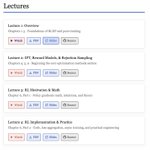
- Lecture 1: Overview of RLHF & Post-training
- Lecture 2: IFT, Reward Models, Rejection Sampling
- Lecture 3: RL Math
- Lecture 4: RL Implementation
I'm going to add question & answer videos throughout the lecture to go deeper on topics that need it, and potentially cover some topics that are too recent and in flux to go in print. I expect 10-15 videos in total over the next few months.
At the same time, development around the code for the book is picking up. It's a great time to build the foundation for post-training methods.
YT playlist and course landing page below.

3
137
Ani retweeted

My "Roman Empire is the realization that my life is a lottery win. Somewhere in Sudan, Pålestine, iran, Afghanistan, Iraq or Congo, there is a boy smarter than me. He is more disciplined, more resilient, and holds more potential in his single finger than I do in my entire career.
The only difference? I am siting in a train and he is sting in the rubble of his dreams.
My "bad days" are his wildest dreams.
My "burnout" is a luxury he can't afford because his only job is staying alive.
It's geographical luck and it's a haunting injustice that we all refuse to acknowledge and look away
This Post is from a suspended account. Learn more
Just realised that the people behind Mercury 2 are all professors from Stanford, UCLA, Cornell and they have a course on deep generative models.
Learning from people who have actually shipped cutting edge foundational model is something else. The projects are especially worth checking out.


Mercury 2 is live.
The world's first reasoning diffusion LLM – 5x faster than leading speed-optimized autoregressive models.
Built for production: multi-step agents without delays, voice AI with tight latency budgets, instant coding feedback.
Diffusion-based generation enables parallel refinement, not sequential tokens. Faster. More controllable. Dramatically lower inference cost.
Available today on the Inception API.
@dinabass has the story in @business.

2
4
297
The scope and need of an AI infra guy is at its peak. If you speak to any reputed recruiter, they are gonna tell you the same thing.
Demand for someone good at infra is insane.
Looking at the contents and the team that came up with the book, this can be the ultimate inference guide.
They don't even gatekeep it by asking for a work email. If you give your personal email and get the book.
Just get this, load the epub and read it, future you will thank you.


11
765
Randomly came across this video.
Spent 3 hours watching it.
Worth every bit of it.
We need to see more of these kinds of scaling ,monitoring ,network and debugging high stakes 1 million request/sec kinda videos.

2
145

Has anyone seen this interview? Its very interesting how both Amodei and Demis seems to agree that they would want AGI to have a 5-10 year timeline instead of 1-2 year so that they can have time to digest and think about potential risks and mitigations strategies of a world post AGI . They mentioned how that’s not possible because of geopolitical adversaries ( China in this case) building at similar speed and how difficult it might be to adhere to a global agreement of taking things slow.
Both agreed that we will probably be on uncharted territory and not enough thought is being put into how if it will effect major issues like labour displacement for example.

1
80