

Professor of Corporate Finance at the University of Antwerp. Curious about entrepreneurial finance and financial history. & everything else.
Joined March 2016
- Tweets1.9K
- Following301
- Followers875
- Likes13.8K




Marc Deloof retweeted

Norway's controversial 2021–2024 reforms nearly doubled the tax on business wealth. Firms of affected owners did not invest less, and outmigration was limited to the very top, from @Mariusring nber.org/papers/w35854

Marc Deloof retweeted
Who profited from colonial entrepreneurship? In a new paper, I investigate this question for one of the worst colonial regimes in history: King Leopold II’s Congo Free State. Paper available at ssrn.com/abstract=7409898

Who profited from colonial entrepreneurship? In a new paper, I investigate this question for one of the worst colonial regimes in history: King Leopold II’s Congo Free State. Paper available at ssrn.com/abstract=7409898

Marc Deloof retweeted
Who invested in King Leopold’s Congo Free State? The Compagnie pour le Commerce et l’Industrie, the first & most successful business investor in the CFS, had a remarkably diversified investor base even BEFORE listing in 1891, with no shareholder holding more than 3% of equity. …

Who invested in King Leopold’s Congo Free State? The Compagnie pour le Commerce et l’Industrie, the first & most successful business investor in the CFS, had a remarkably diversified investor base even BEFORE listing in 1891, with no shareholder holding more than 3% of equity. …
… Most investors were Belgian individuals, with a majority living in Brussels or Antwerp. (Very) limited investments of banks. Occupation of individual investors is quite diverse, with 8 investors reporting a position at the @NBB_BNB_NL, including its governor. …

Marc Deloof retweeted

I was in Ghent last month. The place was obviously very rich once, and I wanted to know what happened to it. It turns out Ghent lost its industry to what may be the oldest export restriction on record: an English one, from 1275. (1/12)
Similar in Belgium, where the separation of commercial and investment banking in the 1930s was initiated by the Société Générale’s governor Emile Francqui, who feared that commercial banking would be nationalized.

The irony of the post depression banking and securities regulation reform was that Wall Street invited it themselves, more than anyone else
Chase had already moved to separate their commercial and investment banks to change public image of the company
National City, one of the largest banks at the time and predecessor to Citi bank, also favored the exact same thing
A lot of people view the Glass Steagall act passed at the time as a decisive blow to Wall Street, when in reality, it was Wall Street who asked to be regulated


Marc Deloof retweeted

Belgium v Egypt is the World Cup’s only group-stage match where both present-day countries contain battlefields where Napoleon personally commanded an army.
Egypt had the Battle of the Pyramids. Belgium had Waterloo.
Stay tuned for more cutting-edge, geography-based World Cup analysis.


Marc Deloof retweeted
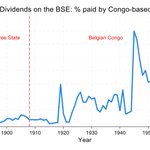
How dependent were Belgian investors on Belgian Congo? This chart shows the share of Brussels Stock Exchange dividends paid by Congo-based firms, 1890–1962. By the mid 20th century, colonial firms were paying 30-40% of all dividends on the BSE.

How dependent were Belgian investors on Belgian Congo? This chart shows the share of Brussels Stock Exchange dividends paid by Congo-based firms, 1890–1962. By the mid 20th century, colonial firms were paying 30-40% of all dividends on the BSE.
In praise of speculation, from Émile Zola’s Money (L’Argent). As someone researching 19th-century corporate finance, reading this amazing novel feels like watching my subject come alive.

Marc Deloof retweeted

Office inside the former Ministry for State Security (Stasi) Headquarters in East Berlin.

New article in @EcHistSocReview: I show that Belgian financial elites were far more involved in companies operating in King Leopold’s Congo Free State than in other Belgian firms, challenging the view that these elites had little interest in the Congo Free State.

Link to article: doi.org/10.1111/ehr.70111