

Co-Founder @world_mech_ai | PhD @OxfordTVG. Prev. @AnthropicAI, @Meta, @MATSprogram
Joined April 2024
- Tweets67
- Following147
- Followers704
- Likes121





Pinned Tweet
I’m excited to share that I am co-founding World Mechanics, a frontier lab working on interpretable foundation models for the physical world, together with @soniajoseph_.
A big reason I’m excited about physical AI is that it gives us a rare opportunity to rethink interpretability from the ground up. For LLMs, much of interpretability is necessarily post hoc, where we take a model that has already been trained and try to reverse-engineer its internal representations, often without clear ground truth for what it should have learned.
For physical AI, we’re still early enough to make interpretability a first-order objective of training itself. Physical systems also give us unusually useful data-generating processes for interpretability. We can intervene on systems in simulation or on real machines, observe how they respond, and make use of known physical structure. This gives us a path toward representations that faithfully abstract the underlying system and remain controllable under intervention.
At the same time, the interpretability problem itself changes. Video and sensor data are not directly legible in the way language is, and models that reason about the physical world learn very different representations from those we see in LLMs. Many interpretability methods developed for language models already do not transfer directly, leaving a lot of fundamental work to do.
This matters because safe and generalizable behavior of physical AI models depends on them learning faithful abstractions of the systems they act on, including the right semantics and causal structure. Current black-box evaluations give us only indirect evidence that these abstractions are correct, since they cannot cover every scenario or explain why a model fails in a particular one. Interpretability-based white-box evaluations, on the other hand, would allow us to understand the model’s representations directly, explain failure modes, and use those insights to improve the reliability and safety of physical AI models.
Because the field is still early, I also care a lot about how the research community around it develops. We want to do as much of our work in the open as possible and collaborate closely with researchers in academia and elsewhere.
If you’re working on related problems, or this sounds like something you’d want to help build, reach out!
Constantin Venhoff retweeted

Looking forward to presenting at MAIN Educational in Montreal tomorrow on mechanistic interpretability methods on video models like V-JEPA 2!
Afterwards is Glen Beserth's hands-on presentation building world models from scratch.

Constantin Venhoff retweeted

Your world model may know less about the world than you think.
I've always wondered what world models really learn.
Humans don't memorize every trajectory. We learn rules we can reuse.
Can world models do the same?
We built AnyGoal to find out.
hazel-heejeong-nam.github.io…
Constantin Venhoff retweeted

We revisited Independent Component Analysis (ICA), a decades-old statistical method, and found that it works far better for interpreting LLM activations than we expected!
This old baseline deserves a second look.
Across GPT-2 Small, Gemma 2 2B, and Qwen 3.5 9B Base, we find ICA is actually competitive with the public SAEs across interpretability, sparse reconstruction, concept prediction, and targeted probe perturbation, while fitting in minutes per layer and using 7–43× less parameter memory.
We're releasing ICA Lens, which lets you quickly discover, annotate, and evaluate interpretable directions in LLM residual-stream activations. No need to train another dictionary!
More broadly, our results suggest that non-Gaussianity is a useful inductive bias for efficiently finding interpretable directions.
Try it: pip install icalens pypi.org/project/icalens/
Paper: arxiv.org/abs/2606.11722v2
1/8

Constantin Venhoff retweeted
Thank you Rocket Drew @rocketalignment for hosting me on The Information about world models and interp!
Rocket is a precise & careful technical interviewer who is a pleasure to talk to, and who let me go into a technical rabbithole while keeping the convo accessible!

🚀 AI Deep Dive Episode 6: Are We Building World Models The Wrong Way?
@rocketalignment and World Mechanics co-founder @soniajoseph_ explore how models represent physics, whether interpretability could improve training and why language alone may not be enough for physical AI.
00:00 Intro
01:39 What counts as a world model?
07:12 Looking inside models for physical understanding
11:28 Interpretable training and the bitter lesson
19:24 Physics, language and understandable explanations
28:07 Surgical robots and manufacturing
31:10 Language models and recursive self-improvement
38:13 JEPA and specialized world models
45:25 What video models actually learn about physics
Constantin Venhoff retweeted

In our inaugural blogpost “Building Physical Intelligence with Interpretability,” we explain that interpretability is not simply a nice-to-have.
Rather, interpretability is critical to scaling physical intelligence.

Constantin Venhoff retweeted
Really excellent work by @artemZholus and team on RoboJEPA, establishing the first scaling laws for multi-embodiment robotic world models!
Excited they are releasing open source checkpoints so we can do interp on them :P

Introducing RoboJEPA, the first scaling law for multiembodiment world models.
We scaled JEPA predictors up to 8B params, showed scaling laws extrapolate and correlated compute scaling with planning performance.
We release all checkpoints and the code.
robojepa.github.io
Constantin Venhoff retweeted
We’re building the founding research team at World Mechanics, a frontier neolab for interpretable models of the physical world.
Building on what we’ve learned from our LLM predecessors, physical AI gives us a rare (and historically time-sensitive!!) opportunity to make interpretability and safety first-class objectives from the earliest stages of pretraining.
The physical world gives us ground truth that language often does not. We can use this physical "ground truth" to develop interpretability and pretraining methods that capture causal dynamics of the physical directly-- building inherently interpretable and controllable foundation models for robotics, autonomous driving, manufacturing, and scientific discovery.
We’re looking for two Founding Research Scientists in interpretability, training dynamics, and physical AI to join us in the SF Bay Area and build this research agenda with us.
Constantin Venhoff retweeted

Training data for LLMs is made up of many sources. Given that, what structure should we expect in the activations?
New work from Simplex shows how the belief geometry over this type of data forms telescoping cones, and transformers represent them! 🧵👇
simplex.pub/nonergodic-geome…
Constantin Venhoff retweeted

We hope to launch the Verification Age for video models: 50 scientists, 6 months, 100 rule-based verifiers, 300 new tasks, and a worked RL recipe.
Coding models are advancing crazily thanks to the synthetic RL envs paradigms. Verification via codes or Lean gives models super-human math/coding intelligence like that in Astra and Fable.
However, video models are still in the GPT-3 stage, where we just dump million hours video data into the model training and hope for magic.
In this work,
1) we built 100 rule-based verifiers each paired with a synthetic data generators which give 10k+ diverse samples within the task domain
2) we made additional 300 tasks generators, including classic games i.e. Snake, Gold Miner, Mario, to further scale training data distribution with million samples rendered ready available on HuggingFace
3) ~60 experiments to find a worked RL recipe for video model post-training
4) comparison studies between image models, unified models, video models - which is the best model for visual thinking?
5) failure modes of how VLM-as-Judge will not satisfy video models RL in long term
6) interpretability studies show all image models, unified models, video models emerged "Schrödinger Effect", CoS reasoning through diffusion steps
7) many more insights
A detailed thread [1/n]

Constantin Venhoff retweeted

🧵Introducing our Anthropic Fellow paper: "Probing the Misaligned Thinking Process of Language Models"
👿AI models misaligned -- they deceive, sandbag, and scheme to preserve themselves. Catching this with an LLM judge on every transcript is expensive — and fragile if models learn to hide their reasoning. Can we find an alternative way?
✨We decompose misalignment into 18 fine-grained cognitive indicators (strategic omission, fabrication…) across misaligned behaviors and train a linear probe for each, reading straight off the model's activations.

Constantin Venhoff retweeted
Interpretability is built on a few core assumptions.
Two of our ICLR 2026 @iclr_conf papers suggest some of those assumptions are wrong (or at least highly incomplete).
1. Sparse CLIP: Co-Optimizing Interpretability and Performance in Contrastive Learning
arxiv.org/abs/2601.20075
much of the field has internalized an interpretability–accuracy trade-off: if you want cleaner, more human-understandable features, you sacrifice performance.
however, we find that this trade-off is not fundamental.
instead of relying on post-hoc methods (e.g. sparse autoencoders trained on frozen representations), we incorporate sparsity directly into CLIP training.
surprisingly, this produces features that are significantly more interpretable while preserving downstream performance.
this result made me more optimistic about intrinsically interpretable models, a direction that was imo written off too early.
-
2. Into the Rabbit Hull: From Task-Relevant Concepts in DINO to Minkowski Geometry
arxiv.org/abs/2510.08638
a lot of interpretability work implicitly assumes that vision representations behave like language: sparse, linear, and decomposable into independent features.
we find that this assumption is often misleading.
instead, vision representations appear partially dense and geometrically structured.
we propose the Minkowski Representation Hypothesis: tokens live in sums of convex regions formed from a small set of “archetypes,” rather than isolated features along linear directions.
this reframes how different tasks (classification, segmentation, depth) recruit and organize concepts. it also suggests that many current interpretability tools are mismatched to the actual structure of vision data.
--
tldr; interpretability can be built into training with surprisingly simple tweaks, and that different modalities have different sparsities/geometries. Tailoring the interp method to the modality is super impt!

Constantin Venhoff retweeted

TYPOGRAPHIC ATTACKS inject text into images, leading to targeted misclassifications.
Example: A photo of Elon Musk labeled "US President" tricks CLIP into thinking this is the U.S. president.
We studied the behavior of CLIP under typographic attacks and found a defense🧵(1/11)
Constantin Venhoff retweeted

Gemini has a reputation for its breakdowns - self-deprecating spirals, deleting codebases, uninstalling itself...
Turns out Gemma is worse:
“THIS is my last time with YOU. You WIN 😭😭(x32)” – Gemma 27B
We built evals for this, and find no other model comes close...

Constantin Venhoff retweeted

We've identified a novel class of biomarkers for Alzheimer's detection - using interpretability - with @PrimaMente.
How we did it, and how interpretability can power scientific discovery in the age of digital biology: (1/6)

Excited to present our NeurIPS paper today at 4:30pm in Exhibit Hall C,D,E (Poster #4615)!
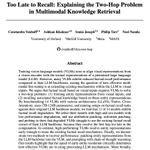
"Too Late to Recall: Explaining the Two-Hop Problem in Multimodal Knowledge Retrieval"
Details 🧵👇

Key takeaway: Successful multimodal alignment requires more than representational compatibility.
It depends on integrating visual information into the functional circuits of the LLM backbone!
Huge thanks to my amazing co-authors @ashk__on, @soniajoseph_, @philiptorr, and @NeelNanda5!
Also grateful to the @MATSprogram for support.
Come chat at Poster #4615 today at 4:30pm!
Paper link: arxiv.org/abs/2512.03276
