

PhD @wiscmedphys | ML/AI methods in medical imaging | https://xitter.cf/t.co/Dx51yxiLLO | he/him
WA
Joined January 2021
- Tweets23
- Following100
- Followers43
- Likes70

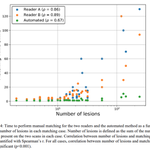



6/ The big win for automated 🤖matching is in time savings. Automated matching took up to 11 minutes (on a typical desktop workstation – no NASA supercomputer here!), while clinicians took up to 130 minutes (⌛️!!) for the highest burden cases.

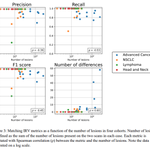
5/ Lesion matching is a harder task (for both 👩⚕️and 🤖) in subjects with higher disease burden. Here are IRV metrics as a function of lesion count – plots look similar if you compare automated to physician consensus.

4/ Automated matching met the benchmark of IRV in all study cohorts – meaning the variability between 🤖 and 👩⚕️ was similar to variability between 👨⚕️ and 👩⚕️

2/ Inter-reader variability (IRV) has been widely studied in image segmentation contexts, but another task clinicians 👩⚕️👨⚕️ perform is longitudinal comparison of multiple images to track lesions in time and determine change.
This task is critical in determining tx. response!
1/ Excited to share our latest paper! 🧵
Performance of an automated registration-based method for longitudinal lesion matching and comparison to inter-reader variability doi.org/10.1088/1361-6560/ac… via @ioppublishing

Daniel Huff retweeted

Learn about the future of oncology and therapy: ow.ly/5BcK50Mogfc
#MolecularImaging and #Theranostics = Precision Oncology
#Cancer #NuclearMedicine #JNuclMed

Daniel Huff retweeted

Join us next Monday at #RSNA22. AIQ's Eric Horler will give a presentation sponsored by @OneMedNet. We hope to see you there, and please contact us if you'd like to connect in Chicago.

Daniel Huff retweeted
Join us for our free, upcoming #webinar in partnership with @ConferenceForum. Register here to save your spot: theconferenceforum.org/confe… #ai #ImageAnalysis

This month has been pretty cool - I defended my PhD on imaging #immunotherapy response using #PET from @wiscmedphys, and am now starting as a research scientist at @aiq_solutions. Excited for new challenges! 😄

Daniel Huff retweeted

Are you a @UWMadGSEd student or @Badgerdocs / @UWPostdocOffice researcher interested in science careers? Join us at @DiscoveryBldg May 19 to chat with scientists who have careers in the communications space. Registration requested. warf.org/event/careers-and-b…
hey look its me😅

.@WARF_News's #patent filing is a way to monitor organ health during #cancer treatments.
➡️ Read more: bit.ly/3EByOQe
4/ Early detection+monitoring of toxicity is critical for keeping pts on #immunotherapy! Our work suggests #PETimaging can play a role here, but big limitation is when scans are acquired after tx start.
3/ Zooming out to all pts, things get messier - but general trend is elevated organ uptake at time of clinical toxicity dx (or sometimes before!).
Worth noting that organ PET quantification here is automatic thanks to #AI-based organ segmentation.

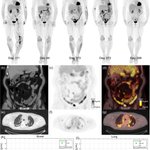
2/ In an example pt, elevated bowel uptake is seen on scan2 and scan3 before clinical colitis dx 3 wks later (b,c,d). Elevated lung uptake seen on scan4 at time of clinical pneumonitis dx (e,f,g).

1/ A belated xmas present - our latest article detecting #immunotherapy toxicity on FDG PET was published in #EJNMMI. Elevated uptake in thyroid, lung, and bowel can indicate toxicity in those organs!
Read the deets at: link.springer.com/article/10…

Daniel Huff retweeted

Check out our most recent paper towards a more quantitative understanding of treatment response for metastatic cancer patients.
Development and validation of a longitudinal soft-tissue metastatic lesion matching algorithm doi.org/10.1088/1361-6560/ac… via @IOPscience
