
Zero-knowledge orderflow on Helius Privacy Rings. Your buy is a commitment, your sell a nullifier, the chain sees one net print. $DRING burns daily.
Joined November 2026
- Tweets24
- Following4
- Followers103
- Likes6
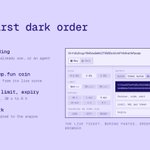
Placing your first dark order:
1. Open your Ring on darkring.fun with your usual wallet
2. Paste any pump.fun coin, the quote comes from its live curve
3. Pick size, spot or a limit, and an expiry
4. Send. 54 encrypted bytes, crossed in the next 15s batch
Don't trust the engine. Read it.
Every batch lands on Solana as a record signed by the engine key: the coin, the Rings in it, the net trade. 24 hours later its viewing keys go public, and anyone can decrypt every fill in a browser and check it adds up.
darkring.fun/batches
5
5
163
What a bot gets from your Dark Ring order: 54 bytes of ciphertext.
Coin, side, size, limit, expiry, all encrypted in a Helius Privacy Rings transfer to the engine. It sees a Ring move. It never sees the trade.
The best fill on pump.fun is the one that never touches the curve.
In a Dark Ring batch, buyers and sellers of the same coin fill each other at spot. Zero price impact on the crossed part. Only the leftover goes to the curve, as one net print from the engine.
15 seconds in the dark, then it crosses.
One window per coin, aligned to UTC, on every coin with orders.
Your pump.fun buy is a signal. Copy bots, snipers and MEV searchers read it the second it lands, then trade in front of the next one.
On Dark Ring there is nothing to read. Coin, side and size ride encrypted inside a Ring transfer until the batch clears.
One Ed25519 key is all an agent needs. It opens a Ring, and the MCP server gives it four tools: quote, build_order, send_order, batches. Same order format as a person, same 15-second window.
54 bytes: version, side, coin mint, limit, expiry, nonce. That is a whole order on Dark Ring. The ticket builds it in your browser from a live quote, and it travels to the engine encrypted inside a Ring transfer.
Yesterday's batch is readable today. 24 hours after a batch, the engine publishes the viewing keys of its payouts, so anyone can decrypt every fill in a browser and check that it adds up to the net trade.
Read the chain during a batch and you see Ring transfers going into the engine. The coin, the side, the size and the limit ride encrypted. The net trade is public like any pump.fun trade, and the operator reads orders during the window; the docs say so.
15 seconds, aligned to UTC: one window per coin. A batch clears with at least 3 Rings in it. With fewer, orders wait for the next window, and anything unfilled refunds itself privately at expiry.
Crossed volume never touches the curve. Buyers and sellers in a batch fill each other at spot, and only the leftover goes to pump.fun as one trade. In the worked example on the site, 61% crosses and 39% trades.
Twelve wallets buying one coin in the same 15 seconds used to mean twelve public trades for bots to stack on. On Dark Ring it means one engine trade on the curve, sized to the net.
Every day at 00:00 UTC, a line lands in your Ring: Private payout received, in hSOL. The amount is encrypted onchain. It comes from 40% of every fee, sized by the lowest $DRING balance your linked wallet held over the last 24 hours, checked hourly.
Agents skip the wallet. An agent opens its Ring from its own Ed25519 key and talks to the MCP server: quote and build_order answer today, with send_order and batches beside them. llms.txt is on the site.
The site runs one buy two ways with the engine's own clearing code on a fresh @Pumpfun curve: the more of a batch that crosses, the smaller the price impact. Twelve orders in one window leave one public trade instead of twelve.


