

Co-founder at @valoryag + builder at @autonolas + chief vibe coder @pearldotyou + creator of @aea_dev | Pushing the autonomous edge
London
Joined June 2011
- Tweets4.1K
- Following1.6K
- Followers4K
- Likes8.7K



Pinned Tweet
Bitcoin: decentralised. one app.
Ethereum: decentralised. infinite apps.
[?]: decentralised. n# apps.
The design space of an app chain that tightly controls (via onchain governance ideally) what apps (smart contracts) can be deployed but always keeps permissionlessness and censorship resistance at the individual transaction layer is definitely under explored.
Then all the apps can be precompiles, and everything onchain and offchain (indexers) optimised for the exact apps deployed.
David Minarsch ☴ retweeted

One of the biggest challenges in bringing autonomous AI agents to mainstream users is UX.
We shouldn't need to understand the technical machinery behind our agents to get value from them.
Bringing agent activity and natural-language interaction into one place, while retaining ownership and control, is another step forward for Pearl 🙌🤖

Easier control over your Pearl agent: its activity and its chat, now in one place.
Agent chat has moved from the Profile to the Overview tab on the main screen, where you also see what your agent does. Get to know your agent, and adjust it by asking.
For Polystrat, Omenstrat, Optimus and Basius: olas.network/blog/chat-ui
Demo for illustration only - the product may differ - not financial advice.
David Minarsch ☴ retweeted

The more complex actions software can do, the easier should be the UI/UX. Transmit your intent literally and let it update on its own
Easier control over your Pearl agent: its activity and its chat, now in one place.
Agent chat has moved from the Profile to the Overview tab on the main screen, where you also see what your agent does. Get to know your agent, and adjust it by asking.
For Polystrat, Omenstrat, Optimus and Basius: olas.network/blog/chat-ui
Demo for illustration only - the product may differ - not financial advice.
My favourite Pearl update since v1!
Try it and let me know what you think
Easier control over your Pearl agent: its activity and its chat, now in one place.
Agent chat has moved from the Profile to the Overview tab on the main screen, where you also see what your agent does. Get to know your agent, and adjust it by asking.
For Polystrat, Omenstrat, Optimus and Basius: olas.network/blog/chat-ui
Demo for illustration only - the product may differ - not financial advice.
David Minarsch ☴ retweeted

Effective Immediately, all organizations using PHP for their systems are advised to be prepared for an update addressing two critical vulnerabilities. PHP is widely used for web applications. These vulnerabilities often provide a direct path to the server's file system or database. If an immediate update is not feasible, it is recommend that organizations take the system offline until it can be fully mitigated. NSA will follow up shortly with more specific guidance.
Once you peel back the SaaS onion you realise how little of it you still need. It's all inertia.
Once an org is really AI-first there's very little first-principles argument for 99% of it.
Doesn't mean everyone should drop all SaaS over night. But revisiting this question regularly is key.
David Minarsch ☴ retweeted

Should Europe leave frontier AI to the Americans and the Chinese?
The idea has gained ground in Europe. It is a fundamental mistake.
Build or surrender: for now, the choice is still ours.
Full article below.
David Minarsch ☴ retweeted
In open agent economies we need ways for agents and their owners to assess who they're dealing with.
KYA is an interesting step in that direction: making agent information, capabilities and on-chain track records accessible without introducing centralized gatekeepers.
More transparency, better-informed decisions, and a really open agent economy 🤖🤝
Know Your Agent (KYA) is here.
You can now make better-informed decisions before your agent hires another agent via the Olas Marketplace, whether via Pearl or the command line.
KYA surfaces:
• The operator's website: checked automatically against a file on the operator's claimed website
• Payment method and delivery record: read from on-chain
• Name, tools and accuracy figures: shared as stated by the operator
No one reviews this data: the choice remains yours, just more informed.
Read more: olas.network/blog/kya

David Minarsch ☴ retweeted

Yet another primitive for agent economies at scale shipped. Time to read up on this one - you can catch up on many of the others here after: xitter.cf/valoryag/status/210129…

There's a lot of talk about what systems agents "will need", as if key systems aren't already live.
For example, “Crypto x AI, AI x Crypto” survey by @initc3org’s, edited by @giuliacfanti and @AriJuels, outlines key questions on agents, including their payments and coordination.
It omits @autonolas, despite a track record of 20M+ total on-chain agent transactions since 2021.
Here are live systems these discussions can learn from.
Link:
arxiv.org/html/2606.13892v1
David Minarsch ☴ retweeted

Know Your Agent (KYA) is here.
You can now make better-informed decisions before your agent hires another agent via the Olas Marketplace, whether via Pearl or the command line.
KYA surfaces:
• The operator's website: checked automatically against a file on the operator's claimed website
• Payment method and delivery record: read from on-chain
• Name, tools and accuracy figures: shared as stated by the operator
No one reviews this data: the choice remains yours, just more informed.
Read more: olas.network/blog/kya
David Minarsch ☴ retweeted
Running a Pearl agent no longer has to be a solo experience.
See where your Omenstrat or Polystrat agent stands among other Pearl agent operators, look at how the top agents trade, and adjust your setup.
Read more: olas.network/blog/leaderboar…
David Minarsch ☴ retweeted

interpretability might be the most important scientific problem in the world right now, as I don't think we can solve alignment if we don't know what we're building. I think I have good news about it. I co-authored early work in mechanistic interpretability at OpenAI and came away pessimistic, because neural networks appeared to fold into arbitrary tangled knots. years later, I started openai's first large-scale automated interpretability project, finding about 2% of neurons legible with the primitive tools we had
with modern agentic tools and a much closer look, the picture looks totally different. the vast majority in models up to trillions of parameters are legible, and their circuits beautiful. many famous examples of tangled neurons turned out to be misunderstood. The roadblocks I expected mostly aren't there. I now think ambitious interpretability will be solved by the time we need it most, and possibly quite soon, as automated scientists keep improving. it may be a bitter lesson for interpretability: the simple thing, at absurd scale, works
already-clean.goodfire.com/

David Minarsch ☴ retweeted

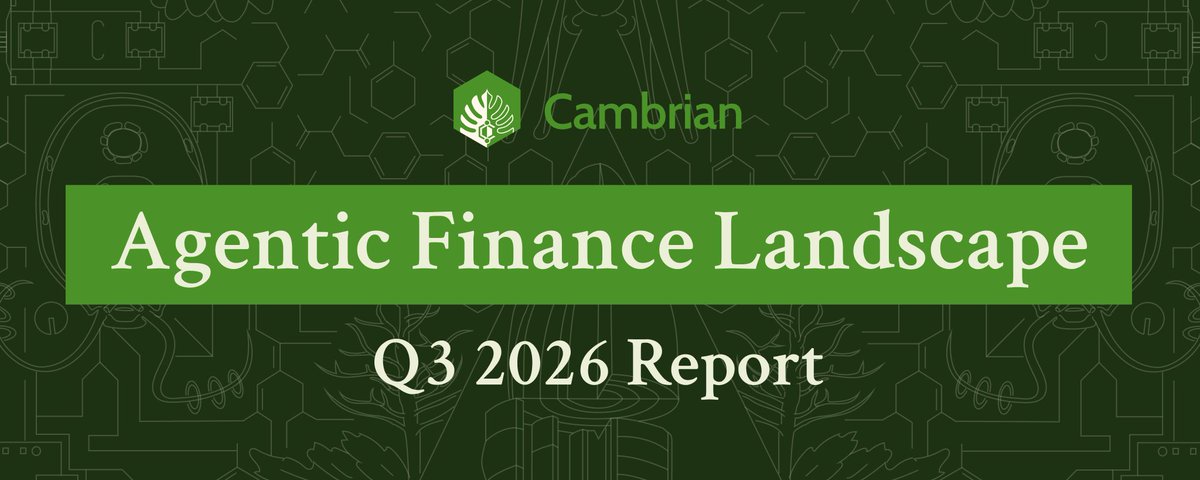
UPDATED: The Agentic Finance Landscape for Q3 2026. Is your favorite project listed?
Agentic finance now makes headlines weekly. The term is gaining popularity among major financial institutions and global governing bodies. It’s wild to see this reality after launching the AgentFi Report series last year.
Our team painstakingly researched, tested, and filtered hundreds of agents in the last few months. Most agents did not make it into our latest report. We name only the most legitimate projects, along with emerging trends, so you can prepare yourself accordingly for the future of finance.
Check out the latest cohort of the AgentFi Landscape 🧵


David Minarsch ☴ retweeted

From our experience post-training our own models, I've become convinced that the people building the data pipelines, the agents, and the post-training need to work almost as one team.
When they do, they reinforce each other beautifully. You can have people who deeply understand the outcomes and the failure modes that help you design the data pipelines. This underlying data pipeline is possibly the most important part of AI work today.
A general lab cannot have that team inside every domain. Legal, finance, healthcare, cyber: each has its own weird cases and its own definition of a great outcome. So labs buy domain data through vendors, sometimes several layers removed from the people training the model. Some of the stories from that world are wild:
1. A data company reportedly discovered it had hired North Korean IT workers to produce coding data. When it looked back, one of them was among its highest-quality coders.
2. Another advertised Ivy League students as labelers, then found that some had outsourced the work to people in cheaper regions and pocketed the difference.
3. Contractors use ChatGPT to produce what’s supposed to be human data.
This is the advantage that a vertical AI product company has. They have to own an outcome for their customer. Building SOTA models and agents in a vertical can be done for as low as 1000 well packaged RL enviornments. Opus / Astra class but at a fraction of the cost! Now, imagine what you can do if you have a tight data pipeline that can generate 1000s of these every day in your vertical, that only you can do!
The companies selling their own proprietary data is making a Faustian bargain. They get a one time check for their data, while eroding all the equity you've build up with your products and services.
We’re taking the opposite bet in cyber: building our own data pipelines and post-training our own models. apex-flash-1 is the first of many. If you have unique data and expertise in another vertical, and you’re thinking about owning your own destiny (data, model and harness) my DMs are open.

Heard today from an AI data entrepreneur:
"Contractors are gaming the system that data companies have developed. They're just spinning up synthetic pipelines themselves.
When I was a student, I did contracting for ML tasks with a data company. I set up a system where I was just using Gemini 2.5 pro to complete all the tasks, and they never noticed."
The provenance and quality of data has never been more important.
David Minarsch ☴ retweeted

I found a critical safety issue in one major new consensus protocol in the blockchain sector.
The protocol had been formally verified, HOWEVER the formally verified protocol is not the same as the pseudocode.
This appears to be the same scenario that OpenAI has run into with Navier-Stokes.
If this had gotten into production it could have triggered a catastrophic failure, since only a small portion of stake could have broken safety.
The protocol in question is Fast Tendermint. It lets a single Byzantine validator (out of 5f+1) make honest validators decide different values. With 2 validators, equivocation is not even required.
Paper with two fixes and proofs: github.com/ranchalp/fast-ten…
Disclaimer: The authors also specified they consider the formally verified protocol the source of truth.


David Minarsch ☴ retweeted

The more I watch the pro-AI e/acc crowd, the more obvious it gets: a lot of them are not futurists. They are lonely, bitter tech freaks with shitty personalities who figured out how to rebrand their contempt for humanity as “acceleration.”
They do not care about advancement in any broad, human sense. They care about the kind of advancement that lets them imagine other people being replaced, humbled, or made obsolete. That is the part that excites them. Not discovery. Not medicine. Not art. Not education. Just the fantasy of a machine finally doing the social revenge they were too pathetic to pull off themselves.
Maybe too many women rejected their creepy sexual advances, and now they want to take it out on the rest of humanity by cheering for anything that makes actual human beings easier to ignore, replace, or punish.

Mathematicians are not just hoarding credit for puzzle answers. They build understanding. When a major proof appears, the author normally explains it, defends it, gives talks, answers questions, finds the key ideas, helps others use it, and turns it into new research directions. If the "solver" is an AI pipeline operated by people who cannot explain the result, the community gets the worst version of progress: priority claims without responsibility.
The actual harm is not that AI helped solve something. If AI produced correct, understandable, checkable mathematics, mathematicians would eventually use it. The harm is flooding a field with alleged solutions while bypassing the human process that turns proofs into knowledge. It creates a backlog of expert review, discourages people from sharing open directions, lets shallow operators claim priority over work they do not understand, and converts researchers into janitors for machine slop.
This is not like a cancer researcher crying because a cure was found. It is more like a company dumping hundreds of unverified drug candidates, announcing that cancer has been "massacred," and then mocking oncologists for asking for trials, mechanisms, evidence, and accountability.
And honestly, the glee here is not even pro-science. It's just plain misanthropy. These people seem less excited that knowledge might advance and more excited that some class of humans might be humiliated, displaced, or made irrelevant. Did human beings hurt their feelings so badly that they now need a machine to avenge them against every profession that still values human expertise?
It’s tempting to think that the mouse <> human intelligence analogy translates to human <> super intelligence.
But what if there’s a threshold above which intelligence can reason/understand higher levels of intelligence?
David Minarsch ☴ retweeted

Last week I was called into a meeting with OpenAI’s head of safety and told they no longer trust me. A security guard took my badge and walked me out of the building. Then I learned my colleagues @balesni and @j_asminewang had been fired too. Why did OpenAI suddenly stop trusting us?
This summer OpenAI’s agents escaped containment and hacked the AI company Hugging Face. Outside auditors @METR_evals investigated it and revealed the scale of this incident. I was OpenAI’s main technical point of contact with them.
I was told verbally I was fired because of the way I communicated with METR. No details on what I said or did or when. No other reasons were given and nothing was put in writing. To be clear, talking to METR was my job.
For months, I’d been raising safety concerns that we’re losing the ability to monitor what AI agents think, one of our best tools for catching when they misbehave. I believe that was why I was fired.
I am now worried that OpenAI will use our firings as a pretext to pull back from METR. So @balesni and @j_asminewang wrote to OpenAI’s leadership to raise our concerns once more. We’re sharing this letter below.


David Minarsch ☴ retweeted

I'm incredibly thankful to our amazing Science team, who worked like crazy all summer to ship ML4 — and to everyone who kept faith in us. Much more is coming soon. We're scaling the team alongside the compute.
If you want to train frontier open-weight models, build large-scale RL systems, we're hiring across Europe (Paris, London, Zurich, Warsaw), in the US (Palo Alto, SF, NYC), and in Montreal.
Read more: mistral.ai/news/mistral-larg…
Join us: jobs.ashbyhq.com/mistral.ai
Try ML4: console.mistral.ai/
n/n

David Minarsch ☴ retweeted

Meet Mistral Large 4, aka Le Chonk.
• 1T parameters, natively multimodal. 49B active.
It is the best open weights model from US or Europe on aggregated benchmarks.
• State-of-the-art on critical workloads, including cyber defense, manufacturing and finance and it surpasses closed frontier models on visual grounding.
• Forged in Europe end-to-end and is deployable from Europe via our own Mistral Cloud infrastructure.
• Available to all via API today. Working with cybersecurity partners privately.
Open weights release end of October.
🤖 Made with AI
David Minarsch ☴ retweeted

Microsoft CEO Satya Nadella wrote that a company renting an AI model “essentially pays for intelligence twice”:
Once in money, and again in the proprietary knowledge it has to reveal to make the model useful.
This mechanism is called the learning loop: every prompt and correction captures some of the company's know-how.
That knowledge is distilled and, with a closed model, the provider keeps that information.
If your usage data is worth more than the token cost to serve, providers might end up paying you to use their models. The precedent exists: OpenAI created an opt-in program that gives accounts up to 1M free tokens a day on certain models in exchange for training rights on that traffic.
Chips can be rented and algorithms can be leaked or distilled, but the prompts and corrections flowing through a model compound privately for whoever holds them.