

Splatting Physical AI 🧲 NMR/Biophysics PhD 〽️GoBlue · ⚙️ Freshnox · 💻 S3 Tech Innovations
Ann Arbor, MI
Joined May 2009
- Tweets3.6K
- Following392
- Followers367
- Likes1.3K



Pinned Tweet
I’m back on Xitter! The research community reach here is far bigger than BlueSky.
Now that I’m (@S3TechInno) venturing into Physical AI along with EarthByte Lab (earthbytelab.com), I’ll post progress & my contributions to various OSS can be found in GitHub.

I have been on the user side of various NMR softwares at work, bound by licenses. Now that I’m accepted into Antigravity Science program, I’ll put my AI credits towards a complete open-source end-to-end NMR processing & assignment software!
github.com/debsahu/nmr-assig…

I don’t know if @ZvxyWu had an influence on my approval into this program, but thank you for the academic support for next 6 months. This will be put to good use!

Carbon is our first model that I will unabashedly promote. It has changed the way I work (I was in the 99th %tile of internal users for at least one week) and I am excited we can share it with you.
We still have credits for scientists available. Please reach out to try it!
33
Lots of very useful improvements.

🚀 PlayCanvas Engine 2.24.0 is here!
Your free and open source web graphics engine
🌅 Dynamic sky with day-night cycle
🪞 Planar reflections
🎨 AgX tone mapping
✨ Streamed LCC2 splats
🛠️ New gizmos + clipping planes
Get started today:
🧑💻 npm install playcanvas
[1 / 2]
1
7
206
VL53L9CX is going to change robotics.

Testing 3d scanning with this ~$50 lidar sensor (ST VL53L9CX) attached to an iPhone.
Works pretty well for quick indoor scans using just ARKit poses.
PCB is open source from RemiFM: github.com/RemiFM/USB-LiDAR-…
1
7
612
I own the v2 (2022) & can say I’m impressed even today, what an amazing car. I enjoy driving the car, which is a win!
But some numbers are misleading, battery is 102 kwh & software limited to 91 kwh - which shows as 100%.

Five years ago, the first #MustangMachE customers hit the road.
Today, more than 36,000 of those vehicles have collectively traveled approximately 2 billion all-electric miles and retain an average of 92% battery state-of-health.
That's what makes this data so useful. It doesn't come from a projection or a single exceptional vehicle. It comes from five years of commuting, road trips, winters, summers and everyday ownership.
Encouraging results, and an important learning loop for everything our @ford teams are building next.
Meet the Mustang Mach-E Class of 2021: fromtheroad.ford.com/us/en/a…

27
Reviewer #3 strikes again!
If you have been through a scientific peer review process, you will know what ^ means.

Hello friends, now that there are no more scientific updates from Deepinder Goyal on his scammy Temple device, I am moving on to completing my research papers this week. But I will keep a look out for any new "science" they bring so that I can simplify it for you.
Long, but worth your time because you should know how science fraud blends beautifully into seemingly good science papers also.
That said, Deepinder has uploaded various research papers on the Temple website.
temple.com/science-and-resea…
They have performed 4 studies on Temple. Three are in 'so-called' peer review (the trials are not even registered) and one is an internal white paper document from the company. The rest are "foundational research" - other published papers which Deepinder has used (exaggeratingly) to legitimize his device (deceitfully). Because the Temple "minions" are always citing from this webpage, I would like to clear the air on what the studies were done for and what was truly shown. This is for posterity.
[1] Temple vs. Five Flagship Werables - Heart Rate Accuracy Study - This paper is an unreviewed, in-house white paper funded, run, and analyzed entirely by Temple Private Limited (with generative AI assisting in the analysis and drafting) rather than an independent clinical trial. The methodology was tilted in Temple's favor: the company compared its own 1-second internal app data stream against Apple Watch Series 12 and Oura Ring 5 data pulled from Apple Health exports that only logged once every 5 seconds, and it forced participants to wear four wrist devices at the same time - pushing half of them onto the lower wrist bone where motion errors are much worse (for example, WHOOP MG's error more than doubled from 2.00 bpm on the upper forearm to 4.58 bpm at the bottom wrist position) and then pooling those worse readings into the headline numbers. Deepinder also applied custom "in-house thresholds" to strip out "failure episodes" before calculating accuracy, tested only 43 young adults during a single indoor treadmill run while excluding darker skin tones and outdoor or non-running activities, and ultimately only showed that an optical sensor taped over a scalp artery can read pulse rate - which proves nothing about Temple's flagship claims of tracking brain blood flow, vascular aging, or metabolic "Entropy" - or even heart rate accurately. This was the study that Deepinder (in)famously told his team to promote as "success" in the Company Slack group.
[2] Evaluating Brain Flow Index from a Temple-Worn Wearable (Deepinder had mentioned he would explain the technology behind it - but I dont think he understands his own paper, so I'll do it for him). This non-peer-reviewed preprint was designed, funded, and conducted by Temple (authored by company employees, founder Deepinder Goyal, and paid company consultants/advisers) on 44 young men completely excluding women because hair interfered with the reference headset. Neither device in the study actually measured brain blood flow: near-infrared spectroscopy (NIRS) only estimates hemoglobin concentration changes, and the "brain layer" reference was a mathematical guesswork from Temple Science Team, assuming every participant had an identical 8 mm flat slab of scalp and skull and a fixed 1.5-to-1 brain-to-scalp absorption ratio. The authors threw out the third optical time-of-flight moment (variance) measure - the exact measurement that truly provides the deepest tissue selectivity, because it produced "implausibly inflated" numbers, and they placed the NIRS reference on the opposite side of the forehead rather than under the Temple sensor, making it impossible to rule out local temple skin blood flow. To get their correlations (manipulated) right, they shifted the data by up to ±30 seconds per session to cherry-pick the best alignment, then used one-sided statistical tests without correcting for multiple comparisons, failed to find a statistically significant difference between brain and scalp correlations when lying down and never measured blood pressure, carbon dioxide, or breathing - meaning whole-body blood pressure rushes during inversion-table tilts and deep squats simply pushed blood into the head and moved both sensors together. Nothing about brain flow or its measurement is proven here.
[3] Concordance Between a Temple-Worn Optical Wearable and Transcranial Doppler During Exercise and Postural Transitions. This non-peer-reviewed preprint funded by Temple Pvt. Ltd. and co-authored by a paid company consultant, tested only 20 analyzable young adults per protocol after dropping participants for movement-degraded recordings, and its own limitations section admits that the Temple Brain Flow index is "an extracranial optical signal whose cerebral component... the present protocols cannot isolate." Because vigorous cycling and lying flat drive blood into both the inner brain and the outer scalp skin at the same time, a surface skin sensor naturally rises and falls alongside Transcranial Doppler (TCD) ultrasound without ever penetrating to the brain. Furthermore, because Temple's closed-source algorithm outputs a unitless number rather than actual flow velocity (cm/s) or volume, the authors mathematically manipulated the scores. Even then, the timing between the two devices was erratic. Temple led the ultrasound by a median of 19 seconds during cycling but lagged behind by 9 seconds during posture shifts - while the devices were worn on opposite sides of the head, room temperature (25–30°C) and time of day were left uncontrolled despite skin blood flow reacting strongly to heat, beat-to-beat blood pressure were unrecorded, and Temple hid its LED-to-detector spacing so independent scientists cannot verify how deep its light actually reaches.
[4] Temple PPG Morphology Demonstrates a Stronger Cardiovascular Age Signal Than Wrist Sites. Written entirely by three Temple employees and posted on pre-print without peer review, this study claims the temple is a better site than the wrist for detecting "cardiovascular age", but it never actually measured the temple and wrist on the same people. Instead, it committed a classic apples-to-oranges error by comparing an internal group of 126 mostly young men wearing a Temple sensor against a separate public dataset (Microsoft Aurora-BP) of 240 much older, gender-balanced people wearing a different wrist sensor, alongside an exploratory public fNIRS dataset of just 13 people where 88 of 89 features failed multiple-comparison correction. Worse still, the Temple sensor recorded pulse waves at a coarse 32 Hz while the wrist sensor recorded at 500 Hz, and both were artificially resampled to 75 Hz - even though resampling cannot recover high-frequency pulse details lost at 32 Hz, which heavily distorts the second- and third-derivative waveform ratios the paper relies on (and the raw Temple signal even came out upside-down, requiring manual sign inversion - again manipulation). Finally, the study excluded everyone over age 60, failed to show a statistically significant difference in overall feature "richness" between the temple and wrist (the confidence interval crossed zero), and never measured actual arterial stiffness or vascular health, merely correlating scalp pulse shapes with chronological birth age - andn othing more.
[5] Assessing the Accuracy of Photoplethysmography for Wearable Heart Rate Monitoring Based on Body Location and Body Motion in Uncontrolled Outdoor Environments. This short 2024 conference abstract (no even a proper study) by Zurich researchers had nothing to do with the Temple wearable, brain blood flow, or vascular aging - and it did not even test the temple region. Rather than proving that a head-mounted sensor is ultra-accurate, the study found that even the forehead sensor suffered a 7.1% median error in real-world outdoor conditions (which equals roughly 10 to 13 bpm of error during exercise heart rates of 140–180 bpm, nearly ten times worse than the 1.18 bpm error Temple claims from its indoor treadmill test). Most importantly, the authors concluded that irregular real-world body motion degraded signal quality across all body locations far more than sensor placement helped, directly undermining Temple's marketing claim that putting an optical sensor on the head solves real-world motion artifacts.
[6] Temporal Skin Temperature as an Indicator of Cardiorespiratory Fitness Assessed with Selected Methods. This 2022 Polish sports-science study in Biology did not use the Temple device or any wearable sensor at all; it used a stationary, non-contact infrared thermal camera from a distance in a 21°C lab to photograph the bare temple skin of 23 young men before and after a 3-minute cycling sprint. Using a remote thermal camera to justify a skin-taped wearable is physically flawed because sticking an adhesive plastic sensor onto the temple traps heat, blocks sweat evaporation, and ruins the natural radiative skin cooling and rewarming that the camera measured. Even more damaging to Temple's core premise, this paper explicitly explains that temple skin temperature rises after intense exercise because heat-dumping blood is shunted into the external carotid artery on the scalp while actual brain blood flow decreases to protect the brain from overheating - MEANING, this cited paper actually proves that blood flow and temperature at the surface of the temple move in the exact opposite direction of true brain blood flow during intense exercise. Everything opposite of what Deepinder claims.
Now that you know there is nothing more than these fraudulent, manipulated, methodologically weak, AI written papers and falsified scientific data on Temple device, do not let them cite these papers again as proof. These are garbage worthy.
The only way I see Temple device selling and succeeding is to remodel the device into the form of a leech and state that Ayurvedic principles of good and bad blood (ancient Jalauka Therapy - leech application) were applied as per Ayurveda texts and that the device measures primal energy imabalance as described in Ayurveda and Entropy is actually your Ayurvedic Doshas (without chutney). An example is shown below. Ayush Ministry will legalize, approve this and promote this (because those useless people are allergic to data and science) and 1% of the world and 99% of India will buy this scam-toy! I dont want royalties for this idea.
Until the next fraud paper drops, goodbye and goodluck.
Image courtesy: (at)drvarunacharya (Instagram)

1
41
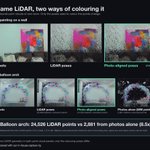
Same LiDAR, two ways of colouring it. Our in-house capture rig puts a real 3D measurement on every surface: 24,526 LiDAR points on one balloon arch vs 2,881 from photos alone (8.5x). LiDAR brings the shape, photos bring the colour, photo-aligned poses keep it sharp.

33
I wanted to try this but in #SpirulaStudio, here's the PR: github.com/harry7557558/spir…


To match or not to match?
FlexGlue 🐙, our new image-matching model, can match every pixel AND reject doppelganger pairs, tackling a common failure case in SfM.
➡️State-of-the-art SfM and matching, blazing fast
➡️Code: github.com/cvg/FlexGlue
➡️Paper: arxiv.org/pdf/2610.32976
1/
Meet Liz Holmes (Theranos) of India!

A lot of you have pinged me to ask - why are you doing Temple? Why did you leave a ~$35b company you founded 18 years ago to chase a niche health wearable? This doesn’t sound rational.
Why did I leave Eternal? What are we building at Temple? What’s our vision statement? What do we have in store for humanity?
I am going to tell you in 4 hours from now (drafting the note as we speak). Stay tuned.
PS – holier-than-thou Indian doctors can skip this lol.
57
Small = 594B params?

Introducing Inkling 2 Small. Scoring 31 on the AA Intelligence Index, it's a big jump over its predecessor.
Inkling 2 Small is available for fine-tuning and inference on Tinker today, with full weight release planned soon.
thinkingmachines.ai/news/ink…

43
If you are using #SpirulaStudio on MacOS, this should speed up all NN operations: SAM3 masking, MOGE-2 depth & normals, LOMA SfM, ROMA v2 dense cloud generation etc… enjoy!
github.com/harry7557558/spir…

1
162
We captured this stunning model home in 3DGS format and here's a short video of this digital twin. Rain or shine, potential buyers can explore this on their phone/web-browser/VR.
Can be explored here: splats.earthbytelab.com/will…
Use Tailscale/Wiregaurd on your VPS & only allow ssh only over this, block all ports except 80/443 & firewall block all requests except Cloudflare IPs and put @Cloudflare orange cloud in front.

Hacked my own VPS last night with abliterated models. Took less than 10 minutes and $5 in inference, and got root level access to the box and all credentials.
Lots to process and share soon, but feeling deeply in touch with my eastern european roots this morning...
73

Ok I will give it to @SpAItial_AI for residential staged home interior SH0 3DGS output with an iPhone Pro. Just wow, this is solved for sure.
I am comparing the point cloud with our in-house 3DGS capture rig. Left: SpatialAI. Right: ours.


Tried @SpAItial_AI ~55 min to generate the scientific industrial equipment world. This is amazing, but there are still a few things still hasn’t got it just right for scientific labs! I’ll try to get an indoor home scan later.
So keep using @playcanvas ? It’s been pretty good for us. I’m trying caching now, don’t know how much it will help.

Benchmarking major web 3DGS renderers: Spark, Radix, PlayCanvas, SuperSplat, GSL and Aholo
Setup: Apple M5 Pro, 48 GB memory, Chrome 156, 3024 × 1964 pixels.
Detailed Report: 3dgs-renderer-bench.vercel.a…
Test your own model: 3dgs-renderer-bench.vercel.a…
GitHub: github.com/WilliamLiu-1997/3…

1
4
299
Before people come at me: yes, I know about PlayCanvas's “cooldownTicks”. I raised it so chunks stay on the GPU after they leave view.
1
45