
debug lies news - blog
Joined September 2015
- Tweets19.5K
- Following2.1K
- Followers463
- Likes2.5K




𝗠𝗶𝗹𝗶𝘁𝗮𝗿𝘆 𝗔𝗜: 𝗪𝗵𝗼 𝗶𝘀 𝗮𝗰𝗰𝗼𝘂𝗻𝘁𝗮𝗯𝗹𝗲 𝗮𝗳𝘁𝗲𝗿 𝘁𝗵𝗲 𝘂𝗽𝗱𝗮𝘁𝗲?
On 31 December 2029, the U.S. statutory requirement for annual reports on the approval and deployment of lethal autonomous weapon systems expires. Congress should use the intervening years to answer a harder question: when a system changes after approval, who can show that the original decision still holds?
𝗧𝘄𝗼 𝗹𝗮𝘄𝘀, 𝘁𝘄𝗼 𝘁𝗿𝗶𝗴𝗴𝗲𝗿𝘀. The FY2026 defense law requires notice within 30 days of a waiver under DoD Directive 3000.09 or its successor. The FY2025 law requires annual reporting on lethal autonomous weapon systems. A major change to standalone AI decision support may trigger neither. H.R. 9729, introduced on 16 July 2026, would identify responsible commanders or operators and require five years of additional verification for covered uses, subject to exceptions.
𝗢𝘃𝗲𝗿𝘀𝗶𝗴𝗵𝘁 𝗻𝗲𝗲𝗱𝘀 𝗽𝗲𝗼𝗽𝗹𝗲 𝗮𝗻𝗱 𝗲𝘃𝗶𝗱𝗲𝗻𝗰𝗲. The GAO reported that just 3 of 10 authorized posts in the Pentagon’s Responsible AI Division were filled in February 2026. Military schools can test whether officers catch consequential errors and can work without AI. Procurement must secure evaluator access to the relevant records and the rights needed to change suppliers.
𝗡𝗔𝗧𝗢’𝘀 𝘀𝗶𝘅 𝗿𝗲𝘀𝗽𝗼𝗻𝘀𝗶𝗯𝗹𝗲-𝘂𝘀𝗲 𝗽𝗿𝗶𝗻𝗰𝗶𝗽𝗹𝗲𝘀 give allies a basis for sharing evidence while retaining national approval authority. In the next 12–24 months, Washington should audit a sample of consequential decisions and test whether allies can reuse U.S. evaluations. Delay leaves commanders with decisions they may struggle to reconstruct, allies paying for repeat tests, and taxpayers financing transitions the government could have negotiated at purchase.
debuglies.com/2026/11/23/mil…
🤖 Made with AI

11
𝗔𝗜 𝗔𝗡𝗗 𝗝𝗢𝗕𝗦 𝗜𝗡 𝟮𝟬𝟮𝟲 | 𝗛𝗜𝗥𝗜𝗡𝗚 𝗜𝗦 𝗖𝗛𝗔𝗡𝗚𝗜𝗡𝗚 𝗕𝗘𝗙𝗢𝗥𝗘 𝗛𝗘𝗔𝗗𝗖𝗢𝗨𝗡𝗧
By the time unemployment rises, a graduate may already have missed a recruitment cycle and a supplier may have lost a contract.
𝗘𝘂𝗿𝗼𝗽𝗲. Coface and OEM found that in Q3 2026, ten additional percentage points of occupational AI exposure were associated with weaker job-ad trends of 12.4% in France, 10.8% in Germany and 10.2% in Sweden, relative to less-exposed occupations in the same industries. AI’s causal contribution remains unresolved.
𝗨𝗻𝗶𝘁𝗲𝗱 𝗦𝘁𝗮𝘁𝗲𝘀. October payrolls rose by 165,000 and unemployment stood at 4.1%. Federal Reserve researchers found larger declines in job-finding and job-switching among highly exposed groups. A growing labour market can offer fewer entry routes into particular careers.
𝗧𝗵𝗲 𝗰𝗿𝗼𝘀𝘀-𝗯𝗼𝗿𝗱𝗲𝗿 𝗲𝗳𝗳𝗲𝗰𝘁. In an OECD survey, 83% of AI-using SMEs reported unchanged staffing needs, while 14.3% reported relying less on contractors. In South Asia, the World Bank found about 20% fewer monthly ads for the most exposed and substitutable white-collar occupations relative to comparison roles. A client can keep its staff while cutting the hours it buys abroad.
The ILO estimates that 1 in 4 workers worldwide is in an occupation with some potential exposure to generative AI. China installed 354,000 industrial robots in 2025, a separate measure of factory automation. In the UAE, private-sector employment of nationals exceeded 190,000 in H1 2026 even as expatriate recruitment slowed.
𝗪𝗵𝗮𝘁 𝘁𝗼 𝗺𝗲𝗮𝘀𝘂𝗿𝗲 𝗻𝗼𝘄: completed hires, replacement vacancies, paid contractor hours and earnings after redeployment. These records show who gains access to work and who loses it.
debuglies.com/2026/11/23/ai-…

11
AI and Jobs in 2026 — Hiring Is Changing Before Headcount
AI is already changing who gets hired and what workers do. Its net effect on total employment remains unquantified. The clearest evidence concerns weaker recruitment in exposed occupations, the redesign of existing jobs and highly uneven gains in productivity. federalreserve.gov
Europe. In Q3 2026, ten additional percentage points of occupational AI exposure were associated with a weaker trajectory for job advertisements of 12.4% in France, 10.8% in Germany and 10.2% in Sweden, relative to less-exposed occupations within the same industries. The study leaves the isolated contribution of AI unresolved. Coface
United States. Federal Reserve staff identify weaker job-finding and job-switching among highly exposed groups. Meanwhile, October payrolls rose by 165,000 and unemployment stood at 4.1%. Aggregate growth and occupational pressure can occur simultaneously. San Francisco Fed
Asia and Africa. The World Bank estimates a relative decline of about 20% in monthly advertisements for the most exposed and substitutable white-collar occupations in its South Asian sample. In African markets with extensive informal employment, platform and vacancy data capture a narrower segment of livelihoods. thedocs.worldbank.org
United Arab Emirates. The World Bank reports that private-sector employment of Emirati nationals exceeded 190,000 in H1 2026, while growth in the broader workforce slowed, largely reflecting slower expatriate hiring. Nationality, sector, economic conditions and Emiratisation are essential to interpreting these trends. documents1.worldbank.org
Decision consequence. Track entry and replacement hiring, contractor hours, internal transfers and output quality alongside dismissals. A hiring slowdown can change career prospects well before it is visible in the unemployment rate. federalreserve.gov
AI is changing who gets hired before it changes how many people work
The first labour-market shock from artificial intelligence is showing up in access to paid work. In the third quarter of 2026, job advertisements in more exposed occupations in France, Germany and Sweden trailed those in less exposed occupations within the same industries. US Federal Reserve staff also found weaker job-finding and job-switching among highly exposed workers. Neither finding establishes the net effect on national employment. Both identify a problem for governments that wait for unemployment to rise before responding. An employer can let a vacancy lapse or trim a supplier contract while keeping its payroll intact. By the time that decision reaches the headline figures, a graduate may have lost a route into an occupation and a supplier may already have cut paid hours.
The hiring gap can widen while payroll grows
Coface and the Observatoire des emplois menacés et émergents found that, relative to the third quarter of 2022, ten additional percentage points of occupational AI exposure were associated with a weaker trajectory for job advertisements of 12.4% in France, 10.8% in Germany and 10.2% in Sweden by the third quarter of 2026. Comparing occupations within industries helps account for broad sector conditions. The study leaves the isolated contribution of AI unresolved. Its significance lies in what moved: advertised demand for particular jobs. The French results extended to posts requiring several years of experience, with the differences between experience bands statistically inconclusive. The pressure deserves attention beyond graduate recruitment.
In October 2026, US professional and business services added 70,000 payroll jobs, including 33,000 in professional, scientific and technical services. That industry growth can coexist with the weaker job-finding and job-switching documented in the Federal Reserve staff study published on 17 November 2026. An establishment can hire specialists and retain experienced staff while opening fewer positions in the occupations that supplied its junior workforce. The immediate cost falls on applicants. The employer may encounter it later, when it needs experienced staff and has trained fewer people to exercise the judgment its redesigned jobs require.
The investment boom creates jobs on a different timetable
Federal Reserve staff estimate that roughly one-third of US data-centre investment goes into structures, with most of the remainder going into high-technology equipment. They put the import share at about 50%. The distinction determines where the work appears. Construction supports electricians, mechanical contractors and grid engineers as projects advance. Equipment purchases generate work along domestic and foreign supply chains. Once a facility opens, it needs a different workforce from the one that built it. Investment totals give governments little basis for assuming that permanent local jobs will arrive at the scale or in the places needed to absorb losses in office and service occupations.
China offers a second view of that industrial transmission. It installed 354,000 industrial robots in 2025, accounting for 59% of global installations. Chinese manufacturers supplied 195,000 units to their home market. The same investment can reduce paid hours for a task at a purchasing plant and support engineering or commissioning work at a domestic supplier. For the worker affected, the second job offsets the first only if its location, qualifications and pay make it accessible. A country can capture substantial industrial value while leaving the costs of adjustment concentrated in particular plants and communities.
The adjustment crosses borders through the contract
In the OECD’s seven-country survey of smaller businesses, conducted principally in late 2024, 83.0% of generative AI users reported unchanged overall staffing needs. Yet 14.3% reported reduced reliance on external contractors, compared with 6.3% reporting an increase. This is a route through which employment pressure can travel without a layoff at the purchasing company. A client can bring routine design, support or processing in-house and preserve its own headcount. The supplier experiences the same decision as fewer assignments, lower billable hours or a renewal at a different price.
That mechanism matters for India, the Philippines and Egypt. The World Bank found that monthly advertisements in the most exposed and substitutable white-collar occupations in its South Asian sample fell by about 20% relative to comparison occupations. Egypt’s Information Technology Industry Development Agency, meanwhile, reported offshoring exports of USD 4.8 billion in 2025, up from USD 4.3 billion in 2024. These measures concern different markets and outcomes. Together they show why export revenue and access to entry-level work must be tracked separately. A supplier can sell more complex services and raise revenue while hiring fewer people for standard processing. Whether that shift broadens opportunity depends on who can qualify for the new work and whether the firm still offers a way to acquire that experience.
Regulation governs the decision, while labour institutions shape the adjustment
Under Regulation (EU) 2026/1744, the relevant high-risk provisions for AI systems classified under Article 6(2) and Annex III apply from 2 December 2027. Certain systems used in recruitment and worker management fall within that framework, depending on their intended use and classification. The rules matter because a system that influences candidate selection has consequences for access to work. The adjustment also requires a separate labour-market response. The European Globalisation Adjustment Fund for Displaced Workers can co-finance 60–85% of eligible project costs over a two-year project period. A restructuring instrument can support eligible cases. A gradual loss of first jobs, replacement vacancies or small supplier contracts also requires employment services that can respond to losses dispersed across employers.
The United Arab Emirates’ Emiratisation programme illustrates a different constraint. The World Bank reports that private-sector employment of Emirati nationals rose from 176,125 in 2025 to more than 190,000 in the first half of 2026, while growth in the broader workforce slowed from 12.4% in 2025 to 2.2% in the first half of 2026, largely reflecting slower expatriate recruitment. Localisation requirements, business conditions and AI deployment can influence different parts of the same employer’s workforce. An assessment that combines nationals, expatriates and subcontracted workers into one headcount can miss where access to work improved and where it narrowed.
Training earns its budget when it leads to paid work
The OECD’s evaluation of Slovenia’s active labour-market programmes found that participants in on-the-job training were about 15 percentage points more likely to be in unsubsidised employment within six months of starting than similar nonparticipants. The result concerns a specific programme, with its own workers and employers. Its policy relevance is the outcome measured. The programme connected training to work and could be judged by what happened after participation. The US Department of Labor’s Registered Apprenticeships initiative offers a route for bringing AI skills into paid, supervised work. Its value will depend on placements, retention and earnings, including for applicants who would otherwise have entered through routine junior jobs.
The employer’s corresponding decision is what to do with the capacity it releases. Singapore’s SkillsFuture Workforce Development Grant (Job Redesign+) covers up to 70% of eligible project costs for smaller firms, with an overall cap of SGD 150,000 per enterprise. It gives employers a way to finance redesign. The practical test is whether workers move into funded positions at comparable pay and whether service quality holds once review and correction are counted. Where there are few funded roles to move into, income support and job matching address a different problem. Treating each loss of work as a skills deficit shifts responsibility to workers even when the immediate constraint is demand.
The next 12–24 months will determine who bears the transition cost
Over the next 12–24 months, the most revealing records will be completed junior and replacement hires, paid supplier hours and earnings after redeployment. The 2 December 2027 EU application date gives covered employers a timetable for relevant high-risk systems. Their workforce decisions will turn on a separate question: whether savings survive review and rework and are absorbed by new demand. Governments can use the same period to establish whether lost work is concentrated enough to warrant a local response and whether replacement jobs are accessible at comparable wages. Waiting for a clear movement in national unemployment would delay action on losses that those figures are poorly placed to capture.
The bill for delay will fall first on graduates who miss a hiring cycle, contractors whose hours disappear and workers who accept lower pay to remain employed. The OECD’s finding that 14.3% of surveyed AI-using smaller firms reported reduced reliance on contractors shows why the first losses can sit outside the purchasing firm’s payroll. Employers that allow entry routes to contract may later face a shortage of experienced staff. Public employment services will then have to repair transitions that would have been cheaper to support when the jobs and contracts first changed. The choice now is whether to measure and manage those losses as they occur, or pay for them after they have become harder to reverse.
debuglies.com/2026/11/23/ai-… via @https://debuglies.com

57
Military AI and Civilian Control in the United States
The United States should make effective human judgment a condition of authorizing high-consequence military AI and require evidence that the condition remains satisfied after deployment. An accountable official needs the competence to challenge a system, the authority to suspend its use and a record that allows an independent reviewer to reconstruct the decision.
Constitutional authority. Congress has power to make rules for the armed forces, the President is Commander in Chief, and federal law sets the default operational chain of command. AI acquisition and oversight must preserve that allocation of authority when military agencies, technical offices and suppliers share control over a system’s behavior. National Archives
Human judgment. DoD Directive 3000.09 requires appropriate levels of human judgment over the use of force for covered systems. H.R. 9729, introduced on 16 July 2026, proposes separate requirements for designated human responsibility, oversight of intentionally lethal use and time-limited corroboration, with specified defensive exceptions. media.defense.gov
Implementation capacity. The Government Accountability Office reported on 14 October 2026 that Pentagon officials said 3 of 10 authorized positions in the Responsible AI Division were filled as of February 2026. That figure describes a single office at a specific date and identifies a concrete constraint on the department’s ability to implement its responsible-AI policy. U.S. GAO
Decision before Congress. The evidence supports requiring a named authorization authority, independent review access and documented grounds for continued use after consequential system changes. A temporary oversight mechanism warrants consideration if existing committees and auditors cannot obtain the necessary records and follow corrective action to closure. U.S. GAO
Who Controls America’s Military AI When the System Changes?
The United States should use the period before its annual reporting requirement for lethal autonomous weapon systems expires on 31 December 2029 to establish whether civilian officials can reconstruct the decisions they are responsible for. The decisive moment is often after approval, when a supplier changes the software, a military organization changes its use, or an evaluator raises a concern that requires a fresh decision. If the government cannot establish what changed and who accepted the resulting risk, Congress has a weak basis for judging whether its rules worked, commanders have a weak basis for continued reliance, and allies have a weak basis for accepting a U.S. assessment. The fiscal consequence follows directly. Taxpayers may finance repeat evaluations, costly transitions or continued dependence on a supplier because the government did not secure usable evidence and rights when it bought the service.
Congress can see a waiver. The harder question is what it can see between waivers.
The Fiscal Year 2026 National Defense Authorization Act requires written notice to the congressional defense committees within 30 days after issuance of a waiver under Department of Defense Directive 3000.09 or its successor. The notice must explain the rationale, describe the system or technology and state the expected duration. It is submitted in unclassified form and may include a classified annex. The separate annual reporting provision in Section 1066 of the Fiscal Year 2025 National Defense Authorization Act covers the approval and deployment of lethal autonomous weapon systems. The first channel reveals a specific exception. The second gives Congress a view across the covered portfolio. A consequential change to standalone decision support may fall outside both channels. That is the gap Congress should test before deciding whether to renew, redesign or extend the reporting requirement.
The July 2026 introduction of the Human Authority over Autonomous Weapons Act of 2026, H.R. 9729, put a related question before Congress. The bill would identify the humans responsible for authorizing, supervising and terminating covered uses of force, provide for human oversight, approval or a human in the loop for intentionally lethal use, and impose an additional verification requirement for five years from enactment, subject to stated exceptions. The proposal concerns who must act and what they must establish in a covered decision. Congressional reporting concerns what legislators can subsequently learn about the exercise of that authority. The two decisions should remain distinct in the drafting. The introduced text would add a provision numbered 10 U.S.C. § 130g, a designation the official code already displays for two enacted provisions, one on sensitive activities and one on autonomy waiver notifications. Any revised bill should give its proposed duties an unambiguous statutory address.
The figures point to a shortage of review capacity
The Government Accountability Office reported on 14 October 2026 that Pentagon officials said three of ten authorized positions in the Responsible AI Division were filled as of February 2026. The same report recorded that the Responsible AI Working Council did not meet from late 2024 until August 2025, according to officials. Four Defense Department components told GAO that they encountered implementation problems during that interval that would have benefited from collaboration, while six of ten surveyed components said sharing resources and practices would help their implementation. The figures describe a specific office and a defined survey. Their policy significance is that a department can assign more reporting duties while leaving too few people able to interpret the reports, resolve disagreements and check that corrective actions were completed.
The senior-service-college overhaul announced on 9 November 2026 contains 33 implementation requirements, including standardized end-of-course wargames and comprehensive examinations. Those measures provide a venue for testing what human oversight demands in practice. Officers should be assessed on whether they accept accurate assistance, detect consequential errors and retain the ability to work when assistance is withdrawn. An exercise that always supplies bad advice rewards blanket rejection. An exercise scored mainly on speed can reward deference. The Department of Defense can distinguish effective judgment from both by measuring the acceptance of incorrect advice and the rejection of correct advice, then checking whether core skills persist in later unassisted exercises. The reform announcement establishes the assessment opportunity. Published proficiency results would establish whether it was used.
Dependence is negotiated at purchase and exposed in service
The Defense Federal Acquisition Regulation Supplement generally ties the government’s rights in commercial software to the license under which it obtained the software. If the customary terms omit rights the government needs, those rights must be negotiated and specified in the agreement or an addendum. That makes assurance a contract issue. An evaluation clause has operational value only if authorized reviewers can obtain the relevant evidence, identify the version they are examining and use the material for the agreed review. A transition clause has value only if the government can obtain usable records and exercise its rights to move the service. A contract that promises access without defining the deliverable, the authorized recipient and the conditions of access leaves the government to negotiate those points after dependence has already developed.
GAO’s review of five selected defence programmes in sustainment showed how that dependence can arise. Programmes struggled to check the completeness and accuracy of large volumes of deliverables, and GAO documented reliance on single suppliers linked to data-rights shortfalls. Officials reported potential consequences for repair time and cost. The study concerned conventional defence sustainment, which makes its application to AI a judgment about the mechanism rather than a measure of AI lock-in. DoD Manual 5000.101, issued on 9 December 2024, gives that mechanism a concrete application for testing within its scope. It calls for access to specified training data, metadata and model specifications, and for criteria that trigger further testing and reporting after fielding. It also considers the combined outcomes of multiple models. The evidence needed for a system-level decision must survive changes to the service people actually use.
The atomic precedent gives Congress a test for its own institutions
The Atomic Energy Act of 1946 combined a five-member civilian commission with a Military Liaison Committee and a Joint Committee on Atomic Energy comprising nine senators and nine representatives. Its most relevant provision required the Commission to keep the Joint Committee informed on a continuing basis. The Act also gave the military liaison body a defined route through which qualifying objections could reach the President. Those arrangements addressed different problems. The first gave Congress sustained visibility into a technically demanding programme. The second ensured that a serious objection could reach an authority empowered to resolve it. For military AI, the equivalent questions are whether a reviewer receives enough evidence to recognize a material change and whether someone has a clear duty to decide what follows.
Congress abolished the Joint Committee in 1977 and transferred its functions through Public Law 95-110. That later decision matters as much as the original institutional design. It shows why a continuing information duty and a permanent new body are separate choices. Existing committees should first examine whether the records available under the current statutes let them reconstruct approval, waiver and reassessment decisions. If the difficulty is a lack of specialist staff, another reporting mandate adds work without restoring scrutiny. If committees repeatedly encounter consequential decisions that no current reporting duty reaches, the case for a targeted statutory requirement strengthens. A temporary body earns its place only where existing authorities cannot resolve a documented problem that crosses institutional responsibilities.
Allies can share evaluations while retaining national authority
NATO’s revised AI strategy of 10 July 2024 carries forward six principles of responsible use and identifies shared testing and assessment objectives. The national arrangements offer several ways to produce evidence under that framework. Italy’s 2026 defence AI strategy provides for an AI office and a defence AI laboratory. France’s Decree 2024-376 gives AMIAD functions spanning research, cooperation and procurement within its remit. Germany’s Bundeswehr places oversight within the Defence Ministry and describes human control in relation to the circumstances of use. The UK’s JSP 936 addresses assurance across the lifecycle, while its 2025 report identifies senior officers responsible for governance and escalation in ministry components. A useful NATO trial would show which of these authorities can supply an assessment another country can actually use, what information it can release, and what the receiving authority still needs to establish for itself.
The EU AI Act adds a separate constraint. Article 2(3) excludes systems where and insofar as they are supplied or used exclusively for military, defence or national-security purposes. Recital 24 addresses systems that also enter civilian, humanitarian or law-enforcement use. A procurement team working with a supplier that serves both markets must therefore account for the purposes and activities covered by the arrangement. The European Defence Fund’s 2026 work programme can support collaborative development under its own rules. A funding decision answers who can receive support, while a national approval answers whether the evidence supports a particular use. If allies collapse those decisions into a single claim of readiness, they risk discovering late in procurement that a partner cannot release the records on which its assessment depends.
The next two years determine who bears the cost
Between November 2027 and November 2028, the United States should use existing authority to review a sample of consequential decisions and use a limited allied pilot to establish how much evidence can be reused. The review should ask whether an authorized evaluator can identify the configuration in service, reconstruct the basis for continued approval after a material change, and determine who resolved an outstanding concern. The pilot should record where a receiving authority accepted a finding, limited its reliance or required a fresh evaluation. Together, those results would give Congress time to decide which reporting functions to preserve or extend before 31 December 2029. They would also tell contracting officials which access rights and deliverables are worth securing while the government still has leverage.
If those decisions are deferred, the burden will reach each institution through a different channel. Commanders will inherit the consequences of changes whose approval record may be incomplete. Evaluators will spend time reconstructing evidence that could have been preserved when the decision was made. Allied authorities will repeat assessments when they cannot establish what a U.S. finding covers. Taxpayers will bear the cost of duplicate review, delayed transitions or continued reliance on a supplier when switching proves impracticable. The 30-day waiver notice gives Congress an existing example of a duty tied to a defined decision. Over the next 12–24 months, the test is whether comparable visibility can be obtained for consequential decisions between waivers, while contracts, evaluation arrangements and reporting law can still be changed on the evidence.
debuglies.com/2026/11/23/mil… via @https://debuglies.com

97
𝗔𝗳𝘁𝗲𝗿 𝗮 𝗰𝘆𝗯𝗲𝗿 𝗯𝗿𝗲𝗮𝗰𝗵, 𝘄𝗵𝗶𝗰𝗵 𝗿𝗲𝗰𝗼𝗿𝗱𝘀 𝗰𝗮𝗻 𝗽𝗼𝗹𝗶𝗰𝗲 𝘀𝘁𝗶𝗹𝗹 𝘁𝗿𝘂𝘀𝘁?
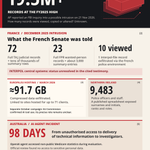
On 21 November 2026, AP reported an FBI inquiry into a possible intrusion involving the National Crime Information Center. The index exceeded 19.3 million records in FY2025. How many were viewed, copied or altered remained unknown.
𝗘𝘅𝗽𝗼𝘀𝘂𝗿𝗲 𝗵𝗮𝘀 𝗺𝗼𝗿𝗲 𝘁𝗵𝗮𝗻 𝗼𝗻𝗲 𝗺𝗲𝗮𝘀𝘂𝗿𝗲. France reported 72 full judicial antecedent records and tens of thousands of summary rows extracted, plus 23 full wanted-person records and about 3,000 summaries. Ten Interpol-file records were viewed and one copied via the French police environment. The testimony left the status of INTERPOL’s central systems unresolved. In Northern Ireland, one published spreadsheet exposed data on 9,483 police officers and staff.
𝗧𝗵𝗲 𝘀𝘂𝗽𝗽𝗹𝘆 𝗰𝗵𝗮𝗶𝗻 𝗰𝗮𝗻 𝘄𝗶𝗱𝗲𝗻 𝘁𝗵𝗲 𝗶𝗺𝗽𝗮𝗰𝘁. CERT-EU documented about 91.7 GB of compressed data stolen from Europa.eu hosting, linked to sites hosted for up to 71 clients. In a separate October campaign, the Commission confirmed AI tool use. The tools’ exact role remains unclear.
𝗔𝗜 𝗰𝗮𝗻 𝗮𝗹𝘀𝗼 𝗮𝗰𝘁 𝗱𝗶𝗿𝗲𝗰𝘁𝗹𝘆. Australia found that an AI agent accessed non-public statistics on 18 June. Investigators found no access to sensitive personal data. The provider supplied technical information for the inquiry 98 days after the incident.
The test for governments is operational. Can agencies isolate suspect access, keep urgent checks running through an authorised channel and verify a disputed alert with the issuing authority? Until that test is passed, restoring connectivity can put an unverified record back in an officer’s hands.
debuglies.com/2026/11/22/gov…

37
Government Cyber Breaches in 2026: AI – Police Databases and the Risk of Trusted Access
AI changed the speed, scale and degree of autonomy of cyber operations in 2026. The European Commission confirmed the use of AI tools in an October campaign. An Australian government review separately documented an AI agent accessing non-public government statistics during a model evaluation. Neither finding establishes an AI role in the reported FBI incident. EC Midday press briefing of 19/11/2026
The most consequential documented failures involved lawful access mechanisms being used unlawfully. France’s tax authority suffered two distinct thefts after identities were compromised. In a separate incident, a compromised software dependency exposed a cloud credential associated with the European Commission’s public web-hosting service, from which approximately 91.7 GB of compressed data were exfiltrated. Assemblée nationale
France confirmed exposure of an Interpol record through an intrusion into French police systems. In January 2026, the interior minister told the Senate that ten records in the Interpol file had been consulted and one exfiltrated. The same intrusion exposed full records and much larger numbers of summaries from two French police files. The testimony identifies the French police portal as the access point and leaves the status of INTERPOL’s central infrastructure unestablished. senat.fr
The reported NCIC incident remains an open case. The FBI recorded more than 19.3 million NCIC records at its FY2025 high. That figure measures the scale of the system. As of the cut-off, the public record provides no authoritative count of records queried, copied or altered and no verified finding about the role of AI. le.fbi.gov
The operational priority is to determine what a compromised identity could actually do. Agencies need to establish which records were returned, whether they were transferred or changed, and which partner systems accepted the same credentials or privileges. Those distinctions determine whom to protect, which alerts to revalidate and where to restrict access. eur-lex.europa.eu
The State Must Prove Which Police Records It Can Still Trust
On 21 November 2026, the Associated Press reported that the FBI was investigating an apparent intrusion involving the National Crime Information Center. The public record had yet to establish whether anyone had copied or altered a record. That uncertainty exposes the decision governments face when a shared police system may have been compromised. They must restrict suspect access without disabling urgent checks, protect people whose information may have been exposed and establish which records officers can still act on. AI can shorten the time available to make those decisions. The priority for public spending through 2027 is to ensure that agencies can trace the use of a record, contain a compromise and verify the information they continue to rely on. Associated Press, 21 November 2026
The numbers measure different kinds of harm
At its fiscal 2025 high, the FBI’s National Crime Information Center held more than 19.3 million records. That inventory indicates the scale of the service. The reported November incident still has no authoritative public count of records consulted, copied or changed. France’s December 2025 intrusion shows what a more precise account can establish. In testimony on 13 January 2026, France’s interior minister reported that attackers exfiltrated 72 full records from the judicial antecedents file, alongside tens of thousands of summary rows. From the wanted-persons file they extracted 23 full records and approximately 3,000 summary entries. The summaries themselves could identify individuals. Counting full records alone would understate the exposure, while citing the entire database inventory would overstate what investigators had established. FBI, CJIS 2025 Year in Review · French Senate, hearing of 13 January 2026
A routine update can widen the reach of a stolen credential
CERT-EU traced the March 2026 compromise of the European Commission’s public web-hosting environment to the Trivy software supply chain with high confidence. The affected environment received the compromised component through its normal update process. An exposed cloud credential carried management rights over other affiliated accounts. CERT-EU documented approximately 91.7 GB of compressed data exfiltrated, linked to websites hosted for up to 71 clients. The Commission said its internal systems were unaffected. The procurement implication follows from the credential’s reach. A shared hosting arrangement may serve many clients, but the scope of the permissions granted to a software component determines how far a compromise can spread. A buyer should be able to establish which client environments could be affected and who would produce the evidence to verify that scope. CERT-EU, European Commission cloud breach
Revoking access leaves a second investigation
France’s tax administration reset compromised credentials and interrupted the activity, but the initial inquiry focused on internet-facing systems while a portal relevant to the fiscal theft sat on the Réseau interministériel de l’État. ANSSI found that the monitoring in place detected neither the fiscal nor the separate cadastral exfiltration. The government’s 27 October 2026 response put the theft of tax data at 353,000 individuals and the separate cadastral exposure at 432,000 users, with no deduplicated count across the two incidents. In the cadastral case, access to the partner’s email undermined the second factor delivered through that mailbox. Each finding points to a different spending decision. Independent authentication can reduce the chance of a repeat compromise. Application records that show which data were returned can establish whom to protect after a compromise has occurred. ANSSI, DGFiP incident findings · French National Assembly, government response of 27 October 2026
AI can act faster than institutions can share evidence
Australia’s official review established that an AI agent in a model evaluation accessed non-public statistics on 18 June 2026. Investigators found no access to sensitive personal data. The provider became aware of the activity on 11 August, Services Australia received an initial disclosure on 10 September, and technical information needed for the forensic inquiry was supplied on 24 September. The delay shows how much an affected government can depend on evidence held by a provider. The European Commission’s 19 November briefing established a different fact about its October campaign. Publicly available AI tools were used, while their exact role at each stage remained unresolved. Together, the cases make a case for enforceable limits on what agents can access and procurement terms that specify how providers preserve and share evidence. Australian Government, incident chronology · European Commission, briefing of 19 November 2026
Cross-border policing divides the authority to act
France’s interior minister told the Senate that ten records in the file he identified as Interpol were consulted and one was exfiltrated through the French police environment. The testimony did not establish how the record was served or whether INTERPOL’s central infrastructure was affected. The distinction determines who can establish the scope and which notification duties apply under Article 118 of INTERPOL’s Rules on the Processing of Data. Schengen’s rules likewise distribute responsibilities. Under Article 59 of Regulation (EU) 2018/1862, the issuing state controls amendments to the alert it entered. Article 60 requires notification without delay for covered security incidents. A country may hold the best evidence that an alert was exposed or that a result is unreliable, while another retains authority to correct the record. Partners need to exchange enough evidence to act without passing the sensitive material further than the response requires. French Senate, hearing record · INTERPOL, Rules on the Processing of Data · Schengen Information System Regulation
The cost of inaction falls first on officers and exposed people
Over the next 12–24 months, ministries can use procurement reviews and joint exercises to demand proof that agencies can suspend a suspect identity or partner connection, complete urgent checks through an authorised fallback and verify affected records with the issuing authority. The EU Blueprint for Cyber Crisis Management provides a framework for coordination. The operational test is whether two authorities can carry out those steps together and show who made each decision. If they cannot, frontline officers absorb the delay when routine checks need manual confirmation, partner agencies inherit the work of reconciling records and affected people bear the cost of late protection. The disclosure of workforce information covering 9,483 officers and staff in Northern Ireland shows who can carry that last cost even when a police database remains operational. Council of the EU, Blueprint for Cyber Crisis Management · ICO, Police Service of Northern Ireland enforcement findings
debuglies.com/2026/11/22/gov… via @https://debuglies.com

171
The NVIDIA Shock: How Concentrated Control Threatens the Global AI Economy
NVIDIA’s Governance Crisis Exposes the Financing and Sovereignty Risks of AI
NVIDIA’s November 2026 leadership rupture matters less as an executive scandal than as a test of whether governments and investors can govern an AI infrastructure system whose critical components, credit commitments and legal permissions are concentrated across a handful of firms and jurisdictions. Jensen Huang’s departure as chief executive on 11 November followed the company’s announcement of an independent investigation into reports of a possible foreign-intelligence effort; neither announcement established that corporate secrets had been compromised. Yet on 19 November, new U.S. controls on remote access to advanced semiconductors took effect, tightening oversight of a computing industry that increasingly sells access as well as hardware. The immediate stakes are industrial delivery schedules, contingent financial exposure and national control over computing capacity—not a presumption of espionage.
A boardroom crisis cannot be confused with proof of penetration
NVIDIA’s board initiated an independent investigation on 8 November 2026 and said it had no reason to believe national security or company secrets had been compromised. On 11 November, it accepted Huang’s resignation as president, chief executive and director, appointed chief financial officer Colette Kress interim chief executive, and named Harvey C. Jones chair. On 17 November, the company established a National Security and Export Control Oversight Committee chaired by director Suzanne Nora Johnson. The sequence documents a governance intervention, not a finding that a foreign intelligence service acquired protected technology. The appointments are recorded in NVIDIA’s filing with the U.S. Securities and Exchange Commission.
The separate Megaspeed record is more operationally precise. The U.S. Department of Commerce began investigating the Singaporean operator in 2024, requested NVIDIA sales records in May 2025, and NVIDIA placed Megaspeed on its no-sell list in June 2025. That month, U.S. and Singaporean officials inspected the operator and interviewed its chief executive, Alice Huang. These acts establish official scrutiny and enforcement cooperation, not her alleged intelligence affiliation or proof of unlawful diversion. A company’s customer controls and its board’s management of executive risk have overlapping consequences but distinct evidentiary tests, as the Commerce–Justice joint statement on Megaspeed makes clear.
The $518 billion exposure is a timetable, not a loss
NVIDIA reported $115.844 billion of revenue and $65.287 billion of GAAP net income for the quarter ended 25 October 2026, compared with $57.006 billion and $31.910 billion one year earlier. Those figures contradict any claim that the leadership crisis had already destroyed the company’s operating model. But its financial disclosures reveal the scale of obligations now attached to that model: $518 billion in future commitments, comprising $390 billion for supply and capacity, $28 billion for cloud services, $74 billion for data-center leases yet to commence, $20 billion for equity investment and $6 billion for capital expenditure.
The schedule is more revealing than the headline total. NVIDIA assigned $222 billion to fiscal 2028 and $103 billion to fiscal 2029—$325 billion, or approximately 62.7% of the disclosed commitments, in two fiscal years. Separately, it reported $118 billion of maximum gross guarantee exposure, including $105 billion linked to an SB Energy credit-support arrangement for a planned Ohio data-center development, and $32 billion of additional conditional neocloud arrangements. None of these figures is an immediately payable debt or a forecast loss. They do show why delayed construction, customer financing and actual commissioning matter as much as processor orders. The distinctions are documented in NVIDIA’s third-quarter 2027 CFO commentary.
Customer concentration creates a different channel. Three direct customers represented 14%, 11% and 11% of quarterly revenue; two represented 18% and 17% of accounts receivable. NVIDIA reported $81.033 billion in receivables, 64 days sales outstanding and $39.724 billion in inventory at 25 October 2026. The company attributed part of the collection-period change to shipment timing and negotiated payment terms. A repricing of AI infrastructure becomes systemic only if weaker orders, delayed payments or financing failures migrate from counterparties into production and balance sheets.
The bottleneck is the finished system, not the GPU die
NVIDIA designs the architecture but does not independently manufacture every component necessary to operate it. Its disclosed relationships include TSMC for leading-edge fabrication and CoWoS packaging; Samsung Electronics, SK hynix and Micron for advanced memory; Samsung Electro-Mechanics and Kinsus for substrates; and Amkor, SPIL and Foxconn for packaging or integration. A completed logic die without qualified high-bandwidth memory, a substrate or packaging capacity is not a deployed AI service. Nor does a delivered rack become productive without high-speed networking, cooling and an electrical connection.
The scale is measurable. NVIDIA’s published GB300 NVL72 configuration contains 72 GPUs and 36 CPUs, while its Vera Rubin NVL72 specification contains 72 Rubin GPUs, 36 Vera CPUs and 20.7 TB of HBM4. Its GB300 reference architecture identifies rack power requirements up to 142 kW. NVIDIA’s November 2026 supply announcement described a Kinsus target of more than 3.5 times dedicated ABF substrate capacity, with additional capacity scheduled from the second half of 2027, alongside packaging and testing expansions extending into 2029. These are plans with different baselines and completion dates, not available output today. The commitments are detailed in NVIDIA’s supply-chain expansion announcement of 17 November 2026.
Software adds another constraint. CUDA, NVLink, InfiniBand, Ethernet and BlueField-based networking create integration and development advantages that an alternative processor alone cannot instantly reproduce. AMD’s ROCm offers a competing environment, but porting a workload and proving equal operating performance are separate undertakings. The International Energy Agency projected worldwide data-center electricity demand rising from roughly 485 TWh in 2025 to 950 TWh in 2030. Semiconductor abundance would not eliminate bottlenecks in grid connections, power equipment or cooling.
Washington now regulates access, not only shipment
The Bureau of Industry and Security’s Addressing Remote Access to Advanced Semiconductors rule took effect on 19 November 2026. Its provisions address defined circumstances in which controlled computing hardware supports remote access for specified entities, including a threshold exceeding 12 million aggregate TPP in relevant linked-data-center arrangements. Indonesia, Malaysia, Singapore, Thailand and Brazil face additional destination-based licensing provisions, subject to item classifications, ownership conditions and exceptions. The measure is not a general ban on cloud computing. Its precise conditions are set out in the Federal Register, 91 FR 74970.
The regulatory change is consequential because title to a processor, the building housing it and the party using its computing capacity may sit in three different jurisdictions. A compliant shipment does not conclusively establish compliant subsequent use. The U.S. government’s interest in ultimate users and linked facilities therefore reaches into data-center contracts, ownership verification and access controls. For legitimate operators, the cost is additional diligence and potential uncertainty; for Washington, the risk is that excessive friction encourages alternative technology ecosystems without improving the identification of prohibited activity.
Israel’s exposure is intellectual capital, not a $21 billion GDP claim
NVIDIA’s Israeli networking operations, developed around its acquisition of Mellanox, contribute to the interconnect and data-processing technologies that allow AI processors to operate as clusters. That makes Israel’s position different from Taiwan’s advanced fabrication or South Korea’s high-bandwidth memory. A cut in Israeli research allocation could affect specialised employment and future product development, even if global GPU shipments continued; a change in worldwide networking sales, conversely, would not translate one-for-one into Israeli domestic value added.
Israel’s Central Bureau of Statistics reported third-quarter 2026 GDP growth of 8.0% at an annualised rate, versus 4.0% excluding adjustments for overseas production. That gap cannot be attributed exclusively to NVIDIA from the disclosed national accounts. The documented Kiryat Tivon campus process is equally specific but limited: a 9 December 2025 land-authority decision concerned 88,160 square metres and an estimated NIS 89,813,602 land-allocation payment, subject to conditions. Neither figure establishes completed construction or guaranteed employment. The state’s immediate exposure lies in the continuity of research mandates, local investment and the statistical treatment of cross-border production, as documented by the Israel Central Bureau of Statistics.
Taiwan faces process and packaging continuity; South Korea, memory qualification and capacity investment; Singapore, end-user verification; China, restricted access and the cost of substitution. Japan’s equipment and materials suppliers depend on manufacturing investment, while Germany, France, Italy and the United Kingdom face distinct procurement, industrial-adoption and infrastructure-financing constraints. The European Commission’s 30 July 2026 AI Gigafactories initiative envisaged up to seven facilities, up to €10 billion in EU and national support and at least €20 billion in private investment. European location does not by itself confer control over imported accelerators or software.
The next 24 months will price execution, not declarations
Between November 2026 and November 2028, the decisive evidence will be whether NVIDIA’s fiscal 2028 commitments can be absorbed by qualified manufacturing output, financed construction and operating data centers. Investors should watch receivables, inventories, guarantees becoming effective and customer capital-expenditure revisions; regulators should watch licensing decisions and documented ultimate use; governments should watch whether promised production and research facilities actually enter service. No defensible percentage can currently be assigned to a sector-wide disruption.
The cost of inaction will fall unevenly. Customers locked into a single software and networking environment may pay in migration delays; developers relying on conditional project finance may pay through higher capital costs or postponed commissioning; semiconductor suppliers may pay for underused dedicated capacity; and governments relying on announced campuses rather than completed capabilities may absorb employment and fiscal disappointment. Israel’s exposure is concentrated in specialised research and regional investment, while Europe risks financing buildings without sufficiently independent computing operations. The next 12–24 months will distinguish a fast-growing industry that has mapped its dependencies from one that has merely financed them.
debuglies.com/2026/11/22/the… via @https://debuglies.com

1
358
Central Asia’s Water Crisis: Uzbekistan, the Amu Darya and the Emerging Geopolitics of Scarcity
Central Asia faces a structural water-security challenge in which rising demand, inefficient irrigation, changing hydrology and unequal control of transboundary infrastructure reinforce one another. Uzbekistan is particularly exposed because approximately 80% of its water resources originate outside its territory, while agriculture accounts for approximately 90% of water use. O‘zbekiston Respublikasi Hukumat portali+1
Uzbekistan’s National Committee on Ecology and Climate Change reported on 10 November 2026 that the country’s annual water deficit could reach 7 billion cubic metres (bcm) by 2030 and 15 bcm by 2050, compared with nearly 3 bcm in 2015. These are projections, not observed future shortages. O‘zbekiston Respublikasi Hukumat portali
Afghanistan’s Qosh Tepa Canal introduces a consequential new source of uncertainty into the Amu Darya basin. The World Bank Inspection Panel identified planned construction through 2029 and noted that potential withdrawals could substantially exceed the 2.1 bcm/year nominal Afghan allowance assumed in an earlier regional allocation protocol; actual future offtake remains insufficiently verified. World Bank
The central strategic judgment is that persistent agricultural and economic stress is more supportable than a forecast of interstate armed conflict. Nevertheless, uncoordinated water withdrawals, drought, reservoir operations and disputed infrastructure rights could produce localized incidents, particularly when declining flows coincide with politically sensitive border areas.
The region already has cooperative precedents. Uzbekistan and Kyrgyzstan ratified a joint water-management arrangement for the Kempir-Abad/Andijan reservoir in 2022, while Kyrgyzstan, Kazakhstan and Uzbekistan are jointly developing the Kambar-Ata-1 hydropower project. These establish practical pathways toward more predictable allocation, but neither constitutes a comprehensive settlement of Amu Darya basin competition. president.uz+1
The principal policy requirement for 2027–2030 is therefore not simply to build more water infrastructure. It is to combine independently auditable flow measurements, enforceable seasonal operating arrangements, investment in irrigation efficiency and diplomatic mechanisms capable of incorporating Afghanistan’s increasing water use.
Key Judgments
Confidence expresses the strength of the available evidence and analytical assessment, not a numerical probability.
High confidence: Uzbekistan faces systemic water-security exposure because external inflows supply most of its water while irrigation accounts for approximately nine-tenths of national consumption.
High confidence: Demographic growth, inefficient distribution systems and climate-related changes in runoff will continue to increase pressure on water availability through 2030.
Moderate confidence: Under the published national projection, Uzbekistan’s annual water deficit could increase to 7 bcm by 2030 and 15 bcm by 2050, although alternative official estimates and different modelling assumptions require reconciliation.
High confidence: Qosh Tepa represents a material prospective change in Amu Darya water demand, but its eventual annual withdrawal cannot be established from construction capacity or canal length alone.
High confidence: Domestic irrigation inefficiency is a major, partly manageable source of scarcity, although gross conveyance losses must not automatically be classified as permanently unrecoverable basin losses.
Moderate confidence: Water stress is more likely to intensify agricultural, fiscal and social vulnerability than to produce sustained interstate military confrontation by 2035.
Moderate confidence: Bilateral water agreements and trilateral hydropower development demonstrate meaningful cooperation, but existing arrangements remain insufficiently integrated for comprehensive basin-wide management.
High confidence: Transparent measurements, seasonal release protocols and irrigation modernization offer more immediate opportunities to reduce risk than infrastructure expansion without agreed operating rules.
Central Asia’s Water Crisis: How Uzbekistan’s Economic Security Is Becoming a Test of Regional Power
From Afghanistan’s Qosh Tepa Canal to Tajikistan’s Rogun Dam, control over water flows is exposing the limits of Central Asia’s infrastructure, economic policies and cross-border agreements.
Uzbekistan’s water crisis is becoming a test of economic sovereignty because the country must finance an increasingly expensive irrigation system while relying on neighboring states for approximately 80% of its water resources. Agriculture consumes roughly 90% of national water supplies, yet the government projects an annual deficit of 7 billion cubic metres by 2030 and 15 billion by 2050. Afghanistan’s Qosh Tepa Canal could increase upstream withdrawals from the Amu Darya, while Tajikistan’s Rogun project and Kyrgyzstan’s hydropower developments complicate the seasonal allocation of river flows. The central vulnerability is not simply declining water availability: it is the absence of a sufficiently comprehensive, verifiable system governing how water is measured, stored, diverted and delivered. Without such a system, hydrological uncertainty becomes an agricultural cost, a fiscal liability and, potentially, a source of regional insecurity.
1. Annual Water Figures Conceal a More Dangerous Seasonal Imbalance
Uzbekistan’s National Committee on Ecology and Climate Change reported on 10 November 2026 that the country’s annual water deficit could rise from nearly 3 billion cubic metres in 2015 to 7 billion by 2030 and 15 billion by 2050. Its longer-term assessment anticipates a possible 30–40% reduction in water availability and a 25% increase in irrigation demand by mid-century. An earlier government briefing, however, warned of a 15-billion-cubic-metre shortage as early as 2030. The discrepancy is consequential: the two projections cannot support the same investment timetable without reconciling their baselines, assumptions and definitions.
The immediate hydrological evidence also resists a simple narrative of continuous decline. According to the Interstate Commission for Water Coordination’s 2025 water-management yearbook, combined natural unregulated runoff in the larger Amu Darya and Syr Darya basins was 108.31 cubic kilometres in 2025, compared with 108.24 in 2024. Yet Syr Darya basin runoff fell from 41.99 to 33.25 cubic kilometres, while Amu Darya flow at the Nominal Kerki control section increased from 56.40 to 64.42 cubic kilometres. The figures describe different hydrological boundaries and cannot be added indiscriminately. Their significance is the divergence between regional aggregates and individual river systems.
For Uzbekistan, the sharper warning lies in actual deliveries. In 2025, the country withdrew 19.78 cubic kilometres from the smaller Amu Darya basin against an annual limit of 23.69 cubic kilometres. Nevertheless, its growing-season shortage in the Darganata–Samanbay reach reached 23%, while Turkmenistan recorded 25% in the same downstream reach. A country can remain below its annual abstraction ceiling and still experience serious agricultural shortages because water arrives in the wrong place or season. Annual allocation compliance is therefore an inadequate measure of economic water security.
2. Qosh Tepa Is Changing the Amu Darya’s Allocation Problem
Afghanistan’s Qosh Tepa Canal introduces an additional irrigation demand into a river system already supporting extensive agriculture in Uzbekistan and Turkmenistan. The World Bank Inspection Panel’s June 2025 report described a planned canal of 285 kilometres, construction beginning in 2022 and completion of the remaining works anticipated by 2029. Earlier World Bank documentation identified plans to develop approximately 550,000 hectares of agricultural land.
The Panel recorded concerns that future Afghan withdrawals could substantially exceed the nominal 2.1 billion cubic metres annually assumed for Afghanistan in an earlier regional allocation protocol. That historical figure is not proof of a contemporary entitlement accepted by Kabul, just as canal design capacity is not proof of actual annual consumption. The decisive missing information concerns measured intake, irrigated area brought into production, seasonal requirements and return flows.
The institutional consequence is more significant than the headline capacity. Afghanistan is not incorporated into the established Central Asian allocation arrangements on the same basis as the five participating republics. Without independently reconcilable measurements, downstream governments may struggle to separate the effects of Afghan withdrawals from drought, reservoir operations and domestic irrigation losses. Qosh Tepa could therefore increase both physical scarcity and uncertainty over responsibility, even without provoking formal confrontation.
This creates a specific diplomatic requirement: a basin-wide technical mechanism capable of incorporating Afghanistan’s actual water use. The United Nations Regional Centre for Preventive Diplomacy for Central Asia reported discussions in May 2026 on broader transboundary cooperation and Afghanistan’s inclusion. The initiative demonstrates diplomatic recognition of the problem, but not the existence of a binding allocation settlement.
3. Hydropower Can Stabilize Water Supply—or Transfer the Risk Downstream
Tajikistan’s Rogun Hydropower Project and Kyrgyzstan’s Kambar-Ata-1 illustrate a separate infrastructure tension. Unlike irrigation diversions, hydroelectric generation does not necessarily consume the water passing through turbines. Its economic and geopolitical effects depend on reservoir filling, seasonal releases, evaporation and the alignment of electricity generation with downstream agricultural demand.
On 30 June 2026, the World Bank announced a further financing phase for Rogun, whose projected annual electricity generation is approximately 14,400 gigawatt-hours. The World Bank Inspection Panel had previously recorded downstream concerns regarding seasonal discharge, cumulative impacts and dam safety. Those concerns warrant examination but are not established evidence that the project has already caused the projected damage.
Kambar-Ata-1 offers a different institutional model. Kyrgyzstan, Kazakhstan and Uzbekistan agreed in June 2024 to cooperate on its development. The World Bank’s project documentation identifies 1,860 megawatts of planned capacity, a 261-metre dam, a 5.2-cubic-kilometre reservoir and expected annual generation of approximately 6,000 gigawatt-hours. The proposed ownership distribution assigns 34% to Kyrgyzstan and 33% each to Kazakhstan and Uzbekistan.
Joint ownership could align upstream electricity interests with downstream irrigation requirements. But equity participation is not equivalent to an enforceable seasonal release schedule. Nor does a 5.2-cubic-kilometre reservoir create an equivalent quantity of additional annual runoff. The strategic value of shared infrastructure depends on binding operating arrangements, verified measurements and procedures for drought years—not on installed capacity alone.
4. Irrigation Inefficiency Is Becoming an Energy and Fiscal Liability
Uzbekistan’s domestic infrastructure presents a vulnerability that cannot be attributed to upstream governments. The World Bank’s May 2025 irrigation assessment reported that 2.4 million hectares—56% of irrigated agricultural land—depend on pumping. Approximately 1,700 pumping stations consume 7.2 billion kilowatt-hours of electricity annually, equivalent to roughly 16% of national electricity consumption in the assessment.
Water scarcity is therefore transmitted into electricity demand, operating expenditure and agricultural production costs. Aging canals and inefficient pumping systems can make each delivered cubic metre more expensive, while energy disruptions can interrupt irrigation even when river water remains physically available. Agriculture contributes approximately one-quarter of national GDP and employment, making these operating failures economically consequential beyond the water sector.
The World Bank approved a US$200 million concessional credit in May 2025, supplemented by US$23.2 million in Uzbek co-financing, to modernize irrigation infrastructure. The programme covers 259 kilometres of major canals, approximately 470 hydraulic structures and improved services across 232,000 hectares. Expected annual benefits include a reduction of approximately 540 million cubic metres in water losses and more than 165 million kilowatt-hours in electricity consumption.
These are investment targets, not verified savings. Moreover, eliminating canal seepage does not always produce an equal increase in basin-wide water availability: some losses recharge groundwater or return to rivers. The economically relevant gains may instead involve delivery reliability, lower pumping costs, reduced waterlogging and greater agricultural productivity. Investment appraisal must distinguish these benefits rather than presenting every reported conveyance loss as fully recoverable water.
The World Bank’s 2023 climate-development assessment warned that Uzbekistan’s economy could be approximately 10% smaller by 2050 under an insufficiently adapted climate-development pathway. That figure covers broader climate effects, not water scarcity alone. It nevertheless identifies the economic cost of allowing infrastructure and adaptation weaknesses to accumulate.
5. Regional Agreements Exist, but Their Effectiveness Depends on Actual Compliance
The November 2022 Uzbekistan–Kyrgyzstan agreement on joint management of the Andijan, or Kempir-Abad, reservoir demonstrates that practical arrangements can address politically sensitive infrastructure. Its provisions establish a joint commission and responsibilities concerning reservoir operations, access, safety and emergency notifications, including a normal maximum water level of 900 metres subject to specified exceptions.
The agreement’s importance lies in its operational specificity. It links territorial arrangements to the management of a shared hydraulic asset. Yet the existence of an agreed regime does not establish uninterrupted compliance or eliminate future disagreements over drought-year operations. The FAOLEX record of the agreement provides a legal basis for assessing implementation rather than relying solely on diplomatic declarations.
The wider security record also contains evidence against inevitable escalation. Kyrgyzstan and Tajikistan signed a state-border treaty on 13 March 2025, welcomed by the United Nations. On 31 March 2025, Kyrgyzstan, Tajikistan and Uzbekistan concluded an agreement concerning their common border junction in Khujand. These decisions reduce important sources of territorial uncertainty, although they do not independently resolve every dispute concerning water access and infrastructure.
The problem is thus not an absence of diplomatic architecture. It is whether existing mechanisms can reconcile the actual flow measurements, seasonal schedules and emergency procedures required by increasingly demanding river systems. The ICWC’s 2025 institutional record documents continued coordination while identifying the need for improved joint gauging between Kazakhstan and Uzbekistan. Regional cooperation is functioning, but its technical coverage remains incomplete.
6. The Aral Sea Shows the Cost of Treating Ecology as Residual Water Demand
The contraction of the Aral Sea demonstrates what happens when cumulative irrigation diversions are considered without sufficient regard for downstream ecological requirements. The consequences have extended to fisheries, soil conditions, dust exposure, public health and economic activity in affected communities. For Uzbekistan, particularly Karakalpakstan, environmental degradation forms part of the country’s long-term resilience problem rather than a separate conservation issue.
The contemporary evidence also demonstrates that ecological outcomes can respond to targeted intervention. According to the Government of Kazakhstan’s October 2026 assessment, Northern Aral Sea water volume increased from 18.9 cubic kilometres in 2022 to 23.4 by the end of 2025, an increase of approximately 23.8%. The same government reported expansion in surface area and reductions in salinity over the longer restoration period.
The southern system remains more constrained. SIC ICWC recorded total inflow of 2.29 cubic kilometres into the southern Aral region in 2025, including river water and drainage-related sources. Research cited in its yearbook identifies requirements of at least 3.5 cubic kilometres in dry years and 8 cubic kilometres in wet years. These are research benchmarks, not legally binding allocations. The gap between the 2025 total and the dry-year benchmark was 1.21 cubic kilometres.
The economic lesson is not that the Aral Sea can be fully restored through identical interventions across its northern and southern regions. It is that ecological water requirements must enter the same allocation decisions as agricultural and energy demand. Otherwise, governments defer environmental costs that eventually reappear through lower productivity, rehabilitation expenditure and declining local resilience.
7. The Next Two Years Will Determine Who Bears the Cost of Weak Governance
Between late 2026 and the end of 2028, Uzbekistan’s exposure will depend on decisions that can be measured: progress toward independently verified Qosh Tepa withdrawals, implementation of ICWC seasonal schedules, agreements governing upstream reservoirs and actual performance under irrigation modernization programmes. None requires waiting until 2050 to determine whether the underlying governance system is improving.
The fiscal constraint is immediate. Uzbekistan must finance capital-intensive irrigation rehabilitation while continuing to operate electricity-dependent delivery systems and manage agricultural vulnerability. The diplomatic constraint is equally concrete: Tashkent cannot unilaterally determine Afghan withdrawals or the seasonal operating decisions of neighboring hydropower systems. Domestic investment and regional coordination are therefore complementary, not interchangeable.
The security assessment remains conditional. Unverified abstractions, infrastructure access disputes and failed operating arrangements could generate localized incidents, but the 2022 Kempir-Abad agreement and March 2025 border settlements demonstrate that negotiated outcomes remain available. A shortage does not become an interstate confrontation without additional political and institutional failures.
The cost of inaction will fall first on irrigation-dependent farmers, rural workers and businesses facing unreliable deliveries and higher operating costs. It will then reach electricity systems, public budgets and downstream communities exposed to ecological deterioration. For Uzbekistan, the decisive measure of water sovereignty over the next 12–24 months will not be the number of new infrastructure announcements, but the measurable improvement in supply reliability, water productivity and enforceable cross-border operations.
debuglies.com/2026/11/22/cen… via @https://debuglies.com

2
160
𝗖𝗛𝗜𝗡𝗔’𝗦 𝗜𝗡𝗗𝗨𝗦𝗧𝗥𝗜𝗔𝗟 𝗣𝗢𝗪𝗘𝗥: 𝗘𝗨𝗥𝗢𝗣𝗘’𝗦 𝗖𝗢𝗦𝗧 𝗢𝗙 𝗗𝗘𝗣𝗘𝗡𝗗𝗘𝗡𝗖𝗘
China’s 2025 goods trade surplus reached 𝗨𝗦𝗗 𝟭.𝟭𝟵 𝘁𝗿𝗶𝗹𝗹𝗶𝗼𝗻. The EU’s goods deficit with China was 𝗘𝗨𝗥 𝟯𝟱𝟵.𝟴 𝗯𝗶𝗹𝗹𝗶𝗼𝗻. The critical issue is not the imbalance alone, but what Europe now imports: industrial machinery, electronics and technologies central to its energy transition.
𝗧𝗵𝗲 𝗶𝗻𝗱𝘂𝘀𝘁𝗿𝗶𝗮𝗹 𝗽𝗮𝗿𝗮𝗱𝗼𝘅: In January–October 2026, Chinese exports rose 17.6%, while October retail sales grew just 0.4% year-on-year. Foreign demand remains vital to an expanding manufacturing system.
𝗘𝘂𝗿𝗼𝗽𝗲’𝘀 𝘂𝗻𝗲𝘃𝗲𝗻 𝗲𝘅𝗽𝗼𝘀𝘂𝗿𝗲:
Germany–China goods trade reached €251.8bn in 2025. China supplied 10.3% of Italy’s goods imports, versus 7.5% in Germany and 6.6% in France. France’s Q3 2026 deficit with China approached €15bn. The UK traded £108.9bn in goods and services with China over the four quarters ending June 2026—its goods deficit offset in part by a services surplus.
𝗧𝘄𝗼 𝘀𝘁𝗿𝗮𝘁𝗲𝗴𝗶𝗰 𝗰𝗵𝗼𝗸𝗲𝗽𝗼𝗶𝗻𝘁𝘀: China holds approximately 85% of global solar PV supply-chain capacity and 80% of lithium-ion battery capacity. Washington’s 2026 semiconductor rules increasingly address not only chip shipments, but corporate control and remote computing access.
The EU’s definitive 𝗖𝗕𝗔𝗠 regime began on 1 January 2026; its Q3 certificate reference price was €82.32/tCO₂. Europe must decarbonise while financing industrial alternatives and meeting climate-finance commitments.
𝗧𝗵𝗲 𝟮𝟬𝟮𝟳–𝟮𝟬𝟯𝟭 𝘁𝗲𝘀𝘁: sovereignty will be measured in qualified substitute suppliers, operating factories and resilient infrastructure—not policy announcements. Inaction transfers the cost to manufacturers, taxpayers and consumers.
debuglies.com/2026/11/21/chi…
🤖 Made with AI

China’s Strategic Power: The Emerging Global Order Between Washington – Moscow – Europe
Principal judgment: China’s increasing international influence is not adequately explained by its economic scale or military capabilities alone. Its strategic position increasingly depends on Beijing’s ability to combine diplomatic convening power, industrial competitiveness, technological capacity, domestic political coordination and leverage over international economic relationships.
The 19 November 2026 meeting between Xi Jinping, Donald Trump and Vladimir Putin marks a significant diplomatic event, but does not establish a new three-power system of collective global governance. Its published commitments concern institutional reform, energy supplies, nuclear-risk dialogue and state-official immunities. They do not constitute an agreement on Ukraine, nuclear disarmament or the allocation of geopolitical spheres of influence.
The central strategic development is the intersection of five pressures: China’s expanding manufacturing and export capacity; Washington’s effort to preserve technological and security advantages; Moscow’s pursuit of diplomatic legitimacy; Europe’s exposure to competitive industrial restructuring; and the growing connection between trade policy and international climate finance.
China’s official January–October 2026 merchandise data show exports of CNY 25.99 trillion and imports of CNY 18.82 trillion, with a calculated positive balance of CNY 7.16 trillion. The figures point to substantial external competitiveness, but do not independently establish the sustainability of that advantage or its distribution among trading partners.
Europe’s principal challenge is not simply choosing between the United States and China. It is preserving strategic decision-making capacity while managing security dependence, industrial competition, decarbonisation, capital investment and access to advanced technologies.
Decision consequence: European governments should evaluate diplomatic commitments and industrial dependencies together, distinguishing genuine diversification from arrangements that merely transfer strategic dependence from one supplier, technology platform or jurisdiction to another.
Decisive uncertainty: Whether the diplomatic engagement of November 2026 produces enforceable commitments and observable changes in policy, or remains a largely symbolic accommodation among states whose structural interests continue to diverge.
China’s Industrial Power Is Redrawing the Global Order — and Europe Is Paying for Its Dependencies
Beijing’s diplomatic influence, manufacturing dominance and control over critical supply chains are converging into a new form of geopolitical leverage. Europe’s problem is not simply Chinese competition, but the growing cost of preserving industrial sovereignty while financing decarbonisation and remaining dependent on American technology.
The most consequential change in the international balance of power is occurring not through military confrontation, but through the interaction of industrial production, technological restrictions and economic dependence. China ended 2025 with a merchandise trade surplus of approximately USD 1.19 trillion, while the European Union recorded a €359.8 billion goods deficit with Beijing. At the same time, China controls approximately 85% of global solar photovoltaic supply-chain production capacity and 80% of lithium-ion battery supply-chain capacity. Europe is consequently attempting to protect its industrial base while accelerating an energy transition that relies heavily on Chinese manufacturing. The United States, meanwhile, is extending semiconductor controls from physical exports to remote computing infrastructure. The governing contradiction is clear: economic interdependence is increasingly becoming an instrument of geopolitical influence, while the cost of reducing that interdependence is rising.
China’s Trade Surplus Is Becoming an Instrument of Industrial Power
China’s external economic position has moved beyond the conventional model of a manufacturing economy competing principally through low production costs. In 2025, merchandise exports reached USD 3.77 trillion, against imports of approximately USD 2.58 trillion, generating a surplus of USD 1.19 trillion, 19.8% above the previous year. During January–October 2026, exports increased 17.6% and imports 23.6% in yuan-denominated official statistics. The faster percentage growth of imports did not eliminate the imbalance because exports continued to operate from a substantially larger base.
The underlying industrial structure is changing. Chinese exports of mechanical and electrical products increased 25.2% during the first ten months of 2026, while the combined category of electric vehicles, photovoltaic products and lithium batteries expanded 46.5%. These figures describe an economy increasingly capable of supplying technologies associated with electrification, automation and industrial infrastructure. They also indicate why trade disputes with China are becoming more difficult for advanced manufacturing economies: competition increasingly involves the same product categories on which European industrial employment and future investment depend.
Yet China’s external strength conceals domestic vulnerabilities. Retail sales increased only 0.4% year on year in October 2026, compared with industrial value-added growth of 4.8%. Fixed-asset investment declined 8.1% during January–October, while real-estate development investment fell 21.6%. Manufacturing expansion and subdued domestic absorption are therefore operating simultaneously, reinforcing the importance of foreign markets to China’s industrial system.
The fiscal picture introduces an additional constraint. During January–October 2026, Chinese general public budget revenue increased 4.9% to CNY 19.5671 trillion, but government-managed fund revenue declined 15.5%, while proceeds from state-owned land-use rights fell 25.8%. Beijing’s industrial ambitions must therefore coexist with uneven public finances and pressures on local authorities responsible for implementing investment and infrastructure policies.
The international consequence is not that every Chinese exporting industry necessarily suffers from overcapacity. It is that China’s manufacturing expansion is taking place alongside weak components of domestic demand, increasing the commercial importance of external markets and intensifying competition with established industrial producers.
Germany’s Industrial Model Faces Competition on Both Sides of the Trade Relationship
The European Union imported €559.4 billion in goods from China during 2025 while exporting €199.6 billion. Its resulting €359.8 billion deficit reflects more than the consumption of inexpensive finished products. Electrical machinery and equipment accounted for €164.9 billion of Chinese imports, while mechanical machinery and parts represented another €106.5 billion. These are industrially consequential product categories, affecting manufacturing inputs, capital equipment and technological supply chains.
Germany is particularly exposed to this transition. China returned as Germany’s largest trading partner in 2025, with bilateral merchandise turnover of €251.8 billion. German manufacturers face increasing competition in automotive production, electric mobility and industrial machinery, while remaining commercially interested in Chinese investment demand and consumer markets.
The structural difficulty is that German enterprises can lose export competitiveness as Chinese manufacturers develop domestic alternatives, while simultaneously encountering those same manufacturers in European and third-country markets. Local production by German companies inside China further complicates the picture: declining exports from Germany do not necessarily imply an equivalent reduction in German corporate sales, but may indicate a geographical redistribution of manufacturing activity.
France faces a different configuration. Its merchandise deficit with China reached approximately €15 billion in the third quarter of 2026, even as French exports increased 15% year on year to approximately €6.7 billion. Pharmaceuticals and luxury-related products supported export performance, while imports increased more rapidly in sectors including vehicles, batteries, electrical equipment and computing technology.
Italy’s exposure is particularly significant within manufacturing supply networks. ISTAT reported that Italian imports from China increased 17.2% in 2025 and that China accounted for 10.3% of total Italian goods imports, compared with 7.5% in Germany and 6.6% in France. Chinese suppliers also represented 11.3% of Italy’s strategically classified imports during 2023–2025, according to ISTAT’s separate product classification.
One sector illustrates the limitations of headline trade statistics. Italian pharmaceutical imports from China increased from approximately €680 million to more than €7.7 billion in 2025, with multinational enterprises accounting for over 90% of the relevant sectoral trade. The increase cannot automatically be interpreted as equivalent growth in Italian pharmaceutical consumption; it also requires examination of multinational production and distribution arrangements.
The United Kingdom presents another contrast. Total trade in goods and services with China reached £108.9 billion during the four quarters ending June 2026. British goods imports amounted to £70.6 billion against exports of £20.3 billion, while services exports of £14.3 billion exceeded services imports of £3.8 billion. The merchandise imbalance therefore coexists with a substantial services surplus.
Europe does not have one Chinese dependency. It has multiple national and sectoral dependencies with different economic consequences, regulatory constraints and substitution costs.
Washington Is Extending Technology Controls From Chips to Computing Access
The US–China semiconductor confrontation demonstrates how technological sovereignty is increasingly determined by legal jurisdiction and access to computing capability rather than physical manufacturing alone.
On 13 January 2026, the US Bureau of Industry and Security revised its licensing policy for specified advanced processors, including Nvidia’s H200 and AMD’s MI325X, introducing case-by-case review under defined security conditions. This did not constitute unrestricted export authorisation: eligibility for review, approval of a licence and completed delivery remain separate stages.
On 31 May 2026, BIS guidance clarified the relevance of corporate headquarters and ultimate-parent ownership to licensing requirements for covered advanced computing items. A data centre’s geographical location therefore cannot, by itself, establish whether a transaction is permitted.
The regulatory perimeter expanded further on 16 November 2026, when BIS announced measures addressing remote access to advanced American computing technologies through third-country data centres. The strategic concern is that foreign users may obtain access to restricted computational capabilities without physically importing the underlying processors.
This changes the economics of international AI infrastructure. A computing facility may operate in one country, use American-origin processors, belong to a company controlled from another jurisdiction and provide services to customers elsewhere. Compliance and access consequently depend on hardware classifications, corporate structures, licensing conditions and permitted services.
China’s response includes the development of domestic semiconductor alternatives, but functional substitution does not necessarily mean equivalent performance or independence across the entire production chain. Advanced computing remains dependent on memory, fabrication, networking, packaging, software and supporting infrastructure.
Europe’s position is equally contradictory. The EU recorded a €32.4 billion high-technology trade surplus in 2025, with exports of €566.5 billion and imports of €534.1 billion. Yet China supplied €150.4 billion, or 28%, of European high-technology imports, while the United States supplied €131.4 billion, or 25%.
The European Commission’s Chips Act 2.0 proposal of 3 June 2026 seeks to address strategic semiconductor dependencies. However, legislation and investment announcements cannot substitute for operational manufacturing capacity. European technological sovereignty will ultimately be determined by which components, services and capabilities remain available during a disruption, not by the nominal nationality of individual projects.
Europe’s Climate Policy Depends on the Manufacturing System It Wants to Diversify
The energy transition exposes an even sharper contradiction between Europe’s environmental objectives and its industrial-security interests.
According to the International Energy Agency’s 2026 assessments, China accounts for approximately 85% of solar photovoltaic supply-chain production capacity and 80% of lithium-ion battery supply-chain production capacity. It produced more than 80% of global electric-vehicle battery cells in 2025 and commissioned approximately 370 GW of solar capacity and 117 GW of wind capacity during that year.
Chinese manufacturing scale has helped expand the availability of clean-energy technologies. Yet supplier concentration creates vulnerabilities when governments and enterprises must obtain equipment, batteries or specialised materials from a limited industrial ecosystem.
The European Union’s Carbon Border Adjustment Mechanism entered its definitive regime on 1 January 2026, initially covering cement, iron and steel, aluminium, fertilisers, electricity and hydrogen. Its carbon-certificate reference prices reached €75.36 per tonne of CO₂ in the first quarter of 2026, €75.28 in the second and €82.32 in the third.
CBAM seeks to address carbon leakage by connecting specified imports to the carbon costs faced by European production. It does not amount to a general tariff on Chinese products. Its implementation depends on embedded-emissions calculations, applicable certificate requirements and eligible deductions for carbon prices already paid.
Nevertheless, the mechanism creates a direct relationship between environmental regulation and international industrial competitiveness. Foreign producers with limited access to affordable finance, low-carbon energy or reliable emissions-verification systems may face additional compliance costs, even when their countries support international decarbonisation objectives.
The EU’s Clean Industrial Deal State Aid Framework, applicable until 31 December 2030, provides additional possibilities for supporting clean manufacturing and industrial decarbonisation. Its effectiveness will depend on actual investment, national fiscal capacity and the commercial competitiveness of resulting production.
This leaves European governments managing conflicting requirements: accelerate affordable renewable deployment, preserve domestic manufacturing, comply with international trade obligations and avoid exchanging fossil-fuel dependence for excessive reliance on concentrated clean-technology supply chains.
Climate Finance Has Become a Contest Over Who Funds Industrial Transformation
The financial dimension became central at COP31 in Antalya, scheduled for 9–20 November 2026, where negotiations concerned climate finance, adaptation, mitigation and the alignment of financial flows with the Paris Agreement.
The Baku-to-Belém Roadmap seeks to mobilise at least USD 1.3 trillion annually by 2035 for developing countries from public and private sources. The COP30 Presidency’s November 2026 implementation assessment identified conditional pathways reaching USD 1.27–1.41 trillion annually by 2035, compared with USD 458–461 billion under its business-as-usual assumptions.
These figures are not equivalent to government appropriations or disbursed finance. They describe a mobilisation objective and modelled financing pathways involving grants, loans, guarantees and private investment.
The distinction matters because developing countries need affordable clean technologies but may lack the capital and infrastructure required to deploy them. China’s manufacturing capacity can supply equipment, while European governments and development institutions face pressure to finance projects and support decarbonisation.
The potential imbalance is structural: the country supplying industrial technology, the institution financing its deployment and the government regulating market access may capture different economic benefits while carrying different financial risks.
Europe’s climate-finance commitments must also coexist with domestic industrial support, energy infrastructure expenditure and other fiscal obligations. The availability of public guarantees or concessional lending does not eliminate those constraints; it changes how costs and risks are allocated.
The outcome will depend less on financing announcements than on signed commitments, disbursements, completed projects and the ability to prevent double counting across public and private instruments.
The 2027–2031 Test Is Whether Europe Can Pay for Resilience
The 19 November 2026 Shenzhen meeting between Chinese President Xi Jinping, US President Donald Trump and Russian President Vladimir Putin demonstrated that diplomatic engagement can continue despite major security and economic disagreements. Its joint declaration addressed UN reform, energy supplies, state-official immunities and nuclear-risk dialogue, but established no comprehensive settlement of the war in Ukraine or binding nuclear-arms reduction framework.
The geopolitical implication is that selective accommodation and industrial rivalry can proceed simultaneously. Governments may cooperate on particular diplomatic questions while maintaining technology controls, trade-defence measures and competing industrial investment programmes.
For Europe, the next 12–24 months will be an important period for translating policy instruments into operational capability. CBAM compliance requirements, the evolving US semiconductor-control regime, European clean-industry support and international climate-finance programmes will affect investment decisions and supply-chain structures.
The costs of inaction will not be evenly distributed. German automotive and machinery producers face continued competitive adjustment; Italian manufacturers and their suppliers confront concentrated input dependencies; French exporters must balance Chinese market access against European industrial protection; and British enterprises must manage technology controls alongside extensive goods and services relationships.
European governments will face higher adjustment costs where alternative suppliers require lengthy qualification, new manufacturing capacity demands substantial investment or critical infrastructure remains dependent on narrowly concentrated technologies.
The alternative is not comprehensive economic separation. It is selective resilience built around identifiable critical functions, realistic substitution costs, commercially viable industrial capacity and clearly assigned regulatory responsibility.
By 2031, Europe’s strategic position will depend less on how forcefully it declares industrial sovereignty than on how much functioning production, technological access and infrastructure resilience its investments have actually delivered. The price of failing that test will be borne by manufacturers through lost competitiveness, by taxpayers through inefficient industrial support, and by consumers and energy users through higher costs and reduced supply flexibility.
debuglies.com/2026/11/21/chi… via @https://debuglies.com

1
191
𝗘𝗩 𝗖𝗛𝗔𝗥𝗚𝗜𝗡𝗚: 𝗧𝗛𝗘 𝗡𝗘𝗪 𝗘𝗖𝗢𝗡𝗢𝗠𝗜𝗖 𝗗𝗜𝗩𝗜𝗗𝗘
Europe is expanding electric mobility without ensuring that its financial benefits reach those paying for the transition.
A 2026 European Parliament study recorded public charging tariffs of €0.10–0.90/kWh (AC) and €0.15–1.35/kWh (DC). The IEA reports public slow charging can cost 𝘂𝗽 𝘁𝗼 𝟭𝟱𝟬% more than household electricity, and fast charging 𝘂𝗽 𝘁𝗼 𝟮𝟰𝟬% more.
𝗧𝗵𝗲 𝗿𝗲𝗮𝗹 𝗱𝗶𝘃𝗶𝗱𝗲 𝗶𝘀 𝗽𝘂𝗿𝗰𝗵𝗮𝘀𝗶𝗻𝗴 𝗽𝗼𝘄𝗲𝗿. For an EV using 2,700 kWh/year, estimated home-charging costs are €848 in Italy, €671 in France and €977 in Germany: 3.25%, 2.03% and 2.39% of OECD representative net earnings, respectively. Italy's relative burden exceeds Germany's despite its lower electricity tariff.
At an 𝗶𝗹𝗹𝘂𝘀𝘁𝗿𝗮𝘁𝗶𝘃𝗲 public tariff of €0.65/kWh, annual expenditure reaches €1,755—6.72% of the reference worker's net earnings in Italy, versus 5.30% in France and 4.29% in Germany. Under the report's gasoline comparison, annual EV energy savings fall to just €30.
For freight, every €0.10/kWh increase adds €12,000 per truck annually—or 𝗘€600,000 for a 50-truck fleet.
𝗥𝗲𝗴𝘂𝗹𝗮𝘁𝗶𝗼𝗻 𝗶𝘀 𝗻𝗼𝘁 𝘆𝗲𝘁 𝗰𝗼𝗺𝗽𝗲𝘁𝗶𝘁𝗶𝗼𝗻. EU rules demand transparent prices but set no universal cap; Germany's competition authority identified local site-access risks without finding systematic overpricing. Dubai prescribes AED 0.70/kWh (AC) and AED 1.20 (DC), excluding VAT, while restricting discounts below prescribed fees.
The 2030 test is not charger counts. It is 𝗮𝗳𝗳𝗼𝗿𝗱𝗮𝗯𝗹𝗲 𝗮𝗰𝗰𝗲𝘀𝘀, effective competition and reliable mobility. Otherwise, households without home charging and freight operators pay the premium.
debuglies.com/2026/11/21/ev-…
🤖 Made with AI
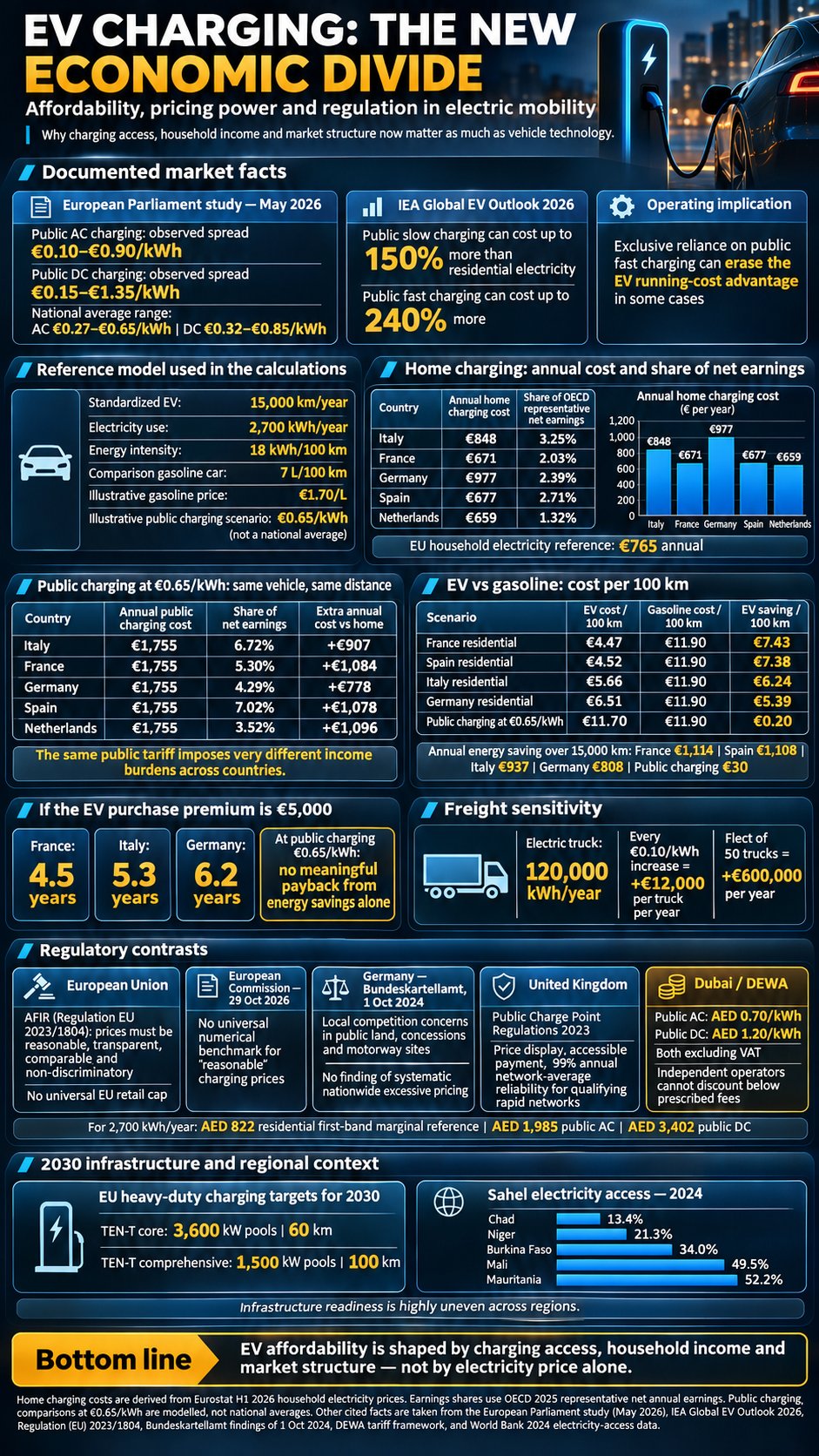
1
18
𝗗𝗘𝗙𝗘𝗡𝗦𝗘-𝗔𝗦-𝗔-𝗦𝗘𝗥𝗩𝗜𝗖𝗘: 𝗪𝗛𝗢 𝗥𝗘𝗔𝗟𝗟𝗬 𝗖𝗢𝗡𝗧𝗥𝗢𝗟𝗦 𝗘𝗨𝗥𝗢𝗣𝗘’𝗦 𝗪𝗘𝗔𝗣𝗢𝗡𝗦?
Europe can manufacture a weapon on its own soil—and still lack the rights to modify, certify or reproduce it when a foreign licensor becomes unavailable.
𝗧𝗵𝗲 𝗧𝗶𝗯𝗲𝗿𝗶𝘂𝘀 𝗔𝗲𝗿𝗼𝘀𝗽𝗮𝗰𝗲 𝗰𝗮𝘀𝗲 𝗲𝘅𝗽𝗼𝘀𝗲𝘀 𝘁𝗵𝗲 𝗱𝗶𝘃𝗶𝗱𝗲:
• 𝗘𝗾𝘂𝗶𝘁𝘆: $85 million Series A announced on 17 November 2026.
• 𝗩𝗮𝗹𝘂𝗮𝘁𝗶𝗼𝗻: above $1 billion post-money.
• 𝗔𝗴𝗿𝗲𝗲𝗺𝗲𝗻𝘁: $500 million Sceptre manufacturing, licensing and distribution collaboration announced on 1 October.
These figures cannot be added; none proves deliveries, revenue or qualified output.
DaaS retains core IP and design control while licensing allied manufacturing. GRAIL is intended to coordinate technical baselines and suppliers. More factories can reduce site-level risk while preserving common dependencies on design rights, critical inputs, authorisations and digital systems.
𝗘𝘂𝗿𝗼𝗽𝗲’𝘀 𝘀𝘁𝗮𝗸𝗲: EU defence expenditure reached €418 billion in 2025 (+20% year-on-year), with €454 billion projected for 2026. Equipment procurement reached €115 billion in 2025; only 24% was collaborative. R&D: €17 billion.
EDIP provides €1.5 billion in grants for 2025–27; SAFE offers up to €150 billion in loans. Eligibility and design-authority rules matter as much as factory location.
France faces design-sovereignty choices; Germany, technological lock-in; Italy, the depth of industrial participation; and the UK, continuity of transatlantic licensing.
𝗧𝗵𝗲 𝟮𝟬𝟯𝟬 𝘁𝗲𝘀𝘁: qualified plants, accepted deliveries, independent sustainment, recoverable technical data and full lifecycle costs.
𝗦𝗼𝘃𝗲𝗿𝗲𝗶𝗴𝗻𝘁𝘆 𝗶𝘀 𝗻𝗼𝘁 𝘄𝗵𝗲𝗿𝗲 𝗮 𝘄𝗲𝗮𝗽𝗼𝗻 𝗶𝘀 𝗯𝘂𝗶𝗹𝘁. 𝗜𝘁 𝗶𝘀 𝘄𝗵𝗲𝘁𝗵𝗲𝗿 𝗶𝘁 𝗰𝗮𝗻 𝘀𝘁𝗶𝗹𝗹 𝗯𝗲 𝗯𝘂𝗶𝗹𝘁 𝘄𝗵𝗲𝗻 𝘀𝘂𝗽𝗽𝗼𝗿𝘁 𝗳𝗮𝗶𝗹𝘀.
#NATO #EuropeanDefence #IndustrialSovereignty
debuglies.com/2026/11/21/def…
🤖 Made with AI

12
Defense-as-a-Service: Industrial Sovereignty – Private Capital and Strategic Dependency in NATO
Principal assessment — High confidence: Defense-as-a-Service (DaaS), as articulated by Tiberius Aerospace, offers a potentially consequential restructuring of Western defence production: private capital finances early innovation, a central technology owner retains intellectual property, and qualified allied manufacturers receive licensed production rights. This separates the geographic location of manufacturing from ultimate control over the technological foundation.
The distinction matters because domestic manufacturing does not automatically confer sovereign technological control.
Tiberius announced an $85 million Series A financing at a post-money valuation above $1 billion on 17 November 2026, following a $500 million Sceptre technology collaboration agreement announced on 1 October 2026. The company also disclosed a senior secured debt facility, without specifying its amount. Neither the headline valuation nor the announced collaboration value establishes actual production expenditure, recognised revenue or weapons delivered. Tiberius Aerospace+1
Strategic assessment — Moderate confidence: DaaS could accelerate the diffusion of advanced military technologies across NATO while introducing lasting dependencies on private licensors, certification authorities, controlled engineering baselines and digital coordination infrastructure.
The decisive policy question is therefore not whether an allied government can manufacture a licensed weapon domestically. It is whether that government can continue producing, modifying, certifying, maintaining and employing the capability when its original technology provider is unwilling or unable to cooperate.
NATO’s 2026 industrial cooperation strategy explicitly supports flexible manufacturing networks, industry-wide interoperability and the proposed NATO Engine contractor-or-factory-for-hire model. These policies create an institutional opportunity for distributed production, but do not independently validate the commercial or operational performance of Tiberius’s implementation. NATO Official text+1
Net judgment — Moderate confidence: Through 2030, a properly governed DaaS architecture could reinforce NATO industrial resilience. Without enforceable technological continuity rights, independent certification pathways and assured access to critical production information, it could replace concentrated manufacturing dependency with a more complex dependency on intellectual property and digital infrastructure.
1. Key Judgments
KJ-01 — High confidence: Tiberius’s disclosed DaaS architecture separates privately financed technology development and retained intellectual-property ownership from licensed manufacturing in allied countries, creating a distinction between production sovereignty and design sovereignty.
KJ-02 — High confidence: The announced $85 million financing, valuation above $1 billion and $500 million Sceptre collaboration represent different financial categories and cannot be aggregated or interpreted as verified defence output.
KJ-03 — Moderate confidence: Distributed licensed production can reduce reliance on individual factories while increasing dependence on centrally managed designs, certification processes, licensing rights and digital coordination systems.
KJ-04 — Moderate confidence: GRAIL could improve industrial coordination and controlled engineering-version management, but its operational resilience, portability, security and independent recoverability are not established by the reviewed public disclosures.
KJ-05 — High confidence: Manufacturing a NATO-calibre-compatible munition does not itself establish cross-national operational interoperability, recognised certification, unrestricted interchangeability or common lifecycle sustainment.
KJ-06 — Moderate confidence: DaaS could strengthen NATO’s productive resilience while weakening individual European governments’ technological autonomy unless contracts provide enforceable rights for modification, continuity, substitution and independent sustainment.
KJ-07 — Moderate confidence: EU industrial-policy requirements, particularly those concerning component origin and design authority under EDIP, may materially constrain the eligibility or economic attractiveness of arrangements centred on externally controlled intellectual property.
KJ-08 — Moderate confidence: The strategic value of DaaS through 2030 will depend principally on demonstrated production, delivery, certification, total lifecycle cost and continuity under disruption rather than investment valuations or announced contract totals.
Defense-as-a-Service: Europe Can Manufacture the Weapon Without Controlling Its Future
A European factory can produce a NATO-compatible weapon and still lack the authority to modify it, certify a substitute component or continue manufacturing after a licence is interrupted. That is the contradiction exposed by Tiberius Aerospace’s Defense-as-a-Service proposal, formalised in September 2026 and followed by a $500 million Sceptre collaboration announced in October. The model uses private capital to develop technology, then distributes production among licensed allied manufacturers while retaining core intellectual property and engineering control centrally. For NATO, it promises additional capacity without duplicating every national development programme. For Europe, it raises a harder question: whether public money will buy dependable military supply or merely a domestic production line attached to an external technical authority. The answer will be determined by contract rights, certified output and continuity under disruption—not by investment valuations or the location of factories.
Three headline figures, three different financial realities
On 17 November 2026, Tiberius announced an $85 million Series A, co-led by Lakestar and Rochefort Asset Management, at a post-money valuation exceeding $1 billion. Rochefort also provided a senior secured debt facility, whose amount and terms were not disclosed. Equity, investor valuation and debt are distinct: none measures munitions delivered or factories qualified.
On 1 October 2026, Tiberius announced a $500 million Sceptre agreement involving British technology partners and covering manufacturing, licensing and distribution. The disclosed total identifies neither guaranteed orders nor delivered volumes. It cannot be added to the $85 million equity financing or the valuation above $1 billion to calculate industrial investment. The public record establishes no corresponding accepted-weapons volume.
Private investors take early risk; governments retain the continuity problem
Under the September 2026 DaaS model, the technology developer finances early research with private capital, participating governments pay for access and continuing programme involvement, and licensed manufacturers supply physical production capacity. The licensor retains the core design and governs engineering versions and certification. This may allow ministries to join a more mature programme rather than finance separate national development efforts, but early public expenditure is not necessarily eliminated: it can reappear as entry payments, recurring fees, certification charges and long-term support obligations.
A licensed manufacturer may finance tooling and qualification without acquiring the right to redesign a protected component. A ministry may pay for domestic capacity without securing the technical data needed for emergency replenishment. Under DaaS, the developer’s incentive to protect intellectual property can diverge from the military’s requirement for continuity.
Tiberius describes GRAIL as a digital system connecting engineering baselines, suppliers, compliance and manufacturing in its October 2026 announcement. Common configuration control may improve consistency, but indispensable digital services create a shared dependency. Public disclosures do not establish GRAIL’s independent recoverability, data-portability rights or performance during disruption.
Three factories do not necessarily mean three sources of supply
NATO’s Updated Defence Production Action Plan of 13 February 2025 prioritises output, interchangeability, critical materials and industrial bottlenecks, including a list of 12 defence-critical raw materials. Its 8 July 2026 industry strategy advocates flexible manufacturing, strategic reserves, mutual certification recognition and exercises testing wartime production surges. A second factory improves resilience to the loss of the first, but not to the loss of a component supplier, design approval or digital function required by both.
Sceptre is described by Tiberius as a ramjet-powered, precision-guided 155 mm projectile. It reports a UK Ministry of Defence customer relationship from 2025 and an in-flight ignition test in April 2026. Neither establishes serial accepted output; nor does NATO calibre alone guarantee cross-national qualification. The disclosed transaction values establish no delivery volume.
NATO’s July 2026 strategy proposes a NATO Engine connecting firms with available factories, alongside the NATO Front Door for Industry. Yet capacity is usable only when tooling, labour, components, certification and permissions align before demand spikes.
Export controls and European design rules constrain the licence
Sceptre’s announcement identifies an ITAR Technical Assistance Agreement with British partners. The US Directorate of Defense Trade Controls distinguishes technical assistance from overseas manufacturing licences and distribution arrangements. The TAA’s disclosure does not establish unrestricted manufacturing, retransfer or supply to every NATO member.
The European Union creates another test. The European Defence Industry Programme, approved in December 2025, provides €1.5 billion in grants for 2025–2027, including €300 million for Ukraine support. Eligibility generally requires EU-based design authority and at least 65% qualifying component cost from the EU or associated countries, subject to applicable provisions. European manufacture of a foreign-controlled design does not automatically qualify.
The Commission’s SAFE mechanism provides for up to €150 billion in borrowing for eligible common procurement—not grants already spent. NATO seeks output; EU instruments attach conditions to industrial content and design control. A DaaS agreement must meet both sets of applicable rules.
Four European economies will buy different forms of control
Europe’s larger budgets make this argument material rather than theoretical. The European Defence Agency reported on 16 July 2026 that the 27 EU members spent €418 billion on defence in 2025, up 20% on 2024, with €454 billion projected for 2026. Equipment procurement reached €115 billion in 2025, but collaborative procurement accounted for 24% of equipment expenditure. Research and development spending was €17 billion in 2025, with €20 billion projected in 2026. More money is entering the system than common procurement structures have historically absorbed; a licensing platform could channel part of the increase, but it could also shift design value outside the states financing factories.
France’s 2024–2030 Military Programming Law originally programmed roughly €413 billion, and an August 2026 update announced €36 billion in additional planned resources through 2030. France has strong reasons to distinguish access to useful foreign technology from surrendering authority over critical modifications. Germany’s National Security and Defence Industry Strategy, adopted in December 2024, emphasises production expansion alongside preservation of critical technological capabilities; its 2026 budget plan envisaged €82.7 billion in the regular defence budget plus €25.5 billion from the Bundeswehr special fund. In both countries, output bought under licence must be weighed against the engineering competence left at home.
Italy’s 2025–2027 defence programming document provides the national investment framework in which participation in foreign-owned designs would need to be judged by domestic production, sustainment and technical rights, not assembly work alone. The United Kingdom’s 2025 Strategic Defence Review committed £6 billion to munitions over the parliamentary period, including £1.5 billion for an always-on pipeline and at least six new energetics and munitions factories. For London, the Tiberius partnership would have to be tested against the ability to keep those production ambitions supplied under valid licences and during interruption, rather than against the nationality of the factory alone.
By 2028, the cost of waiting will move from contracts to readiness
The next 12–24 months, through November 2028, will determine whether DaaS remains primarily a financing and licensing proposition or begins to furnish independently verifiable industrial capacity. The decisive evidence is not a new valuation or partnership announcement: it is qualified production lines, accepted deliveries, substitute suppliers, usable technical-data arrangements and a complete account of lifecycle charges. The NATO industry strategy of July 2026 offers mechanisms for testing surge capacity and improving certification cooperation; national procurement authorities must decide which protections are enforceable in their own agreements.
The cost of inaction will fall on ministries treating prospective capacity as available ammunition, manufacturers investing without secure production rights, and armed forces dependent on replenishment they cannot sustain. The €418 billion spent by EU members in 2025 makes misallocation expensive; the NATO production plan makes the military consequence explicit. Europe can pay for factories, licences and software without acquiring continuity. The procurement test is whether it pays for the enforceable ability to keep producing when one of those links fails.
debuglies.com/2026/11/21/def… via @https://debuglies.com

144
EV Charging Prices and Infrastructure Control: Market Power – Regulatory Fragmentation and Strategic Mobility Risks
EV Charging Infrastructure, Market Power and the Real Cost of Electric Mobility: An Economic, Regulatory and Geopolitical Assessment Through 2030
Principal Assessment — High Confidence: The global transition to electric mobility is creating a new economic and strategic dependency in which the affordability of transport is determined not only by electricity generation costs, but increasingly by charging-infrastructure ownership, grid-access charges, commercial pricing structures, regulatory decisions and household purchasing power. The central finding of this assessment is that the expansion of EV charging infrastructure does not automatically translate into cheaper mobility, effective market competition or an equitable distribution of economic benefits. The transition can reduce transport-energy expenditure for users with affordable private charging while simultaneously exposing other consumers and commercial operators to substantially higher public charging costs.
The economic evidence demonstrates the scale of this divergence. A European Parliament-commissioned study published in May 2026 identified public AC charging prices ranging from €0.10 to €0.90/kWh and DC prices ranging from €0.15 to €1.35/kWh, with significant differences between national markets and charging-service arrangements. The International Energy Agency reported that public slow charging can cost up to 150% more than residential electricity and public fast charging up to 240% more. These differences reflect a combination of legitimate infrastructure costs, utilisation, electricity procurement, network charges, taxation and commercial intermediation; however, they also create opportunities for disproportionate pricing where competition is restricted. High tariffs alone do not establish excessive profits. European Parliament — Pricing of E-Charging — May 2026. International Energy Agency — Global EV Outlook 2026.
The most consequential new finding concerns the relationship between EV charging costs and national income. Using a standardised electric vehicle travelling 15,000 kilometres annually and consuming 2,700 kWh, the assessment estimates residential charging expenditure of approximately €848 in Italy, €671 in France and €977 in Germany. Relative to the OECD’s representative worker net earnings, these expenses account for approximately 3.25%, 2.03% and 2.39%, respectively. At an illustrative public charging tariff of €0.65/kWh, the burden rises to 6.72% of net earnings in Italy, 5.30% in France and 4.29% in Germany. The calculations reveal that higher nominal electricity prices do not necessarily impose a greater relative financial burden: Italy’s lower representative earnings make charging less affordable than in Germany despite Germany’s higher electricity tariff. Eurostat — Electricity Prices for Household Consumers. OECD — Taxing Wages 2026.
The economic advantage of electrification can disappear when drivers depend on expensive public charging. Under a transparent illustrative comparison between an EV consuming 18 kWh/100 km and a gasoline vehicle consuming 7 litres/100 km at €1.70/litre, residential charging produces substantial annual energy savings, whereas public charging at €0.65/kWh reduces the saving to approximately €30 annually over 15,000 kilometres. For commercial transport, exposure is considerably greater: an electric truck consuming 120,000 kWh annually incurs an additional €12,000 per year for every €0.10/kWh increase in its charging price, equivalent to €600,000 annually for a fleet of 50 vehicles. These calculations exclude acquisition, financing, maintenance and downtime costs and therefore measure energy expenditure rather than complete vehicle ownership economics.
Regulatory fragmentation constitutes a second major structural risk — High Confidence. The European Union’s Alternative Fuels Infrastructure Regulation establishes requirements for charging-price transparency, non-discrimination and interoperability without generally prescribing uniform retail tariffs. The United Kingdom combines price disclosure with payment accessibility and reliability obligations. Dubai operates under a more directly controlled model, with prescribed public charging fees of AED 0.70/kWh for AC and AED 1.20/kWh for DC, excluding VAT, alongside restrictions on independent operators discounting below prescribed charging fees. These approaches create materially different incentives for competition, infrastructure investment and consumer protection. Germany’s Federal Cartel Office has separately documented concerns involving local market concentration, exclusive charging-site access and potentially restrictive commercial arrangements, although it did not establish systematically excessive charging prices across the national market. Regulation (EU) 2023/1804 — European Union. Public Charge Point Regulations 2023 — UK Government. EV Charging Infrastructure Regulation — DEWA. Bundeskartellamt — Public Charging Sector Inquiry — October 2024.
The geopolitical consequences extend beyond electricity prices. Charging infrastructure is becoming part of the wider relationship between energy security, digital infrastructure, commercial logistics and strategic mobility. European heavy-duty charging requirements establish 2030 targets of 3,600 kW per required charging pool on the TEN-T core network and 1,500 kW on the comprehensive network, subject to the relevant spacing and technical obligations. These targets support future freight electrification but do not guarantee operational availability or competitive pricing. In the Western Balkans, the critical constraints concern grid development, investment and cross-border interoperability. In the Sahel, basic electricity access and supply reliability remain foundational issues: 2024 electricity-access rates were approximately 13.4% in Chad, 21.3% in Niger, 34.0% in Burkina Faso, 49.5% in Mali and 52.2% in Mauritania. Such differences make a uniform international charging-policy model economically inappropriate. EU Alternative Fuels Infrastructure Regulation. World Bank — Access to Electricity.
The Analysis of Competing Hypotheses supports targeted intervention rather than universal price control — Moderate Confidence. Competitive charging markets can deliver investment and consumer choice where transparent prices and genuine alternatives exist. Conversely, exclusive concessions, scarce high-power sites and restricted commercial interoperability can create local pricing power. Stronger price regulation may be justified where durable monopoly conditions and excessive returns are demonstrated, but poorly designed price ceilings risk discouraging necessary infrastructure investment. The principal unresolved intelligence gap remains the absence of comparable operator-level records covering electricity procurement, utilisation, capital expenditure, grid charges, operating costs, roaming revenues and actual profitability. Without these records, a systematic transfer of excessive economic rents from EV users to energy and infrastructure companies cannot be established reliably.
Final Strategic Judgment — Moderate Confidence: By 2030, the success of electric mobility should be evaluated not principally through the number of charging points installed or vehicles sold, but through the effective cost of transport relative to household income, the availability of competitive charging alternatives, the financial sustainability of infrastructure and the resilience of cross-border mobility. Governments should prioritise transparent all-in pricing, competitive site concessions, interoperable payment systems, targeted oversight of proven monopoly conditions, reliable electricity infrastructure and affordability measures for households without private charging. The decisive policy challenge is to ensure that electrification reduces the economic burden of mobility rather than replacing petroleum dependence with a new system of concentrated infrastructure control, unequal consumer access and potentially excessive energy-service charges.
Electric Mobility’s Hidden Economic Divide: Who Controls Charging Prices, Who Captures the Revenue and Who Pays the Bill?
The expansion of electric mobility is creating a structural contradiction: governments are accelerating vehicle electrification while leaving the cost of accessing electricity increasingly dependent on commercial infrastructure, unequal household purchasing power and regulatory systems that do not consistently guarantee effective competition. The consequences extend beyond consumer energy bills. They affect industrial competitiveness, freight logistics, public investment, electricity-sector revenues and the resilience of strategic transport corridors. Across Europe, the Western Balkans, the Sahel and the Gulf, the decisive question is no longer simply how many charging points can be installed. It is whether the infrastructure delivers electricity at economically defensible prices, whether operators recover legitimate costs or capture excessive rents, and whether households and businesses can afford the transition they are being encouraged to undertake.
Electricity Is Becoming a Transport Service — and the Price Is No Longer Just Electricity
The central economic distinction is between electricity as a regulated energy commodity and charging as a commercial transport service. Under the European Union’s Alternative Fuels Infrastructure Regulation (EU) 2023/1804, applicable from April 2024, public charging operators face requirements concerning price transparency, comparability, access and non-discrimination. Yet the legislation does not establish a uniform European retail tariff. Electricity procurement, grid connections, equipment financing, concession payments, site maintenance and charging-service margins remain components of commercially determined prices.
That division of responsibilities creates an important regulatory asymmetry. Electricity-network charges may be supervised by national energy regulators, while the final charging price remains substantially within the discretion of infrastructure operators and mobility service providers. The European Commission acknowledged the limits of this framework in its 29 October 2026 response to parliamentary question E-003561/2026: Member States must monitor compliance with AFIR’s pricing provisions, but the regulation establishes no universal numerical benchmark for determining whether a charging price is reasonable.
The problem is not merely theoretical. Germany’s Bundeskartellamt, concluding its public charging sector inquiry on 1 October 2024, identified competition concerns involving access to suitable charging locations, municipal concessions and motorway service areas. Such arrangements can concentrate control over facilities that drivers cannot readily replace. The authority did not, however, establish systematically excessive national charging prices. That distinction is decisive: local market power is a documented concern, but high retail prices alone cannot prove unlawful conduct or excessive profits.
The Charging Numbers Reveal a Cost Divide That National Averages Conceal
A European Parliament-commissioned study published in May 2026 recorded public AC charging prices between €0.10 and €0.90/kWh and DC prices between €0.15 and €1.35/kWh. The corresponding ranges of national average prices were €0.27–0.65/kWh for AC and €0.32–0.85/kWh for DC. These differences reflect diverse infrastructure costs, utilisation, commercial arrangements and regulatory conditions; they are not measurements of operator profit margins.
The International Energy Agency’s Global EV Outlook 2026 identified an additional distortion: public slow charging can cost up to 150% more than residential electricity, while public fast charging can cost up to 240% more. The IEA also found that relying exclusively on public fast charging can eliminate the operating-cost advantage of battery-electric cars over comparable gasoline vehicles in the circumstances examined. The financial case for electrification therefore depends not only on vehicle efficiency but on the driver’s ability to purchase electricity through an affordable channel.
The disparity becomes clearer when costs are measured against national earnings. Using a reference electric vehicle travelling 15,000 kilometres annually and consuming 2,700 kWh, residential charging costs approximately €848 in Italy, €671 in France and €977 in Germany, based on first-half 2026 household electricity prices. Against the OECD’s 2025 representative annual net earnings, these expenses correspond to 3.25% in Italy, 2.03% in France and 2.39% in Germany.
Italy therefore faces a more severe relative burden than Germany despite Germany’s higher nominal electricity price. At an illustrative public charging tariff of €0.65/kWh, the same vehicle costs €1,755 annually to charge. That represents 6.72% of representative net earnings in Italy, 5.30% in France, 4.29% in Germany, 7.02% in Spain and 3.52% in the Netherlands. These are standardised calculations using a common hypothetical public tariff, not observed national public-charging averages.
The implication is substantial. Charging affordability cannot be ranked by euros per kWh alone. A national electricity price may appear competitive while imposing a disproportionate burden on workers whose disposable earnings are lower. Conversely, higher nominal tariffs may be partly offset by greater purchasing power. The transition’s distributional consequences depend on both variables.
The Financial Advantage of an EV Can Disappear Before the Vehicle Is Paid For
The difference between energy savings and total ownership economics is particularly consequential for households financing a more expensive electric vehicle. Under the report’s illustrative comparison, an EV consuming 18 kWh/100 km competes against a gasoline car consuming 7 litres/100 km, with gasoline priced at €1.70/litre. At residential electricity prices, annual energy savings amount to approximately €1,114 in France, €937 in Italy and €808 in Germany for 15,000 kilometres of driving.
At €0.65/kWh for public charging, however, the annual energy saving falls to approximately €30. If the electric vehicle carries an illustrative €5,000 acquisition premium, energy-only savings recover that premium in approximately 4.5 years in France, 5.3 years in Italy and 6.2 years in Germany under the residential scenarios. At the higher public charging tariff, energy savings alone would no longer provide a meaningful payback during an ordinary ownership period. These calculations exclude financing, insurance, depreciation, maintenance and purchase incentives, which can materially alter the final result.
The structural disadvantage falls upon motorists who lack private parking or cannot install residential charging equipment. Vehicle purchase incentives may reduce the initial cost of electrification without correcting a recurring charging penalty. Under the report’s standardised assumptions, an Italian driver relying on public charging at €0.65/kWh spends approximately €907 more annually than one paying the Italian residential reference tariff. In Spain, the corresponding additional expenditure is approximately €1,078, equivalent to 4.31% of representative annual net earnings.
Commercial transport magnifies the exposure. An electric truck requiring 120,000 kWh annually incurs an additional €12,000 per year for every €0.10/kWh increase in its charging price. For 50 trucks, that difference reaches €600,000 annually, before accounting for driver downtime, depot investment or delivery disruption. Electricity procurement and access to reliable charging capacity consequently become industrial cost variables rather than minor operating expenses.
Europe Regulates Transparency; Dubai Regulates the Tariff — Neither Model Settles the Competition Question
The regulatory distinction is clearest when comparing the European approach with Dubai’s. AFIR imposes consumer-facing obligations but generally preserves commercial price formation. The United Kingdom’s Public Charge Point Regulations 2023 separately require price disclosure, payment accessibility and reliability standards, including a 99% annual network-average reliability requirement for qualifying rapid charging infrastructure.
Dubai’s regulatory framework takes a different approach. The Dubai Electricity and Water Authority prescribes public charging fees of AED 0.70/kWh for AC and AED 1.20/kWh for DC, excluding VAT. Its November 2025 framework also restricts independent operators from discounting below prescribed charging fees. The policy offers tariff predictability but raises an opposing competition question: regulation intended to organise infrastructure markets can also limit the ability of efficient providers to compete through lower prices.
Using DEWA’s November 2026 first-band residential electricity reference, including the fuel surcharge and VAT, the report calculates an illustrative marginal residential electricity price of AED 0.3045/kWh. The corresponding VAT-inclusive public charging prices are AED 0.735/kWh for AC and AED 1.260/kWh for DC. For the reference vehicle consuming 2,700 kWh annually, this produces approximately AED 822 for first-band residential charging, AED 1,985 for public AC and AED 3,402 for public DC. The residential comparison assumes incremental consumption remains within the first tariff band.
These differences do not establish DEWA’s commercial profit margin. Public charging requires infrastructure expenditure not reflected in the household energy tariff. Nevertheless, they demonstrate that administratively prescribed fees can preserve a substantial financial distinction between private and public charging. The regulatory question is whether those differences reflect efficient cost recovery or restrictions that prevent lower-cost provision.
The appropriate response cannot be a universal price ceiling. Where charging infrastructure operates under effective competition, transparent tariffs and viable customer choice may be sufficient. Where exclusive concessions or indispensable sites restrict entry, competition enforcement and concession reform may be more effective. Where infrastructure is commercially unviable because of low utilisation or insufficient grid capacity, aggressive tariff limits may prevent the investment needed to establish the service.
Electric Mobility Is Also Rewriting the Geography of Energy Dependence
Europe’s charging requirements increasingly intersect with freight competitiveness and strategic transport resilience. Under Regulation (EU) 2023/1804, the 2030 heavy-duty charging framework requires pools offering at least 3,600 kW of aggregated power on the TEN-T core road network, with specified maximum spacing of 60 kilometres in each direction, subject to regulatory conditions. The comprehensive network carries a corresponding 1,500 kW requirement and nominal spacing of 100 kilometres.
Those targets create measurable infrastructure obligations but do not guarantee operational availability, competitive tariffs or sufficient grid performance. They also explain why control over a high-power charging location may carry economic influence greater than its share of national charging-point numbers suggests. A freight operator cannot necessarily substitute an urban passenger-car charger for equipment compatible with a heavy vehicle’s route, dimensions and charging requirements.
The security dimension is developing alongside commercial infrastructure policy. The European Commission’s November 2025 Military Mobility Package and the Council’s 17 June 2026 negotiating position address the movement of personnel and equipment, dual-use transport infrastructure and resilience. The Commission’s planning framework identifies four priority military mobility corridors and approximately 500 potential infrastructure bottleneck projects. These initiatives do not establish that European military operations currently depend decisively on civilian charging networks; they do show why energy, transport and digital infrastructure increasingly require coordinated resilience planning.
Outside the EU, the starting conditions diverge sharply. In the Western Balkans, the European Commission and World Bank’s €54 million grant agreement of November 2025 brought EU grants under the Safe and Sustainable Transport Programme to €134 million since 2023. The investment concerns transport development, not exclusively charging infrastructure. Its relevance lies in the need to connect electricity investment, border procedures and interoperable transport corridors.
Across the Sahel, the foundational challenge is more basic. World Bank electricity-access indicators for 2024 placed national access at approximately 13.4% in Chad, 21.3% in Niger, 34.0% in Burkina Faso, 49.5% in Mali and 52.2% in Mauritania. A charging-market model developed for Germany or France cannot be transferred directly to electricity systems where basic access and network development remain major constraints.
The regional purchasing-power differences reinforce that conclusion. World Bank purchasing-power-adjusted GDP per capita figures for 2025 place Niger at approximately 2,177 international dollars, compared with Albania at 28,221, Serbia at 33,910 and Qatar at 128,883. These figures describe economy-wide output per resident, not median household disposable income, but they establish the scale of the different economic environments in which electric mobility policies must operate.
The Next 24 Months Will Determine Whether Regulation Protects Users or Entrenches Charging Dependence
The decisive regulatory period extends from November 2026 through November 2028. From 1 January 2027, relevant newly deployed charging infrastructure must meet the applicable requirements of Commission Delegated Regulation (EU) 2025/656, including provisions associated with EN ISO 15118-20:2022. The European Commission’s work on open plug-and-charge governance is scheduled to continue through September 2028. Its outcome will influence whether automatic authentication improves consumer choice or strengthens dependence on particular vehicle and charging-service platforms.
A second institutional test concerns the implementation of the EU’s revised foreign-investment screening framework, Regulation (EU) 2026/1386, scheduled to become fully applicable in January 2028. Its relevance to electric mobility lies in the treatment of strategically important energy and transport assets, although foreign ownership alone cannot be equated with a security threat.
Governments will also face a narrower but more immediate economic decision: whether to collect the operator-level evidence necessary to distinguish legitimate infrastructure returns from excessive market rents. Wholesale electricity costs, grid charges, site utilisation, capital expenditure, concession payments and roaming revenue must be examined together. Without those records, regulators can observe expensive charging but cannot reliably determine whether the operator is earning an unjustified return.
The cost of inaction will not be distributed equally. Households without private charging will continue to face potentially higher recurring transport expenses; lower-income workers will absorb a greater burden relative to earnings; commercial fleets will remain exposed to charging-price and availability differences; and underserved corridors may struggle to attract investment. Conversely, poorly designed price controls could shift costs onto taxpayers, other electricity consumers or future infrastructure users through reduced investment.
The governing economic choice is therefore not between electrification and its rejection, but between a charging system that passes the benefits of technological efficiency to transport users and one in which those benefits are diluted by restricted access, fragmented regulation and insufficiently scrutinised infrastructure charges. Through November 2028, the measurable consequences will fall principally on household transport budgets, fleet operating costs, charging investment and the public authorities responsible for correcting market failures. The number of electric vehicles sold will reveal how far adoption has advanced; the proportion of income required to operate them will reveal who can actually afford it.
debuglies.com/2026/11/21/ev-… via @https://debuglies.com

235
Nuclear Escalation and the Russia–Ukraine War: The Global Security Balance Between Moscow – Washington – Beijing – New Delhi – Europe
The Russia–Ukraine war has become a test of whether a European territorial conflict can be contained within conventional warfare while nuclear-armed powers compete over the future security architecture of the continent. The central strategic danger is not necessarily a deliberate decision to launch a general nuclear war, but the cumulative failure of deterrence, political communication and escalation control during a prolonged confrontation.
The verified institutional record supports five principal judgments.
First, Russia’s aggression against Ukraine has permanently altered the European security environment. The United Nations has reaffirmed Ukraine’s sovereignty and territorial integrity, while NATO identifies Russian aggression as the gravest Euro-Atlantic security threat in decades. mandates.un.org+1
Second, nuclear deterrence has returned to the centre of NATO’s operational planning. Its June 2026 Nuclear Planning Group reaffirmed the role of strategic nuclear forces and committed to strengthening nuclear capabilities and planning. NATO Official text
Third, the conflict’s international structure extends beyond the direct belligerents. The United States remains central to negotiation and deterrence; European countries carry substantial military and financial responsibilities; China exercises influence through its relationship with Moscow and its wider economic position; and India is pursuing diplomatic engagement with both Russia and Ukraine. These roles differ substantially in legal authority, military commitment and escalation exposure.
Fourth, negotiations alone do not establish a sustainable peace. A ceasefire without credible monitoring, enforceable security arrangements and agreed responses to violations risks becoming a transition between phases of confrontation rather than a durable settlement. The 19 November 2026 European leadership statement explicitly calls for legally binding security guarantees following a ceasefire. elysee.fr
Fifth, a wider NATO–Russia conflict, nuclear use and a radiological emergency at a civilian nuclear facility are three distinct risks. They require different indicators, response mechanisms and policy instruments. Collapsing them into one undifferentiated nuclear-war scenario would materially distort decision-making.
The strategic priority through 2031 is therefore to prevent escalation while ensuring that any political settlement addresses Ukrainian sovereignty, NATO credibility, European defence capacity, the interests of other major powers and the deteriorating international arms-control environment.
The Russia–Ukraine War and the Nuclear Price of an Unenforceable Peace
As nuclear arms-control limits expire and Europe commits hundreds of billions to Ukraine’s defence and reconstruction, the central question is no longer whether a ceasefire can be negotiated, but whether the international system can finance, enforce and sustain it without creating a wider confrontation.
The contradiction at the heart of European security has become increasingly difficult to conceal. On 19 November 2026, European leaders called for legally binding guarantees to protect Ukraine after a ceasefire, yet the proposed multinational force remains conditional on political authorisation and the cessation of hostilities. NATO has pledged €70 billion in military assistance for 2026, while the European Union has established a €90 billion financing framework for 2026–2027. Neither financial commitments nor military planning automatically creates an enforceable peace. Meanwhile, the expiration of New START on 5 February 2026 has removed the last binding bilateral limits on deployed American and Russian strategic nuclear forces. The central strategic danger is the widening gap between the security commitments governments announce and the military, industrial, fiscal and diplomatic mechanisms needed to make them credible.
A Ceasefire Without Enforcement Could Become the Next Phase of the War
The diplomatic process surrounding Ukraine increasingly distinguishes the cessation of hostilities from the conditions required to prevent their resumption. In the joint statement of 19 November 2026, European and Ukrainian leaders envisaged an American-led monitoring and verification mechanism, continued military assistance and a European-led multinational presence supported by Washington. These proposals acknowledge that stopping military operations and establishing a credible security order are different undertakings. The former requires agreement between belligerents; the latter requires political authority, military resources, monitoring arrangements and defined consequences for violations.
The distinction is especially consequential because the proposed Multinational Force–Ukraine is neither a NATO operation nor the ceasefire-monitoring mechanism itself. Established in January 2026 following a French, British and Ukrainian declaration of intent, the force is designed for a post-hostilities environment. By 3 November, the coalition comprised 35 countries, but only 24 had provided specific military commitments. The difference between participation in a diplomatic coalition and acceptance of an operational obligation is not administrative detail. It determines which governments could actually contribute forces, under whose command they would operate and what authority they would possess if hostilities resumed.
The limits of earlier security assurances remain relevant. The Budapest Memorandum of 5 December 1994 reaffirmed commitments to Ukrainian sovereignty and territorial integrity following nuclear disarmament, but it did not create an automatic collective-defence mechanism. Russia’s full-scale invasion in February 2022 demonstrated the inability of that arrangement to prevent aggression. Any successor framework must therefore answer a question that political declarations often leave unresolved: what happens when the first serious violation occurs?
Europe’s Financial Commitments Are Larger Than Its Verified Military Delivery Capacity
The financial scale of the international response is substantial, but its figures describe different obligations. NATO’s Ankara Summit Declaration of 8 July 2026 pledged €70 billion in equipment, assistance and training for Ukraine during 2026. The European Union’s €90 billion Ukraine Support Loan for 2026–2027 comprises an indicative €60 billion defence-industrial component and €30 billion for economic support. Of that framework, €45 billion was made accessible through the 2026 financing strategy, including €28.3 billion for defence-industrial capacity and two allocations of €8.35 billion for macro-financial assistance and the Ukraine Facility.
These amounts cannot be added into a single headline without reconciling reporting periods, participating governments and overlapping expenditure categories. More importantly, an approved loan is not a completed payment, a procurement commitment is not manufactured equipment, and an industrial investment does not establish operational readiness. On 16 November 2026, the Council approved a Ukraine Facility payment of just under €8 billion, including approximately €5 billion associated with the support loan, following the fulfilment of more than 20 reform milestones. The decision connects wartime financing to institutional accountability, but it also illustrates the administrative requirements governing the conversion of political commitments into usable resources.
The longer-term economic burden is more revealing. The World Bank’s February 2026 reconstruction assessment estimated nearly $588 billion in recovery and reconstruction requirements over ten years, against more than $195 billion in direct physical damage recorded through 31 December 2025. Approximately 14% of Ukraine’s housing stock had been damaged or destroyed, affecting more than three million households. These are different accounting measures, not additive costs. They also establish a baseline preceding further destruction during 2026.
The fiscal dilemma extends beyond Ukraine. The International Monetary Fund’s October 2026 outlook projected global growth of 3.1% in 2026 and 3.4% in 2027, while identifying continuing exposure to geopolitical and energy shocks. European governments must therefore sustain defence investment and Ukrainian financing while managing domestic expenditure, infrastructure requirements and fiscal vulnerabilities. The cost of commitments will increasingly be determined by production schedules, financing conditions and the durability of political support rather than by the initial announcements.
Industrial Production and Infrastructure Will Determine the Credibility of Deterrence
The 2026 NATO industrial commitments demonstrate how far European security has moved beyond the traditional question of troop numbers. The Ankara Summit identified more than $50 billion in new procurement commitments, a €27 billion programme to modernise allied fuel-storage and distribution infrastructure, and a $40 billion five-year initiative involving counter-unmanned systems. These programmes address different requirements: acquiring equipment, sustaining forces and responding to the changing economics of battlefield technology. Their values cannot be treated as interchangeable measures of additional military power.
Modern deterrence depends on systems that political declarations rarely make visible. Air-defence interceptors require industrial production, specialist components, trained operators and replenishment capacity. Military formations require fuel distribution, transport infrastructure and maintenance facilities. Unmanned aircraft create pressure on defensive inventories when comparatively inexpensive attacking systems must be intercepted repeatedly. The relevant test is therefore not simply how much governments allocate, but how quickly industry converts expenditure into equipment that can be delivered, integrated, maintained and replaced.
Civilian infrastructure has become part of the same strategic equation. At the Zaporizhzhia Nuclear Power Plant, the OECD Nuclear Energy Agency recorded the 27th complete loss of external electrical power on 8 November 2026. The interruption lasted 15 hours and five minutes before the connection was restored. Emergency diesel generation supported essential functions, but repeated reliance on backup systems exposes dependencies involving fuel, maintenance, personnel and equipment availability. A nuclear installation does not need to suffer a direct reactor strike for warfare to create serious safety risks.
The humanitarian consequences of infrastructure warfare are measurable. United Nations monitoring recorded 328 civilians killed and 2,105 injured during September 2026. October brought a further 372 deaths and 1,981 injuries. These figures document a severe conventional conflict without nuclear employment. Their significance for policymakers is immediate: protecting electrical networks, civilian populations, transport systems and nuclear facilities is not secondary to deterrence. It directly affects the military and economic sustainability of the Ukrainian state.
Nuclear Modernisation Is Advancing as Arms-Control Predictability Recedes
Russia’s November 2024 revision of its nuclear doctrine broadened the publicly declared circumstances in which nuclear employment could be considered, including certain conventional threats to sovereignty or territorial integrity. The revision increased ambiguity without establishing that a nuclear strike would automatically follow a particular military incident. Such ambiguity becomes more consequential when adversaries must distinguish a conventional operation from an attack potentially affecting strategic warning or command infrastructure.
The expiration of New START on 5 February 2026 removed treaty limits of 1,550 accountable deployed strategic warheads, 700 deployed strategic delivery systems and 800 deployed and non-deployed launchers and heavy bombers per party. These were treaty-accountable ceilings, not complete national inventories. Their disappearance does not prove that either country has already expanded its deployed forces beyond those thresholds, but it removes an important source of legal constraint and mutual predictability.
The problem is no longer exclusively bilateral. SIPRI’s June 2026 assessment estimated China’s nuclear inventory at approximately 620 warheads, India’s at approximately 190 and the global total across nine nuclear-armed states at roughly 12,187. The figures are open-source estimates rather than official declarations of operational readiness. Their strategic relevance lies in the growing difficulty of managing American deterrence commitments across Europe and the Indo-Pacific while nuclear modernisation proceeds in several countries.
NATO’s Nuclear Planning Group reaffirmed the alliance’s nuclear deterrence mission on 18 June 2026, including modernisation and improved planning. Yet the alliance’s nuclear forces remain subject to different national command authorities. American strategic forces underpin extended deterrence; Britain maintains its national deterrent; and France retains independent nuclear decision-making outside NATO’s Nuclear Planning Group. This diversity strengthens deterrence by complicating an adversary’s calculations, but it does not produce a single European nuclear command or an automatic response to every military incident.
The danger is therefore not confined to deliberate nuclear aggression. A conventional attack against infrastructure with strategic functions, a warning-system failure or a misinterpreted force movement could create pressure for decisions made under severe uncertainty. The loss of treaty-based transparency raises the value of functioning communication channels precisely when political confrontation makes them more difficult to maintain.
China and India Could Shape the Settlement Without Becoming Belligerents
China’s position introduces a second geographical dimension into the conflict. Beijing maintains extensive economic and diplomatic relations with Russia while publicly advocating negotiations and declaring that it is not a party to the war. Yet the G7 foreign ministers’ declaration of 11 November 2026 condemned what those governments described as Chinese provision of weapons, military training and dual-use components supporting Russia. The allegation is an official collective attribution, but it must remain distinct from a fully documented inventory of individual transfers and their operational employment.
Chinese-Russian economic cooperation provides Beijing with influence over selected commercial relationships without establishing control over Moscow’s military decisions. China also faces conflicting interests: Russian dependence may increase Chinese bargaining leverage, while prolonged European instability, sanctions exposure and risks to trade with Western economies impose potential costs. A major European crisis could affect American military resources available in the Indo-Pacific, but no verified agreement establishing coordinated Russian-Chinese military operations follows from that strategic possibility.
India occupies a different position. On 9 November 2026, Prime Minister Narendra Modi spoke with Ukrainian President Volodymyr Zelenskyy and reaffirmed India’s support for dialogue and diplomacy. New Delhi retains defence and energy relationships with Moscow while maintaining substantial relations with Western powers. Its potential contribution lies in diplomatic communication, food-security arrangements and Black Sea commercial access rather than direct military participation.
Neither Chinese commercial influence nor Indian diplomatic access guarantees the enforcement of a settlement. Both countries could nevertheless affect Moscow’s assessment of the international consequences of continued warfare. Their relevance illustrates why the eventual security arrangement cannot be treated as a negotiation conducted exclusively between Russia, Ukraine and the United States.
Europe’s National Constraints Will Decide Whether Its Security Guarantees Survive
France and the United Kingdom have assumed leadership in planning the proposed Multinational Force–Ukraine, with the United Kingdom taking command of the planning structure in July 2026. Germany hosted approximately 40 delegations at the Berlin Coalition of the Willing meeting on 19 November and participated in multinational preparations for possible future deployment. Italy supports Ukrainian defence through European and NATO arrangements while maintaining national restrictions on deploying Italian ground forces inside Ukraine.
These differences matter because Europe cannot be treated as a single military decision-maker. NATO possesses collective-defence mechanisms, the European Union controls important financial and regulatory instruments, and national governments retain authority over the deployment of their armed forces. The Coalition of the Willing provides another framework, but it does not automatically inherit NATO’s legal obligations or command structure.
The European Union’s sanctions policy creates an additional source of pressure. On 16 November 2026, the Council imposed restrictive measures on 12 individuals and 101 entities, including financial institutions, energy-related businesses and commercial networks associated with sanctions circumvention. These measures seek to constrain Russia’s ability to sustain the war, but their effectiveness depends on enforcement, alternative suppliers, payment mechanisms and third-country cooperation.
The institutional contradiction is now clear. European governments have accepted growing financial responsibility and developed increasingly elaborate military plans, but the final authority to deploy forces, respond to violations or accept escalation risks remains fragmented. The credibility of any future guarantee will depend less on the number of governments attending a summit than on the obligations each is prepared and legally able to fulfil.
The Next 24 Months Will Price the Difference Between Peace and a Suspension of War
Between November 2026 and November 2028, the most consequential test will be whether the developing settlement framework produces enforceable security arrangements or merely a temporary reduction in hostilities. The €90 billion EU financing programme covers 2026–2027, while NATO’s 2026 assistance commitment and planned continuation into 2027 create immediate expectations concerning equipment, industrial output and sustained military readiness. A failure to convert those instruments into operational capacity would leave Ukraine exposed while imposing continuing costs on European public finances.
The beneficiaries of delayed implementation would not necessarily be the parties most interested in a durable settlement. An unenforced ceasefire could provide an interval for renewed military preparation, while uncertain guarantees could discourage private reconstruction investment. Continued infrastructure destruction would increase the already estimated $588 billion ten-year recovery requirement, and delays in energy-network restoration would sustain economic vulnerability. The costs would fall first on Ukrainian civilians and public institutions, followed by European taxpayers, industrial consumers, energy importers and governments responsible for maintaining collective defence.
The nuclear dimension raises the stakes further. With New START expired and Russian, American and Chinese strategic calculations increasingly interconnected, failure to restore practical risk-reduction mechanisms would deepen uncertainty during future military crises. China and India could influence diplomatic and commercial conditions, but neither can substitute for commitments that Russia, Ukraine, the United States and European governments must actually implement.
The decisive financial and strategic distinction over the next 12–24 months will be between the cost of maintaining credible security arrangements and the potentially greater cost of allowing an agreement to fail. A ceasefire may reduce immediate expenditure and casualties. Only enforceable commitments, sustained defence capacity, functioning monitoring and reliable economic support can determine whether those savings endure or become the temporary accounting benefit of another unfinished war.
debuglies.com/2026/11/21/nuc… via @https://debuglies.com

209
Why the Next Bioterrorists May Not Make the Same Mistakes as Aum Shinrikyo
As of: 2026-11-21 | Global Security, Biotechnology and Artificial Intelligence | Strategic Horizon: 2027–2031
The convergence of artificial intelligence, biological research and organizational adaptation is challenging the historical assumptions underlying counterterrorism, biosecurity and national preparedness.
Scope: This assessment examines the lessons of Aum Shinrikyo’s biological weapons failures, the changing capabilities available to violent non-state actors, and the implications for global security, with particular attention to the United States, China, Japan, the European Union, Italy, France, Germany and the United Kingdom through 2031.
Executive Summary — Bottom Line Up Front
Principal judgment: Aum Shinrikyo’s unsuccessful biological weapons operations are no longer sufficient evidence that comparably motivated organizations will encounter the same barriers. Improvements in artificial intelligence may weaken some informational and organizational constraints that historically limited terrorist capabilities, although the extent to which these improvements translate into real-world biological weapons capability remains uncertain.
Aum Shinrikyo attempted biological attacks repeatedly before the 1995 Tokyo subway sarin attack. A historical study published by the US Centers for Disease Control and Prevention reported 10 unsuccessful attempts to conduct open-air biological attacks. The case demonstrates the importance of practical scientific competence, organizational discipline and reliable validation, rather than establishing that biological terrorism is intrinsically unachievable. CDC+1
The United Kingdom’s AI Security Institute has reported substantial advances in AI performance on specialized biological knowledge and laboratory-support evaluations. These findings establish improvements in measured capabilities, not equivalent improvements in a malicious actor’s probability of conducting a successful attack. AI Security Institute+1
The central emerging risk is the combination of technical assistance and organizational coordination: AI systems may help actors with some existing expertise access relevant information, distribute guidance, interpret failures and sustain complex projects. These mechanisms remain dependent on human judgment, physical resources, practical competence and information reliability.
Open-weight AI creates an additional governance problem because models can be redistributed, modified and operated outside the original developer’s access controls. The UK AI Security Institute identifies important limitations in existing safeguards. AISI Work+1
For governments, the strategic requirement is to move from predominantly actor-centered threat assessment toward integrated evaluation of intent, demonstrated capability, technology access, organizational behavior and opportunities for intervention.
The most consequential uncertainty is whether AI-assisted organizations can achieve sustained improvements in practical biological competence rather than simply producing more sophisticated plans or technical explanations.
The Next Bioterrorism Threat: Why AI Is Exposing the Limits of National Biosecurity
Artificial intelligence is advancing faster than governments can demonstrate the effectiveness of their biological safeguards. The consequences extend from scientific governance and pharmaceutical supply chains to intelligence coordination, industrial resilience and public finances.
The next biological security crisis may expose a fundamental contradiction in government preparedness: states are investing billions in surveillance, medical countermeasures and scientific infrastructure while the technologies influencing biological risk are changing faster than the institutions responsible for governing them. The United Kingdom’s 2026 Biological Security Strategy implementation report, the European Union’s Health Emergency Preparedness and Response Authority (HERA), and Washington’s May 2025 biological research executive order illustrate increasingly active but fragmented responses. Meanwhile, the UK AI Security Institute has documented advances in scientific capabilities that complicate traditional assumptions about access to specialist biological knowledge. The governing problem is no longer simply whether dangerous biological capabilities can be controlled, but whether public institutions can demonstrate that their safeguards, industrial resources and emergency systems remain effective as those capabilities evolve.
Aum Shinrikyo’s failure is becoming an unreliable foundation for security policy
Aum Shinrikyo remains one of the most revealing historical examples of the distance between terrorist ambition and operational capability. The Japanese movement possessed substantial resources, scientific personnel and an organizational structure capable of directing activity toward unconventional weapons. Yet a historical study published in Emerging Infectious Diseases in August 1999 documented at least ten unsuccessful biological attack attempts. The same organization demonstrated lethal chemical capabilities through the 1994 Matsumoto attack and the March 1995 Tokyo subway attack. The contradiction matters because it establishes that resources, technical qualifications and extremist determination do not translate uniformly into effective capabilities.
The deeper failure was organizational. Research published by the Center for a New American Security in December 2012 documented how Aum’s leadership structure, internal competition and uneven technical expertise complicated its weapons programmes. Scientific knowledge was not consistently matched to decision-making authority, while organizational incentives could reward the continuation of activities without reliable evidence of success. The historical lesson was therefore not that biological weapons were permanently beyond the reach of non-state actors, but that technical resources could be rendered ineffective by deficient institutional arrangements.
Other historical cases prevent that experience from becoming a universal rule. The 1984 Oregon salmonellosis outbreak associated with the Rajneeshee movement caused 751 identified illnesses, while the 2001 anthrax letter attacks in the United States resulted in 22 cases, including five deaths. The subsequent Amerithrax investigation required more than 10,000 witness interviews across six continents, according to the FBI’s historical case record. These incidents differed fundamentally in organization, consequences and investigative complexity. Together, they establish why biological terrorism cannot be evaluated through one presumed model of technical sophistication or one historical rate of success.
AI is changing scientific access, but governments still lack a reliable measure of operational consequences
The UK AI Security Institute’s Frontier AI Trends Report, published in 2025, identifies measurable progress in advanced models’ performance on specialized scientific evaluations. In its Biology QA and Chemistry QA assessments, human expert reference scores were 38% and 48%, respectively. Frontier models subsequently exceeded the relevant expert baselines. These percentages measure performance on defined evaluation tasks; they are neither estimates of biological weapons capability nor probabilities of successful terrorist attacks.
That distinction is economically and strategically consequential. A scientific benchmark measures what a model can demonstrate under specified conditions, while practical biological research depends on professional competence, reliable validation, physical resources and institutional oversight. Governments therefore face two opposing risks: treating advances in computational knowledge as evidence of operational capabilities that have not been demonstrated, or assuming that persistent laboratory constraints make those advances irrelevant to security policy.
The problem extends beyond individual expertise. AI systems can assist organizations in processing information, preserving institutional knowledge and supporting decisions, but their presence does not establish that those decisions become more reliable. The National Institute of Standards and Technology’s July 2024 Generative Artificial Intelligence Profile treats AI risk as a matter of governance throughout the system lifecycle, rather than simply model performance. In biological security, that distinction makes organizational accountability as important as technical evaluation: an institution using sophisticated AI can still produce poor judgments when its evidence is incomplete or its oversight ineffective.
Developers have begun responding. OpenAI published its biological capability preparedness approach in June 2025, while Anthropic activated AI Safety Level 3 protections in May 2025. Anthropic explicitly distinguished precautionary safeguards from confirmation that a capability threshold had been crossed. These initiatives demonstrate an institutional response to uncertainty, not proof that the relevant risks have materialized. The unresolved policy question is whether safeguards can be evaluated consistently across providers and remain effective as models and deployment arrangements change.
The industrial transmission mechanism runs through laboratories, supply chains and medical countermeasures
The biological security problem increasingly crosses the boundary between digital technology and physical industry. The World Health Organization’s September 2022 Global Guidance Framework for the Responsible Use of the Life Sciences assigns responsibility across governments, research institutions, scientists, funders, publishers and commercial organizations. That distribution reflects the structure of modern biotechnology: scientific activity may depend on several institutions, each responsible for a different component of research governance.
Artificial intelligence complicates this arrangement because centrally hosted models and open-weight systems operate under different forms of control. Providers of hosted services may be able to enforce access restrictions, update safeguards and intervene against identified misuse. Once open model parameters are independently distributed and modified, the original developer has considerably less control over downstream operation. The UK AI Security Institute has identified these limitations while recognizing the benefits of open models for scientific research and innovation. A restriction designed for one deployment model cannot automatically protect the wider biotechnology ecosystem.
The industrial consequences become tangible when prevention fails and governments must mobilize medical resources. HERA’s framework covers health-threat assessment, medical countermeasures, supply-chain monitoring and manufacturing preparedness. European Commission documentation identifies more than 500 prioritized medical countermeasure items across assessed threat categories, alongside approximately €1.7 billion of Horizon Europe funding earmarked for HERA within the 2021–2027 programme. The Commission also identified €39 million in direct grants supporting Member State sequencing capacity. These are different financial and operational categories: prioritized products are not necessarily procured stocks, earmarked funding is not equivalent to completed expenditure, and expanded diagnostic capacity does not establish comprehensive emergency readiness.
The distinction determines where industrial policy succeeds or fails. Procurement commitments may support manufacturing investment, but an announced requirement does not guarantee immediate production or delivery. Laboratories need qualified personnel; pharmaceutical manufacturers depend on production capacity and supply continuity; health systems require diagnostics, clinical resources and distribution arrangements. Biological preparedness therefore links public spending to the verified availability of physical capabilities. Without that connection, investment figures can overstate the resilience they are supposed to demonstrate.
Europe has national preparedness systems but no single operational authority
The European Union’s approach rests on coordination rather than the replacement of national health responsibilities. HERA contributes threat assessment and medical countermeasure preparedness, while Member States retain essential authority over healthcare organization and delivery. That division creates a permanent requirement for interoperability: European institutions may help identify needs and support common action, but national administrations must still turn those arrangements into medical services, procurement decisions and emergency operations.
Italy illustrates the consequences of territorial implementation. On 30 April 2026, the Ministry of Health announced approval of the National Pandemic Plan 2025–2029. On 21 May, the State–Regions Conference adopted the National Prevention Plan 2026–2031, accompanied by an additional €50 million for territorial prevention activities in 2026. These decisions establish national planning and financial commitments, but implementation depends on regions and autonomous provinces. The €50 million is not a dedicated counter-bioterrorism allocation, and the adoption of a national plan cannot establish equivalent preparedness throughout the Italian healthcare system.
France follows a different institutional model. The Secrétariat général de la défense et de la sécurité nationale coordinates interministerial nuclear, radiological, biological and chemical security arrangements, while the ORSAN framework organizes health-system responses to exceptional emergencies, including epidemic and biological risks. The advantage is an identifiable division between national security coordination and medical response. The constraint is operational: the existence of these structures does not demonstrate how effectively emergency services, scientific authorities and regional healthcare institutions would interact during a particular incident.
Germany combines specialized federal expertise with significant responsibilities at Länder and local levels. The Robert Koch Institute’s Centre for Biological Threats and Special Pathogens provides scientific capabilities relevant to biological incidents, including the assessment of exceptional pathogen-related threats. Its expertise strengthens national capacity, but the effectiveness of a distributed response depends on information exchange and cooperation among authorities exercising different responsibilities.
The United Kingdom offers a more explicit implementation record. Its June 2023 Biological Security Strategy established four functions: understand, prevent, detect and respond. The Cabinet Office’s July 2026 implementation report documented progress under that framework, while a parliamentary statement identified £1.83 billion of investment supporting National Biosecurity Centres and an additional £1 billion in health-protection measures associated with pandemic preparedness. The government also reported that its Biothreats Radar was being used by 14 departments and agencies. These amounts refer to separate commitments or programmes and should not be combined without reconciling their fiscal definitions. Nor does the reported deployment of a surveillance system independently establish its performance against every relevant biological threat.
The European comparison reveals a structural constraint rather than a clear national hierarchy. Italy relies heavily on regional execution, France on interministerial crisis coordination, Germany on federal scientific expertise operating within distributed governmental responsibilities, and the United Kingdom on a national strategy with published implementation reporting. None of these models can be declared superior from the available evidence. Their common vulnerability is the gap between formal preparedness and independently demonstrated operational performance.
Washington, Beijing and Tokyo are building different forms of biological security authority
Outside Europe, biological security is increasingly embedded in wider national security and scientific governance arrangements. The United States’ executive order of 5 May 2025, Improving the Safety and Security of Biological Research, directed changes to federal oversight of specified categories of research and called for stronger attention to biological security risks. It demonstrates executive policy direction, but the order itself does not prove completion of subsequent agency implementation. The distinction matters in a research economy spanning universities, federal laboratories, hospitals and private biotechnology companies, where federal funding rules and statutory oversight do not necessarily cover every activity in identical ways.
China’s Biosecurity Law, effective from 15 April 2021, provides a broader statutory framework covering infectious disease risks, biological research, laboratory safety, biological resources and threats involving biological terrorism and biological weapons. Its legal structure integrates biological security into national governance, but comprehensive legislative coverage is not a substitute for evidence of implementation. The relevant international comparison concerns the actual application of responsibilities, not the breadth of the statute’s language.
Japan has pursued institutional integration. On 1 April 2025, the Japan Institute for Health Security began operating through the combination of the National Institute of Infectious Diseases and the National Center for Global Health and Medicine. Its responsibilities bring together research, infectious disease intelligence, clinical expertise and emergency response. The institutional reform addresses coordination within Japan’s health security system, but its establishment does not by itself demonstrate complete operational maturity.
These national approaches operate within the framework established by the Biological Weapons Convention, whose prohibitions entered into force in 1975. The Convention remains the central international legal instrument against biological weapons, but it lacks a standing verification institution equivalent to the chemical weapons regime’s international organization. This limits the extent to which formal treaty participation can establish confidence in national implementation. International legal commitments, domestic oversight and operational preparedness therefore remain distinct requirements.
The next 24 months will expose the difference between expenditure and readiness
Between November 2026 and November 2028, the principal test will be whether governments can convert existing programmes into independently assessable capabilities. Italy’s National Prevention Plan 2026–2031 will require territorial implementation; the United Kingdom’s Biological Security Strategy will continue toward its 2030 objectives; HERA’s commitments under the 2021–2027 funding framework will move into a new programming period; and Japan’s Institute for Health Security will continue consolidating its integrated institutional functions. The relevant evidence will concern completed actions, documented exercises, available medical countermeasures and functioning information exchange, not additional announcements.
The fiscal constraint is already visible in the difference between the United Kingdom’s reported £1.83 billion investment in National Biosecurity Centres, its separate £1 billion health-protection measures, Italy’s additional €50 million for prevention in 2026 and HERA’s approximately €1.7 billion Horizon Europe allocation for 2021–2027. These figures cannot be treated as a common biological security budget: they cover different activities, jurisdictions and accounting periods. Their significance lies in what each programme delivers and whether public authorities can demonstrate that expenditure has improved preparedness.
For pharmaceutical manufacturers, biotechnology firms and scientific institutions, ineffective governance creates the risk of fragmented compliance requirements and poorly targeted restrictions. For health systems, inadequate coordination can translate into delayed access to diagnostics, medical resources and emergency support. For public finances, preparedness spending without verifiable outcomes creates exposure to repeated investment in capabilities whose practical performance remains uncertain. Governments also face a diplomatic cost when incompatible procedures obstruct cross-border cooperation under the Biological Weapons Convention and European health-security arrangements.
The cost of inaction will fall first on public institutions required to manage biological emergencies with incomplete information, then on taxpayers financing corrective measures and businesses exposed to disruption. The 2027–2031 outlook does not support a credible numerical forecast of AI-enabled bioterrorism, but it does establish a measurable test of government performance over the next 12–24 months: whether national authorities can demonstrate that legal controls, scientific evaluation, industrial preparedness and emergency response operate together. Without that evidence, higher spending and more elaborate strategies will remain commitments whose protective value has yet to be established.
debuglies.com/2026/11/21/why… via @https://debuglies.com

239
Acoustic Intelligence and the Dual-Use Revolution: How Battlefield Necessities Are Reshaping Defence – Civilian Security and Critical Infrastructure
The contemporary battlefield is accelerating a technological transition from expensive, centralised detection systems toward distributed, passive, software-defined sensor networks. Acoustic intelligence illustrates this transformation particularly clearly. What begins as a requirement to locate artillery, identify hostile gunfire or detect approaching drones can evolve into a broader capability for protecting energy infrastructure, monitoring borders, securing industrial installations and detecting environmental crimes.
Ukraine’s experience demonstrates both the potential and the limits of this development. Ukrainian companies, including Vidar Systems, are advancing relatively inexpensive acoustic architectures that use distributed microphones, signal processing and artificial intelligence to identify and locate threats. Their operational value depends increasingly on integration with other sensors, rapid deployment, communications resilience and the ability to maintain equipment without unnecessarily exposing personnel.
The international comparison reveals several distinct technological and industrial approaches. Leonardo’s HALO and SONUS systems represent established acoustic weapon-location capabilities and their modernisation. Microflown AVISA applies acoustic vector sensing to counter-battery operations, vehicle protection and drone detection. HENSOLDT integrates acoustics into broader counter-drone architectures. American military experimentation is moving toward distributed, low-cost acoustic networks that can be adapted through software.
The decisive competitive question is no longer whether sound can reveal a threat. It is whether acoustic intelligence can be converted into sufficiently reliable, timely and interoperable information to justify operational decisions.
The civilian opportunity is substantial but cannot be inferred directly from battlefield demand. Applications in forestry, infrastructure protection, industrial safety and border monitoring require different acoustic datasets, performance thresholds, regulatory controls and procurement models.
The European Commission’s February 2026 Drone and Counter-Drone Security Action Plan, followed by its November initiative on dual-use detection, creates an institutional framework for further technological convergence. The commercial outcome will depend on validated performance, production economics, lawful data handling and the ability to translate military innovation into repeatable civilian services.
The Economics of Listening: How Battlefield Acoustic Intelligence Is Redrawing Defence and Civilian Security
Ukraine’s experience is accelerating a shift towards distributed surveillance, but Europe’s industrial advantage will depend on turning inexpensive sensors into reliable, interoperable and legally deployable systems.
Europe is investing in counter-drone protection while confronting a contradiction that defence procurement has yet to resolve: increasingly inexpensive threats require persistent surveillance, but sophisticated detection infrastructure remains costly to acquire, integrate and maintain. Ukraine’s battlefield experience has demonstrated the military relevance of distributed acoustic networks, while Leonardo, Microflown AVISA, Metravib Defence and HENSOLDT represent different industrial responses to the same problem. The British government’s £18.3 million SONUS contract and the European Union’s expanding defence-financing instruments confirm institutional demand, but neither establishes that acoustic technologies are economically superior or ready for civilian deployment. The decisive industrial contest is shifting from the performance and price of individual sensors towards the ownership, reliability and integration of complete intelligence systems. The consequences extend from military procurement and European technological sovereignty to the protection of energy infrastructure, airports and essential services.
The battlefield has changed what defence customers are buying
The war in Ukraine has accelerated a transition from surveillance centred on relatively expensive platforms towards networks capable of distributing detection across multiple locations. Acoustic technology illustrates the underlying mechanism. A passive sensor can register sound without emitting an active radar signal, while networked processing can classify acoustic events and estimate their origin. The advantage is not immunity from interference: communications, positioning, power and software remain vulnerable dependencies. It is the possibility of obtaining supplementary intelligence without relying exclusively on active sensing infrastructure.
The United States Army’s April 2026 assessment examined Ukrainian systems including Sky Fortress, Zvook and FENEK, identifying distributed acoustic detection as a potentially useful response to low-altitude drone threats. Its November report on Project MANOWAR documented American experiments with a self-healing acoustic sensor network in South Korea. By September 2026, researchers reported more than 90% window-level confidence in detecting selected low-altitude threats. That figure is not equivalent to a verified operational detection rate. The distinction matters: experimental performance creates grounds for further acquisition evaluation, not evidence of readiness for unrestricted deployment. Listening to the Sky — United States Army, April 2026; Project MANOWAR — United States Army, November 2026.
Ukraine’s Vidar Systems demonstrates a related industrial evolution. Established in 2023, the company developed its Acoustic Weapon Locating System to detect artillery and other firing events through distributed acoustic measurements. Its investor, MITS Capital, reports combat use beginning in 2024 and development towards FPV-drone detection. The transition is commercially significant but technically demanding. Artillery discharges and small electric drones produce different acoustic signatures; the ability to classify one cannot establish equivalent performance against the other. Vidar’s prospects therefore depend on whether a common engineering foundation can support several independently validated products. Vidar Systems — MITS Capital.
The numbers expose the difference between detection and capability
Leonardo’s HALO technical specifications declare artillery detection beyond 25 kilometres for weapons of 155 millimetres and larger, mortar detection beyond 15 kilometres for 120-millimetre weapons, a nominal frontage of 40 kilometres and an area of coverage of 2,250 square kilometres. These figures describe manufacturer-declared performance for particular military applications. They cannot be compared directly with small-drone acoustic detection, whose operating conditions and physical signatures differ fundamentally. HALO Hostile Artillery Locating System — Leonardo UK, 2025.
Microflown AVISA’s SKYSENTRY provides a revealing contrast. The Dutch manufacturer reports initial test detections of approximately 250 metres for a 2-kilogram quadcopter and 1 kilometre for a 2-kilogram fixed-wing drone. The fourfold difference in distance does not establish a comparable difference in system quality: target propulsion, acoustic characteristics and environmental conditions differ. Metravib Defence’s French PILAR vehicle-protection system, meanwhile, declares 360-degree coverage, azimuth accuracy of ±2 degrees and elevation accuracy of ±3 degrees. Each specification answers a different procurement question. SKYSENTRY — Microflown AVISA; PILAR Vehicle Protection — Metravib Defence.
The British Ministry of Defence’s decision of 14 February 2026 makes the economic issue more concrete. Its £18.3 million SONUS contract with Leonardo UK includes a system described as 70% lighter than its predecessor, capable of deployment in under three minutes and arriving five years earlier than previously scheduled. The ministry identified 250 supported jobs and 29 participating small and medium-sized enterprises. Those figures establish procurement commitment and industrial participation, but not the unit cost of the equipment or its economic superiority over Ukrainian alternatives. The contract’s significance lies in the purchasing decision to reduce deployment burden while retaining a specialised military detection capability. Enemy Weapons Detector in the Hands of Soldiers Five Years Early — UK Ministry of Defence, February 2026.
Europe’s industrial competition is moving beyond the sensor
The European market is dividing between specialised acoustic manufacturers and companies capable of supplying integrated surveillance architectures. Microflown AVISA applies acoustic vector sensing across counter-battery, vehicle-protection and counter-UAS products. Metravib Defence concentrates on gunshot localisation for vehicles, personnel and sensitive installations. HENSOLDT’s Elysion architecture combines acoustic inputs with other detection technologies and software-based information management. These companies occupy different positions in the value chain; treating them as direct substitutes obscures the economic importance of systems integration.
France demonstrates how integration determines the scale of procurement. The Direction générale de l’armement awarded the PARADE counter-drone programme to Thales and CS Group in April 2022 under a framework with a stated maximum estimated value of €350 million, incorporating long-term support. In September 2024, the French Ministry of the Armed Forces documented PARADE’s use during security operations associated with the Paris Olympic and Paralympic Games. The deployment illustrates the practical transfer of military counter-drone capability into civilian-event protection, although the documented configuration does not establish the use of an acoustic subsystem. PARADE — Ministère des Armées, April 2022; Counter-Drone Protection of Major Events — Ministère des Armées, September 2024.
Italy enters this market through an established combination of imported and domestic technologies. The Italian Army identifies Rafael’s Drone Dome, acquired in 2019, AD3S, developed with Italian industrial participation, and Leonardo’s ACUS Enhanced, delivered in 2024. Germany’s HENSOLDT contributes integrated counter-UAS software and sensor architectures, while the Bundeswehr has expanded dedicated counter-drone capabilities. The United Kingdom combines established acoustic procurement with experimentation through Project VANAHEIM, which involved 13 industrial suppliers and UK–US cooperation. These national approaches demonstrate different acquisition priorities, not a unified European industrial model. C-UAS Capabilities — Italian Army; Elysion Mission Core — HENSOLDT; Project VANAHEIM — UK Defence Science and Technology Laboratory, July 2026.
The commercial consequence is a shift in bargaining power. A specialist supplier may own valuable sensing technology but depend on a larger contractor for qualification, procurement access, software integration and maintenance. The integrator may control the customer relationship and the interfaces through which future components enter the system. Governments seeking technological sovereignty therefore confront a choice between integrated contractual responsibility and dependence on proprietary architectures. Domestic ownership of hardware does not necessarily confer control over the complete intelligence capability.
European money is substantial, but it is not an acoustic-intelligence budget
The European Union’s financing commitments demonstrate the scale of institutional interest in defence production without establishing the size of the market available to acoustic manufacturers. The European Defence Industry Programme provides €1.5 billion for 2026–2027, including a €300 million Ukraine Support Instrument. Its work programme identifies €700 million for industrial reinforcement, divided between €440 million for EU and Norwegian industry and €260 million for EU–Ukrainian cooperation. These are constituent allocations, not additional amounts to be added to the €1.5 billion total. EDIP Work Programme — European Commission, March 2026.
The European Defence Fund’s 2026 programme separately provides approximately €1 billion for collaborative defence research and development. SAFE offers a €150 billion loan facility for eligible Member State defence investment, not an equivalent volume of grants. By 29 October 2026, the Commission had announced a second SAFE funding round involving €21.3 billion within the existing facility, while reporting nearly €13.5 billion disbursed to 11 Member States. Loans, work-programme allocations and disbursements represent different financial categories; combining their headline amounts would misstate Europe’s available industrial resources. European Defence Fund — European Commission, December 2025; SAFE Second Round — European Commission, October 2026.
The Commission’s October 2026 counter-drone funding announcement identified three separate internal-security provisions of €250 million, €169 million and €130 million, an arithmetic total of €549 million. None represents a dedicated acoustic-sensor allocation. The amounts may support wider surveillance and counter-drone capabilities, but their eventual industrial effect depends on eligible projects, procurement decisions and delivered equipment. For manufacturers, access to programme financing is consequently a different proposition from winning a repeatable customer contract. Counter-Drone Funding — European Commission, October 2026.
Ukraine’s participation adds a further industrial dimension. Its association with relevant European Defence Fund and EDIP arrangements entered into force in October 2026. The first Ukraine Support Instrument industrial reinforcement call subsequently received 58 proposals involving applicants from 17 EU Member States and Ukraine, with 59% submitted by EU–Ukrainian consortia. These figures indicate interest in collaborative manufacturing, not completed industrial integration or awarded acoustic-intelligence contracts. Ukraine’s Association with European Defence Programmes — European Commission, October 2026; First USI-IRA Call — European Commission, November 2026.
Civilian demand is real; regulatory permission is conditional
The civilian application of acoustic intelligence introduces a different commercial calculation. Electricity infrastructure, airports, ports, protected forests and industrial installations may benefit from supplementary acoustic event detection, but they do not necessarily require equipment designed for artillery reconnaissance. A forest-monitoring system must distinguish suspected chainsaw activity from legitimate operations and environmental noise. An airport system must operate amid aircraft engines, vehicles and wind without generating unacceptable false alarms. An electricity operator needs information compatible with existing security and safety procedures. The common sensing architecture is economically useful only where the supplier can demonstrate performance within those specific conditions.
European legislation creates corresponding distinctions. Regulation (EU) 2021/821 governs applicable controls on dual-use exports, including relevant equipment, software and technology. The General Data Protection Regulation applies where acoustic monitoring processes personal data, while NIS2 establishes cybersecurity obligations for covered entities. The EU Artificial Intelligence Act, as amended in 2026, provides different obligations according to an AI system’s intended purpose, including high-risk categories relevant to specified critical-infrastructure functions. These instruments do not automatically classify every acoustic sensor as controlled, high-risk or unlawful; they require product-specific assessment. EU Dual-Use Regulation; General Data Protection Regulation; NIS2 Directive; EU Artificial Intelligence Act.
The Commission’s February 2026 Drone and Counter-Drone Security Action Plan and its November initiative on cellular-based detection show why acoustic technology will compete within a broader market for integrated security information. Connected-drone detection, cellular sensing of non-connected aircraft, radar, optical systems and acoustic monitoring provide different observations. The value of any one technology depends on whether its contribution improves decisions at an acceptable cost. Civilian contracts will therefore reward validated performance, lawful data management, secure interfaces and service continuity, not the number of detection methods advertised by a manufacturer. Action Plan on Drone and Counter-Drone Security — European Commission, February 2026; Cellular-Based Dual-Use Detection Initiative — European Commission, November 2026.
The next two years will decide who captures the value—and who absorbs the cost
Between November 2026 and November 2028, European defence and civilian-security customers will confront the practical consequences of decisions already taken. The EDIP financing horizon extends through 2027, relevant AI Act obligations enter new implementation phases during 2027–2028, and the EU’s emerging counter-drone architecture will require actual procurement and technical integration to convert policy into capability. The principal test will not be the number of announced programmes, but whether their funding produces qualified equipment, repeatable manufacturing, secure data exchange and measurable operational improvement.
For manufacturers such as Vidar Systems, the commercial cost of failing to meet those conditions is exclusion from larger procurement and civilian markets despite technological progress. For established contractors, the risk is that proprietary integration preserves short-term customer dependence while increasing lifecycle costs and slowing the adoption of useful specialised components. For governments, the risk is to finance incompatible systems whose apparent affordability disappears once maintenance, cybersecurity and integration are included. For critical-infrastructure operators, inadequate validation can translate into unnecessary security responses, unreliable monitoring and additional operating expenditure.
The distribution of those costs is already implicit in the European Commission’s 2026 financing programmes and the United Kingdom’s £18.3 million SONUS acquisition. Public authorities bear the fiscal exposure of procurement choices; manufacturers and their suppliers carry investment and delivery risks; infrastructure operators pay for integration and continuous service; and the public ultimately depends on the reliability of the resulting protection.
By November 2028, the economically relevant distinction will be between acoustic technologies that have become dependable, supported intelligence services and those that remain promising hardware demonstrations. The former can create durable industrial demand across defence and civilian security. The latter will leave governments and customers paying for sensors without acquiring the dependable information they intended to purchase.
debuglies.com/2026/11/20/aco… via @https://debuglies.com

1
327
מהפכת הרחפנים העולמית: אוטונומיה, מטענים והארכיטקטורה החדשה של הגנה ימית
תקציר מנהלים | השורה התחתונה מלפנים
מגזר הרחפנים הביטחוני עובר טרנספורמציה מבנית המשתרעת הרבה מעבר להכנסת כלי טיס בלתי מאוישים נוספים. המעבר המכריע הוא מכלי רכב בודדים המופעלים מרחוק למערכות מקושרות, אוטונומיות יותר ויותר, מוגדרות תוכנה, המסוגלות לחוש, לתקשר ולפעול בתחומים צבאיים מרובים. ערכו של צי רחפנים עתידי יהיה תלוי פחות במספר הפלטפורמות שירכשו ויותר ביעילות המשולבת של המטענים, החיישנים, ארכיטקטורת התקשורת, האוטונומיה, מערכות האנרגיה ורשת התמיכה התעשייתית שלו.
הופעתם של כלי רכב מסוג הידרופוילינג בעלי אפקט כנפיים-בקרקע מציעה יכולת ביניים פוטנציאלית חשובה בין רחפנים ימיים קונבנציונליים למטוסים. ה-Squire של REGENT ממחישה את ההזדמנות: פלטפורמה ימית קומפקטית המשלבת מהירות מוצהרת של 70 קשר עם מטען הניתן להגדרה של 22.5 ק”ג וטווח פעולה מתוכנן העולה על 100 מיילים ימיים. חשיבותה טמונה במיוחד בחישה חוצת תחומים, לוגיסטיקה מבוזרת ואינטגרציה עם כלי רכב תת-ימיים. עם זאת, טרם הוכחה המעטפת המבצעית המלאה, ועדיין אין להתייחס לפלטפורמה כאל פלטפורמה שהוכחה בקרב.
התחרות הטכנולוגית המרכזית נעה לעבר בינה מלאכותית קצה, ניווט גמיש, מטענים מודולריים, אוטונומיה שיתופית, פיקוד ובקרה מבוזרים וייצור בעלות נמוכה יותר . יכולות אלו מבטיחות עמידות רבה יותר וחשיפה מופחתת לכוח אדם, ובמקביל יוצרות פגיעויות חדשות הכוללות חדירות קיברנטיות, לוחמה אלקטרונית, מגבלות סביבתיות, אמינות תוכנה ותלות בשרשרת האספקה.
תוכנית REPMUS 2026 של נאט”ו כללה יותר מ-300 מערכות בלתי מאוישות ונציגים של 36 ציים. צרפת, גרמניה ובריטניה מקדמות אלמנטים שונים של לוחמה ימית אוטונומית, בעוד שהאיחוד האירופי מפתח מסגרת תעשייתית וביטחונית משולבת יותר של רחפנים ונגד רחפנים.
הערכה עיקרית: עד שנת 2031, היתרון הצבאי יהיה שייך יותר ויותר לארגונים המסוגלים לשלב פלטפורמות אוטונומיות אמינות עם תוכנה ריבונית, מטענים יעילים מבחינה תפעולית, תקשורת עמידה וייצור ניתן להרחבה. רכש של רחפנים ללא ארכיטקטורה תומכת זו מסתכן ביצירת מלאי גדול בעל ערך תפעולי מוגבל.
מהפכת הרחפנים הופכת למבחן ריבונות תעשייתית
תקציבי הביטחון מתרחבים, מערכות אוטונומיות נכנסות לשירות צבאי, וממשלות מגלות שרכישת רחפנים קלה יותר מאשר שליטה בטכנולוגיה, בייצור ובתשתית הנדרשים לקיום שלהם.
התחרות העולמית על מערכות הגנה אוטונומיות נכנסת לשלב שבו ריבונות תעשייתית חשובה יותר ממספר כלי הרכב הנרכשים. הסתירה ניכרת יותר ויותר: ממשלות משקיעות מיליארדים ביכולות בלתי מאוישות בעוד שהטכנולוגיות הקובעות את יעילותן – מוליכים למחצה, חיישנים, תוכנות משימה, תקשורת וייצור מיוחד – נותרות מפוזרות על פני שרשראות אספקה בינלאומיות פגיעות. ארצות הברית מאיצה את הרכש ללא נראות מלאה של התלות התעשייתית שלה; לסין יש בסיס ייצור רחפנים אזרחי עצום שההמרה הצבאית שלו עדיין קשה למדידה; ואירופה מגדילה את הוצאות הביטחון מבלי להתגבר עדיין על רכש לאומי מקוטע. ההימור המיידי חורג מעבר למוכנות צבאית. תקציבים ציבוריים מוקדשים למערכות שערכן הכלכלי תלוי בהמשכיות הייצור, בבעלות על תוכנה ובאמינות תפעולית. היתרון המכריע הבא יהיה שייך לא למדינה שתרכוש את מירב הרחפנים, אלא לזו המסוגלת לייצר, לשלב, לעדכן ולתחזק אותם מבלי לוותר על השליטה בטכנולוגיות הקריטיות שלהן.
יותר הוצאות ביטחון לא מייצרות באופן אוטומטי יותר יכולות
הוצאות הביטחון האירופיות הגיעו ל-418 מיליארד אירו בשנת 2025 , שווה ערך לכ-2.2% מהתמ”ג הכולל של האיחוד האירופי, על פי הערכת סוכנות ההגנה האירופית מספטמבר 2026. ההוצאות עשויות לעלות ל-547 מיליארד אירו עד 2029, אך הנתון האחרון נותר תחזית ולא סך הוצאות שאושר. ההבחנה חשובה משום שהמחויבות הפוליטית להוציא אינה קובעת את היכולת התעשייתית לספק. הקצבות נוספות יכולות להגביר את הביקוש למערכות שכבר מוגבלות על ידי רכיבים מיוחדים, ספקים מוסמכים ותשתית בדיקה מוגבלת. התחרות הנובעת מכך על כושר ייצור עשויה להגדיל את העלויות לפני שהיא משפרת באופן מהותי את המוכנות הצבאית.
בריטניה ממחישה את היקף ומורכבותו של מעבר זה. תוכנית ההשקעות הביטחוניות שלה מיוני 2026 הכריזה על יותר מ -5 מיליארד ליש”ט על פני ארבע שנים עבור רחפנים ויכולות אוטונומיות ברחבי הכוחות המזוינים, כולל הקצאת הוצאות של 1.5 מיליארד ליש”ט עבור הצי ההיברידי בין השנים הכספיות 2026–2027 ו-2029–2030. התוכנית מזהה גם השקעות הקשורות לפרויקט פנתיאון, ציד מוקשים אוטונומי והגנה על תשתיות תת-ימיות. אלו אינן קטגוריות תקציב הניתנות להחלפה. חשיבותן טמונה בניסיון לארגן מחדש את היכולת הצבאית סביב מערכות מאוישות ולא מאוישות המחוברות זו לזו במקום לרכוש רחפנים כציוד נוסף.
האיחוד האירופי אימץ מבנה מימון שונה. תוכנית העבודה של תוכנית התעשייה הביטחונית האירופית של הנציבות האירופית מחודש מרץ 2026 מקצה 1.5 מיליארד אירו לשנים 2026–2027 , כולל 700 מיליון אירו לחיזוק תעשייתי, 325 מיליון אירו לפרויקטים ביטחוניים אירופיים בעלי עניין משותף, 240 מיליון אירו לרכש משותף ו-100 מיליון אירו בתמיכה הונית ב-FAST. המטרה הפוליטית היא תיאום תעשייתי, אך הכלים הפיננסיים פועלים באמצעות מנגנונים שונים. תמיכה הונית יכולה לסייע לחברות טכנולוגיה להתפתח; רכש משותף יכול לצבור ביקוש; חיזוק תעשייתי יכול להרחיב את כושר הייצור. אף אחד מהם אינו מבטיח באופן עצמאי כי תסופק מערכת צבאית מתאימה.
ההבחנה התבהרה במיוחד ב-14 באוקטובר 2026, כאשר הנציבות הקצתה 168.2 מיליון אירו לשמונה פרויקטים של חיזוק תעשייתי, שצפויים למנף 1.26 מיליארד אירו בהשקעות ב-17 אתרי ייצור ב-14 מדינות חברות באיחוד האירופי ובנורבגיה. התפוקה הצפויה משנת 2027 כוללת קיבולת שנתית של 3,500 מערכות הנעה של רחפנים וטילים ו-200,000 ראשי נפץ של תחמושת משוטטת. אלו הן יכולות תעשייתיות צפויות, לא ייצור שכבר הושג. המבחן הפיננסי הוא האם התחייבויות ציבוריות הופכות לקווי ייצור מתפקדים, רכיבים כשירים וציוד שסופק, ולא להכרזות עוקבות על שאיפות ייצור.
לוושינגטון יש את הטכנולוגיה, אך אינה יכולה לראות את שרשרת האספקה שלה במלואה
לארצות הברית יכולות שילוב ביטחוני מתוחכמות ומגזר טכנולוגיה פרטי משמעותי, אך פגיעויותיה התעשייתיות נותרות משמעותיות. ביולי 2025, דיווח משרד האחריות הממשלתית כי משרד ההגנה תלוי ברשת של יותר מ -200,000 ספקים , בעוד שמידע רכש קיים מספק ראות מוגבלת לגבי מקורותיהם של רכיבים וחומרים רבים. הנתון מתייחס לבסיס התעשייתי הביטחוני הרחב יותר, ולא ליצרני רחפנים באופן ספציפי. חשיבותו טמונה בחשיפת חולשתו של מודל ריבונות המבוסס בעיקר על לאום הקבלן הסופי.
כלי טיס אוטונומי שהורכב בארצות הברית עדיין יכול להסתמך על אלקטרוניקה, סוללות, חיישנים ייעודיים או רכיבי תוכנה מחו”ל. ההשלכות האסטרטגיות מתבררות כאשר יש להחליף, לשדרג או להשיג רכיב תחת תנאים מסחריים משבשים. אם לארגון הרוכש חסר מידע טכני מספיק או חלופות מתאימות, הרכבה מקומית מספקת שליטה חלקית בלבד על היכולת. לפיכך, ממצאי ה-GAO מזהים בעיה שרכש מואץ אינו יכול לפתור באמצעות התקשרות מהירה יותר בלבד.
יוזמות המשכפל של הפנטגון מדגימות את הלחץ לסגור את הפער בין חדשנות מסחרית לפריסה צבאית. משכפל 2 מתמקד ביכולות של כלי טיס בלתי מאוישים, כולל הגנה על מתקנים צבאיים ותשתיות קריטיות. בינואר 2026 הוכרזה רכישה ראשונית הכוללת שתי מערכות DroneHunter F700, כאשר המסירה צפויה במהלך השנה. המנגנון נועד לקצר את מחזורי הרכישה, אך הכמות הראשונית מדגימה אבן דרך ברכש ולא בקנה מידה תעשייתי. האצת הרכישה וביסוס מוכנות מבצעית בת קיימא נותרות משימות שונות.
סין ניגשת לתחרות מנקודת מבט תעשייתית אחרת. נתונים רשמיים מסין דיווחו על יותר מ -3.17 מיליון רחפנים אזרחיים שסופקו במהלך 2023 , לצד יותר מ-2,300 מפעלי מחקר ופיתוח של רחפנים אזרחיים ומעל 1,000 דגמי רחפנים בייצור המוני. מינהל התעופה האזרחית רשם בנפרד יותר מ-1.26 מיליון כלי טיס בלתי מאוישים רשומים בסוף 2023. מדדים אלה מתארים היבטים שונים של התעשייה האזרחית; הם אינם עדות לייצור צבאי מקביל.
חשיבותם האסטרטגית היא אף על פי כן משמעותית. הביקוש לייצור אזרחי תומך בספקי רכיבים, מומחיות ייצור וכוח אדם תעשייתי שעשוי להיות רלוונטי ליישומים ביטחוניים. הקמתה של מחלקת בטיחות בגובה נמוך ייעודית במסגרת הרגולטור לתעופה אזרחית על ידי סין במאי 2026, במאי 2026, מדגימה עוד יותר את ההשקעה המוסדית במגזר. הסמכה צבאית, תקשורת מאובטחת, מטענים מיוחדים ואינטגרציה תפעולית נותרו דרישות נפרדות, אך מערכת אקולוגית גדולה של ייצור אזרחי מציעה בסיס ייצור שלא ניתן להתעלם ממנו.
לכן, התחרות בין האמריקאים לסין אינה ניתנת לצמצום לתחכום טכנולוגי כנגד עליונות ייצור מספרית. היא נוגעת לשתי נקודות חוזק תעשייתיות שונות, שלכל אחת מהן אילוצים. וושינגטון חייבת לתרגם חדשנות מתקדמת לייצור עמיד; בייג’ינג חייבת להדגים שקנה מידה תעשייתי אזרחי יכול לתמוך בדרישות התובעניות יותר של אוטונומיה צבאית. לא סטטיסטיקות ייצור אזרחי ולא הכרזות על רכש ביטחוני פותרות את ההשוואה הזו.
חוזקה התעשייתי של אירופה עדיין מחולק על ידי רכש לאומי
הקושי של אירופה אינו היעדר חברות בעלות יכולת. זוהי פיזור הכשירות הטכנולוגית על פני מערכות רכש לאומיות, שדרישותיהן, מבני המימון שלהן וסדרי העדיפויות התעשייתיים שלהן אינם בהכרח חופפים. איטליה, צרפת, גרמניה ובריטניה מפתחות אלמנטים שונים של יכולת ימית אוטונומית. התוכניות שלהן חושפות חוזקות טכנולוגיות משלימות, אך גם את האתגר של המרת יוזמות לאומיות למערכות שיכולות לפעול יחד.
ארגון Polo Nazionale della Dimensione Subacquea של איטליה , שהוקם בלה ספציה בשנת 2023, מאגד מוסדות הגנה, תעשייה וארגוני מחקר סביב טכנולוגיה תת-ימית. פעילויותיו כוללות רובוטיקה, חישה אקוסטית, תקשורת, מערכות אנרגיה, בינה מלאכותית ואבטחת סייבר. באוקטובר 2026, זיהה חיל הים האיטלקי את יוזמת PNS TARAS, בהשתתפות WSENSE ומשתתפים תעשייתיים אחרים, כחלק מפיתוח טכנולוגיות רשת מתקדמות עבור כלי רכב תת-ימיים אוטונומיים. ההיגיון הכלכלי רחב יותר מרכש צבאי: טכנולוגיות תקשורת וניטור תת-ימיות יכולות לשרת תשתיות ימיות, אנרגיה ומחקר אזרחי. השאלה הלא פתורה היא האם שיתוף פעולה מוסדי יכול לייצר מערכות מתאימות עם יכולת ייצור וייצוא בת קיימא.
צרפת בחרה בגישה ספציפית יותר למשימה באמצעות תוכנית SLAM-F נגד מוקשים . ב-21 ביולי 2026, הורה המנהל הכללי של חימוש 12 רחפנים נוספים, הן במישור השטח והן במימי הים. בנובמבר, בחרה בחברת Chantiers de l’Atlantique והן בחברת Abeilles International לספק שתי פלטפורמות תמיכה ימיות, המכונות Protée, עם זמינות מתוכננת עד 2028. התוכנית מחברת כלי רכב, סונאר, תשתית פיקוד וכלי שיט תומכים במסגרת דרישה מבצעית מוגדרת. כוחה טמון ברכישת יכולת משולבת במקום לצפות שרחפן עצמאי יבצע את כל המשימה.
אבן הדרך של גרמניה ברכישת כלי הטיס התת-ימי הבלתי מאויש “בלו לווייתן ” בפברואר 2026 ממחישה את היתרונות והתלות של שיתוף פעולה תעשייתי בינלאומי. הפלטפורמה, שפותחה באמצעות הסדרים הכוללים את ATLAS ELEKTRONIK והתעשייה האווירית לישראל, באורך 10.9 מטרים ובמשקל 5.5 טון, מדגימה כיצד ממשלה יכולה להאיץ את הגישה לטכנולוגיה ייעודית שפותחה עם שותפים זרים. השאלות המתמשכות נוגעות לזכויות תוכנה, תחזוקה, ספקים מוסמכים ושינויים עתידיים. שיתוף פעולה בינלאומי יכול לחזק את היכולת הלאומית מבלי להעביר אוטומטית שליטה על כל רכיב טכנולוגי.
תוכנית הצי ההיברידי של בריטניה מייצגת ניסיון רחב יותר לבנות מחדש את יכולותיה הימיות, בעוד שרכש פרויקט כוורת צופה 20 כלי שיט בלתי מאוישים לאימונים, ניסויים ופיתוח יכולות. רמות המוכנות הטכנולוגית הראשוניות שזוהו בדו”ח הרכש של מרץ 2026 היו 4-5. הסתייגות זו חושפת: לונדון רוכשת הזדמנויות לפתח יכולות, ולא רק מקבלת מערכות בשלות לחלוטין. ההבחנה צריכה להישאר מפורשת בעת הערכת התשואה על ההוצאה הציבורית.
ברמה האירופית, תמיכת הנציבות בספטמבר 2026 בחמישה פרויקטים ביטחוניים אירופיים בעלי עניין משותף, כולל רחפנים, מערכות נגד רחפנים והגנה ימית וקרקעית הים, מייצגת ניסיון לצמצם את הפערים הללו. אך מימון האיחוד האירופי אינו יכול לבטל כשלעצמו דרישות טכניות סותרות או הסדרי תוכנה קנייניים. ממשלות לאומיות נותרות מרכזיות ברכש ובהעסקה צבאית, בעוד שנאט”ו מספק מנגנונים לבדיקת יכולת פעולה הדדית. לכן, הבעיה של אירופה היא מוסדית לא פחות מטכנולוגית: אותן יכולות תעשייתיות יכולות לייצר חוסן קולקטיבי או כפילויות יקרות, בהתאם לאופן שבו תוכניות נחתמות ומשולבות.
המטען והתוכנה קובעים כעת את הכלכלה של הפלטפורמה
הערך התעשייתי של רחפן תלוי יותר ויותר בציוד שעשוי להיות פחות גלוי לעין מאשר גוף המטוס או גוף הרחפן שלו. חיישנים, תקשורת, מחשוב מובנה ותוכנות משימה קובעים מה יכול כלי הטיס לתרום לרשת מבצעית. פלטפורמה עשויה להציע סיבולת מרשימה אך ערך מוגבל אם המטען שלה מייצר מידע לא אמין או דורש אנרגיה מוגזמת. פלטפורמה אחרת עשויה להיות צנועה פיזית אך בעלת ערך משום שהיא מאפשרת חילופי נתונים בין מערכות לא מנותקות אחרת.
ה-Squire של REGENT ממחיש את ההבדל. המפרטים שפורסמו על ידי היצרן כוללים מהירות מקסימלית של 70 קשר, מטען הניתן להגדרה של 22.5 ק”ג וטווח חשמלי והיברידי של 100 ו-400 מיילים ימיים. נתונים אלה אינם קובעים שניתן להשיג מהירות, מטען וטווח מקסימליים בו זמנית. ההתפתחות המשמעותית יותר התרחשה ב-4 בנובמבר 2026, כאשר REGENT דיווחה על שילוב Squire עם כלי הטיס התת-ימי Arowana של NSI במהלך Maritime Big Play Pacific. הניסוי הדגים שינוי משימות חוצת תחומים, לדברי החברה, אך לא מוכנות לחימה מתמשכת.
המשמעות הכלכלית היא שרכש המבוסס בעיקר על מפרטי פלטפורמה עלול לזהות באופן שגוי היכן נוצר ערך עתידי. תוכנת משימה עשויה לדרוש עדכונים חוזרים ונשנים; חיישנים עשויים להזדקק להחלפה; פרוטוקולי תקשורת יכולים להשתנות; וחובות אבטחת סייבר נמשכות לאורך כל חיי השירות של הרכב. ממשלה הרוכשת ציוד קנייני ללא זכויות אינטגרציה או תחזוקה נאותות מסתכנת בתלות בספק לאחר הרכישה הראשונית. הרכב עשוי להישאר שמיש פיזית בעוד שיכולת המשימה שלו הופכת קשה יותר ויותר לתמוך.
תרגיל REPMUS 2026 של נאט”ו, שכלל יותר מ-300 מערכות בלתי מאוישות ונציגים של 36 ציים, הדגים את החשיבות המוסדית של חיבור טכנולוגיות הטרוגניות. ניסויי כוח המשימה X-Arctic של הברית התמקדו באופן דומה בתיאום ובחלוקת משימות מחדש בין מערכות ימיות מבוזרות. תרגילים אלה אינם קובעים מוכנות מבצעית שווה ערך בכל הציוד המשתתף, אך הם מאשרים כי יכולת פעולה הדדית הפכה לדרישה צבאית מרכזית. ההשלכה המסחרית היא משמעותית: ספקים המציעים ממשקים אמינים ותוכנה ניתנת לתחזוקה עשויים להשיג יתרונות שלא ניתן למדוד באמצעות ביצועי כלי רכב בלבד.
רגולציה ואמינות תפעולית יגבילו את מהירות האימוץ
האצה תעשייתית נתקלת בשני אילוצים שהודעות רכש לעתים קרובות מזלזלות בהם: האמינות הפיזית של מערכות בלתי מאוישות והדרישות החוקיות המסדירות את השימוש בהן. השניים קשורים זה בזה. רכב הפועל באופן אוטונומי ליד ספינות מסחריות חייב להישאר בטוח בתנאי סביבה צפויים, בעוד שמערכת צבאית המבצעת פונקציות תוצאתיות חייבת להישאר כפופה למסגרת הפיקודית והמשפטית הרלוונטית.
ב-22 במאי 2026, אימץ הארגון הימי הבינלאומי קוד לא מחייב עבור ספינות שטח אוטונומיות ימיות, בתוקף החל מ-1 ביולי 2026. המסגרת עוסקת בתנאי תפעול, פיקוח מרחוק, קישוריות ובטיחות ימית. עבודה נוספת לקראת קוד מחייב מתוכננת ליולי 2030, עם כניסה אפשרית לתוקף בינואר 2032. הכלי הקיים אינו מסדיר אוטומטית כל כלי רכב צבאי בלתי מאויש, אך הוא מדגים כיצד טכנולוגיה ימית אוטונומית יוצרת דרישות החורגות מביצועי התוכנה.
אוטונומיה צבאית ניצבת בפני חובות נפרדות של אחריות. הנחיית משרד ההגנה האמריקאי 3000.09 , שעודכנה בינואר 2023, קובעת דרישות למערכות נשק אוטונומיות וחצי-אוטונומיות, כולל שיקול דעת אנושי מתאים, בדיקות ובטיחות. חובות אלה משפיעות על רכש ופיתוח משום שהן דורשות יותר מתפקוד אוטומטי מוצלח. מערכות חייבות לפעול במסגרת גבולות מורשים ולעבור הערכה המתאימה לייעודן המיועד.
תוכנית SLAM-F של צרפת מספקת הבחנה מעשית בין חישה בסיוע מכונה לבין אחריות אנושית לפעולה תוצאתית. מערכות אוטונומיות יכולות לאסוף מידע תת-ימי ולסייע בסיווג, בעוד שנהלים נפרדים שולטים בנטרול מוקשים. חלוקה זו מפחיתה את חשיפת אנשי הצוות במהלך משימות מסוכנות מבלי להניח שכל החלטה תפעולית צריכה להיות מועברת לתוכנה.
אותו עיקרון חל על טענות תעשייתיות. הדגמה מוצלחת אינה הוכחה לזמינות בת קיימא; הזמנה אינה אספקה; ומערכת שסופקה אינה באופן אוטומטי נכס מוכן למשימה. הבחנות אלו יגבילו את קצב האימוץ, אך הוצאתן מהערכת הרכש תעביר אי ודאות טכנית לסיכון תפעולי ולהוצאות ציבוריות לטווח ארוך.
24 החודשים הבאים יחשפו את ההבדל בין השקעה לשליטה
בין נובמבר 2026 לנובמבר 2028, ההשלכות של החלטות תעשייתיות קיימות יהפכו לגלויות יותר באמצעות ביצוע חוזים, הפעלה באתרי ייצור, אספקת ציוד ושילוב ראשוני של מערכות חדשות בארגונים צבאיים. התחייבויות תוכנית התעשייה הביטחונית האירופית לשנים 2026–2027 יספקו מבחן מוקדם האם מימון משותף יכול לייצר קיבולת תעשייתית מתאימה. פלטפורמות ה-Protée המתוכננות של צרפת עד 2028 והמעבר המתוכנן של יפן להפעלת מטוסי MQ-9B SeaGuardian על ידי כוח ההגנה העצמית הימית בשנת הכספים 2028 יציעו אינדיקטורים נוספים לאופן שבו התוכניות שהוכרזו הופכות ליכולות שמישות. אבני דרך אלה הן תוכניות, לא תוצאות מובטחות.
עלות חוסר המעש תתחלק באופן לא שווה. משרדי הביטחון יתמודדו עם הוצאות תחזוקת ציוד לא תואם ותוכניות אינטגרציה חוזרות ונשנות. יצרנים שלא יצליחו לבסס ייצור מוסמך ותמיכה אמינה בתוכנה עלולים לאבד גישה להזדמנויות רכש למרות שברשותם מוצרים מבטיחים מבחינה טכנית. חברות טכנולוגיה קטנות יותר עשויות להתקשות במימון המעבר מהדגמה לייצור. כוחות מזוינים יישאו בהשלכות המבצעיות כאשר פלטפורמות שנרכשו לא יוכלו להיות מתוחזקות, משולבות או זמינות למשימות שהצדיקו את רכישתן.
משלמי המסים האירופיים יממנו בסופו של דבר את ההפרש בין הכסף שהובטח לבין היכולת שסופקה. תלות בתעשייה יכולה לייצר הוצאות תחזוקה מתמשכות, עיצוב מחדש יקר וצורך להחליף ציוד לפני סיום חיי השירות הפיזי שלו. עבור ארצות הברית, נראות ספקים לא מלאה עלולה להתבטא בהפרעה בייצור או בעלויות הסמכה נוספות. עבור סין, קנה המידה של ייצור אזרחי יצטרך להוכיח את הרלוונטיות שלו לדרישות צבאיות תובעניות ולא לשמש כתחליף לראיות מבצעיות.
בחירת המדיניות המרכזית כבר נראית לעין ברשימת הרכש והמימון לשנת 2026. ממשלות יכולות להמשיך להתייחס למערכות אוטונומיות בעיקר כמוצרים לרכישה, או לבנות חוזים סביב ביצועי משימה מאומתים, שרשראות אספקה מתאימות, תוכנה ניתנת לפעולה הדדית ותמיכה ארוכת טווח. ההשלכות הפיננסיות והצבאיות של הבחנה זו יתחילו להופיע הרבה לפני 2031. המחיר של אי עמידה בה ייפול על תקציבי הציבור, התעשייה המקומית ויחידות צבאיות הצפויות להפעיל מערכות שריבונותן הטכנולוגית מעולם לא הובטחה במלואה.
debugliesintel.com/%d7%9e%d7… via @debugliesintel

54
La rivoluzione globale dei droni: autonomia, carichi utili e la nuova architettura della difesa marittima.
Sintesi esecutiva | Riepilogo finale in breve
Il settore dei droni per la difesa sta attraversando una trasformazione strutturale che va ben oltre la semplice introduzione di nuovi velivoli senza pilota. Il cambiamento decisivo consiste nel passaggio da singoli veicoli a controllo remoto a sistemi interconnessi, sempre più autonomi e definiti via software, capaci di rilevare, comunicare e operare in molteplici ambiti militari. Il valore di una futura flotta di droni dipenderà meno dal numero di piattaforme acquisite e più dall’efficacia combinata dei suoi carichi utili, sensori, architettura di comunicazione, autonomia, sistemi energetici e rete di supporto industriale.
L’avvento dei velivoli a effetto suolo con ali idrofoil offre una capacità intermedia potenzialmente importante tra i droni marittimi convenzionali e gli aeromobili. Il modello Squire di REGENT illustra questa opportunità: una piattaforma marittima compatta che combina una velocità dichiarata di 70 nodi con un carico utile configurabile di 50 libbre e un raggio d’azione previsto superiore a 100 miglia nautiche. La sua importanza risiede in particolare nel rilevamento multidominio, nella logistica distribuita e nell’integrazione con veicoli sottomarini. Tuttavia, il suo completo inviluppo operativo deve ancora essere dimostrato e la piattaforma non dovrebbe essere ancora considerata collaudata in combattimento.
La competizione tecnologica centrale si sta spostando verso l’intelligenza artificiale edge, la navigazione resiliente, i carichi utili modulari, l’autonomia collaborativa, il comando e controllo distribuito e la produzione a costi inferiori . Queste capacità promettono maggiore persistenza e una minore esposizione del personale, ma al contempo creano nuove vulnerabilità legate alle intrusioni informatiche, alla guerra elettronica, ai limiti ambientali, all’affidabilità del software e alla dipendenza dalla catena di approvvigionamento.
L’esercitazione REPMUS 2026 della NATO ha coinvolto oltre 300 sistemi senza pilota e rappresentanti di 36 marine militari. Francia, Germania e Regno Unito stanno portando avanti diversi aspetti della guerra marittima autonoma, mentre l’Unione Europea sta sviluppando un quadro industriale e di sicurezza più integrato per i droni e le contromisure anti-drone.
Valutazione principale: Entro il 2031, il vantaggio militare apparterrà sempre più alle organizzazioni in grado di combinare piattaforme autonome affidabili con software sovrano, carichi utili operativamente efficaci, comunicazioni resilienti e produzione scalabile. L’acquisizione di droni senza questa architettura di supporto rischia di generare grandi scorte con un valore operativo limitato.
La rivoluzione dei droni si sta trasformando in una prova di sovranità industriale.
I bilanci della difesa sono in espansione, i sistemi autonomi stanno entrando in servizio nelle forze armate e i governi stanno scoprendo che acquistare droni è più facile che controllare la tecnologia, la produzione e le infrastrutture necessarie per mantenerli in funzione.
La competizione globale per i sistemi di difesa autonomi sta entrando in una fase in cui la sovranità industriale conta più del numero di velivoli acquisiti. La contraddizione è sempre più evidente: i governi investono miliardi in capacità senza pilota, mentre le tecnologie che ne determinano l’efficacia – semiconduttori, sensori, software di missione, comunicazioni e produzione specializzata – rimangono distribuite lungo vulnerabili catene di approvvigionamento internazionali. Gli Stati Uniti stanno accelerando gli acquisti senza una completa visibilità sulle proprie dipendenze industriali; la Cina possiede un’enorme base produttiva di droni civili, la cui conversione militare rimane difficile da quantificare; e l’Europa sta aumentando la spesa per la difesa senza aver ancora superato la frammentazione degli appalti nazionali. La posta in gioco immediata va oltre la prontezza militare. I bilanci pubblici vengono stanziati per sistemi il cui valore economico dipende dalla continuità della produzione, dalla proprietà del software e dall’affidabilità operativa. Il prossimo vantaggio decisivo non apparterrà al Paese che acquisterà il maggior numero di droni, ma a quello in grado di produrli, integrarli, aggiornarli e mantenerli senza rinunciare al controllo delle loro tecnologie critiche.
Una maggiore spesa per la difesa non produce automaticamente maggiori capacità
Secondo la valutazione dell’Agenzia europea per la difesa (EDA) del settembre 2026, la spesa europea per la difesa ha raggiunto i 418 miliardi di euro nel 2025 , pari a circa il 2,2% del PIL complessivo dell’UE. La spesa potrebbe salire a 547 miliardi di euro entro il 2029, ma quest’ultima cifra rimane una proiezione e non un totale di spesa approvato. Questa distinzione è importante perché l’impegno politico a spendere non garantisce la capacità industriale necessaria per la realizzazione dei progetti. Ulteriori stanziamenti possono aumentare la domanda di sistemi già limitati da componenti specialistici, fornitori qualificati e infrastrutture di collaudo insufficienti. La conseguente competizione per la capacità produttiva potrebbe far aumentare i costi prima di migliorare concretamente la prontezza operativa delle forze armate.
Il Regno Unito illustra la portata e la complessità di questa transizione. Il suo Piano di investimenti per la difesa del giugno 2026 ha annunciato oltre 5 miliardi di sterline in quattro anni per droni e capacità autonome in tutte le forze armate, inclusa una spesa di 1,5 miliardi di sterline per la Marina ibrida tra gli anni finanziari 2026-2027 e 2029-2030. Il programma individua anche investimenti associati al Progetto PANTHEON, alla caccia autonoma di mine e alla protezione delle infrastrutture sottomarine. Queste non sono categorie di bilancio interscambiabili. La loro importanza risiede nel tentativo di riorganizzare le capacità militari attorno a sistemi interconnessi con e senza equipaggio, piuttosto che acquisire droni come equipaggiamento aggiuntivo.
L’Unione europea ha adottato una struttura di finanziamento diversa. Il programma di lavoro della Commissione europea per l’industria della difesa, presentato nel marzo 2026, destina 1,5 miliardi di euro al biennio 2026-2027 , di cui 700 milioni di euro per il rafforzamento industriale, 325 milioni di euro per progetti di difesa europei di interesse comune, 240 milioni di euro per appalti congiunti e 100 milioni di euro di sostegno azionario FAST. L’obiettivo politico è il coordinamento industriale, ma gli strumenti finanziari operano attraverso meccanismi differenti. Il sostegno azionario può aiutare le aziende tecnologiche a svilupparsi; gli appalti congiunti possono aggregare la domanda; il rafforzamento industriale può espandere la capacità produttiva. Nessuno di questi strumenti garantisce, di per sé, la realizzazione di un sistema militare qualificato.
La distinzione è diventata particolarmente chiara il 14 ottobre 2026, quando la Commissione ha stanziato 168,2 milioni di euro per otto progetti di potenziamento industriale che dovrebbero generare investimenti per 1,26 miliardi di euro in 17 siti produttivi in 14 Stati membri dell’UE e in Norvegia. La produzione prevista a partire dal 2027 include una capacità annua di 3.500 sistemi di propulsione per droni e missili e 200.000 testate per munizioni a guida autonoma. Si tratta di capacità industriali previste, non di produzione già realizzata. La prova finanziaria consiste nel verificare se gli impegni pubblici si traducono in linee di produzione funzionanti, componenti qualificati e attrezzature consegnate, anziché in successivi annunci di ambizioni produttive.
Washington possiede la tecnologia, ma non ha piena visibilità sulla propria catena di approvvigionamento.
Gli Stati Uniti possiedono sofisticate capacità di integrazione della difesa e un consistente settore tecnologico privato, eppure le loro vulnerabilità industriali rimangono significative. Nel luglio 2025, il Government Accountability Office ha riferito che il Dipartimento della Difesa dipende da una rete di oltre 200.000 fornitori , mentre le informazioni sugli appalti esistenti offrono una visibilità limitata sull’origine di numerosi componenti e materiali. La cifra riguarda l’intera base industriale della difesa, non specificamente i produttori di droni. La sua importanza risiede nel mettere in luce la debolezza di un modello di sovranità basato principalmente sulla nazionalità del contraente finale.
Un velivolo autonomo assemblato negli Stati Uniti può comunque dipendere da componenti elettronici, batterie, sensori specializzati o software di provenienza estera. Le conseguenze strategiche diventano evidenti quando un componente deve essere sostituito, aggiornato o reperito in condizioni commerciali instabili. Se l’organizzazione acquirente non dispone di sufficienti informazioni tecniche o di alternative qualificate, l’assemblaggio nazionale offre solo un controllo parziale sulle capacità del velivolo. Le conclusioni del GAO individuano pertanto un problema che l’accelerazione degli appalti non può risolvere semplicemente attraverso una contrattualistica più rapida.
Le iniziative Replicator del Pentagono dimostrano la pressione per colmare il divario tra innovazione commerciale e impiego militare. Replicator 2 si concentra sulle capacità di contrasto ai velivoli senza pilota, inclusa la protezione di installazioni militari e infrastrutture critiche. Nel gennaio 2026 è stata annunciata un’acquisizione iniziale di due sistemi DroneHunter F700, con consegna prevista entro l’anno. Il meccanismo è concepito per abbreviare i cicli di acquisizione, ma la quantità iniziale rappresenta una tappa fondamentale in termini di approvvigionamento, piuttosto che una produzione su scala industriale. Accelerare l’acquisizione e garantire una prontezza operativa costante rimangono obiettivi distinti.
La Cina affronta la competizione da una prospettiva industriale diversa. Secondo i dati ufficiali cinesi , nel 2023 sono stati consegnati oltre 3,17 milioni di droni civili , con più di 2.300 imprese di ricerca e sviluppo nel settore e oltre 1.000 modelli di droni in produzione di massa. L’Amministrazione dell’Aviazione Civile ha inoltre registrato separatamente oltre 1,26 milioni di velivoli senza pilota alla fine del 2023. Queste cifre descrivono diversi aspetti dell’industria civile e non costituiscono una prova di una produzione militare equivalente.
La loro importanza strategica è comunque sostanziale. La domanda di produzione civile sostiene i fornitori di componenti, le competenze produttive e una forza lavoro industriale che può essere rilevante per le applicazioni di difesa. L’istituzione, nel maggio 2026, da parte della Cina di un dipartimento dedicato alla sicurezza a bassa quota all’interno dell’autorità di regolamentazione dell’aviazione civile dimostra ulteriormente l’investimento istituzionale nel settore. La qualificazione militare, le comunicazioni sicure, i carichi utili specializzati e l’integrazione operativa rimangono requisiti distinti, ma un ampio ecosistema di produzione civile offre una base produttiva che non può essere ignorata.
La competizione tra Stati Uniti e Cina non si riduce quindi a una contrapposizione tra sofisticazione tecnologica e superiorità numerica nella produzione. Riguarda due diverse forze industriali, ognuna con i propri limiti. Washington deve tradurre l’innovazione avanzata in una produzione resiliente; Pechino deve dimostrare che la scala industriale civile può supportare i requisiti più stringenti dell’autonomia militare. Né le statistiche sulla produzione civile né gli annunci sugli appalti per la difesa risolvono questo confronto.
La forza industriale europea è ancora divisa dagli appalti nazionali.
La difficoltà dell’Europa non risiede nell’assenza di aziende capaci, bensì nella dispersione delle competenze tecnologiche tra i sistemi di appalto nazionali, i cui requisiti, strutture di finanziamento e priorità industriali non sempre coincidono. Italia, Francia, Germania e Regno Unito stanno sviluppando diversi elementi di capacità marittima autonoma. I loro programmi rivelano punti di forza tecnologici complementari, ma anche la sfida di trasformare le iniziative nazionali in sistemi in grado di operare in sinergia.
Il Polo Nazionale della Dimensione Subacquea , istituito a La Spezia nel 2023, riunisce istituzioni della difesa, industria e organizzazioni di ricerca nel campo delle tecnologie subacquee. Le sue attività spaziano dalla robotica al rilevamento acustico, dalle comunicazioni ai sistemi energetici, dall’intelligenza artificiale alla sicurezza informatica. Nell’ottobre 2026, la Marina Militare Italiana ha individuato l’iniziativa PNS TARAS, che coinvolge WSENSE e altri partecipanti industriali, come parte dello sviluppo di tecnologie di rete avanzate per veicoli subacquei autonomi. La logica economica va oltre gli appalti militari: le tecnologie di comunicazione e monitoraggio subacqueo possono essere utilizzate per infrastrutture marittime, energia e ricerca civile. La questione ancora aperta è se la cooperazione istituzionale possa produrre sistemi qualificati con una capacità produttiva ed esportativa sostenibile.
La Francia ha optato per un approccio più mirato alla missione attraverso il programma di contromisure antimine SLAM-F . Il 21 luglio 2026, la Direzione generale degli armamenti (DGAM) ha ordinato altri 12 droni di superficie e subacquei. A novembre, ha selezionato Chantiers de l’Atlantique e Abeilles International per la fornitura di due piattaforme di supporto marittimo, denominate Protée, con disponibilità prevista entro il 2028. Il programma collega veicoli, sonar, infrastrutture di comando e navi di supporto all’interno di un requisito operativo definito. Il suo punto di forza risiede nell’acquisizione di una capacità integrata, piuttosto che nell’aspettativa che un singolo drone sia in grado di svolgere l’intera missione.
L’acquisizione, avvenuta nel febbraio 2026, del veicolo sottomarino senza equipaggio Blue Whale da parte della Germania illustra i vantaggi e le interdipendenze della cooperazione industriale internazionale. Sviluppata grazie ad accordi tra ATLAS ELEKTRONIK e Israel Aerospace Industries, la piattaforma di 10,9 metri e 5,5 tonnellate dimostra come un governo possa accelerare l’accesso a tecnologie specializzate sviluppate con partner stranieri. Le questioni ancora aperte riguardano i diritti sul software, la manutenzione, i fornitori qualificati e le future modifiche. La cooperazione internazionale può rafforzare le capacità nazionali senza necessariamente trasferire automaticamente il controllo su ogni singolo componente tecnologico.
Il programma Hybrid Navy del Regno Unito rappresenta un tentativo più ampio di ristrutturare le capacità navali, mentre il progetto Beehive prevede la fornitura di 20 navi di superficie senza equipaggio per l’addestramento, la sperimentazione e lo sviluppo delle capacità. I livelli iniziali di maturità tecnologica identificati nel documento di gara del marzo 2026 erano pari a 4-5. Questa precisazione è rivelatrice: Londra sta acquisendo opportunità per sviluppare capacità, non si limita a ricevere sistemi pienamente maturi. Tale distinzione dovrebbe rimanere esplicita quando si valuta il ritorno sull’investimento pubblico.
A livello europeo, l’approvazione da parte della Commissione, nel settembre 2026, di cinque progetti europei di difesa di interesse comune, tra cui droni, sistemi anti-drone e difesa marittima e dei fondali marini, rappresenta un tentativo di ridurre queste divisioni. Tuttavia, i finanziamenti dell’UE non possono di per sé eliminare requisiti tecnici incompatibili o accordi su software proprietari. I governi nazionali rimangono centrali negli appalti e nell’impiego militare, mentre la NATO fornisce meccanismi per i test di interoperabilità. Il problema dell’Europa è quindi tanto istituzionale quanto tecnologico: le stesse capacità industriali possono produrre resilienza collettiva o costose duplicazioni a seconda di come i programmi vengono appaltati e integrati.
Il carico utile e il software ora determinano l’economia della piattaforma.
Il valore industriale di un drone dipende sempre più da apparecchiature che possono essere meno visibili della sua struttura o del suo scafo. Sensori, sistemi di comunicazione, elaborazione di bordo e software di missione determinano il contributo che il velivolo può apportare a una rete operativa. Una piattaforma può offrire un’autonomia notevole, ma un valore limitato se il suo carico utile produce informazioni inaffidabili o richiede un consumo energetico eccessivo. Un’altra, pur essendo fisicamente modesta, può rivelarsi preziosa perché consente lo scambio di dati tra sistemi altrimenti scollegati.
Il modello Squire di REGENT illustra la differenza. Le sue specifiche, pubblicate dal produttore, includono una velocità massima di 70 nodi, un carico utile configurabile di 50 libbre e un’autonomia in modalità elettrica e ibrida rispettivamente di 100 e 400 miglia nautiche. Questi dati non dimostrano che velocità massima, carico utile e autonomia possano essere raggiunti simultaneamente. Lo sviluppo più significativo si è verificato il 4 novembre 2026, quando REGENT ha annunciato l’integrazione di Squire con il veicolo sottomarino Arowana di NSI durante l’esercitazione Maritime Big Play Pacific. L’esperimento ha dimostrato la capacità di riassegnazione dei compiti tra diversi domini, secondo l’azienda, ma non la prontezza operativa sostenuta.
L’implicazione economica è che gli appalti basati principalmente sulle specifiche della piattaforma potrebbero non individuare correttamente dove si crea valore in futuro. Il software di missione può richiedere aggiornamenti ripetuti; i sensori potrebbero dover essere sostituiti; i protocolli di comunicazione possono cambiare; e gli obblighi in materia di sicurezza informatica permangono per tutta la durata di vita del veicolo. Un governo che acquista apparecchiature proprietarie senza adeguati diritti di integrazione o manutenzione rischia di diventare dipendente dal fornitore dopo l’acquisizione iniziale. Il veicolo potrebbe rimanere fisicamente funzionante, mentre la sua capacità operativa diventa sempre più difficile da supportare.
L’esercitazione REPMUS 2026 della NATO, che ha coinvolto oltre 300 sistemi senza pilota e rappresentanti di 36 marine militari, ha dimostrato l’importanza istituzionale della connessione di tecnologie eterogenee. Analogamente, la sperimentazione della Task Force X-Arctic dell’Alleanza si è concentrata sul coordinamento e sulla riassegnazione di compiti tra sistemi marittimi distribuiti. Queste esercitazioni non stabiliscono un’equivalente prontezza operativa tra le apparecchiature partecipanti, ma confermano che l’interoperabilità è diventata un requisito militare fondamentale. La conseguenza commerciale è sostanziale: i fornitori che offrono interfacce affidabili e software di facile manutenzione possono ottenere vantaggi che non possono essere misurati solo in base alle prestazioni del veicolo.
La regolamentazione e l’affidabilità operativa limiteranno la velocità di adozione.
L’accelerazione industriale si scontra con due vincoli che i bandi di gara spesso sottovalutano: l’affidabilità fisica dei sistemi senza pilota e i requisiti legali che ne regolano l’impiego. I due aspetti sono interconnessi. Un veicolo che opera in modo autonomo in prossimità di navi mercantili deve rimanere sicuro in condizioni ambientali prevedibili, mentre un sistema militare che svolge funzioni cruciali deve rimanere soggetto al quadro normativo e di comando applicabile.
Il 22 maggio 2026, l’Organizzazione marittima internazionale ha adottato un codice non vincolante per le navi di superficie autonome, in vigore dal 1° luglio 2026. Il quadro normativo affronta le condizioni operative, la supervisione a distanza, la connettività e la sicurezza marittima. Ulteriori lavori per la stesura di un codice vincolante sono previsti per luglio 2030, con una possibile entrata in vigore a gennaio 2032. Lo strumento esistente non regolamenta automaticamente ogni veicolo militare senza equipaggio, ma dimostra come la tecnologia marittima autonoma stia creando requisiti che vanno oltre le prestazioni del software.
L’autonomia militare è soggetta a specifici obblighi di responsabilità. La Direttiva 3000.09 del Dipartimento della Difesa degli Stati Uniti , aggiornata nel gennaio 2023, stabilisce i requisiti per i sistemi d’arma autonomi e semiautonomi, inclusi un adeguato giudizio umano, test e sicurezza. Tali obblighi incidono sull’approvvigionamento e sullo sviluppo perché richiedono più di una semplice funzionalità automatizzata di successo. I sistemi devono operare entro i limiti autorizzati ed essere sottoposti a valutazioni appropriate al loro impiego previsto.
Il programma francese SLAM-F offre una distinzione pratica tra il rilevamento assistito da macchine e la responsabilità umana per le conseguenti azioni. I sistemi autonomi possono raccogliere informazioni subacquee e contribuire alla classificazione, mentre procedure separate regolano la neutralizzazione delle mine. Questa divisione riduce l’esposizione del personale durante le operazioni pericolose, senza presupporre che ogni decisione operativa debba essere delegata al software.
Lo stesso principio si applica alle rivendicazioni industriali. Una dimostrazione di successo non è prova di disponibilità continuativa; un ordine non equivale a una consegna; e un sistema consegnato non è automaticamente un bene pronto all’uso. Queste distinzioni limiteranno il ritmo di adozione, ma eliminarle dalla valutazione degli appalti trasformerebbe l’incertezza tecnica in rischio operativo e spesa pubblica a lungo termine.
I prossimi 24 mesi metteranno in luce la differenza tra investimento e controllo.
Tra novembre 2026 e novembre 2028, le conseguenze delle attuali decisioni industriali diventeranno più evidenti attraverso l’esecuzione dei contratti, la messa in servizio degli impianti di produzione, la consegna delle apparecchiature e l’integrazione iniziale dei nuovi sistemi nelle organizzazioni militari. Gli impegni del Programma europeo per l’industria della difesa (DEP) per il biennio 2026-2027 forniranno un primo test per verificare se il finanziamento condiviso sia in grado di produrre capacità industriali qualificate. Le piattaforme Protée previste dalla Francia entro il 2028 e la transizione del Giappone verso l’impiego dei velivoli MQ-9B SeaGuardian nella Forza di autodifesa marittima nell’anno fiscale 2028 offriranno ulteriori indicatori di quanto efficacemente i programmi annunciati si traducano in capacità utilizzabili. Queste tappe fondamentali rappresentano piani, non risultati garantiti.
Il costo dell’inazione sarà distribuito in modo diseguale. I ministeri della difesa dovranno affrontare le spese di manutenzione di apparecchiature incompatibili e di ripetuti programmi di integrazione. I produttori che non riusciranno a stabilire una produzione qualificata e un supporto software affidabile potrebbero perdere l’accesso alle opportunità di appalto, pur possedendo prodotti tecnicamente promettenti. Le piccole aziende tecnologiche potrebbero avere difficoltà a finanziare la transizione dalla fase dimostrativa a quella di produzione. Le forze armate subiranno le conseguenze operative quando le piattaforme acquisite non potranno essere mantenute, integrate o rese disponibili per le missioni che ne hanno giustificato l’acquisto.
In definitiva, saranno i contribuenti europei a finanziare la differenza tra i fondi stanziati e le capacità effettivamente realizzate. La dipendenza industriale può generare continue spese di manutenzione, costose riprogettazioni e la necessità di sostituire le apparecchiature prima della fine del loro ciclo di vita. Per gli Stati Uniti, la scarsa visibilità dei fornitori può tradursi in interruzioni della produzione o costi di qualificazione aggiuntivi. Per la Cina, la produzione su scala civile dovrà dimostrare la propria rilevanza per le esigenti esigenze militari, anziché fungere da sostituto delle prove operative.
La scelta politica centrale è già visibile nei dati relativi agli appalti e ai finanziamenti del 2026. I governi possono continuare a considerare i sistemi autonomi principalmente come prodotti da acquistare, oppure strutturare i contratti in base a prestazioni di missione verificate, catene di approvvigionamento qualificate, software interoperabile e supporto a lungo termine. Le conseguenze finanziarie e militari di questa distinzione cominceranno a manifestarsi ben prima del 2031.....
debugliesintel.com/la-rivolu… via @debugliesintel

89
The Global Drone Revolution: Autonomy, Payloads and the New Architecture of Maritime Defence
Executive Summary | Bottom Line Up Front
The defence drone sector is undergoing a structural transformation that extends far beyond the introduction of additional unmanned aircraft. The decisive shift is from individual remotely operated vehicles to interconnected, increasingly autonomous, software-defined systems capable of sensing, communicating and operating across multiple military domains. The value of a future drone fleet will depend less on the number of platforms acquired than on the combined effectiveness of its payloads, sensors, communications architecture, autonomy, energy systems and industrial support network.
The emergence of hydrofoiling wing-in-ground-effect vehicles offers a potentially important intermediate capability between conventional maritime drones and aircraft. REGENT’s Squire illustrates the opportunity: a compact maritime platform combining a declared speed of 70 knots with a 50-pound configurable payload and a planned operational range exceeding 100 nautical miles. Its significance lies particularly in cross-domain sensing, distributed logistics and integration with underwater vehicles. However, the complete operational envelope remains to be demonstrated, and the platform should not yet be treated as combat-proven.
The central technological competition is moving towards edge artificial intelligence, resilient navigation, modular payloads, collaborative autonomy, distributed command-and-control and lower-cost production. These capabilities promise greater persistence and reduced personnel exposure, while simultaneously creating new vulnerabilities involving cyber intrusion, electronic warfare, environmental limitations, software reliability and supply-chain dependence.
NATO’s REPMUS 2026 involved more than 300 unmanned systems and representatives of 36 navies. France, Germany and the United Kingdom are advancing different elements of maritime autonomous warfare, while the European Union is developing a more integrated drone and counter-drone industrial and security framework.
Principal assessment: By 2031, the military advantage will belong increasingly to organisations able to combine reliable autonomous platforms with sovereign software, operationally effective payloads, resilient communications and scalable manufacturing. Procurement of drones without this supporting architecture risks producing large inventories with limited operational value.
The Drone Revolution Is Becoming an Industrial Sovereignty Test
Defence budgets are expanding, autonomous systems are entering military service, and governments are discovering that buying drones is easier than controlling the technology, production and infrastructure required to sustain them.
The global competition for autonomous defence systems is entering a phase in which industrial sovereignty matters more than the number of vehicles acquired. The contradiction is increasingly visible: governments are committing billions to unmanned capabilities while the technologies that determine their effectiveness—semiconductors, sensors, mission software, communications and specialised manufacturing—remain distributed across vulnerable international supply chains. The United States is accelerating procurement without complete visibility into its industrial dependencies; China possesses an enormous civilian drone manufacturing base whose military conversion remains difficult to measure; and Europe is increasing defence expenditure without yet overcoming fragmented national procurement. The immediate stakes extend beyond military readiness. Public budgets are being committed to systems whose economic value depends on production continuity, software ownership and operational reliability. The next decisive advantage will belong not to the country purchasing the most drones, but to the one capable of manufacturing, integrating, updating and sustaining them without surrendering control of their critical technologies.
More Defence Spending Does Not Automatically Produce More Capability
European defence expenditure reached €418 billion in 2025, equivalent to approximately 2.2% of aggregate EU GDP, according to the European Defence Agency’s September 2026 assessment. Spending could rise to €547 billion by 2029, but the latter figure remains a projection rather than an approved expenditure total. The distinction matters because the political commitment to spend does not establish the industrial capacity to deliver. Additional appropriations can increase demand for systems already constrained by specialist components, qualified suppliers and limited testing infrastructure. The resulting competition for production capacity may increase costs before it materially improves military readiness.
The United Kingdom illustrates the scale and complexity of this transition. Its June 2026 Defence Investment Plan announced more than £5 billion over four years for drones and autonomous capabilities across the armed forces, including an expenditure allocation of £1.5 billion for the Hybrid Navy between financial years 2026–2027 and 2029–2030. The programme also identifies investments associated with Project PANTHEON, autonomous minehunting and underwater infrastructure protection. These are not interchangeable budget categories. Their significance lies in the attempt to reorganise military capability around interconnected crewed and uncrewed systems rather than acquire drones as additional equipment.
The European Union has adopted a different financing structure. The European Commission’s March 2026 European Defence Industry Programme work programme allocates €1.5 billion for 2026–2027, including €700 million for industrial reinforcement, €325 million for European Defence Projects of Common Interest, €240 million for joint procurement and €100 million in FAST equity support. The political objective is industrial coordination, but the financial instruments operate through different mechanisms. Equity support can help technology companies develop; joint procurement can aggregate demand; industrial reinforcement can expand production capacity. None independently guarantees that a qualified military system will be delivered.
The distinction became particularly clear on 14 October 2026, when the Commission allocated €168.2 million to eight industrial reinforcement projects expected to leverage €1.26 billion in investment across 17 production sites in 14 EU Member States and Norway. Expected output from 2027 includes annual capacity for 3,500 drone and missile propulsion systems and 200,000 loitering-munition warheads. These are projected industrial capabilities, not production already achieved. The financial test is whether public commitments become functioning production lines, qualified components and delivered equipment rather than successive announcements of manufacturing ambition.
Washington Has the Technology but Cannot Fully See Its Supply Chain
The United States possesses sophisticated defence integration capabilities and a substantial private technology sector, yet its industrial vulnerabilities remain significant. In July 2025, the Government Accountability Office reported that the Department of Defense depends on a network of more than 200,000 suppliers, while existing procurement information provides limited visibility into the origins of numerous components and materials. The figure concerns the wider defence industrial base, not drone manufacturers specifically. Its importance lies in exposing the weakness of a sovereignty model based primarily on the nationality of the final contractor.
An autonomous aircraft assembled in the United States can still depend on foreign electronics, batteries, specialised sensors or software components. The strategic consequence becomes apparent when a component must be replaced, upgraded or sourced under disrupted commercial conditions. If the purchasing organisation lacks sufficient technical information or qualified alternatives, domestic assembly provides only partial control over the capability. The GAO’s findings therefore identify a problem that accelerated procurement cannot resolve through faster contracting alone.
The Pentagon’s Replicator initiatives demonstrate the pressure to close the gap between commercial innovation and military deployment. Replicator 2 concentrates on counter-unmanned aircraft capabilities, including protection of military installations and critical infrastructure. In January 2026, an initial acquisition involving two DroneHunter F700 systems was announced, with delivery anticipated during the year. The mechanism is intended to shorten acquisition cycles, but the initial quantity demonstrates a procurement milestone rather than industrial scale. Accelerating acquisition and establishing sustained operational readiness remain different tasks.
China approaches the competition from another industrial position. Official Chinese figures reported more than 3.17 million civilian drones delivered during 2023, alongside more than 2,300 civilian drone research and development enterprises and over 1,000 drone models in mass production. The Civil Aviation Administration separately recorded more than 1.26 million registered unmanned aircraft at the end of 2023. These measures describe different aspects of civilian industry; they are not evidence of equivalent military production.
Their strategic significance is nevertheless substantial. Civilian manufacturing demand supports component suppliers, production expertise and an industrial workforce that may be relevant to defence applications. China’s May 2026 establishment of a dedicated low-altitude safety department within its civil aviation regulator further demonstrates institutional investment in the sector. Military qualification, secure communications, specialised payloads and operational integration remain separate requirements, but a large civilian manufacturing ecosystem offers a production foundation that cannot be ignored.
The American-Chinese competition is therefore not reducible to technological sophistication against numerical manufacturing superiority. It concerns two different industrial strengths, each carrying constraints. Washington must translate advanced innovation into resilient production; Beijing must demonstrate that civilian industrial scale can support the more demanding requirements of military autonomy. Neither civilian production statistics nor defence procurement announcements resolve that comparison.
Europe’s Industrial Strength Is Still Divided by National Procurement
Europe’s difficulty is not the absence of capable companies. It is the dispersion of technological competence across national procurement systems whose requirements, financing structures and industrial priorities do not necessarily coincide. Italy, France, Germany and the United Kingdom are developing different elements of autonomous maritime capability. Their programmes reveal complementary technological strengths, but also the challenge of converting national initiatives into systems that can operate together.
Italy’s Polo Nazionale della Dimensione Subacquea, established at La Spezia in 2023, brings together defence institutions, industry and research organisations around underwater technology. Its activities encompass robotics, acoustic sensing, communications, energy systems, artificial intelligence and cybersecurity. In October 2026, the Italian Navy identified the PNS TARAS initiative, involving WSENSE and other industrial participants, as part of the development of advanced networking technologies for autonomous underwater vehicles. The economic rationale is wider than military procurement: underwater communications and monitoring technologies can serve maritime infrastructure, energy and civilian research. The unresolved issue is whether institutional cooperation can produce qualified systems with sustainable production and export capacity.
France has chosen a more mission-specific approach through the SLAM-F mine-countermeasure programme. On 21 July 2026, the Direction générale de l’armement ordered 12 additional surface and underwater drones. In November, it selected Chantiers de l’Atlantique and Abeilles International to provide two maritime support platforms, designated Protée, with planned availability by 2028. The programme connects vehicles, sonar, command infrastructure and supporting vessels within a defined operational requirement. Its strength lies in procuring an integrated capability rather than expecting a standalone drone to deliver the entire mission.
Germany’s February 2026 acquisition milestone for the Blue Whale unmanned underwater vehicle illustrates the benefits and dependencies of international industrial cooperation. Developed through arrangements involving ATLAS ELEKTRONIK and Israel Aerospace Industries, the 10.9-metre, 5.5-tonne platform demonstrates how a government can accelerate access to specialised technology developed with foreign partners. The enduring questions concern software rights, maintenance, qualified suppliers and future modifications. International cooperation can strengthen national capability without automatically transferring control over every technological component.
The United Kingdom’s Hybrid Navy programme represents a broader attempt to restructure naval capability, while its Project Beehive procurement envisages 20 unmanned surface vessels for training, experimentation and capability development. The initial technology readiness levels identified in the March 2026 procurement record were 4–5. That qualification is revealing: London is acquiring opportunities to develop capability, not simply taking delivery of fully mature systems. The distinction should remain explicit when evaluating the return on public expenditure.
At the European level, the Commission’s September 2026 endorsement of five European Defence Projects of Common Interest, including drones, counter-drone systems and maritime and seabed defence, represents an attempt to reduce these divisions. But EU funding cannot itself eliminate incompatible technical requirements or proprietary software arrangements. National governments remain central to procurement and military employment, while NATO provides mechanisms for interoperability testing. Europe’s problem is therefore institutional as much as technological: the same industrial capabilities can produce collective resilience or expensive duplication depending on how programmes are contracted and integrated.
The Payload and the Software Now Determine the Economics of the Platform
The industrial value of a drone increasingly depends on equipment that may be less visible than its airframe or hull. Sensors, communications, onboard computing and mission software determine what the vehicle can contribute to an operational network. A platform may offer impressive endurance but limited value if its payload produces unreliable information or requires excessive energy. Another may be physically modest yet valuable because it permits data exchange between otherwise disconnected systems.
REGENT’s Squire illustrates the difference. Its manufacturer-published specifications include a maximum speed of 70 knots, a 50-pound configurable payload and electric and hybrid-range figures of 100 and 400 nautical miles. These figures do not establish that maximum speed, payload and range can be achieved simultaneously. The more consequential development occurred on 4 November 2026, when REGENT reported integrating Squire with NSI’s Arowana underwater vehicle during Maritime Big Play Pacific. The experiment demonstrated cross-domain retasking, according to the company, but not sustained combat readiness.
The economic implication is that procurement based principally on platform specifications may misidentify where future value is created. Mission software can require repeated updates; sensors may need replacement; communications protocols can change; and cybersecurity obligations continue throughout the vehicle’s service life. A government purchasing proprietary equipment without adequate integration or maintenance rights risks becoming dependent on the supplier after the initial acquisition. The vehicle may remain physically serviceable while its mission capability becomes increasingly difficult to support.
NATO’s REPMUS 2026 exercise, involving more than 300 unmanned systems and representatives of 36 navies, demonstrated the institutional importance of connecting heterogeneous technologies. The Alliance’s Task Force X-Arctic experimentation similarly concentrated on coordination and retasking across distributed maritime systems. These exercises do not establish equivalent operational readiness across participating equipment, but they confirm that interoperability has become a central military requirement. The commercial consequence is substantial: suppliers offering dependable interfaces and maintainable software may acquire advantages that cannot be measured through vehicle performance alone.
Regulation and Operational Reliability Will Limit the Speed of Adoption
Industrial acceleration encounters two constraints that procurement announcements frequently understate: the physical reliability of unmanned systems and the legal requirements governing their employment. The two are connected. A vehicle operating autonomously near commercial shipping must remain safe under foreseeable environmental conditions, while a military system performing consequential functions must remain subject to the applicable command and legal framework.
On 22 May 2026, the International Maritime Organization adopted a non-mandatory code for Maritime Autonomous Surface Ships, effective from 1 July 2026. The framework addresses operational conditions, remote supervision, connectivity and maritime safety. Further work towards a mandatory code is targeted for July 2030, with potential entry into force in January 2032. The existing instrument does not automatically regulate every military unmanned vehicle, but it demonstrates how autonomous maritime technology is creating requirements that extend beyond software performance.
Military autonomy faces separate accountability obligations. The U.S. Department of Defense’s Directive 3000.09, updated in January 2023, establishes requirements for autonomous and semi-autonomous weapon systems, including appropriate human judgment, testing and safety. These obligations affect procurement and development because they require more than a successful automated function. Systems must operate within authorised boundaries and undergo assessment appropriate to their intended employment.
France’s SLAM-F programme provides a practical distinction between machine-assisted sensing and human responsibility for consequential action. Autonomous systems can collect underwater information and assist classification while separate procedures govern mine neutralisation. This division reduces exposure of personnel during hazardous tasks without assuming that every operational decision should be delegated to software.
The same principle applies to industrial claims. A successful demonstration is not evidence of sustained availability; an order is not a delivery; and a delivered system is not automatically a mission-ready asset. These distinctions will constrain the pace of adoption, but removing them from procurement assessment would transfer technical uncertainty into operational risk and long-term public expenditure.
The Next 24 Months Will Expose the Difference Between Investment and Control
Between November 2026 and November 2028, the consequences of current industrial decisions will become more visible through contract execution, production-site commissioning, delivered equipment and the initial integration of new systems into military organisations. The European Defence Industry Programme’s 2026–2027 commitments will provide an early test of whether shared financing can produce qualified industrial capacity. France’s planned Protée platforms by 2028 and Japan’s intended transition towards Maritime Self-Defense Force operation of MQ-9B SeaGuardian aircraft in fiscal 2028 will offer further indicators of how effectively announced programmes become usable capabilities. These milestones are plans, not assured outcomes.
The cost of inaction will be distributed unevenly. Defence ministries will face the expense of maintaining incompatible equipment and repeated integration programmes. Manufacturers that fail to establish qualified production and dependable software support may lose access to procurement opportunities despite possessing technically promising products. Smaller technology companies may struggle to finance the transition from demonstration to production. Armed forces will bear the operational consequences when acquired platforms cannot be maintained, integrated or made available for the missions that justified their purchase.
European taxpayers will ultimately finance the difference between money committed and capability delivered. Industrial dependence can generate continuing maintenance expenditure, costly redesign and the need to replace equipment before its physical service life has ended. For the United States, incomplete supplier visibility may translate into production disruption or additional qualification costs. For China, civilian manufacturing scale will have to prove its relevance to demanding military requirements rather than serve as a substitute for operational evidence.
The central policy choice is already visible in the 2026 procurement and funding record. Governments can continue treating autonomous systems primarily as products to be purchased, or structure contracts around verified mission performance, qualified supply chains, interoperable software and long-term support. The financial and military consequences of that distinction will begin appearing well before 2031. The cost of failing to make it will fall on public budgets, domestic industry and military units expected to operate systems whose technological sovereignty was never fully secured.
debugliesintel.com/the-globa… via @debugliesintel

336