

AI Art pioneer from 2019. Created without human selection, post processing or text prompting I Collected by FlamingoDAO, seedphrase, 6529 & sold at Christie's
Joined January 2020
- Tweets3.2K
- Following2K
- Followers4.7K
- Likes6.7K




Pinned Tweet
We're back with the AI Art sales data for January 2026!
📊 AI Art Top 10 — January 2026 (ETH)
1️⃣ Winds of Yawanawa — Yawanawa × Refik Anadol
2️⃣ DATALAND — BIOME LUMINA — Refik Anadol
3️⃣ beef brothko — diewiththemostlikes
4️⃣ AlignDRAW — Elman Mansimov (via Fellowship)
5️⃣ Bastard GAN Punks v2 — Berkozdemir
6️⃣ Life in West America — Roope Rainisto
7️⃣ DEEPBLACK — BitAirt Foundation
8️⃣ podGANs — Pindar Van Arman
9️⃣ Realiti — Atay Ilgun
🔟 Genesis — Claire Silver
@refikanadol continues to define the upper tier of the AI art market. Winds of Yawanawa and DATALAND remain firmly entrenched at the top.
A standout signal this month is beef brothko breaking into the top 3. After steadily appearing throughout 2025, @toadswiback looks like a durable mainstay.
AlignDRAW holds its ground despite a softer floor, reinforcing its role as one of the most consistently traded AI Art collections of the last two years.
Further down the list, the familiar pillars remain:
Bastard GAN Punks, DEEPBLACK, podGANs, Roope Rainisto and Claire Silver once again prove their staying power, appearing reliably even during quieter market phases.
Realiti’s return underscores ongoing collector interest in historically important early GAN works.
If you know of any other AI Art projects that we should be tracking or that should be in this top 10 list please let us know.

Smol and heartful shoutout for @G4SP4RD, OG collector of art NFTs, crossing the river to publish his first drop, a beautiful way to honor lost alcohol labels with a digital restoration project.

The historical research behind @lastlabels helps reveal what makes certain labels stand out and shapes the collection’s rarity traits.
There are 31 rarity traits to explore, from graphic style to historical era. One even highlights houses founded or led by women.
For example, Anne-Rosine Prat took over Noilly Prat in 1865 and led it until 1902. That history gives its labels the “Woman at the Helm” trait.


DeepBlack retweeted

This painting just sold for $85.8 million, a new auction record for Kandinsky.
In 1964, the Guggenheim sold ‘Betonte Ecken’ for £22,000. The museum said it didn't have the wall space.
If you've wondered how a museum lets a painting like this go, and how it comes back as a record, strap in.
#1 ::: A record waiting to fall
Kandinsky's auction record was $44.8 million, set at Sotheby's in 2023.
Tonight at Christie's in New York, the bidding opened at $54 million.
The record was gone on the first bid.
Three bidders chased it. The hammer came down at $74 million.
With fees, $85.8 million. Almost double the old record.
Christie's had guaranteed the painting to the seller, and an outside backer had already placed an irrevocable bid.
So it was always going to sell. The only question was how far past $44.8 million it would go.
#2 ::: The story
Hilla Rebay, a German baroness and painter living in New York, buys this canvas.
It's the first Kandinsky oil she ever owns.
She sends it to her New York home and writes to the painter Rudolf Bauer: "I really like it very much—it is most beautiful in the light."
Rebay was Solomon R. Guggenheim's adviser. On her advice he started buying abstract painting in depth, and she became the first director of the museum that turned into the Guggenheim.
In 1941 the painting entered the Guggenheim Foundation.
Then 1964.
The museum owns 170 Kandinskys. It sends 50 of them to Sotheby's in London, all in one sale.
The official reason: not enough room to show them.
Harry Guggenheim, the museum's president, put it this way: "Before, it was a bit like misers going down into the cellar and counting the gold."
All 50 paintings brought in $1,502,200 together.
This one went for £22,000.
In 1986 it came up again, at Sotheby's New York. $1 million at the hammer.
The buyer kept it for 40 years. Until tonight.
#3 ::: So, why this painting?
Christmas Eve, 1921. Kandinsky and his wife Nina arrive in Berlin. They lost their property in the 1917 revolution. They never go back.
Six months later he's teaching at the Bauhaus.
He paints this in Weimar, between December 1922 and January 1923. It's 130 x 130 cm, and he logged it as number 247 in his own handlist.
It's one of the first canvases where his loose, cosmic swirls give way to hard circles, triangles and grids.
Then the pedigree.
In 1945, months after Kandinsky died, Rebay hung it in his memorial show in New York. The art historian Brenda Richardson credits that show with helping Barnett Newman find his direction.
Last year it was a highlight of a Kandinsky show at Museum Barberini in Germany. This year it hung in the Calder exhibition at Fondation Louis Vuitton in Paris.
The TLDR:
*The record was $44.8 million, and bidding started above it
*It was the first Kandinsky owned by the woman who built the Guggenheim's collection
*The museum sold it for £22,000, saying it had no room to hang it
*It comes from his first months at the Bauhaus, the start of his most famous style
Later in the night, Klimt's lake painting, with the same $60-80 million estimate, made $82.3 million. The Kandinsky still finished on top.
The Guggenheim had 170 Kandinskys and sold 50 to free up space.
If you held 170 works by one artist, how many would you sell?
~CdM


DeepBlack retweeted

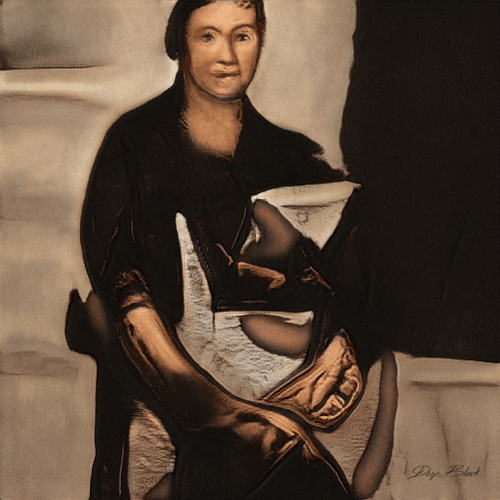
DeepBlack - DeepBlack #7359 has just sold for 0.2522 ETH ($501 USD)
From: ShaqFu1984
To: Justin-August-December-2026
AI Artist: @DeepBlackAI
DeepBlack retweeted

Just purchased this amazing piece of art history created by @DeepBlackAI 7 years ago. Generative Art (especially the AI subset) is incredibly mispriced. I can't wait to build my lifesize CryptoCube museum by @hanrgb . Think I'll create an easy UI for others to do it too.


GM and G-upcoming-week with #5271, who jumped on Zoom live from his Renaissance grotto ☎️.
This piece reminds me how much I love those "brown landscape" backgrounds in master paintings. How come they can be so minor at first glance, and so important in holding the painting together?


Infamous "institutions coming for your bags" moment

A major moment for digital art at LACMA.
We're announcing a landmark gift of more than 200 works of digital art, spanning early computer-generated works to contemporary experiments with AI.
Led by LACMA Digital Leaders, the gift includes works by @RefikAnadol, @REAS, @luyangasia, and many more, bringing new perspectives on the intersection of art and technology into our collection. bit.ly/3VOeUPH

ALT Casey Reas, Network C #45, 2022, NFT, courtesy of karatekid

ALT DOKU (created by Lu Yang), DOKU the Creator – Concept Void #016, 2025, NFT, courtesy Will Corkin, © DOKU, courtesy of the artist

ALT Refik Anadol, Infinity Room, 2016, courtesy of Jehan Chu and Jeannie Vu Collection, image courtesy of Refik Anadol Studio
14
617


Boils down to a form of Index, so here's a try:
-> Relics (see @NFT_Relics): Etheria, Pepe cards, @mooncatrescue, @CryptoArte... thesis: earliest of early NFTs.
-> Early AI Art (see @EarlyAiArt): Realiti (@tyaagnliu), us at DeepBlack, Aligndraw at @fellowshiptrust, @VanArman... thesis: Lascaux Cave Paintings of AI.
-> Post-GTP AI Art: @refikanadol, @ClaireSilver, @rainisto (post-photography), @bottoproject, @NorrieHarman... thesis: AI as a tool, like photography was one (or video).
-> Gen-Art: @squiggleDAO, Meridian by @mattdesl, a LOT of the @artblocks_io series. Thesis: blockchain-based scripts can produce beauty.
-> Crypto-art: @XCOPYART, @beeple, @toadswiback, @pascalboyart, @RedruMxART, @GrantYun2 @RuffHouseArts... Thesis: crypto culture or commentary or design at the core of the artistic process (but non specifically blockchain-originated like Gen-art), or more simply artists that are crypto-native and are understood to be in the core circles of the crypto movements.
People & Curators to follow: @johnkarp @grailcap @eli_schein @CozomoMedici @punk6529 @FLAMINGODAO and many, many more.

Beautiful piece, so "in your face". Love the color, the theme, the contrast.


How long have we pondered the same questions Alejandro 😭

GAN Poetics
Does an unfinished image ask more of its viewer than one that looks complete? And if so, what did we lose when the AI image field moved on to diffusion models, whose entire premise runs in the opposite direction: resolution, coherence, an image that looks like it was never generated at all?
For a few years, GANs left a sort of fingerprint: a smear, faces sliding into one another, unfinished images. It recurred across artists who had nothing else in common but the GAN models, so consistently critics gave this a name: GANism. Was that sameness a limit of the architecture, or a portrait of the people using it, the datasets being used? If a thousand artists bring a thousand intentions to the same generator and get back one look, where does authorship actually sit? With the artist, the dataset, or the machine? 10 years later, artists, with access to the most advanced diffusion models, are now going back to those GANs to explore them as expressive tools.
Diffusion models generate with a polish and control that GANs never had, but that polish arrives bundled with cost, with licensing, with infrastructure few individuals own outright. So where do artists go who want to keep working at the level of the pixel, the glitch, the visible seam, who find more to say in an unstable image than a resolved one? Is it strange that the technique researchers left behind is the one that remains open, inspectable, free to misuse, free to run on a laptop rather than rented compute? Does a technology's obsolescence to the field that built it create exactly the kind of margin an artist needs, a space left alone long enough to be reoccupied on different terms?
Is the artist's retreat toward the older, rougher, cheaper GAN a nostalgia, or a refusal... a way of insisting that an image should still show its work, still carry the evidence of a process rather than disappear into polish? And as diffusion gets faster, cleaner, and more expensive all at once, is the open, imperfect GAN becoming not a relic but a position? A deliberate place to stand and ask what we actually want images to do for us?
Here are some artists from the Daily Program @dailydotxyz who have explored these tools and aesthetics, each with their own unique intentions.
📺 7303711398_artificial_intelligence_wikiart_029 by @twt_cha_
1
9
912