

Just a curious guy sharing what I learn. Exploring the depths of finance, tech, web3, and ancient texts. Let's talk about what you're obsessed with.
Everywhere
Joined August 2025
- Tweets210
- Following39
- Followers47
- Likes342




My brain: Build the infinitely scalable, technically perfect App.
My users: Can you just make this one thing easier for me?
A daily reminder for everyone in the #buildinpublic space. The simple solution is almost always the right solution

1
8
120
Just spent an hour arguing with an LLM about system design.
It kept insisting on a solution that was technically perfect, but would have created a terrible user experience for our specific audience.
It's a powerful reminder: an AI can give you a "correct" answer, but it can't see the big picture. It doesn't know your users. Human intuition is still the most important part of the stack.
From a capital perspective, this was revolutionary. It was the creation of a decentralized central bank.
It gave the entire DeFi ecosystem a censorship-resistant, stable unit of account.
$DAI became a foundational building block for lending, trading, and yield farming—all without touching the traditional banking system.
1
64
The trade-off? The constant risk of black swan events causing under-collateralization.
Maker's true success isn't just its minting mechanism, but its robust governance and risk management systems run by $MKR holders.
It's a masterclass in crypto-economic design.
If this thread provided value:
1. Repost the first tweet to share the knowledge.
2. Follow me for more breakdowns at the intersection of code and capital.
367
DeFi is a multi-billion dollar ecosystem built on a simple, terrifying assumption: that a smart contract can know the real-world price of an asset.
But how?
The answer is the 'oracle problem,' and solving it is the entire thesis behind Chainlink's multi-billion dollar network.
$LINK @chainlink
1
10
357
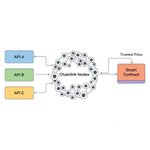
Chainlink's solution wasn't just a better API. It was a decentralized network of independent node operators.
• They fetch data from multiple sources.
• They aggregate it to find a consensus price.
• They are financially incentivized to report truthfully and are punished (slashed) for reporting false data.
It’s trust through crypto-economic security.

1
51
This technical solution for decentralized data unlocked the entire DeFi ecosystem.
Without trusted oracles, protocols like Aave and Synthetix simply could not exist. Chainlink doesn't just provide data; it provides the trust layer for billions in capital.
If this thread provided value:
Repost the first tweet to share the knowledge.
Follow me for more breakdowns at the intersection of code and capital.
1
46
I deleted my old X account when it hit almost 1,000 followers.
Why? Because I built it entirely on the "Follow for Follow" meta. The result was a ghost town—a high number with zero signal. An empty asset.
So I have a serious question for those still grinding F4F on X: What is the actual end game?
Are you building an audience or just inflating a number? A community, or an echo chamber of people who will never actually read your content?
I had to learn the hard way that a vanity metric is worse than no metric at all. It lies to you.
This is the type of code that lost The DAO $60 million.
It's called a reentrancy attack, and it's one of the most classic and devastating vulnerabilities in smart contract history.
It works like a classic bank robbery: the attacker withdraws funds before the bank can update their balance, allowing them to withdraw the same funds over and over.
2
8
387
The vulnerability lies in the order of operations.
Here's a simplified look at the vulnerable code versus the secure pattern. The difference is subtle, but it has secured billions of dollars in DeFi.
1
1
81
The fix is a simple but powerful design pattern: Checks-Effects-Interactions.
Check permissions.
Update the state (Effect).
Interact with the external contract.
By updating the balance before sending the ETH, the contract is no longer vulnerable to the attack loop.
What's the most subtle but dangerous smart contract vulnerability you've seen?
#SmartContracts #Security #DeFi $ETH
1
52
There are two types of builders:
The Architect: Spends weeks perfecting a beautiful, logical system design on paper before writing a single line of code.
The Brawler: Dives headfirst into the code, building features and figuring out the structure as they go.
I just spent a week as The Architect. My 'perfect' plan shattered within the first 100 lines of code.
Which one are you? And how do you balance the need for a plan versus the reality of building?
#buildinpublic
7
11
667
The Web3 community's obsession with maximum decentralization is killing mainstream adoption.
We treat decentralization as a binary switch (it's either decentralized or it's not) when we should be treating it as a spectrum.
From a capital flow perspective, money follows utility. If a user has to choose between a seamless Web2 experience and a clunky, expensive Web3 app, they will choose Web2 every time, regardless of the underlying ideology.
The optimal path for most protocols isn't 'decentralized from day one.' It's progressive decentralization: start with a centralized, user-friendly product to find product-market fit, then systematically cede control over time.
What's a core Web3 'truth' that you think we need to challenge?
1
7
141