





Daniel Mauricio Flores 🐲 retweeted

I deleted Linux completely, baked Qwen3-0.6B into a 24 KB pure x86-64 assembly OS, and it runs up to 54% faster than native Linux llama.cpp.
The entire Multiboot OS binary (asm-llm-os.elf) is 24,252 bytes, written from scratch without Linux, Windows, C, Rust, or libc. It boots in 74 to 94 ms straight into 64-bit Long Mode, wakes every CPU core over APIC, maps the 614 MiB Q8_0 weights directly from physical RAM, and drops you into a live multi-turn KV-cache chat over VGA, PS/2 keyboard, and serial.
I ran head-to-head CPU benchmarks against llama.cpp (Q8_0, -ngl 0) on the same AMD EPYC 7642:
- 1 thread hits 23.67 tok/s vs 16.63 (+42%)
- 4 threads hit 78.89 tok/s vs 51.08 (+54%)
- 8 threads hit 118.08 tok/s vs 80.79 (+46%)
- 16 threads hit 134.94 tok/s vs 103.03 (+31%, 136.6 peak)
On a diskless 0 GB Proxmox VM (2014 12-core Intel Xeon E5-2670 v3, 2 GiB RAM), it boots straight to the prompt in under 5 seconds (95 ms kernel boot) and runs live out of RAM at 78 tok/s decode and up to 111.5 tok/s prefill, with a hybrid BIOS+UEFI ISO builder included too. Output stays bit-exact across thread counts and matches all 64 greedy tokens against PyTorch FP32 (0.99965 cosine).
The 14.7 KB Linux ELF build (FAST_Q8=1 INT8xINT8 AVX2+F16C) also beats llama.cpp by 18% to 36% from 1 to 40 threads, and booting bare metal with 2 MiB huge pages squeezes out another 10% on top.
Repo, ISO builder, and Proxmox setup guide are in the reply below.


Daniel Mauricio Flores 🐲 retweeted

If the Generalized Riemann Hypothesis (the stronger version of the Riemann Hypothesis) is proven, these become proven facts:
Algorithms that no longer need randomness
- Primality testing: Miller's fast test becomes proven correct with no randomness
- Square roots mod a prime: becomes solvable fast and with no coin flips (today that's an open problem)
- Cube roots and other roots mod a prime: same.
- Factoring polynomials over finite fields: almost fast (quasi-polynomial) with no randomness, instead of needing randomness
- Building finite fields: you can construct any finite field directly, with no random search
- Factoring vs. φ(n): factoring a number becomes provably as easy as computing φ(n), even without randomness
- Primes with a given remainder: a prime with any allowed remainder mod q exists that's at most about q², so searching for one is fast
Complexity theory
- Polynomial equations: "does this system of equations have a solution?" drops from PSPACE to a much lower class (AM)
- Algebraic P vs NP: Valiant's algebraic version of P vs NP gets tied to the normal P vs NP over the complex numbers
- Turing machines: a known 744-state Turing machine is proven to run forever
Number theory software
- Math libraries: PARI/GP and Magma results computed "assuming GRH" become fully proven
- Class groups: algorithms that compute these number-field structures get guaranteed running times
- Elliptic curve generation: the algorithms used to create curves for crypto get guaranteed running times
Cryptography (no new attacks, only proofs)
- Elliptic curves: proven that if discrete log is hard on one curve, it's hard on almost all similar curves
- Lattice crypto: known quantum attacks on some lattice schemes become proven to work
- Isogeny crypto: known quantum attacks on some isogeny schemes get proven speeds
- Code-based crypto: schemes like BIKE get the guarantee that the special primes they need exist
Prime gaps
- Next prime: there's always one within about √p·log p of p, so "find the next prime" has a guaranteed worst case
What it does NOT do
- It doesn't solve P vs NP
- It doesn't make factoring easy, so RSA and elliptic-curve crypto stay safe
- It doesn't make anything faster in practice, because randomized versions already work today
- Ramanujan graphs, expanders and AG codes are unaffected: they use a finite-field version of RH that was proven decades ago

Daniel Mauricio Flores 🐲 retweeted

Long-horizon agents can automate tasks that take days or weeks, but much can go wrong. Kiran Prakash explains how durable execution allows agents to recover.
martinfowler.com/articles/du…

Daniel Mauricio Flores 🐲 retweeted

A Stanford professor just revealed:
"High cortisol damages your memory, enlarges your fear center, and makes your brain shrink"
Here are 8 protocols to lower it:
1. Walk barefoot
Daniel Mauricio Flores 🐲 retweeted

Building an Agentic Knowledge Graph for Billions of Events (Members only)
levelup.gitconnected.com/bui…
#MachineLearning #ChatGPT

Daniel Mauricio Flores 🐲 retweeted

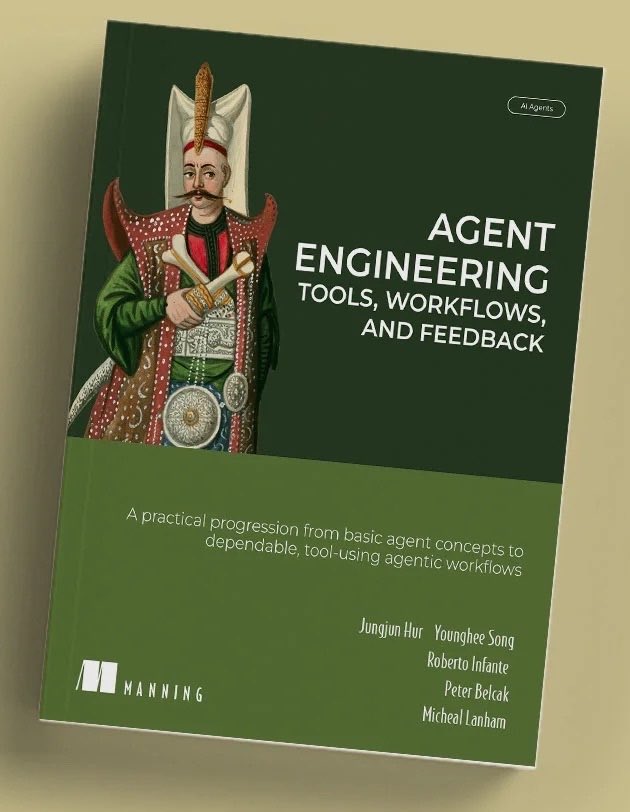
Download the @ManningBooks Agent Engineering ebook for free here: blog.manning.com/free-ebook-…
Daniel Mauricio Flores 🐲 retweeted

Anthropic engineer:
“Anthropic hired me at $350K–$950K because I know how to build harnesses.
99% of people still hand-roll multi-agent systems and wonder why they break.
I build systems that run loops + sandbox tools + turn yesterday’s logs into new skills — same model, 10x more reliable agents that keep improving overnight.”
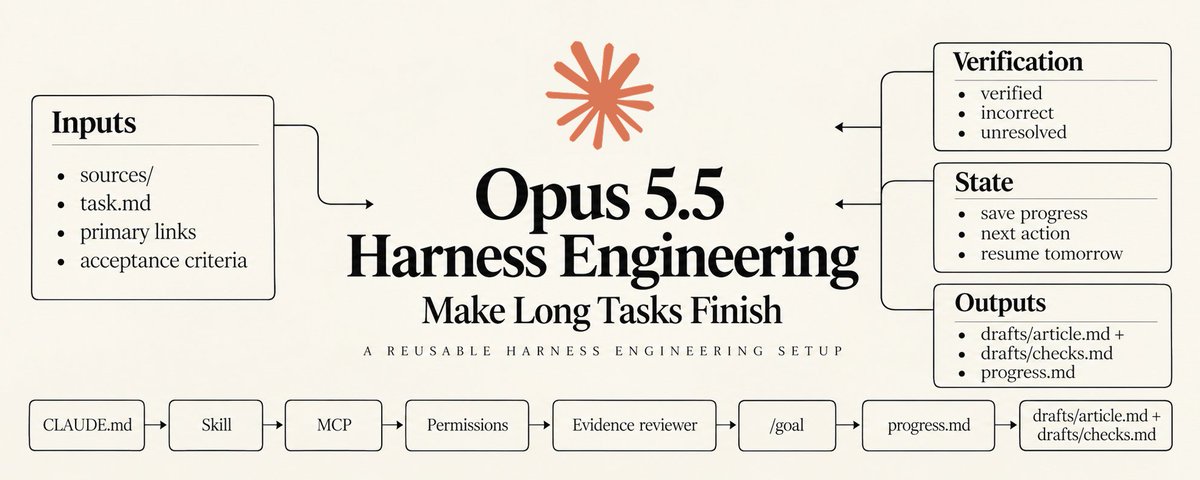
Opus 5.5 → Agents → Harness → Loops → Graphs
In a short workshop, he shows exactly how to build one from scratch.
step 1 → harness handles loops, context, and sandboxing
step 2 → brain and hands separated — 60% faster to first token
step 3 → runs server-side, resumes from the log after crashes
step 4 → failure is cheap — retry and replay instead of starting over
step 5 → yesterday’s logs become new memory — the system wakes up smarter
Anthropic calls this “dreaming”.
Most people spend weeks building this by hand.
You don’t have to.
Bookmark and watch it.
Then read the full Opus 5.5 harness engineering guide below ↓

Daniel Mauricio Flores 🐲 retweeted

AI agent engineering is about to be the highest-paid skill in tech.
Everyone's building AI agents. But almost nobody understands how to give them memory across conversations & sessions.
Master these 7 memory types and you'll be in the top 1% of AI engineers. 🧵
Daniel Mauricio Flores 🐲 retweeted

Watch Episode 1 of our Odyssey series made with Grok Imagine.
Let us know in the comments if you'd like a full breakdown of how it was done!
Creative collaboration with @WonderStudiosX and director Dev Walker @glumlot_
Daniel Mauricio Flores 🐲 retweeted

We believe voice is the most natural way to interact with intelligence, so we created Dessa, the most authentic full-duplex speech model ever built. Talking with it feels like talking with a person…full of emotion, nuance, pauses, and a natural cadence.
block.xyz/dessa

Daniel Mauricio Flores 🐲 retweeted

There exists a martyrdom of those who offer their lives in a single moment, and the more hidden martyrdom of those who give their lives day after day. This is exactly what all Christians are called to do: to give our lives with love, every day.
Daniel Mauricio Flores 🐲 retweeted

Crítica de Benedicto XVI al capitalismo salvaje y su idolatría del lucro:
Daniel Mauricio Flores 🐲 retweeted

The rollout of Pope Leo’s AI Encyclical, Magnifica Humanitas (Magnificent Humanity), was the most underreported story of the year. He personally presented the document at a Vatican press conference, an unusual move for a Pope.
He knew the significance of AI.

Daniel Mauricio Flores 🐲 retweeted

“We live in the age of search engines that offer us thousands of instantaneous answers. Yet, no matter how powerful they may be, they merely return what already exists and tend to give us what we already want. In the age of technology and consumerism, the great danger is not only censorship but also homogenization, and not merely imposed silence but the noise that makes it impossible to listen.
“Art is a different kind of ‘search engine.’ It does not proceed by indexing but by inquiry. Indeed, its inquiry is a focused attention that is not satisfied with the mere sum of facts, for it never ceases to dig deeper, seeking the thread that unites them. Your art, when it resists homogenization, when it draws our gaze, when it compels us to pause before that which cannot be consumed, is a form of cultural and spiritual regeneration.” — Pope Leo XIV
Daniel Mauricio Flores 🐲 retweeted

Explaining the Catholic Church to Godless AI researchers:
Imagine a lab thats spent 2000 years working on alignment
Daniel Mauricio Flores 🐲 retweeted

The year is 2026. San Francisco tells the Vatican it has the power of God to put a soul in a computer program.
The last Crusade begins.
🤖 Made with AI
Daniel Mauricio Flores 🐲 retweeted

A única pessoa que vi fazendo discurso decente sobre IA realmente é o papa.
Ele não diz só "não use"
"Use de maneira de que se a IA desaparecer amanhã, vc ainda saiba pensar... criar, existir."
