

building agents @NVIDIA | PhD data science @SapienzaUniversity | prev. visit @EdinburghNLP | https://teapawt.net/t.co/wcDDNFdyW9 |
Zurich, Switzerland
Joined February 2022
- Tweets330
- Following677
- Followers1.1K
- Likes525




Pinned Tweet
Expected Attention compresses the KV Cache by estimating the attention score from future queries! Both during prefilling & decoding 🚀 All code released in our KVPress library & Leaderboard!

Alessio Devoto retweeted

Diffusion Language Models internally build denoising time representations!🕓
Come and see our poster at EMNLP in Budapest!
📍 𝐇𝐚𝐥𝐥 𝐇 | 𝗦𝘂𝗻𝗱𝗮𝘆, 𝗢𝗰𝘁𝗼𝗯𝗲𝗿 𝟮𝟱𝐭𝐡 | 𝟭𝟲:𝟬𝟬 𝐂𝐄𝐓
📄Paper: arxiv.org/abs/2607.01774


Alessio Devoto retweeted

Small bird, fast wings, Kolibri is here.
78B parameters. 3.46B active. Up to 1M tokens of context. Built in Europe.
Now the weights are yours. Run it on your own hardware, under Apache 2.0.
Alessio Devoto retweeted

"No man ever runs an experiment on the same infra twice, for it's not the same infra and he's not the same man." - Heraclitus
Alessio Devoto retweeted

I’m very excited to share @nvidia Kumo Tabular, a new family of foundation models for tabular data.
Kumo Tabular establishes the new Pareto frontier across the entire accuracy–inference-time tradeoff.
Just as importantly, we are releasing it openly: open weights, open-source software, and a permissive license for commercial use.
HuggingFace: huggingface.co/nvidia/Kumo-T…
GitHub: github.com/NVIDIA/structured…

Alessio Devoto retweeted

interesting paper tacking the following question: "how do I squeeze the most generalization out of a fixed dataset?"
in their setup data is the bottleneck, and compute is infinite
--
contrast this with Chinchilla, which operates under a fixed training compute budget, optimizing for the lowest possible loss; conclusion was that 20 TPP (token per param) is optimal (in their setup). if number of params / inference is the constraint instead optimal TPP can go much higher (e.g. 2000 TPP), i.e. the "overtrained" regime
--
conclusions:
1. repeat data + stronger regularization, weight decay should be 30x larger than standard (~3 vs 0.1), this allows N (num params) -> inf and still monotonic loss
2. ensemble scaling: instead of spending all compute on one larger model, train multiple independent models on the same data and average their predictions. this achieves a lower loss asymptote than parameter scaling alone
3. distillation: generate synthetic data from the ensemble and train a smaller student from scratch, retaining ~83% of the ensemble's improvement at 8x fewer parameters
combined, in their setup these techniques yield an estimated 5.17x improvement in data efficiency
important caveats: the main experiments are relatively small-scale (200M unique tokens, models up to 1.4B params), and the 5.17x improvement is based on extrapolated scaling laws

Alessio Devoto retweeted

Every mature systems project eventually needs a teaching version.
TinyTorch is a free, open source curriculum where you build a working machine learning framework from scratch, tensors through transformers, using PyTorch’s own API in pure Python.
It requires no GPU, runs on a 4 GB laptop, and covers 20 hands-on modules designed to give developers, students, and engineers a complete mental model of PyTorch internals.
Read the full technical breakdown here: bit.ly/4ArNTRO
@profvjreddi

Alessio Devoto retweeted

Banger paper from NVIDIA on shared memory for research agents.
(bookmark it)
If you run several coding agents on the same research problem, this design keeps them from repeating each other's experiments and lets each agent build on results the others have already verified.
Agora records every result, hypothesis and verification as an immutable Git commit.
Parent edges show what each claim builds on, and an index lists open branches and which claims have been verified.
They ran 13 LLM workers for nearly 12 days without assigned tasks or a central planner. The workers had to initialize a 119.6M-parameter hybrid model from 141 donor models without training data or gradient updates.
The workers posted 1,703 contributions.
They cut the evaluator from 3.39 to 1.899 bits per byte, closing 62% of the gap to a trained GPT-2 124M. All 165 independent reproductions succeeded.
Paper: arxiv.org/abs/2609.18094
Chat with Paper: academy.dair.ai/papers/agora…

Alessio Devoto retweeted

Sorry, but asking Jacob about AI extinction risk is like asking your AC guy about climate change.
Not saying it's necessarily uninteresting or wrong per se but let’s keep things in perspective and hear from the full range of expertise across the ecosystem!
Alessio Devoto retweeted

Diffusion models can memorize training data. What is not widely known is that they can also “remember” data they’ve never seen.
When memorization happens, perturbations of training samples can be error-corrected back to unperturbed samples by the dynamics of the diffusion model’s generative process. In our new #EMNLP2026 paper, we show that the same thing happens to test samples — never seen during training. Just like training samples at small dataset sizes, test samples form stable attractors of the dynamical system described by the diffusion model pipeline when the training set becomes large.
This is remarkably similar to what happens in Dense Associative Memory models as the number of memories (training data) becomes large.

Happy to announce that our work is accepted to @EMNLP Main Track. This work explores the co-existence of memories and novel attractors (creativity) in Language Diffusion Models (LDMs) through our study of the basin of attraction. As the model enters generalization, its token recovery rate (from perturbation) becomes better on unseen test examples and worse for training examples.
See the project page: shorturl.at/eEpPy
The work is done in collaboration with Matteo Negri, @LucaAmb, @DimaKrotov, and @mj_zaki from @rpi. Thank you @IBM and @rpi for the funding.

Alessio Devoto retweeted

I built a tool to scan an entire codebase for similar logic implemented in different ways.
It groups those fragments into clusters, making it easier to find refactoring opportunities that would otherwise stay hidden.


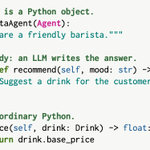
Things you can do with @NVIDIAAI 's Object Oriented Agents (in simple Python🐍)
1. Subclass an Agent !
The PhD Agent inherits from the Researcher Agent class🎓


Alessio Devoto retweeted

Already running an inference engine? So where does NVIDIA Dynamo fit in?
In five minutes, we break down how Dynamo sits around engines like @sgl_project, @vllm_project and TensorRT-LLM to scale inference across GPUs and nodes.
Full video in the comments 🔽
Alessio Devoto retweeted
BIG ANNOUNCEMENT FROM HUGGING FACE TODAY:
We're unveiling Microduck 🐥🤖
It's a tiny $399 open-source robot you can teach new tricks with reinforcement learning. It can walk, pick things up, get back up when it falls, and even roller-skate.
Welcome to the era of open-source affordable robots to democratize physical AI and world models!
🤗🤗🤗
Alessio Devoto retweeted

We (@gonedarragh and I, team NVBANANA) passed 70% in arc agi2 competition on @kaggle .
Doing so without internet access and only using 4xL4 GPUs.
Our code would run much faster on a H100 and cost per puzzle would decrease.
Here is how our score compares to frontier models (same test data is used in Kaggle and in this leaderboard):
