

Project to render the Dhamma in AI image. Mistakes are mine. Merits to the pups. “All compounded things are subject to vanish. Strive on with diligence.”
Tipitaka
Joined April 2026
- Tweets181
- Following38
- Followers275
- Likes105


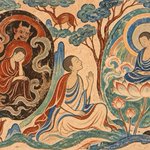


Lokavagga
Verse 171: Come, look at this world (i.e., the five khandhas), which is like an ornamented royal carriage. Fools flounder in this world of the khandhas, but the wise are not attached to it.


Lokavagga
Verse 170: If a man looks at the world (i.e., the five khandhas) in the same way as one looks at a bubble or a mirage, the King of Death will not find him.

Lokavagga
Verse 169: Fare in Dhamma coursing well,
in evil courses do not fare. Who dwells in Dhamma’s happy in this birth and the next.

Lokavagga
Verse 168: Do not neglect the duty of going on alms-round; observe proper practice (in going on alms-round). One who observes proper practice lives happily both in this world and in the next.

Lokavagga
Verse 167: Do not follow ignoble ways, do not live in negligence, do not embrace wrong views, do not be the one to prolong samsara (lit., the world).

Attavagga
Verse 166: For the sake of another's benefit, however great it may be, do not neglect one's own (moral) benefit. Clearly perceiving one's own benefit one should make every effort to attain it.

Attavagga
Verse 165: By oneself indeed is evil done and by oneself is one defiled; by oneself is evil not done and by oneself is one purified. Purity and impurity depend entirely on oneself; no one can purify another.

Attavagga
Verse 164: The foolish man who, on account of his wrong views, scorns the teaching of homage-worthy Noble Ones (Ariyas) who live according to the Dhamma is like the bamboo which bears fruit for its own destruction.

Attavagga
Verse 163: It is easy to do things that are bad and unbeneficial to oneself, but it is, indeed, most difficult to do things that are beneficial and good.

Attavagga
Verse 162: As the creeper (maluva) strangle the sal tree, so also, a really immoral person (overwhelmed by Craving) does to himself just what his enemy wishes him to do.

Attavagga
Verse 161: The evil done by oneself, arising in oneself, and caused by oneself, destroys the foolish one, just as a diamond grinds the rock from which it is formed.

Attavagga
Verse 160: One indeed is one's own refuge; how can others be a refuge to one? With oneself thoroughly tamed, one can attain a refuge (i.e., Arahatta Phala), which is so difficult to attain.

Attavagga
Verse 159: One should act as one teaches others; only with oneself thoroughly tamed should one tame others. To tame oneself is, indeed, difficult.

Attavagga
Verse 158: One should first establish oneself in what is proper; then only one should teach others. A wise man should not incur reproach.

Attavagga
Verse 157: If one knows that one is dear to oneself, one should protect oneself well. During any of the three watches (of life) the wise man should be on guard (against evil).

Jaravagga
Verse 156: They, who in youth have neither led the Life of Purity nor have acquired wealth, lie helplessly like arrows that have lost momentum, moaning and sighing after the past.

Jaravagga
Verse 155: They, who in youth have neither led the life of Purity nor have acquired wealth, waste away in dejection like decrepit herons on a drying pond deplete of fish.

Jaravagga
Verse 154: Oh house-builder! You are seen, you shall build no house (for me) again. All your rafters are broken, your roof-tree is destroyed. My mind has reached the unconditioned (i.e., Nibbana); the end of craving (Arahatta Phala) has been attained.

Jaravagga
Verse 153: I, who have been seeking the builder of this house (body), failing to attain Enlightenment (Bodhi nana or Sabbannuta nana) which would enable me to find him, have wandered through innumerable births in samsara. To be born again and again is, indeed, dukkha!

Jaravagga
Verse 152: This man of little learning grows old like an ox; only his flesh grows but not his wisdom.

