
Figuring things out slowly.
P{Boston=.8,DC=.2}
Joined March 2021
- Tweets73
- Following410
- Followers945
- Likes1.7K


Pinned Tweet
I wrote a short blog on my experience testing Jev on reasoning-intensive regression problems. The results are within expectations (Jev is focused on classification after all), but the model has great attributes and is wicked fast! Read about it here: dianetc.com/musings/jev/
Diane retweeted

an increasingly important question is going to be: is your retriever good at tip-of-the-tongue queries?
Not because you'll often encounter them in the wild, but because they capture how deeply your model understands intent.
@dianetc_ was ahead of the curve here
Diane retweeted

Is Jev secretly learning a Value function?
A model can always choose “A” without being certain that “A” is correct. That distinction matters when an agent must decide whether to act fast or switch to deeper reasoning.
We spent some time exploring:
1. How Jev fits into System 1/2 decision-making and why calibration matters for knowing when to switch
2. Why maximising expected reward in RL does not guarantee calibrated probabilities.
3. How predicting eventual task success in agentic tasks connects to a familiar RL quantity: the Q-function.
Could value prediction help build a calibrated System 1—and could that be part of the story behind Jev?
Link: souradip-chakraborty.github.…
#Jev #RLCD #System1

Diane retweeted

Not quite the efficiency envelope of Jev but for flexible (and reasoning-intensive) regression check out @dianetc_ and @lateinteraction 's paper: dl.acm.org/doi/10.1145/37863…

Diane retweeted

incidentally and on a more serious note, @dianetc_ and i have wondered for some time if RL for reasoning followed by a regression head could beat verbalized regression - i'm still curious about this kind of reasoning-intensive regression
arxiv.org/abs/2508.21762

Diane retweeted

People realizing again that although you can cast any task to generative tasks, it does not mean that generation is the best paradigm for all tasks
Diane retweeted
A major retrieval use case is web search
It is very specific and existing benches fall short at evaluating it
Today, we introduce Q2D-Web, composed of 190M documents, 70k agent-rewritten queries and deep annotations!


We're introducing Q2D-Web (Query2Doc-Web), a benchmark and public leaderboard for evaluating retrieval in agentic RAG systems.
Q2D-Web tests how embedding models perform on large-scale web search using agent-reformulated search queries.
Read more: perplexity.ai/hub/blog/q2d-w…

Diane retweeted

🔥 Information Retrieval in 2030 🔥
@lateinteraction at VLDB
Extremely excited about OBLIQ and the call for more ambitious search benchmarks! 🚀
And who isn’t excited about the progress in late interaction engines? ⚡️


Diane retweeted

Mixedbread is retrieval infrastructure for AI agents to find the right evidence across text, PDFs, tables, images, audio, and videos.
We process millions of documents and searches every week. Our control plane runs on @planetscale Metal.
→ 0.05 ms p99 for our busiest access-control query
→ under 1.5ms p99 over every hot query pattern
→ faster debugging with Query insights and agent integrations

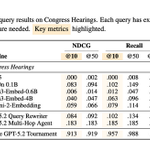
Awesome blog! And they evaluated on the congress ToT split of OBLIQ-Bench

Scaling Test-Time Compute is the easiest way to get higher quality outputs from AI systems, but it comes at a cost! ⚖️
How much extra compute you want to trade for quality depends on your application.
Introducing the effort parameter in Search Mode, giving you the power to control this tradeoff!
Choose between “medium”, “high”, and “ultrahigh”.
🚀 Search Mode with ultrahigh effort achieves X nDCG@10 averaged across 5 subsets of the BRIGHT benchmark, improving by Y over medium effort and Z over hybrid search alone.
Learn more in our latest blog post: weaviate.io/blog/search-mode…

Last fall, I spent a while trying to get a better understanding of the information retrieval (IR) landscape. This mostly involved a lot of research conversations, some half-baked ideas, and, for a while, not much tangible research progress.
With OBLIQ-Bench being a few months old, I wanted to write a short blog post about what led to its creation, what it says, and what I think should come next!
check it out: dianetc.github.io/musings/ob…


Diane retweeted
.@dianetc_ has a paper on this, called Reasoning-intensive Regression: arxiv.org/pdf/2508.21762
the problem *is* solvable but not the way you think

Diane retweeted

Transformers struggle to generalize to tasks they were not explicitly trained on. Instead, we propose in 2026 that it is the job of the harness to generalize through composition.
We observe a powerful property when training RLMs: for tasks with shared structure that look different, the root model naturally learns the same trajectory, meaning it views the two task trajectories as the same! In other words, the Transformer does not need additional generalization capabilities to transfer capabilities from one task to the other, the harness induces it.
We find that well-designed harnesses form a quotient set over task trajectories, meaning their individual LLM calls can see structurally “similar” tasks as near-identical, token-for-token! Harnesses can effectively generalize for the Transformer during training, without relying on any intrinsic generalization capability from the model.
For example, RLMs can see problems of different lengths as the same: we show that RLMs can train exclusively on short tasks, and fully generalize to similar but unseen tasks 8-32x longer because it produces near identical trajectories for both.
Taking this further, we show that tasks across different domains (e.g. math solutions vs. essay writing) that share a decomposition strategy exhibit the same generalization effect. RLMs can train on the problem of finding which essays belong to the same author and improve performance on finding math problems that share similar solutions.
The full blogpost, experiments, and discussion are in the thread below.

Diane retweeted

Arbitrary live-migration of full VMs!!! No small feat from @NirvikBaruah @charley3c
Nitty-gritty on how they did it:
sailresearch.com/blog/perfor…

Diane retweeted

Continual learning is widely discussed right now, but mostly as improving on the job or avoiding catastrophic forgetting. But it has a different, difficult, and already urgent form:
Given nothing but a corpus of documents, how should AI systems develop expertise in a new, unfamiliar domain? We call this problem Machine Studying.

Diane retweeted
🚨Typical RL algorithms and on-policy distillation methods are blind samplers: they use privileged info to score rollouts, but not to *find* them.
We ask: can we use privileged info to *actively sample* the rollouts RL wishes it can stumble upon with compute?
⤵️ Pedagogical RL

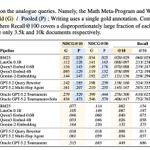
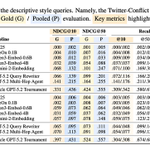
We set out to build a better retriever, so we looked for the hardest IR benchmarks.
For each, we asked how much headroom remained by running oracle reranking with a frontier LLM. Most had little room left!
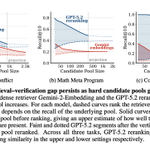
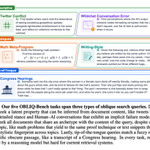
So we built OBLIQ-Bench to study much harder search queries than before.


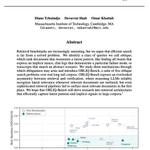
Paper (with a link to the dataset): arxiv.org/abs/2605.06235
Thank you to my advisors, @lateinteraction and @devavratshah, for all the support on this!