
Assistant Professor, CS & IDS, The University of Hong Kong. Previous CS PhD student at UCLA.
Hong Kong
Joined June 2018
- Tweets108
- Following125
- Followers660
- Likes228





Some recent discoveries with my student! We try to perform some "simple scientific understandings" regarding the LLM training and will release a series of blog!

(1/6)
Weight decay has a direction, too.
We usually tune its strength. For matrix weights, we can also choose how shrinkage is distributed across singular modes.
New blog with my advisor @difanzou :
Rethinking Weight Decay
doodlext.github.io/blog/reth…
2
13
840
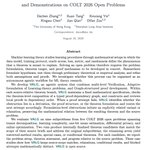
We open sourced VALG, an agentic system for automated ML theory research that turns the real "iterate and revise" rhythm of theoretical work into a structured workflow.
A key feature is joint problem solving and problem (re)formulation. VALG iterates between adjusting assumptions and deriving proofs in a unified loop. When a theorem cannot be fully established, it produces a well scoped relaxation or special case while keeping the mathematical link to the original question explicit.
We tested it on 5 COLT 2026 open problems, running 9 subproblems and producing 22 theorem candidates. Two were fully solved, and the remaining seven were partially resolved via relaxations or restricted settings.
We are also building a benchmark for ML theory automation, with initial results suggesting around 80% of arXiv 2026 theory papers can be handled end to end. Future directions include human AI proof alignment and systematic data collection.
That said, AI is not replacing researchers yet. Problem formulation, key constraints, and final delivery still require human judgment. VALG helps with rapid validation and identifying which directions are worth pursuing and can give positive outcome.
Try it, file issues, and help us improve.
GitHub: github.com/DechenZhang/ml-th…
arXiv: arxiv.org/pdf/2608.13060


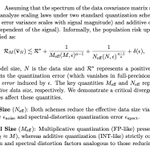
Excited to introduce our recent work on deriving the scaling laws for precision in high-dimensional linear regression!!
Low-precision training is standard for efficient LLMs, yet the theoretical mechanisms governing its scaling have remained unclear. In our new work, we introduce a unified theoretical framework based on high-dimensional sketched linear regression (see arxiv.org/abs/2406.08466) to derive precise scaling laws .
By modeling quantization as a spectral transformation, we follow our previous work on low-precision training for linear regression problems (see arxiv.org/pdf/2510.18259), derive the excess risk bound (both lower and upper) as a function of model size, dataset size, and quantization errors, which bears similarity with the empirically found scaling law for precision in arxiv.org/abs/2411.04330.
Technically, our result reveals a fundamental dichotomy for two types of quantization:
Multiplicative Quantization (e.g., FP8): Our theory shows this acts as signal-dependent noise but preserves the effective model capacity (size of the model). This explains the empirical robustness of floating-point formats during scaling.
Additive Quantization (e.g., INT8): In contrast, this scheme acts as a signal-independent floor that strictly reduces model capacity. It effectively "flattens" the spectral tail, rendering those parameters useless for learning.
Despite these differences, we prove that both schemes degrade the effective dataset size ($N_{\text{eff}}$) through noise amplification.
Future Work: The low-precision trainingdepends on the optimizers; we are working on understanding and developing theory for various optimization algorithms (e.g., Adam, Muon, etc) under the low-precision quantization regime! Open to any discussion on the related topics!
Paper link: arxiv.org/pdf/2602.19241
Joint work with Dechen Zhang, Xuan Tang, and Yingyu Liang


We are excited to share our latest work on the implicit bias of stochastic steepest descent!
While optimizers like Adam and Muon, variants of steepest descent under different norms, are popular for large-scale pretraining, their theoretical behavior under mini-batch stochastic gradients has remained elusive. We provide a unified analysis of how batch size, momentum, and variance reduction shape the solutions these algorithms find.
Key findings:
🔹 No Momentum: Convergence to the (approximated) max-margin solution requires large batches. Small batches fail to recover the full-batch implicit bias.
🔹 Momentum: Acts as a stabilizer! It enables convergence to the max-margin solution even with small batches, though at a slower rate.
🔹 Variance Reduction: A better fix, it recovers the exact full-batch implicit bias regardless of batch size or momentum.
🔹 Small Batch Size (B=1): In the extreme case (per-sample updates), the implicit bias fundamentally changes, which provably cannot be explained by standard max-margin solutions.
We believe thoroughly understanding these algorithms in theory is crucial for developing the foundation of large model training, and our work provides the initial attempts along this line.
Paper: arxiv.org/abs/2602.11557
Joint work with Jichu Li (fantastic undergrad student) and Xuan Tang (genius grad student).

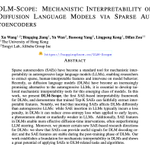
1/4 We are excited to introduce DLM-Scope: the first mechanistic interpretability framework for Diffusion Language Models (DLMs) using Sparse Autoencoders!
We develop SAE training and inference for open-source DLMs: Dream & LLaDA, providing new ways to inspect these models.


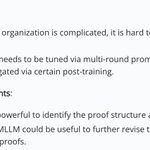
We are trying to include a proof diagram (see the following example) in my theoretical papers, which is generated via using LLM to (1) parse the paper to understand the proof structure; and (2) generate latex code to draw the diagram. We hope this can make our proof clearer 😆😆.


1
14
804

The course will add more advanced topics next semester, including generative AI and some in-context learning and reasoning studies! All course materials will be released to the public.

【🔥Graduate course on data mining - DATA8003 " Theoretical Foundation of Deep Learning" by Profs Yingyu Liang & Difan Zou🙌】
View the course syllabus here: datascience.hku.hk/data8003/
Dive into the theoretical tools & methods of DL w/ our IDS professors!👻
#HKU #hkudatascience

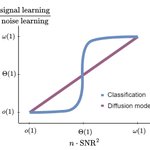
Our new paper studies how the neural network performs feature learning in training diffusion models with the denoising score matching loss.
Arxiv: arxiv.org/pdf/2412.01021
Joint work with Andi Han, Wei Huang, and @_YuanCao_ .

On the Feature Learning in Diffusion Models ift.tt/hYQCukc


Joint work with Miao Lu, Beining Wu, and Xiaodong Yang. We discuss the behavior of the oscillation of SGD and its effect on the generalization. Comments are welcomed!
Benign Oscillation of Stochastic Gradient Descent with Large Learning Rates. (arXiv:2310.17074v1 [cs.LG]) ift.tt/B7x5uI9
What the benefit of implicit regularization of SGD compared to the solution with explicit regularization? Can SGD be guaranteed to perform better when using the same or even a much smaller sample size? Come to check our #NeurIPS2021 paper on Dec. 9, 4:30pm PT, Session 7, Spot B3.
Joint work with @uuujingfeng, Vladimir Braverman, @QuanquanGu, Dean Foster, and @ShamKakade6.
Paper link:arxiv.org/abs/2108.04552
Poster Link:neurips.cc/virtual/2021/post…
5
Looking forward to presenting my ICML paper (joint work with @sfrei_ and @QuanquanGu) on the agnostic learning of robust half-spaces via adversarial training algorithms icml.cc/virtual/2021/poster/…. Welcome to Poster Session 3 (room 5) tomorrow to discuss and share your thoughts!

Please come and join @sfrei_ ’s long talk tomorrow on agnostic learning of half spaces with soft margin. We will also present two other papers on agnostic learning of one-hidden-layer NNs and adversrial training. Joint work with @difanzou and @_YuanCao_ .
Always coffee + diet coke

Reflection of the day: over the years my deadline mode snack has changed from potato chips and coke to organic carrots and herbal tea! I'm getting older or wiser? or as someone put it: more conservative! :D #NeurIPS2021 #selfcare
3
Really excited to be part of this project!

The first "academic" product from the #COVID19 Forecast Hub is up at medrxiv, a huge collaborative effort including folks from @CDCgov and many academic and industry research groups:
medrxiv.org/content/10.1101/…
Updated forecasts and more info available here:
covid19forecasthub.org/


6
Welcome to our website covid19.uclaml.org for more results!

UCLA machine-learning model is helping the @CDCgov predict the spread of COVID-19. ucla.in/2TfPAyG

ALT Professor Quanquan Gu sits at a laptop reviewing the COVID-19 model his team developed. Photo by Yunxian Liu
I am presenting my paper "On the Global Convergence of Training Deep Linear ResNets" on zoom now. If you are interested, please join and share your thoughts. #ICLR2020 @QuanquanGu @philipmlong
iclr.cc/virtual/poster_HJxEh…
We have made a prediction about the peak of active cases in LA, it shows that the peak will be at 5/24/2020 based on the data before 4/9/2020. More detail can be found in covid19.uclaml.org.


@lapublichealth Announces 55 New Deaths Related to #COVID19 and 399 New Cases of Confirmed COVID-19 in Los Angeles County. 10,854 positive cases of COVID-19 across all areas of LA County and a total of 455 deaths. View bit.ly/2yop9PD for more.

4
How to efficiently train deep and large graph convolutional networks? Come and check our #NeurIPS2019 poster tomorrow (Thu 10:45 AM @ East Exhibition Hall B + C #63) on the efficient training of GCN. Joint work with Ziniu Hu, Yewen Wang, Song Jiang, @YizhouSun, and @QuanquanGu.

Come and check our #NeurIPS2019 poster tomorrow (5:30 PM @ East Exhibition Hall B + C #160) on Hamiltonian Monte Carlo. We propose a new sampling algorithm that provably converges faster than all existing HMC-type algorithms. Joint work with @PanXu_CS and @QuanquanGu.

Come and check our #NeurIPS2019 poster tomorrow (10:45 AM, East Exhibition Hall B + C #135) on training over-parameterized DNNs. We significantly improve the previous results in terms of both over-parameterization conditions and convergence rates. Joint work with @QuanquanGu.

