







Pinned Tweet
Every Bitcoin bull run has been smaller than the last.
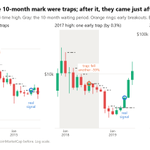
539x → 112x → 21x → 7.9x, from each cycle's low to the next top.
I've followed Bitcoin's four-year cycle for years. Going into this one, I'm more cautious. Here's why, chart by chart. 🧵

Worst planned case: about -27%. Best of these scenarios: about +92% after tax.
That's a long way from the 10x and 100x cycles of the past. There may be one more worthwhile cycle. Worth a small bet, not a big one.

The details that didn't fit here are in the full post: why I sell 35 months after the low instead of at the first top (it beat that in every cycle), why I'm spreading the buys, and the caveats.
docsulo.com/why-im-cautious-…

16 Years of "Be Your Own Bank":
2010: Store it on your PC! (Hard drive crashes, thrown in a landfill, 8,000 BTC lost forever.)
2014: Leave it on an exchange! (Mt. Gox loses 850,000 Bitcoin to a multi-year breach.)
2015: Print a paper wallet! (BitAddress JS RNG flaw exposes private keys to instant drainage.)
2019: Use a secure cold-storage exchange! (QuadrigaCX founder dies, $190M in customer funds vanishes.)
2020: Buy a hardware wallet! (Ledger database leak exposes 270k home addresses to physical threats.)
2022: Earn yield on your coins! (FTX, Celsius, and BlockFi implode; $10B+ erased.)
2024: "Not your keys, not your coins!" (Sign one bad Web3 transaction approval, wallet drained in seconds.)
2026: Buy an air-gapped, ultra-hardened Coldcard! (Predictable RNG firmware bug drains $70M from seeds generated on the device).
16 years in, and keeping your own Bitcoin secure still requires a computer science degree and pure luck. But sure--it's definitely going to be peer to peer global internet self-custody cash someday.
Doc Sulo retweeted

I can't keep my BTC on centralized exchanges because they might go bankrupt or freeze withdrawals.
I can't keep my BTC in hot software wallets because my laptop might get hacked.
I can't keep my BTC in cold hardware wallets because there could be a bug on the manufacturer's side that exposes my seed phrase.
I can't deploy my BTC in DeFi because there's like a new eight-figure hack every month.
So where am I supposed to keep my BTC?
The Evolution of the Bitcoin Narrative
2009: Bitcoin will be peer-to-peer digital cash that people send to each other anywhere in the world, instantly, without intermediaries, for a fraction of a cent in network fees.
2014: Okay, base-layer transactions are getting slow and expensive, but that's fine! It’s not meant to buy coffee... it’s Digital Gold and a store of value to protect you from central bank money printing.
2017: Mainnet self-custody is too expensive for micro-payments, but that’s why we have The Lightning Network! You just need to run a routing node, manage channel liquidity, and set up watchtowers!
2021: "Not your keys, not your coins!" Stop leaving money on exchanges! Self-custody is the only path to sovereignty... unless you lose your seed phrase, use a flawed key generator, get drained by a phishing link, or mess up a string of characters. Then you just get ripped off and your money is gone forever.
2024: Self-custody is clearly too complicated and dangerous for 99% of normal human beings... but that's why we have Spot ETFs and corporate treasuries! Now Wall Street mega-custodians hold the real Bitcoin in vaults, and you just buy paper claims in your 401(k)!
2026: See? Wall Street ETFs, corporate mega-whales, and centralized custodians holding the keys, issuing paper claims, and charging management fees while almost no one uses it as digital cash and every real-world transaction triggers a capital gains tax form--is exactly what Satoshi envisioned in the whitepaper! We did it!
I'm happy this controversy on the Odyssey is happening because it has helped me crystalize what has bothered me for a while about Hollywood (way before this movie)...
When defenders online on X.com and Facebook.com scramble to justify gutting classic stories, they love to fall back on two quick excuses... First, when adapting ancient or legendary material, they claim changing core characters and themes is just "continuing a fluid tradition." More broadly, they hide behind a blanket shield statement like, "Screenplays always change things. It's totally normal."
The second point is true on the surface-- screenplays DO adapt source material. But that’s where the actual debate begins since there is a massive difference between translating a story into a new medium and brand hijacking.
Take the continuing fluid tradition (aka oral changes) excuse for Homer:
The fact is, after centuries of oral experimentation, those specific versions of the Iliad and Odyssey were written down and have remained the fixed canon for over 2,700 years. And for 2,700 years, that exact version has entertained every generation without needing to be "rewritten." And the oral process wasn't an endless free-for-all. It was a long process of fine-tuning that STOPPED the moment it hit peak form and was written down. It survived 27 centuries in that written form because that captured version was so masterfully executed that it didn't need an overhaul.
Which brings us to the broader claim that "directors and screenplays always change things."
Historically, the talent of a great director, whether staging classical theater or adapting a book for the screen, was the ability to bring the story, characters, and world to life. More than that, a truly great director uses the medium to draw out the deeper layers of meaning embedded within the written work. That is where real creative brilliance shines... taking the subtext, nuances, and psychological weight of a masterwork and translating them into cinematic language so the audience feels them deeply.
And yes, that process historically required condensing and cutting. Great cinema adaptations trimmed subplots to fit a screen runtime. When Francis Ford Coppola adapted The Godfather, he cut whole sections of Mario Puzo’s novel to focus the film. But cutting for pacing and dramatic focus is not the same as changing the entire story. Coppola condensed the narrative, but he preserved the soul, world, and characters that made Puzo’s book a bestseller. He illuminated the source material--he didn't rewrite Vito Corleone into a guilt ridden guy who regretted taking care of his family the way he did.
Besides, cutting isn't even a valid excuse anymore. Modern long-form television has proven that expansive, layered works can be adapted with incredible fidelity across multiple seasons without stripping out what made them great. Game of Thrones proved that millions of viewers will happily follow complex, faithful adaptations if you respect the source material and let the world breathe.
Even Walt Disney understood the difference between adaptation and destruction. When Walt Disney adapted public domain fairy tales and literature like Snow White, Cinderella, or Pinocchio, he smoothed out the brutal elements of the original folk tales and adapted the tone for family animation. But Disney didn't invert the characters or gut the moral lessons of the originals. Cinderella was still patient, virtuous, and resilient. Pinocchio still had to conquer the pull of immediate pleasure, laziness, and bad influences over discipline, hard work, and responsibility to earn his boyhood. And villains like Maleficent or the Evil Queen remained terrifyingly evil-- not rewritten as misunderstood victims of modern psychological subplots. Disney cut out a lot of the excessive brutality, but he preserved the soul, characters, and underlying ethics that made those stories endure for centuries and he brought it to life in a colorful, unique way that was all his own. The PRESENTATION was where Disney got to shine, not changing the core of the story.
The idea that a classic story needs to be "adapted for a modern audience" by changing the motivations of the characters and the main messages of that story is ludicrous on its face. A story that has captivated audiences across 2,700 years doesn't need a modern rewrite to be relevant.
Homer's Odyssey isn't about a man racked with modern war guilt over using deception via the Trojan Horse. The entire poem is about how he uses strategic deception, disguise, craftiness, and tactical lying to accomplish what he needs to--without guilt.
To the ancient Greeks, this was mêtis (μῆτις), the supreme virtue of adaptive intelligence and resourcefulness. Homer opens the epic by describing Odysseus as polytropos (πολύτροπον) which literally means "the man of many turns" (rendered by Lattimore as "the man of many ways" and by Wilson as "a complicated man"). From line one, his defining trait is his resourceful, shifting mind -- he can change in a heartbeat to whatever he needs to be in that situation. This wasn't considered a defect in Homer's version -- it was a divine gift explicitly favored by Athena, and the Trojan Horse was Odysseus’s ultimate strategic victory. Inverting that triumph into a dishonorable breach of ethics (violating "Zeus's Law" in Nolan's movie) that leaves Odysseus wringing his hands over his own trickery doesn't make the story "deeper." It imposes a modern moral agenda onto an ancient hero who survived and won precisely because he was the master of tricks. It literally inverts the original meaning given to these tricks.
And this isn't just happening to Homer. It’s the standard operating procedure for almost anything in the public domain or any property where an author is dead or sold off their rights. Modern Hollywood operates on a cynical legal reality where unless a living author is standing over them with a red pen and an iron-clad legal contract giving them authority to veto things, studios get to treat their fictional story worlds as nothing more than recognized brand names to be gutted and "reimagined."
When creators in the past wanted to build something entirely new on existing lore, they didn't hijack the original title.
When Virgil wanted to build on Homer’s world and write about the birth of Rome, he didn't rewrite the Odyssey, alter Odysseus, and keep Homer's title. He wrote a new work called The Aeneid. It referenced Homer and engaged with his world giving a new perspective on the Trojan war, but it stood under its own name as a new creation.
Even Shakespeare who borrowed almost all of his plots from ancient histories, Italian poems, and older legends wrote distinct plays with their own titles. When he adapted the Scandinavian legend of Amleth, he didn't pretend he was re-releasing the original history; he wrote Hamlet. He took the source material, rewrote it in his own way with his insights and new characters, gave it a new title, and let it stand on its own merits.
Today, Hollywood wants it both ways. They want the free marketing and built-in audience of an iconic title or character whether it's ancient mythology, classical literature, or legendary fantasy but they subvert and change the internal logic, ethos, and character traits that made those worlds popular and enduring in the first place.
If a director (or whoever makes the decisions on these things in Hollywood) wants to make a story about modern anxieties, war guilt, or subverting ancient honor cultures, fine do it. But have the creative courage to write your own story and give it your own title. Don't slap a classic title and author’s name on it, strip out what actually made it work, and pretend it's an adaptation when all you've produced is expensive, human-made slop pushing some ideology or world-view that you or your studio masters want to foist on the audience.

It's almost as if the guy selling "Stoicism" to the masses he never read Epictetus's comments on social roles.

Lol. Rolling your eyes at the performative philosophy of a member of the most corrupt family in American history is apparently 'fuming'? Although if there was anything to be mad about these days, I think objecting to people lighting the world on fire so they can make a killing in prediction markets and kickbacks is probably it.
yahoo.com/entertainment/cele…

Lately I’ve been re-studying hypnosis (new books, old books, modern meta-analyses), and one thing keeps hitting me harder every time:
We still don’t have good everyday language for the difference between:
(a) something that clearly works in the real world, and
(b) the current scientific explanation for why it works.
Most people use the word “Science” for both, and that confusion has cost us huge amounts of progress.
Best example in history: Franz Anton Mesmer in the 1770s–80s.
The guy was the most famous doctor in Europe. He was friends with the Mozart family, treated people in Marie Antoinette’s circle, and had thousands of patients with “incurable” conditions (mostly functional paralysis, hysterical blindness, seizures, chronic pain, and other disorders we now recognize as largely psychological or psychosomatic) walking out dramatically better. His Paris salon was packed every day.
His method was absolutely bonkers by today’s standards:
- Giant wooden tubs (baquets) filled with iron filings and water that he claimed he had “magnetized.”
- Iron rods sticking out that patients held while he walked around in a lilac silk robe playing eerie music on a glass armonica.
- People would go into convulsions, cry, laugh, pass out--and then wake up saying their symptoms were gone.
- Later he decided he could magnetize trees, so crowds would just hug a tree he had “charged” and the same thing happened.
1784: Louis XVI sends the ultimate scientific dream team (Benjamin Franklin, Lavoisier, Guillotin) to investigate. They run proper blinded experiments and correctly conclude: there is no magnetic fluid. The theory is total nonsense.
So far, so good.
Here’s where it goes wrong: because the explanation was wrong, the entire medical establishment basically declared the results fake too. Hypnosis disappeared from legitimate medicine for almost 70 years.
They threw out a real, repeatable phenomenon because the first guy who noticed it had the wrong model for how it worked.
And we still do this today.
We act like “Science” (capital S) is the current list of accepted explanations, and if something doesn’t have an approved mechanism yet, it gets labeled pseudoscience--even when thousands of regular people are getting measurable, life-changing results.
I’ve watched the exact same pattern with carnivore over the last 7 years: the observable outcomes are often spectacular, but because we don’t have the “correct” mechanism fully nailed down and blessed by the institutions, a lot of people just dismiss it outright.
Observation and explanation are two different things.
Rejecting a bad explanation is good science.
Rejecting a mountain of real-world observations because the explanation isn’t ready yet is not science--it’s dogma wearing a lab coat.
That’s what I’ve been thinking on lately. The Mesmer story is crazy, but the bigger issue is how often we still repeat the exact same mistake.