

NHS doctor | Cardiology and AI research Real numbers, for trainees and the curious I build teaching tools ECG simulator | https://teapawt.net/t.co/OXyi8TcgSd
United Kingdom
Joined December 2015
- Tweets265
- Following103
- Followers55
- Likes197






Pinned Tweet
ECGs are one of those essential skills that take many years to develop a deep physiological understanding of and intuition for.
That's why @claudeai and I have built Dipole. A free 3D simulator and atlas for medical residents to do just that, faster.
dipoleecg.com
AI tools don't just invent references.
They give you real papers with someone else's PMID, or a real trial attached to a number it never reported.
I built a free tool that checks every reference against PubMed, CrossRef and 3 other databases.
github.com/WarsiMD/citation-…

Four skills in one, all designed to find and verify what you need and never ship anything without you verifying.


ADAPT AF-DES
The bleeding result is convincing major bleeding 10.6% vs 22.0%
The one number I'd watch is ischaemic stroke, 8 vs 3 events (HR 2.64, CI 0.70–9.97), probably noise with numbers that small
Still, it's getting hard to justify routine dual therapy at 1 year +

Presented at #TCT2026:
In patients with atrial fibrillation and a stent placed at least 1 year earlier, non–vitamin K antagonist oral anticoagulant monotherapy resulted in fewer net adverse clinical events at 2 years than a NOAC plus clopidogrel. Full ADAPT AF-DES trial results: nej.md/4yOOTgK
@crfheart

ALT A table shows the clinical end points at 2 years. Columns include "End Point," "NOAC Monotherapy (N = 482)," "Combination Therapy (N = 478)," and "Hazard Ratio (95% CI)." "End Point" column lists the primary end point and secondary end points. The second and third columns have the number of patients and the percentage.
SIMPLAAFY in JAMA
What to give after an uncomplicated LAA closure, 1857 patients randomised to 3 regimens
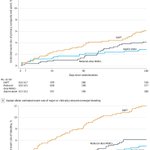
Death, stroke, systemic embolism or major bleeding at 6 months was 6.9% with DAPT, 5.1% with reduced-dose NOAC and 3.3% with aspirin alone

Both simpler options were noninferior to DAPT
Major bleeding was 4.5%, 2.7% and 1.7%, and 45-day device-related thrombus 3.4%, 0.9% and 2.7%. Both are exploratory, so I wouldn't read them as proven differences
US-only, open-label, 6-month follow-up
After an uncomplicated closure, who still needs more than aspirin?
jamanetwork.com/journals/jam…

PROGRESS in NEJM
TAVR vs clinical surveillance in moderate aortic stenosis with at-risk features, 744 patients
Death or heart-failure event at 2 years was 16.7% with TAVR vs 23.9% with surveillance (risk difference −7.2 points, 95% CI −13.1 to −1.3)

That's about 1 event avoided per 14 treated over 2 years
All-cause death was 8.4% vs 7.3%. The gap comes from heart-failure events, 10.8% vs 19.0%
Open-label, mean age 78, transfemoral balloon-expandable valve only, Edwards-funded
I think the real comparison is TAVR now vs replacement later, since 57.4% of the surveillance group had one within 2 years anyway
Would this change how often you re-echo and refer moderate AS once symptoms or LV changes appear?
doi.org/10.1056/NEJMoa260732…

P4 in NEJM presented at @TCTConference
CT-guided PCI was noninferior to IVUS-guided PCI at 12 months in 1105 patients, 98% with stable disease
Target-vessel failure (cardiac death, target-vessel MI or ischaemia-driven TVR) was 4.1% with CT guidance vs 4.6% with IVUS

In the UK, NICE CG95 already offers CT coronary angiography first line for suspected stable angina, so many of these patients will have had a CT before they reach the lab
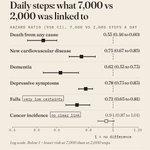
The Dose, No. 2: daily steps.
Compared with 2,000 steps a day, 7,000 was linked to a 47% lower risk of death from any cause (HR 0.53, 95% CI 0.46 to 0.60) in a 2025 meta-analysis in Lancet Public Health.

Who it applies to: adults in general.
What I'd do differently: aim for 7,000 first; 10,000 is fine if you're already there. From 3,000, add about 1,000 a day and hold it for a fortnight before the next 1,000.