




*** XRPL Explained ***
**Bridges & Interoperability**
Ever tried moving your funds from one blockchain to another, only to get tangled up in a web of confusing steps, high fees, and the constant fear that your funds might vanish into a digital black hole? Traditional crypto bridging often feels like trying to drive a car across an unfinished, rickety bridge where you have to build the road as you go. It is stressful, slow, and highly risky. 🧵
The XRP Ledger fixes this chaos by introducing secure, native pathways built directly into its core engine. Instead of relying on fragile, third-party bridges cobbled together with experimental code, the network handles connections to outside worlds seamlessly. Think of it like a universal shipping port with standardized, reinforced cargo lanes that securely move assets back and forth without losing a single item in transit. 🧵

1
2
74
### How It Works: The Automated Train Station
Imagine trying to send a train from a narrow-track railway system to a wide-track system. Instead of forcing passengers to manually climb out, carry their luggage across the tracks, and board a completely different train, the station uses a specialized transfer platform built right into the foundation.
On the network, this is handled by native locking mechanisms. When you want to move an asset to another chain:
* Your original asset is securely locked in a digital safety deposit box on the home network.
* A perfect, verified digital mirror of that asset is automatically created on the destination network.
* When you want to come back, the mirror asset is dissolved, and your original asset is safely unlocked.
1
22
*** Stellar Explained ***
** Key Soroban Features **
For a long time, the Stellar network was optimized exclusively for fast, low-cost asset transfers and currency exchanges. However, as decentralized finance (DeFi) expanded, the network required an upgrade to support fully programmable on-chain applications.
The launch of ** Soroban ** answers this need by adding a lightweight, highly optimized smart contract layer directly into the Stellar core. Built with sustainability and scaling in mind, Soroban avoids the common architectural traps of older smart contract networks. It introduces an institutional-grade runtime environment designed to keep fees predictable and transactions fast, creating a secure foundation for next-generation digital apps. 🧵

1
46
### 🛠️ How It Works: The Four Pillars of Performance
Instead of adapting an existing virtual machine, Soroban was built from the ground up around a core set of modern design decisions aimed at maximizing efficiency and safety:
* ** Futureproof Rust & WASM Architecture: ** Soroban smart contracts are written in ** Rust **, a language praised for its ironclad memory safety that catches major vulnerabilities before code is deployed. The code compiles into ** WebAssembly (WASM) ** bytecode, providing a highly predictable and hyper-fast execution environment.
* ** Absolute Zero Reentrancy: ** Reentrancy loops—where a malicious contract repeatedly drains funds before a ledger balance can update—are responsible for some of the biggest exploits in blockchain history. Soroban eliminates this entire attack vector by strictly banning reentrancy at the protocol level.
* ** Conflict-Free Parallel Execution: ** Many networks process transactions one after the other in a single line, causing traffic jams. Soroban requires contracts to state their data needs upfront. This allows the ledger engine to process completely independent contract transactions side-by-side on multi-core processors without any overlapping conflicts.
* ** Multi-Dimensional Resource Fees: ** Rather than bunching all transaction costs into a single arbitrary "gas" fee, Soroban meters every asset independently. Users pay separate fees tailored to their precise consumption of CPU instructions, memory usage, ledger reads, ledger writes, and storage rent.
1
39
*** XRPL Explained ***
** Sidechains **
Ever wish your favorite blockchain could do *everything*? 🤯 But adding too many bells and whistles slows down the main highway?
Imagine trying to install a massive theme park attraction right onto a quiet, high-speed toll road. Traffic would ground to a halt! Sidechains solve this, and the XRP Ledger is using them to bring endless innovation without jamming the main network. 🧵

1
38
Think of the main XRPL as a super-fast, ultra-secure express highway. It’s perfect for moving value quickly.
But sometimes developers want to build complex dApps, experimental features, or things requiring smart contracts, like fully automated digital pawn shops or gaming economies. Doing that directly on the main highway risks slowing down everyday traffic (payments).
Enter Sidechains! 🛤️ They are parallel roads connected to the express highway.
1
15
*** Stellar Explained ***
** Protocol Upgrades & Amendment Process **
On a decentralized public network, you can’t simply push an "app store update" to change how the blockchain processes data. Because independent global validators must maintain perfect cryptographic agreement on the state of the ledger every few seconds, changing the underlying rules requires an incredibly coordinated, democratic process.
The Stellar network handles these fundamental shifts through its native ** Protocol Upgrades and Amendment Process **. Instead of fracturing the community through disorganized code divisions (known as hard forks), Stellar uses a highly structured governance lifecycle. This process empowers developers to propose new features and gives validator operators complete sovereign voting control over when and how the network evolves. 🧵

### 🛠️ How It Works: From Idea to Core Blueprint
Every single modification to the Stellar network—whether it is a simple adjustment to network fee calculations or a massive paradigm shift like adding the entire Soroban smart contract ecosystem—follows a rigid design pipeline:
* ** Core Advancement Proposals (CAPs): ** The lifecycle begins with a CAP, a highly detailed public document created by developers, engineers, or community members. CAPs lay out the precise code modifications, performance benefits, and security implications of a proposed feature.
* ** Peer Review & Final Comment: ** The proposal enters an intense open-source review period where ecosystem stakeholders stress-test the concept. Once refined, it goes to the CAP Core Team for evaluation. If approved, it enters a "Final Comment Period" before moving to the implementation phase.
* ** Bundling the Protocol Version: ** Once several accepted CAPs are fully coded and tested, they are bundled together into a major software release of the core engine software (`stellar-core`). This bundle defines the next official milestone, such as Protocol 21 or Protocol 23.
2
1
13
*** XRPL Explained ***
** Hooks (Native Smart Contracts) **
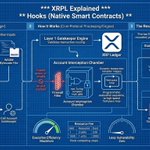
The XRP Ledger has long been celebrated for having standard financial features—like decentralized currency trading, escrows, and payment networks—built directly into its core protocol layer. However, developers wanting to build highly specific business automation or custom defense rules were limited because they couldn't upload custom programming code directly onto an account.
Developed by XRPL Labs, ** Hooks ** introduce lean, protocol-level smart contract functionality to the network. Instead of creating an entirely separate virtual machine layer that sits precariously on top of the blockchain, Hooks are tiny, compiled modules attached directly to individual XRPL accounts. They intercept transactions before they are finalized, acting as smart financial filters that can block, modify, or trigger payments automatically based on custom logic. 🧵

1
51
### 🛠️ How It Works: The Pre and Post Transaction Gatekeepers
Think of an XRPL Hook as an automated security guard standing right at the doorway of your digital account. Every time a payment attempts to enter or leave your wallet, the guard instantly stops it, runs it against your programmed rules, and decides whether to approve or reject it.
This lightweight interception framework functions seamlessly at Layer 1 using standard, high-performance rules:
* ** Fast WebAssembly Execution: ** Hooks are written in languages like C and compile down into ultra-fast, compact ** WebAssembly (WASM) ** bytecode. This means accounts execute complex evaluations in fractions of a millisecond without bogging down the ledger.
* ** The Simple Return Decision: ** When a Hook runs, it analyzes transaction variables and terminates by returning one of two basic instructions to the network: `Accept` (allowing the transaction to proceed normally) or `Rollback` (instantly cancelling the transaction and protecting account balances).
* ** Two Core Transaction Types: ** The infrastructure is managed using just two lightweight ledger additions: `SetHook` (used to attach, update, or remove code from an account) and `Invoke` (used to explicitly call or trigger a specific Hook's business logic).
* ** Deliberately Not Turing-Complete: ** To avoid the massive security bugs, frozen networks, and runaway gas fees found on older blockchain platforms, Hooks are purposefully designed to be non-Turing-complete. They enforce strict computing step boundaries, guaranteeing that a piece of contract code can never get stuck in an infinite processing loop.
1
21
*** Stellar Explained ***
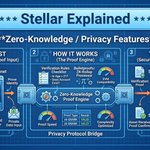
**Stellar Zero-Knowledge / Privacy Features**
In the traditional world, you don't always want your bank balance and every single payment history pasted on a public bulletin board for all to see. 🏦 Privacy matters.
Blockchains are often incredibly public, which is great for transparency but tough for businesses. Imagine a company paying a supplier, but everyone can see the transaction, revealing their strategic partners or pricing! 🧵
🧵

Stellar is a public network, but it understands the need for privacy. This is where specialized features and "Zero-Knowledge" come into play.
But what *is* Zero-Knowledge? 🤔
Imagine you need to prove to a nightclub bouncer that you are over 21, but you don't want to show them your full ID with your home address and entire name.
1
8
*** XRPL Explained ***
** Token Escrow & Freezing Mechanisms **
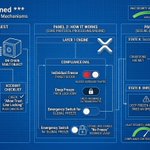
For companies launching real-world assets or digital currencies, handling funds safely requires more than just sending basic payments. They need absolute control over compliance—like halting suspicious transactions—along with the ability to lock up funds safely for future payouts without relying on risky third-party software.
The XRP Ledger (XRPL) handles both of these needs natively at Layer 1. Instead of forcing developers to build complex, glitchy, gas-heavy smart contracts to freeze accounts or schedule payouts, the network embeds highly secure ** Token Escrow ** and ** Freezing Mechanisms ** directly into its core protocol. This provides institutions with ironclad compliance and automated safety tools right out of the box. 🧵

1
51
### 🛠️ How It Works: The Time-Locked Vault
Think of an XRPL Escrow as an automated, cryptographic time-lock vault built directly into the blockchain. A sender takes funds, sets the release rules, and drops them inside. Once locked, absolutely nobody—including the sender or the receiver—can touch those assets until the exact conditions are met.
Thanks to recent ledger upgrades like the `TokenEscrow` amendment, this automated vault works for both ** XRP ** and standard issued tokens:
* ** Rule-Based Release: ** Senders can create time-based vaults (releasing funds only after a certain date passes) or conditional vaults (releasing funds only when a specific cryptographic password/key is provided).
* ** Automated Return Timers: ** While native XRP vaults can last indefinitely, issued token escrows require a hard expiration timer. If the receiver fails to claim the tokens before the time limit runs out, the vault cancels itself and routes the tokens safely back to the sender.
* ** Setup Checklist: ** For trustline tokens to enter an escrow vault, the asset creator must have the "Allow Trust Line Locking" feature enabled on their account. If the token requires compliance pre-approval, both the sender and receiver must be cleared by the issuer before the vault can even be built.
1
17
*** Stellar Explained ***
** Soroban State Archival & Rent Model **
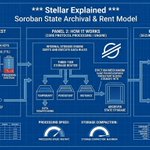
When standard smart contract networks grow, they face a silent performance killer known as "state bloat." Because every piece of deployed data, forgotten test contract, or inactive wallet balance is kept on the active network forever, validator nodes eventually become overwhelmed by massive storage demands. This structural clogging degrades overall network performance and drives up transaction fees over time.
Stellar's ** Soroban ** platform addresses this challenge natively by introducing a revolutionary ** State Archival and Rent Model **. Instead of allowing abandoned data to permanently clutter the network, Soroban treats ledger storage like highly organized, rented real estate. By forcing inactive data to pay rent or face a safe archival system, the network keeps its active ledger footprint incredibly lean, fast, and remarkably affordable. 🧵

1
43
### 🛠️ How It Works: The Three-Tier Storage Cabinet
To keep fees predictable and system storage optimized, Soroban splits all smart contract data into three distinct protocol-level storage cabinets. This structure allows developers to choose the right lifecycle for their specific application data:
* ** Temporary Storage: ** This is an exceptionally cheap, short-lived storage space. It is designed for temporary data records—like decentralized oracle price feeds or simple token allowances—that automatically vanish from the network completely once their timer runs out, requiring zero maintenance fees.
* ** Persistent Storage: ** This bucket holds critical long-term application records, such as your core token balances or complex contract logic. Persistent data stays completely active as long as a baseline "rent" is covered by its Time-to-Live (TTL) counter.
* ** Instance Storage: ** This specialized space stores the fundamental configurations of the contract code itself. It remains fully alive and functional alongside the contract, ensuring the underlying application infrastructure stays stable.
1
13
*** XRPL Explained ***
** Authorized Trust Lines **
When an asset issuer deploys a token on a standard blockchain network, they often lose track of who is buying, holding, or trading it. For businesses handling real-world regulated assets like private credit or security tokens, this lack of visibility is a major roadblock. They need a way to verify exactly who can interact with their assets before any tokens ever change hands.
The XRP Ledger (XRPL) solves this challenge natively at Layer 1 with ** Authorized Trust Lines ** (often called the `Require Auth` flag). Instead of forcing developers to build complex, expensive smart contracts that check white-lists on every single trade, the network builds the security gateway directly into the ledger's core architecture. This allows issuers to maintain strict regulatory compliance over their tokens while keeping transaction costs fractional. 🧵

1
1
41
### 🛠️ How It Works: The Gatekeeper Turnstile
Think of an Authorized Trust Line as a locked security turnstile at an office building. Even if a user stands in front of the turnstile with an empty digital wallet ready to receive a token, they cannot step through or hold the asset until the issuer actively uses their cryptographic master key to unlock that specific user's slot.
This protocol-level framework relies on a clean, three-step architectural lifecycle:
* ** Activating the Master Lock: ** Before issuing any tokens, the creator account turns on a permanent setting called `lsfRequireAuth`. Once this flag is active on the issuer's account, it acts as a global network rule: no account on earth can hold or receive this specific token without explicit permission.
* ** Knocking on the Door: ** To hold the token, a user must first submit a standard transaction to establish a line of trust (a trustline) to the issuer. At this stage, the trustline is created but remains in a "pending" or unauthorized state. No tokens can be transferred into it yet.
* ** Turning the Key: ** The token issuer reviews the user's credentials (such as standard identity or compliance checks). If approved, the issuer submits a lightweight transaction that removes the authorization lock from that specific user's trustline, turning the turnstile green.
1
67
*** Stellar Explained ***
** Soroban Smart Contracts (Rust + WASM) **
For years, the Stellar network operated like a highly efficient, single-purpose highway built specifically for moving money fast. While it excelled at lightning-speed international payments and issuing digital assets, it didn't have a built-in engine to let developers create fully customized, automated apps on top of it.
The launch of the ** Soroban ** platform completely changes that, turning the network into a fully programmable financial ecosystem. Instead of copying older blockchain systems, Stellar built a brand-new engine from scratch. It combines the bulletproof security of ** Rust ** (a programming language famous for preventing glitches) with the lightning speed of ** WebAssembly (WASM) ** to run apps safely, efficiently, and at a fraction of the cost of other networks. 🧵

1
40
### 🛠️ How It Works: The Automated Vending Machine
Think of a Soroban smart contract as a highly advanced, digital vending machine. You drop an instruction in, and the machine automatically spits out a guaranteed result without needing an intermediary or referee.
The network keeps this process completely safe using simple, built-in layout rules:
* ** The Sealed Sandbox: ** Every app runs inside its own isolated, digital quarantine zone. The app code cannot wander off or accidentally tamper with other parts of the network's master filing cabinet.
* ** Protected Service Windows: ** If an app needs to check a wallet balance or talk to another contract, it has to look through a set of strictly monitored protocol service windows. This completely blocks common hackers from using hidden backdoors.
* ** Multi-Lane Traffic Lanes: ** Imagine a highway where cars never have to merge. Soroban forces apps to state exactly what data keys they need ahead of time. This allows the network's validators to process completely unrelated app requests side-by-side on multi-core processors, boosting overall performance to thousands of actions per second.
1
27
Russia's State Duma passed bill No. 1194918-8, titled "On Digital Currency and Digital Rights," in its final readings on July 21, 2026. This landmark legislation comprehensively regulates the country's cryptocurrency market, establishing state-supervised channels for cross-border international settlements while imposing strict new structures on domestic retail investments. [1, 2]
The bill now moves to the Federation Council for approval and requires President Vladimir Putin's signature before officially becoming law. Its main provisions are slated to take effect on September 1, 2026. [1, 3]
Key Frameworks of the New Legislation
•Cross-Border Trade Settlements Allowed: Russian businesses are legally authorized to use digital assets for international payments. This infrastructure is explicitly designed to bypass Western banking blocks, such as SWIFT, and route around sanctions restrictions. [4, 5, 6]
•Domestic Payments Remain Prohibited: The law classifies cryptocurrency as property. However, using it to pay for daily goods and services within Russia remains strictly banned; the ruble remains the only legal tender. [5, 7, 8, 9, 10]
•Two-Tier System for Investors:
◦Non-qualified (retail) investors: Subject to a strict annual purchase cap of 300,000 rubles (~$3,800 USD)through a single licensed intermediary. They must also pass mandatory risk-awareness tests.
◦Qualified (professional) investors: Exempt from the annual volume limits. [5, 11]
•Strict Asset Whitelists: Retail investors are restricted to a highly liquid asset list dictated by the Bank of Russia. Initial approvals are expected to only cover Bitcoin (BTC) and Ethereum (ETH), with Solana (SOL) as a potential third. Anonymous "privacy coins" like Monero (XMR) and Zcash (ZEC) are fully barred from trading. [5, 12, 13, 14]
•Central Bank Supervision: The Bank of Russia is granted sweeping authority to license and supervise five types of crypto operations: exchanges, brokers, asset managers, custodians, and exchangers. [2, 15]
•Ban on Unregulated Platforms: The law provides a transition period for current gray-market actors to register. A complete, enforceable ban on all unlicensed cryptocurrency platforms will take effect on July 1, 2027. [5, 14]
[1] tradingview.com
[2] techtimes.com
[3] bitcoinmagazine.com
[4] finance.yahoo.com
[5] finance.yahoo.com
[6] finance.yahoo.com
[7] finance.yahoo.com
[8] rootdata.com
[9] odaily.news
[10] rt-union.com
[11] finance.yahoo.com
[12] tradingview.com
[13] kucoin.com
[14] bitcoinmagazine.com
[15] coinmarketcap.com

1
105
*** XRPL Explained ***
** Multi-Purpose Tokens (MPTs) **
Fungible tokens on the XRP Ledger have historically relied on Trustlines (traditionally referred to as IOUs). While highly functional for simple cross-currency payments, trustline-based tokens require complex account management, cause balance netting issues, and demand separate account setups to configure unique issuance properties.
Introduced via the `MPTokensV1` amendment, ** Multi-Purpose Tokens (MPTs) ** represent the "Version 2" fungible token standard on the XRPL. Designed natively at Layer 1 based on lessons learned from trustline limitations, MPTs provide a highly compact, flexible framework that blends the scale of fungible tokens with powerful data customization. This makes them an enterprise-grade utility perfectly tailored for tokenizing highly regulated Real-World Assets (RWAs) and complex financial instruments. 🧵

1
51
### 🛠️ The Architecture: Unidirectional & Uniquely Identified
Unlike standard trustline structures that require a bidirectional relationship between accounts, MPTs operate on a simpler, unidirectional conceptual model with an explicit separation between issuer and holder.
* ** Unique 192-Bit Identity: ** Every distinct MPT issuance is uniquely identified across the network by a 192-bit `MPT Issuance ID` rather than a loose currency code. This identifier ensures complete programmatic clarity.
* ** Storage & Cost Efficiency: ** Rather than setting up separate accounts to issue tokens with varied parameters, an issuer can mint distinct token classes directly from a single account. Furthermore, a token definition requires an exceptionally light on-chain footprint, reducing the required owner reserve to just 0.2 XRP per issuance.
* ** Immutable L1 Metadata: ** MPTs can store JSON schema metadata directly on the ledger (following the XLS-89 standard). This enables issuers to bake critical asset parameters—such as ticker names, asset subclasses, interest rates, and maturity dates—directly into the asset definition permanently.
1
15
*** Stellar Explained ***
** Offer Management **
When trading on a traditional decentralized network, adjusting an active limit order or changing market exposure is often an expensive, multi-step process. Traders are forced to pay high gas fees to cancel an old smart contract position, wait for an unpredictable block confirmation, and pay *again* to deploy a new one, running the constant risk of being front-run or trapped during market volatility.
The Stellar network eliminates this mechanical friction entirely at Layer 1. By utilizing a series of unified, highly optimized offer primitives, the ledger gives market makers and everyday users absolute, instant control over their decentralized order book positions at a predictable, fractional base cost. 🧵

### 🛠️ The Architecture: Universal Offer Primitives
Stellar manages its built-in decentralized exchange (DEX) using a native Central Limit Order Book (CLOB) model. Instead of relying on a maze of disconnected smart contracts, order book lifecycles are dictated directly by the protocol using highly versatile transaction operations:
* ** ManageBuyOffer & ManageSellOffer: ** These are the primary engines for on-chain market making. A single operation allows a user to specify the exact asset pairs, price ratio, and maximum amount they wish to buy or sell. If a match exists, it executes atomically; otherwise, it is cleanly recorded as an *Offer* object on the ledger state.
* ** Dynamic 3-in-1 Lifecycle Control: ** What makes these primitives exceptionally powerful is their versatility. A trader uses the exact same `ManageOffer` operation to create a new order, modify an existing order's price/amount, or completely delete a stale order from the book.
1
10
*** XRPL Explained ***
** Check (on-ledger IOUs / post-dated payments) **
When managing commitments on a blockchain, users often face a strict trade-off: transactions must either execute immediately or be completely abandoned. In traditional finance, a check allows a payer to defer execution, giving the recipient the freedom to cash the funds at a time that suits them best.
The XRP Ledger (XRPL) bridges this gap with its native, base-layer ** Check ** feature. This protocol primitive introduces a secure, on-ledger framework for deferred payments, allowing users to issue post-dated or conditional funding commitments without locking up their operational capital or exposing themselves to unexpected balance pulls. 🧵

1
42
### 🛠️ The Architecture: Deferring Execution Safely
An XRPL Check operates similarly to a physical paper check but is backed by cryptographic immutability. Instead of moving funds instantly, a payer submits a transaction that creates a temporary `Check` ledger object.
This native architecture relies on key protocol-level parameters to guarantee deterministic behavior:
* ** Destination & Amount: ** The creator specifies the exact recipient address and the maximum amount of XRP or issued assets (IOUs) the check can pull.
* ** DestinationTag Option: ** Senders can append a specific destination tag to route the funds cleanly into specific destination sub-accounts, such as hosted wallets or merchant ledgers.
* ** The Balance Safeguard: ** Crucially, creating a check does not lock the underlying funds in a custodial escrow. The payer's funds remain fully available in their wallet for active trading or market making until the check is explicitly cashed.
1
18
*** Stellar Explained ***
** Built-in Decentralized Exchange (DEX) & Order Books **
When decentralized exchanges are built as external smart contracts on a blockchain, they suffer from fragmented liquidity, high gas costs, and constant security vulnerabilities. Users are forced to navigate competing protocols just to find a liquid trading pair for basic transactions.
The Stellar network eliminates this complexity entirely by embedding a functional, high-performance ** Decentralized Exchange (DEX) ** directly into its core Layer 1 ledger protocol. Unifying order books at the base layer guarantees that every asset issued on the network can immediately tap into global liquidity without intermediate smart contract code. 🧵

1
1
42
### 🛠️ The Architecture: Native Order Book Lifecycles
Because the DEX is built natively into Stellar's protocol layer, it operates on a standard ** Central Limit Order Book (CLOB) ** model rather than relying solely on automated math curves. Every asset pair maps directly to an on-chain ledger ecosystem managed cleanly by Layer 1 transaction primitives:
* ** ManageBuyOffer & ManageSellOffer: ** These native operations allow user accounts to submit limit orders to the ledger. If an order cannot be immediately matched against a counterparty, the protocol creates a new *Offer* ledger object and tracks it on the order book automatically.
* ** Pathfinding Synergy: ** Because the DEX structure is native, Stellar's built-in pathfinding algorithm can automatically route payments across multiple order books in a single transaction (e.g., USD ➡️ XLM ➡️ EUR), matching fragmented order books together on the fly to secure the absolute best clearing rate.
1
10
*** XRPL Explained *** **Permissioned Domains**
Ever wondered how giant financial institutions and traditional banks can use a public, open blockchain without breaking strict regulatory laws? For big enterprises, jumping into standard public crypto networks feels like opening a high-security bank vault in the middle of a chaotic, unmonitored public park. They need absolute control over who they transact with to meet strict compliance rules, yet they still want the speed and efficiency of decentralized tech. 🧵
The XRP Ledger bridges this gap with a built-in feature called Permissioned Domains. Instead of forcing enterprises to build entirely separate, isolated private networks, this upgrade lets them set up VIP, invite-only zones directly on the public XRPL highway. It allows institutions to create secure, compliant environments where only verified participants can hang out, successfully blending institutional-grade security with the power of public blockchain infrastructure. 🧵

1
50
### How It Works: The Digital VIP Lounge
Imagine an exclusive airport VIP lounge located right inside a massive, public international airport terminal. Anyone can walk through the main terminal, but to cross the threshold into the lounge, a security guard at the door must scan your specific membership credential.
On the network, this screening process is handled smoothly at the protocol level:
* A regulated institution or domain owner sets up a digital "Domain" rulebook directly on the ledger.
* Approved users are issued digital compliance credentials (like a verified KYC or identity check stamp) linked to their accounts.
* When an account tries to interact with a specific service inside that domain—like a private trading book—the network automatically checks for the matching credential. If you have it, you are instantly let in; if you don't, the door stays locked.
1
24
The XRP Ledger is demonstrating clear utility for institutional tokenization at scale. Tokenized real-world assets on XRPL have expanded from approximately $150 million to nearly $4 billion in the past year, driven by native standards optimized for regulated finance and rapid settlement. This reflects a broader macroeconomic shift toward on-chain infrastructure that enhances capital efficiency for traditional institutions. 🧵
phemex.com/blogs/xrp-ledger-…

1
37
Key to this growth is the MPTokensV1 amendment, which introduced a compact, configurable token standard purpose-built for institutional assets. It supports essential metadata such as maturity dates and transfer restrictions while maintaining the ledger’s core strengths of fast finality and predictable low costs—features that reduce friction compared with legacy systems or more complex smart-contract environments.
1
4
This is a pivotal moment for AI and finance. By backing open standards like x402 through the new Foundation, Stellar is helping build the infrastructure for truly accessible global payments where AI agents can transact seamlessly—without gatekeepers. Denelle Dixon nails why getting this right matters for everyone.

“We have the opportunity to create this truly open public global financial system that everyone can have access to”
@DenelleDixon lays out the stakes of getting the x402 protocol right, and what the x402 Foundation will help steward.
From @Coindesk.
coindesk.com/business/2026/0…

1
35
*** STELLAR Explained ***
**Bridges & Interoperability**
Ever tried sending money across borders or between different blockchain networks, only to realize the systems don't talk to each other? Traditional financial networks and isolated blockchains operate like islands with no ferry service. Trying to move assets across them usually requires jumping through endless hoops, dealing with sketchy third-party middlemen, and paying sky-high conversion fees. 🧵
The Stellar network solves this fragmentation by building universal translators and secure entryways directly into its core protocol. Instead of forcing users to rely on vulnerable, unverified smart contracts written by random developers, Stellar acts as an open global financial highway. It connects legacy banking systems, digital stablecoins, and outside blockchains seamlessly, working like a worldwide network of standardized shipping lanes that keep assets moving smoothly without losing value or security along the way. 🧵

1
52
### How It Works: The Universal Currency Passport
Imagine traveling around the world with a passport that automatically updates its visa stamps and instantly converts your local cash into whatever currency the shopkeeper accepts, without you having to find an exchange booth.
On the network, this magic is handled by built-in anchors and native asset-pairing protocols. When you want to bridge an asset out of Stellar or bring one in:
* Regulated financial institutions (called Anchors) act as the official on and off-ramps, securely holding traditional currency in a real-world bank vault.
* The network's core system automatically issues a 1:1 digital token representation of that real-world money.
* Built-in decentralized logic instantly handles the compliance and secure matching required to let these digital tokens jump across network borders safely.
1
19
The institutional migration to public blockchain infrastructure reaches a new milestone as Tradable selects the Stellar network to tokenize up to $1 billion in private credit assets. This integration signifies a major shift toward high-utility, on-chain alternative asset management. 🧵

1
24
Tradable’s decision underscores why global enterprises are increasingly choosing Stellar for real-world asset (RWA) tokenization. The platform’s architecture—built specifically for compliance, security, and low-latency payments—provides the robust foundation necessary for institutional-grade financial products.
1
12