

Research Scientist @Visa. Foundation Models & Risk Modeling & Agent Payments. Opinions are my own.
Palo Alto, CA
Joined April 2016
- Tweets204
- Following274
- Followers541
- Likes435






Yingtong Dou retweeted

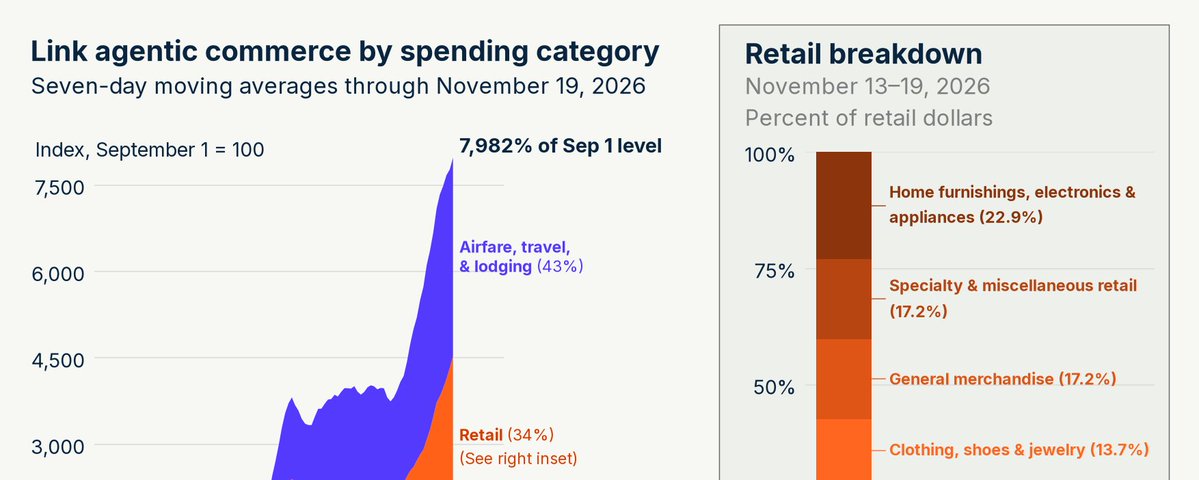
We're releasing new @Stripe agentic commerce data today, telling the story so far as we look ahead to the kickoff of the holiday season next week.
Yingtong Dou retweeted

the agents have been put through the group chat 🧪
Visa Research breaks down what they tested, how they tested it and what’s next.
Can a small LLM outperform competitive tabular classifiers and production-grade deep learning models?
Excited to share our latest research from Visa Research: VRLLM — Turning LLMs into Powerful Tabular Classifiers!
We fine-tuned Llama 3.2 1B on billions of payment transactions, outperforming strong tabular baselines, including XGBoost, LightGBM, SAINT, tabular foundation models, and our production deep learning model.
This work also connects to the emerging direction of LLM-based decision models, where compact language models are adapted into efficient decision engines.
A few notable findings:
By leveraging Llama’s pretrained knowledge and native tokenizer, VRLLM achieves production-competitive tabular classification performance.
Combining VRLLM with our production model improves recall from 38.3% to 45.9%. Our interpretability analysis reveals distinct learning and generalization patterns.
Data serialization, training data composition, and training schedules play critical roles in LLM-based tabular learning.
Our evaluation of 17 frontier LLMs and decision models reveals improving zero-shot classification capabilities, but a substantial gap remains compared with production-grade classifiers.
Next-token prediction can be adapted for continuous classification scoring, opening new possibilities for LLM-powered decision intelligence.
While many frontier LLMs produce highly correlated predictions in zero-shot classification, Gemini-4-argon stands out with distinct prediction patterns, raising interesting questions about the role of training recipes and calibration strategies.
I encourage researchers and practitioners working on LLMs, tabular learning, and decision intelligence to explore our interactive project website and dive into the full paper!
Beyond the headline performance gains, we share extensive experiments on data serialization, training strategies, frontier model benchmarking, and model interpretability. We’d love to hear your thoughts and feedback!
Explore our interactive website: ytongdou.com/vrllm/
Read the full paper: arxiv.org/pdf/2611.22308
#LLM #TabularLearning #FoundationModels #MachineLearning #FinTech


1
4
188
In payment networks, card and merchant behavior shifts faster than production models can be refreshed.
Visa's PersonaAgent accepted at #KDD2027 (arxiv.org/abs/2611.08094) tackles this with self-evolving agentic anomaly detection.
Here is how:
1/3

2
3
98
An agent collects semantically clustered evidence about entities and distills it into a “persona” stored in a refreshable memory.
Offline, a weekly batch job updates the personas. Online, a lightweight adapter retrieves them to augment the base classifier’s score.
2/3
1
27


VR released an impressive benchmark evaluating the agentic shopping capabilities of 22 frontier AI models.
The overall success rate was just 57% across all runs, highlighting how much room for improvement in #agenticcommerce.
The website is best viewed on a desktop browser.

1/ Excited to introduce the Visa Agentic Commerce Benchmark, our first public benchmark designed by Visa Research to evaluate frontier model performance on shopping tasks.
visapaymentsfrontier.io/#age…
We've been cooking similar things at Visa by turning pretrained llms into powerful decision engine. We'll release a technical report about it soon.

We were able to fine tune an open weight model (Qwen3.5-9B) on proprietary internal data at @coinbase, and it out performed frontier models, at much lower cost and speed, for a specialized task (fraud prevention in this case).
I think we'll see more of this pattern inside companies. The frontier models are amazing generalists. But increasingly you'll see specialist models out perform on more narrow tasks, either working on teams, or by themselves.
We're making it easy to fine tune models internally for our employees. We even have a skill for it in our internal harness that makes it easy to spin these up and start training them:
"/fine-tune-and-serve-llm I want to fine-tune Qwen for payments risk review. help me get started"
I imagine we'll have some backend services that could be replaced entirely by this new architecture.


2
130
Yingtong Dou retweeted

Looking for new oppotunities! Most members in our MoE pre-training team got impacted today 😅 Feel free to ask me about what happened inside of Amazon AGI foundation team and I will share my brief thoughts with my tenure period. Also, if you know there is any place that needs people to help/optimize LLM pretraining, please share that with me! I am open to new opportunities in the next few month! #amazon #agi #moe #llm #pretraining
Yingtong Dou retweeted

Some new results I found surprising that I’m tweeting for Chris (who isnt on here). With enough compute, the best data filter for LMs (on DCLM) might be no filter. Why? Large models can tolerate a surprising amount of nominally 'low quality' data, and can sometimes even benefit.

Yingtong Dou retweeted

If you're doing applied AI research (especially system design, benchmarks, evals, efficiency, or ops) you should be submitting to the Conference on AI and Agentic Systems... caisconf.org/pages/cfp/

🧵(3/6) 3𝐃-𝐓𝐫𝐚𝐧𝐬𝐟𝐨𝐫𝐦𝐞𝐫 𝐀𝐫𝐜𝐡𝐢𝐭𝐞𝐜𝐭𝐮𝐫𝐞. We design a new architecture, specifically to model and fuse the complex, multi-modal nature of transaction data. This approach hierarchically encodes transaction features, individual transactions, and their sequences.
1
52
🧵(3/6) 3𝐃-𝐓𝐫𝐚𝐧𝐬𝐟𝐨𝐫𝐦𝐞𝐫 𝐀𝐫𝐜𝐡𝐢𝐭𝐞𝐜𝐭𝐮𝐫𝐞. We design a new architecture, specifically to model and fuse the complex, multi-modal nature of transaction data. This approach hierarchically encodes transaction features, individual transactions, and their sequences.
1
38
Yingtong Dou retweeted

Introducing Eigent — the first multi-agent workforce on your desktop.
Eigent is a team of AI agents collaborating to complete complex tasks in parallel. It is your long-term working partner with fullly customizable workers and MCPs.
Public beta available to download for MacOS, Windows. 100% open-source on Github. Comment for 500 extra credits.