

Educational Content and Theories Only. Not Medical Advice.
1-1 Consultations👉
Joined October 2026
- Tweets873
- Following10
- Followers4.1K
- Likes566
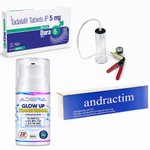





the only pp maxxing protocol that actually works
• pump
• andractim
• glow
• tadalafil
the daily routine:
take 5 to 10 mg tadalafil daily. steady pde5 inhibition keeps cgmp elevated around the clock, boosting arterial inflow, endothelial function, and oxygenation while blunting tgf-beta1-driven corporal fibrosis in preclinical models.
warm up, lube with coconut oil and pump 10 minutes every day. start at low vacuum pressure and bump it up slowly every 2 minutes without chasing pain or bruising. make sure erection is above 90% entire time.
controlled negative pressure creates mechanical stretch across the tunica albuginea and corpora cavernosa, lowering hypoxia (hif-1alpha) and tgf-beta1 while improving smooth muscle-to-collagen ratios in penile rehab models.
wash the coconut oil off right after so it doesn't block the skin barrier, then apply glow peptide blend transdermal while local blood flow is peaked. support local collagen and matrix remodeling.
for educational purposes only, not medical advice.

i biohacked my brain, hormones, sleep, health, hair, physique, mood, cognition, dick, and everything else that can be tinkered with. do not settle with the hand you're dealt, ever.


dutasteride is honestly a way better drug than finasteride. if you are going to touch a 5ar inhibitor at all, use the better molecule.
clinical data backs this up. head-to-head trials and meta-analyses consistently show dutasteride produces significantly higher hair counts and thickness than finasteride, even low-dose dutasteride at 0.1 mg daily edged out 5 mg finasteride on 24-week hair count (+78.5 vs +75.6 hairs).
that is why low-dose dutasteride (like 0.5 mg once or twice a week) is plenty for most guys. because dutasteride has saturable nonlinear clearance at low levels, staying on a lower dose keeps systemic accumulation way below 0.5 mg daily while still hitting strong dht suppression. you only push extreme daily doses if aggressive loss genuinely justifies the extra systemic 5ar1 and 5ar3 suppression.
here is the personal pattern plenty of people notice too: every time i have experimented with finasteride, i feel lethargic and depressed within about an hour. on dutasteride, my energy actually improves.
obviously nobody is spending billions running human brain trials to prove my theory, so here is the real pharmacology behind why that happens:
your body hates hormonal zig-zagging finasteride has a short 5 to 8 hour half-life and lower plasma protein binding (90% vs 99% for dutasteride).
every pill creates a fast spike in free drug within 1 to 2 hours, then a daily drop. neurosteroid studies show your brain reacts sharply to rapid steroid fluctuations, remodeling gaba-a receptor subunits (like alpha4 and delta) and destabilizing mood and excitability.
dutasteride builds slowly and holds a flat, steady multi-week curve. your endocrine system likes balance, not daily whipsaws.
finasteride's acute off-target hit a 2021 proteome-wide study found finasteride binds and inhibits pnmt (phenylethanolamine n-methyltransferase), the enzyme converting norepinephrine into adrenaline, dropping epinephrine while raising norepinephrine in preclinical data. fast cns entry plus acute catecholamine disruption could easily explain feeling flat and sluggish an hour after a dose.
why energy can actually climb on dutasteride dutasteride raises median serum testosterone roughly 18 to 20% (vs about 9% on 1 mg finasteride), alongside a modest bump in estradiol.
extra testosterone and estradiol directly support dopaminergic drive, mood, and energy.
receptor adaptation and backdoor buffering (the theory part) once levels sit rock-steady on dutasteride, your biology can actually recalibrate instead of chasing daily spikes.
gaba-a subunit plasticity and local androgen signaling adapt and theoretically blocked 5-alpha precursors like progesterone can shunt down alternative pathways like 5-beta reduction into pregnanolone, another gaba-a modulator.
dutasteride still carries real systemic risks if you blast it, which is why low-dose dutasteride beats finasteride or reckless high doses every time.
for educational purposes only, not medical advice.


you don't have to wait till 40 to make one of the best decisions a guy can make.

TRT is one of the best decisions a guy 40+ can make.
The first 90 days decide whether it stays that way.
Here are 6 things I watch on anyone starting TRT (#3 is the one your wife notices before you do):
1. Trough labs at week 6
if you are going to use dutasteride, 0.5 mg twice weekly is the absolute max i would go.
pair that with kx826, topical progesterone, and minoxidil, and you cover hair loss locally from every angle with a fraction of the systemic side effect burden.
at 0.5 mg twice weekly, levels stay far lower in the faster nonlinear clearance zone, keeping serum dht reduction closer to ~70 to 80% (for reference, 0.1 mg daily drops serum dht ~70%). in small retrospective data, 2 to 3x weekly dosing halted thinning with zero sexual sides versus 7 to 13% on 5 to 7x weekly schedules.
you do not want 100% 5ar suppression anyway since baseline 5ar activity has necessary roles, keeping tissue exposure dramatically lower avoids the heavy systemic saturation of 5ar1 and concentration-dependent 5ar3 blockade you get on daily dosing.
sparing more type 1 and 3 helps protect liver lipid handling, insulin sensitivity, cortisol metabolism, neurosteroids (allopregnanolone, thdoc, 3a-diol), and dolichol-dependent protein folding.
because low-dose dutasteride leaves more scalp dht active (0.1 mg daily cuts scalp dht ~32% vs ~51% at 0.5 mg), the topicals close the gap: kx826 blocks follicular androgen receptors locally, topical progesterone competes locally for scalp 5ar, and minoxidil drives growth signaling without adding systemic suppression.
for educational purposes only, not medical advice.


kx826 mogs dutasteride
if it only lowered dht, i honestly would not care. blocking dht alone is not the issue. the problem is nuking systemic 5-alpha reductase across your liver, adipose tissue and brain(muh 500 dalton is already debunked btw).
dutasteride potently blocks 5ar1 and 5ar2, and even shows concentration- and substrate-dependent inhibition of 5ar3 (srd5a3) in vitro, the enzyme that converts polyprenol into dolichol for n-linked protein glycosylation and proper protein folding.
in human clinical trials, blocking 5ar1 with dutasteride impaired peripheral and hepatic insulin sensitivity, increased body fat, and promoted intrahepatic lipid accumulation (fatty liver) alongside disrupted glucocorticoid and cortisol metabolism, pushing the dial toward metabolic syndrome.
cherry on top, systemic 5ar blockade hits the entire 5-alpha-reduced neurosteroid cascade, not just allopregnanolone. you also deplete thdoc and 3a-diol, key gaba-a modulators your brain depends on for mood, stress resilience, and sleep.
i will gladly trade slightly less raw regrowth to keep my liver, insulin sensitivity and neurosteroids intact.
kx826 (pyrilutamide) takes a much smarter angle by competitively blocking androgen receptors locally at the follicle instead of shutting down systemic enzymes. pair it with topical progesterone, which acts as a competitive substrate for scalp 5ar (occupying the enzyme locally so less testosterone converts to dht) while supporting local follicle biology.
even without head-to-head human trials proving this combo beats dutasteride outright, stacking local androgen receptor blockade with local 5ar competition gives you serious follicular protection without paying the systemic 5ar tax.
for educational purposes only, not medical advice.


"bb sells nothing"
calls anavar (most likely fake from india) and modafinil ancillaries.
mfw


unavailable
3
25
6,190

kx826 mogs dutasteride
if it only lowered dht, i honestly would not care. blocking dht alone is not the issue. the problem is nuking systemic 5-alpha reductase across your liver, adipose tissue and brain(muh 500 dalton is already debunked btw).
dutasteride potently blocks 5ar1 and 5ar2, and even shows concentration- and substrate-dependent inhibition of 5ar3 (srd5a3) in vitro, the enzyme that converts polyprenol into dolichol for n-linked protein glycosylation and proper protein folding.
in human clinical trials, blocking 5ar1 with dutasteride impaired peripheral and hepatic insulin sensitivity, increased body fat, and promoted intrahepatic lipid accumulation (fatty liver) alongside disrupted glucocorticoid and cortisol metabolism, pushing the dial toward metabolic syndrome.
cherry on top, systemic 5ar blockade hits the entire 5-alpha-reduced neurosteroid cascade, not just allopregnanolone. you also deplete thdoc and 3a-diol, key gaba-a modulators your brain depends on for mood, stress resilience, and sleep.
i will gladly trade slightly less raw regrowth to keep my liver, insulin sensitivity and neurosteroids intact.
kx826 (pyrilutamide) takes a much smarter angle by competitively blocking androgen receptors locally at the follicle instead of shutting down systemic enzymes. pair it with topical progesterone, which acts as a competitive substrate for scalp 5ar (occupying the enzyme locally so less testosterone converts to dht) while supporting local follicle biology.
even without head-to-head human trials proving this combo beats dutasteride outright, stacking local androgen receptor blockade with local 5ar competition gives you serious follicular protection without paying the systemic 5ar tax.
for educational purposes only, not medical advice.
Serotonin does more than just regulate your mood, as it plays a role in anxiety, sleep, impulse control, learning and cognition, to name a few. And depending on the serotonin receptor subtype, these effects can be diametrically opposite. So no, serotonin is not simply your “happy hormone”.
Some SSRIs can cause emotional blunting. This is true. However, cognitive side effects of SSRIs are far less clear cut, with mixed results across clinical studies. Some studies report worse cognition, others better cognition (including improved processing speed and memory), and still others show no effect at all. And even if blunting is real, there’s no reason to assume it would necessarily impair cognition or creativity.
ADHD isn’t caused by too much serotonin. The best understood treatment targets for ADHD are still dopamine and norepinephrine. btw serotonin helps with impulsivity and attention, there’s no indication that ADHD is due to increased serotonin, as if anything, some data point in the opposite direction (this 2025 review mentions decreased serotonin availability in ADHD).
So how did we get here? By cherry-picking one study done in anesthetized rats where they gave a (rather high, 10 mg/kg/day) dose of escitalopram and found decreased firing of dopamine neurons in the VTA, and extrapolating that to mean SSRIs universally decrease dopamine activity and therefore must negatively impact cognition.
Except that same study found no such significant effect of citalopram (escitalopram’s big bro), and other studies (PMID: 20730799) have actually found increased firing of dopamine neurons after escitalopram, along with increased NMDA signaling in the prefrontal cortex and improved recognition memory. Oops.
for educational purposes only, not medical advice.


how to create your perfect cognitive enhancement stack.
skip short acting stims, fast spikes just fry receptors and crash hard. start on concerta or focalin xr for flat osmotic reuptake blockade, only move to vyvanse if needed.
if prone to addiction, run bupropion with safinamide. oral bupropion barely hits dat (~20%) so it feels mostly noradrenergic. safinamide blocks mao-b and calms glutamate to bring real dopamine back.
clean up bupropion liver metabolism with baikal skullcap. it cuts down trash metabolites while boosting radafaxine.
for choline, start with huperzine a, then galantamine for alpha7 nicotinic modulation, then donepezil.
optional low dose luvox if ocd, anxiety, too much emotions or rumination eat your focus.
support: b complex, clean food
eat keto all day for clean ketone brain fuel, then stuff carbs at night to spike insulin and sleep deep.
if eating carbs
berberine or imeglimin if carbs crash your orexin. if hr or bp creep up, nebivolol drops hr via nitric oxide without fatigue and telmisartan fixes bp. daily fasted cardio replaces most of these.
honestly retatrutide + fasting replaces most of this stack.
glucagon signaling cranks ketones and orexin so youre already locked in all day. skip heavy stims there and just add guanfacine to hit prefrontal alpha2a receptors, kill distractions, and get pure tunnel vision.
for educational purposes only, not medical advice.

30
3,085
Stimulants on TRT feel flat, robotic, barely-there? Your estradiol is likely too low (or DHT is too high in comparison).
Estrogen Increases dopamine production (upregulates tyrosine hydroxylase, the rate limiting enzyme in dopamine production)
Keeps dopamine in the synapse longer (regulates DAT - dopamine transporter - trafficking, downregulates COMT transcription (breakdown of dopamine esp. in prefrontal cortex which is critical for working memory & focus), in men acutely regulates dopamine reuptake)
Allows dopaminergic neurons to fire more (downregulates GABAergic tone on dopaminergic neurons)
Downregulate MAO-A (breakdown of dopamine, norepi, serotonin) in certain regions of the brain
Potentiates the rewarding effects of dopamine, modulates D2 receptor signaling
Critical for BDNF and dendritic spine plasticity in prefrontal & striatal dopamine circuits
Boosts serotonin production (TPH2)
Promotes NO production (eNOS) which is likely why some guys describe stimulants + estradiol as smoother, warmer, less anxious
If stimulants aren’t hitting as hard as you’d like on TRT (and if your libido is out of the chat too) a one-off 1mg shot of E2 val or cyp could give you a quick answer as to whether or not estradiol is your missing piece. If you’re happy where things are at though, don’t bother as you will get sides.
for educational purposes only, not medical advice.

stop popping aromatase inhibitors or blasting dht just because some retard on twitter told you "estrogen bad, dht good."
1. male libido
even when testosterone is present blocking aromatization with anastrozole decreased libido and erectile function (finkelstein et al., landmark 2013 nejm trial)
2. dopamine and stimulant response
estradiol regulates the transcription of tyrosine hydroxylase, enhances synthesis of serotonin in the brain (tph2), enhances the sensitivity of d2 receptors in the striatum and is required for ltp (synaptic plasticity) in the dorsolateral striatum.
in rodent data estradiol mediates the large rapid increase in dopamine in response to amphetamines, low estradiol blunts reward signaling and will make stimulants less effective
3. heart, brain, hair, and skin
estradiol at physiological levels helps maintain basal levels of nitric oxide and has been shown to protect cardiomyocytes from injury in male rodents (through er-alpha and gper).
estrogen deficiency increases body fat in men and ai therapy has been shown to negatively impact endothelial function.
estrogen receptors are present in hair follicles and help promote hair growth, increase hair diameter, and prolong the anagen (growth) phase. in the skin estrogen receptors help maintain collagen and elastin.
4. when is estrogen "bad"?
it's all about your androgen-to-estrogen ratio. if you're experiencing side effects from estrogen going more androgenic or dht dominant might help.
if you're experiencing low libido, anhedonia, and stimulants don't seem to work as well as they used to maybe you don't need an ai or more dht but just enough estrogen.
for educational purposes only, not medical advice.

these grifters are getting worse day by day.
the things he tells you to avoid, which are the most effective medications for adhd, he can't sell with an affiliate code.
the things he tells you to take instead which are copes and will not do shit if you have real adhd, he has an affiliate code for them.

stop popping aromatase inhibitors or blasting dht just because some retard on twitter told you "estrogen bad, dht good."
1. male libido
even when testosterone is present blocking aromatization with anastrozole decreased libido and erectile function (finkelstein et al., landmark 2013 nejm trial)
2. dopamine and stimulant response
estradiol regulates the transcription of tyrosine hydroxylase, enhances synthesis of serotonin in the brain (tph2), enhances the sensitivity of d2 receptors in the striatum and is required for ltp (synaptic plasticity) in the dorsolateral striatum.
in rodent data estradiol mediates the large rapid increase in dopamine in response to amphetamines, low estradiol blunts reward signaling and will make stimulants less effective
3. heart, brain, hair, and skin
estradiol at physiological levels helps maintain basal levels of nitric oxide and has been shown to protect cardiomyocytes from injury in male rodents (through er-alpha and gper).
estrogen deficiency increases body fat in men and ai therapy has been shown to negatively impact endothelial function.
estrogen receptors are present in hair follicles and help promote hair growth, increase hair diameter, and prolong the anagen (growth) phase. in the skin estrogen receptors help maintain collagen and elastin.
4. when is estrogen "bad"?
it's all about your androgen-to-estrogen ratio. if you're experiencing side effects from estrogen going more androgenic or dht dominant might help.
if you're experiencing low libido, anhedonia, and stimulants don't seem to work as well as they used to maybe you don't need an ai or more dht but just enough estrogen.
for educational purposes only, not medical advice.
pramipexole mogs every stimulant when it comes to relentless motivation, ambition, libido, confidence, mood, fear reduction and risk-taking.
most people quit early because it slams them with sleepiness and lethargy. initially, it activates presynaptic d2/d3 autoreceptors, cutting dopamine firing by ~40% and quieting brainstem arousal neurons.
the magic hits once you get past that window. over 1 to 2 weeks of steady use, presynaptic d2/d3 autoreceptors desensitize (with d2 receptors recruiting beta-arrestin2 and internalizing). natural dopamine and norepinephrine firing bounce back, serotonin firing climbs and postsynaptic d3/d2 drive stays locked on.
it nukes prolactin to zero, which is the best thing a man can experience, you can never feel lethargic or anhedonic.
modafinil works well during that first week to counter the somnolence and fatigue while autoreceptors adapt.
XR>IR
for educational purposes only, not medical advice.


If you’re prone to anxiety, easily distracted, neurodivergent or struggling with addictions, I personally put bupropion above any other medication for adhd hands down.
Most people overlook it thinking it’s just your run of the mill anti-depressant, but its pharmacology is stacked.
It inhibits net and dat, leading to increased dopamine and norepinephrine in the nucleus accumbens and prefrontal cortex → motivation and drive
nicotinic acetylcholine receptor antagonist (non-competitively inhibits ion flow through alpha3beta4 and alpha4beta2 subunits) → decrease cholinergic signaling help with addictions (cravings), overthinking, and perfectionism (getting stuck)
in preclinical settings it increased vesicular uptake of dopamine by increasing vmat2 expression and redistribution → more efficient packaging of dopamine into vesicles
sigma-1 receptor agonism (ic50 values ranged from 580 to 2,100 nm)
For educational and theoretical purposes only. Not medical advice.


One of the most underrated nootropic is low-dose rauwolscine. It acts like a direct unloader of the brake on both dopamine and norepinephrine. When paired with agmatine sulfate, it is one of the best, cheapest stacks available.
Most people are immediately suspicious when they hear this combination and ask "but, doesn't agmatine close alpha-2 receptors and isn't rauwolscine opening them? Don't they cancel each other out?"
No. There is so much more going on than simple labels.
Lifting the brake on norepinephrine with rauwolscine
Rauwolscine (Alpha-yohimbine) is a potent, selective orthosteric alpha-2 adrenergic antagonist with partial 5-HT1a agonism.
Alpha-2 adrenergic autoreceptors on locus coeruleus neurons are negatively feedback loop. By blocking these autoreceptors, negative feedback is turned off, and noradrenergic neuron firing is disinhibited. Since noradrenergic neurons in the prefrontal cortex co-release dopamine, disinhibiting these noradrenergic terminals releases both norepinephrine and dopamine in the prefrontal cortex, where focus, drive and executive function primarily live.
Alpha-2 push-pull (agmatine vs rauwolscine)
People usually think agmatine acts like a blunt alpha-2 receptor orthosteric agonist like clonidine and completely cancels out the effect of rauwolscine. This is not the case.
When looking into receptor kinetics, agmatine has a unique, complementary role in locus coeruleus alpha-2 receptors. It has an allosteric modulatory site that amplifies the effects of an alpha-2 agonist.
Overall, alpha-yohimbine lifts the brake on both norepinephrine and dopamine. Adding agmatine to this stack completes the overall effect.
Low-dose rauwolscine competitively blocks the presynaptic brake site, allowing norepinephrine and dopamine to be released, and agmatine binds to its allosteric site to help modify and buffer the released norepinephrine, preserving smooth alpha-2 tone instead of raw, overdriven, sympathetic overflow.
low dose is the whole secret (the inverted-u curve)
Prefrontal catecholamines operate on an inverted-u curve. Moderate levels improve task initiation and working memory as well as focus.
Rauwolscine runs the risk of going too high and overfocusing alpha-2a circuits and spilling excess norepinephrine on alpha-1 receptors and flipping you into anxiety and brain scatter.
Agmatine's non-adrenergic backup
Agmatine helps modify and buffer the effects of released norepinephrine.
Aside from Allosteric Alpha-2 modulation, Agmatine fills in all the remaining vacant spots in an Adrenergic Nootropic profile:
•Imidazolines (I1/I2) activation: Smooths out peripheral sympathetic spikes, stabilizes blood pressure and leaves central alertness untouched.
•Voltage-dependent NMDA blockade: Filters out anxious static and helps clear glutamate noise and builds tolerance.
•Isoform selective NOS modulation: Enhances cerebral blood flow and offsets vasoconstriction by activating eNOS and inhibiting nNOS and iNOS.
•Dirt cheap with high ROI: Both compounds are extremely affordable and give disinhibited prefrontal dopamine and norepinephrine, an Alpha-2 Adrenergic buffer, and enhanced cerebral blood flow for a fraction of what people spend on hyped nootropic blends.
Just watch your resting heart rate and blood pressure, and don’t go overboard. Rauwolscine should be dosed low and not combined with other MAOIs and heavy stimulants.
For educational and theoretical purposes only. Not medical advice.


safinamide is unreal. 50mg already maxes out reversible mao-b blockade, but 100mg unlocks the hidden pharmacology that makes it 10x better than selegiline.
1. sigma-1 modulation (not rigid agonism or antagonism)
safinamide binds the intracellular sigma-1 chaperone (ic50 ~19 nm) at er-mitochondria contact sites and acts as a true modulator, showing properties of both agonism and antagonism depending on cellular stress. it stabilizes er-to-mitochondria calcium transfer, ion channels, and synaptic plasticity without forcing a blind one-way signal.
2. state-dependent nav blockade + glutamate control
at 100mg, brain levels unlock use-dependent nav and n-type calcium channel blockade. it selectively silences hyperexcitable neurons and stops abnormal glutamate dumping while leaving baseline physiological firing untouched.
3. skips selegiline's dat upregulation
chronic selegiline uniquely upregulates striatal dat expression (a molecule-specific quirk that blunts dopamine dynamics over time) while leaving dirty levo-amphetamine metabolites behind. safinamide skips dat upregulation completely and clears into inert metabolites.
4. hidden mechanisms almost nobody knows
• bypasses astrocytic dao poop-out: irreversible mao-b blockade (selegiline) forces reactive astrocytes to upregulate diamine oxidase (dao) within weeks, bringing back neuron-dulling tonic gaba so the drug loses punch.
• microglial superoxide block + glutathione boost: directly shuts down microglial superoxide (ros) while raising intracellular glutathione to protect axons.
for educational purposes and theoretical discussion only. not medical advice.


safinamide mogs selegiline and its not even close, it is one of the most potent sigma-1 agonists with mao-b inhibition that makes it 10x more powerful than selegiline for cognitive enhancement
safinamide is an α-aminoamide derivative that completely redefines monoaminergic and glutamatergic optimization. it is a highly selective, reversible non-covalent mao-b inhibitor with a selectivity ratio over 1000:1 against mao-a and zero amphetamine or methamphetamine metabolites.
by binding non-covalently to the mao-b enzyme niche, safinamide blocks the oxidative deamination of striatal and prefrontal dopamine and multiplies endogenous beta-phenylethylamine (β-pea) to fire intracellular trace amine-associated receptor 1 (taar1).
what makes safinamide 10x more powerful than selegiline for raw cognitive output is that mao-b inhibition is only one-third of its mechanism.
first, safinamide is one of the highest-affinity sigma-1 receptor (sig-1r) ligands in clinical pharmacology (ki ≈ 19 nm even tighter binding affinity than fluvoxamine at 36 nm).
anchored directly on the mitochondria-associated endoplasmic reticulum membrane (mam), safinamide's sig-1r activation dissociates the inhibitory bip chaperone and stabilizes ip3r3 calcium channels.
this forces precision calcium transfer straight into the mitochondrial matrix to activate pyruvate dehydrogenase (pdh) and the tricarboxylic acid (tca) cycle while driving endogenous bdnf/trkb synaptogenesis, dendritic spine remodeling, and endoplasmic reticulum stress protection.
second, high-focus cognitive marathons and elevated dopaminergic tone frequently trigger excessive extrasynaptic glutamate release in the prefrontal cortex and striatum leading to nmda receptor calcium overload, excitotoxicity, mental fatigue, and "stimulant brain fog."
safinamide acts as a state- and frequency-dependent blocker of voltage-gated sodium channels (nav1.1–nav1.7) and neuronal n-type calcium channels.
it selectively binds to the inactivated state of sodium channels only on hyper-excitable, rapidly depolarizing glutamatergic terminals. it leaves normal baseline physiological glutamate neurotransmission (memory formation and synaptic plasticity) 100% untouched, while clamping down on pathological, high-frequency glutamate storms.
this creates a triple-pathway nootropic triad in a single molecule:
1. reversible mao-b blockade elevates tonic prefrontal and striatal dopamine + endogenous β-pea with zero levo-amphetamine peripheral dirty stress.
2. sub-20 nm sigma-1 agonism supercharges mam mitochondrial atp production and bdnf neuroplasticity.
3. state-dependent sodium/calcium channel modulation filters out glutamatergic excitotoxicity and synaptic noise, turning high dopamine into crystal-clear, hyper-calm signal-to-noise execution.


i would put tren at the absolute top for 24/7 motivation and ambition.
at 15mg eod (52.5mg a week), i do not even need stimulants most days because my baseline feels like i am on adderall 24/7.
1. why 15mg eod feels like adderall 24/7
17b-trenbolone is highly lipophilic, crosses the blood-brain barrier easily, binds central androgen receptors at roughly 3x the affinity of testosterone, and antagonizes glucocorticoid receptors. that combination drives sustained dopaminergic tone, vigilance, and task lock-in around the clock without the sharp peaks and crashes of classic stimulants.
2. respecting the brain health cost
preclinical data shows 17b-trenbolone accumulates in the hippocampus, promotes beta-amyloid (abeta42) buildup, increases caspase-3 apoptotic signaling, and drives mitochondrial oxidative stress. keeping the dose microdosed and stacking targeted neuroprotective ancillaries to blunt oxidative stress and neuroinflammation is non-negotiable.
3. fixing paranoia and rage (e2 + allopregnanolone)
every time paranoia or rage creeps in on tren, it is almost always crashed estradiol (e2) and depleted allopregnanolone (allop), not some mysterious permanent personality change. i have tested this multiple times: the second that agitation starts, pinning 1mg of estradiol cypionate and taking luvox (fluvoxamine) makes everything go completely chill.
luvox works as a selective brain steroidogenic stimulant that shifts neurosteroid metabolism to rapidly elevate central allopregnanolone, alongside potent sigma-1 receptor agonism. allopregnanolone is a potent positive allosteric modulator (pam) of gaba-a receptors, increasing chloride influx to immediately shut down limbic hyperexcitability, paranoia, and rage.
4. fixing tren sleep issues (dora + 2mg cyproheptadine)
if tren still disrupts your sleep, you do not need heavy gabaergics that wreck cognition the next day. pairing a dora with 2mg of cyproheptadine handles it cleanly.
• dora: selectively blocks ox1r and ox2r orexin receptors to switch off central wakefulness drive while leaving natural sleep architecture intact.
• 2mg cyproheptadine: blocks h1 histamine receptors for smooth sleep onset and potently antagonizes 5-ht2a receptors directly deepening slow-wave sleep at a low enough dose to avoid heavy next-day grogginess.
stop blasting gram-level cycles and blaming the molecule when your neurosteroids crash. keep doses low, protect your brain with ancillaries, keep e2 and allopregnanolone online, lock down sleep with a dora and 2mg cyproheptadine, and tren becomes the cleanest cns upgrade on the planet.
for educational purposes and theoretical discussion only. not medical advice.
