

translating and interpreting M/EEG brain signals; postdoc @CarneyInstitute w/ @drstephjones; previously @mitbrainandcog, @MGH_CNTR, @MGHanesthesia, @CMUcompbio
queens → boston
Joined May 2008
- Tweets8.4K
- Following2.3K
- Followers1.4K
- Likes14.7K


david 为 zhou retweeted

Testing circuit-level theories of consciousness in humans
doi.org/10.1016/j.tics.2025.…
#neuroscience
It's a privilege to be part of this new review in Trends in Cognitive Sciences @CellPressNews: Testing circuit-level theories of consciousness with modern neuroimaging and biophysical modeling 🧵
cell.com/trends/cognitive-sc…

1
1
65
The same circuit principles apply across disorders of consciousness, dementia, and psychiatric conditions. These aren't separate disorders but variations in how circuit disruptions manifest as symptoms in conscious experience.
1
49
It's time to move beyond abstract debates and build a mechanistic systems neuroscience that bridges circuits to #consciousness. Thanks to my co-authors, especially Andy Dykstra, for leading this effort!
david 为 zhou retweeted

The BRAIN Initiative has been an engine of innovation but is now fighting for its survival. Here we discuss why BRAIN is special and why we must all fight for it now nature.com/articles/s41593-0… @TheHongLab @DrZoePhD @bjmarlin @doristsao @moriel_z @HongkuiZeng XiaokeChen ZivWilliams

david 为 zhou retweeted

anyone interested in working on analysis of *directed* graphs of whole brain networks (at the region-to-region level, i.e. high SNR fMRI data in mice)? e.g. making predictions using network control theory & testing them?
we're hiring. ping me at [email protected]
david 为 zhou retweeted

If you are at #SPR2024 @TheRealSPR and enjoy thinking about circuit mechanisms of EEG, consider checking out Symposium VIII.4 on Sat. - I’ll be presenting @HNNsolver microcircuit models of the stop-signal frontocentral ERP (alongside prelim beta event modeling, as a treat)! 🛑🧠
david 为 zhou retweeted

Fantastic, authoritative & comprehensive ‘roadmap’ article out in @NatRevNeurosci by Segobin et al. about in vivo segmentation of the thalamus.
nature.com/articles/s41583-0…

david 为 zhou retweeted
Alpha coherence is a network signature of cognitive recovery from disorders of consciousness
medrxiv.org/content/10.1101/…
#neuroscience

david 为 zhou retweeted

Here's a 🧵on our latest preprint!
Detailed neural models enable novel neuroscience discoveries and many models are now openly distributed. Below is an example of our modeling software @HNNsolver for interpreting cell/circuit elements underlying M/EEG🧠
biorxiv.org/content/10.1101/…
david 为 zhou retweeted

Here, we studied how MEG oscillatory slowing could be characterized by transient spectral event features, in a population of mild cognitive impairment (MCI) patients who later converted to AD (CONV), compared to those who do not converted to AD (NOCONV).

While I’m not a consciousness theorist, I welcome all discussions about the “posterior hot zone” and IIT. It’s something we wondered about…

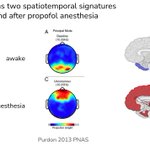
We believe this is the same posterior component that is disrupted when patients lose consciousness during general anesthesia induction with propofol (Purdon 2013 PNAS).

2
284
I just posted a major piece of my graduate research, where we used global coherence (previously used with EEG recordings of general anesthesia) to characterize coherent networks of alpha oscillations in disorders of consciousness medrxiv.org/content/10.1101/…
(Part of the backstory: this whole study was initiated (as so many are) by an almost offhand comment that my advisor Emery Brown made about global coherence never having been explored in this patient population. Glad we went down this road!)
1
3
157
And special thanks too to my advisors and colleagues who taught me more about this technique and in so much detail @PurdonLab @emilyps14
2
128