
Get busy living or get busy dying
Joined June 2010
- Tweets449
- Following371
- Followers375
- Likes357


The Race to 1 GW 🧵
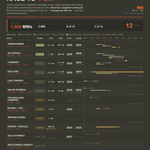
Who gets a gigawatt of new reactors running first? Not ordered or licensed, but actually built and connected to the grid.
12 routes. About 52 GW announced. Under 4 GW of it under binding contracts. 0 MW online.
1/6

2
6
386
On Nov 9 the NRC approved the construction permit for Dow’s Long Mott station: four Xe-100s in Texas, the first HTGR construction permit in nearly 60 years.
5/6
1
28
All the details on thesecondatomicage.com/race-…
Let me know who you think will get there first.
6/6

25
The Second Atomic Age website is now live!
What started in May as one tracker for the race to first criticality is now 22 trackers and tools, all in one place.
thesecondatomicage.com

Race to 10: ten large reactors under construction by 2030
thesecondatomicage.com/race-…
Power Uprates: more power from reactors already running
thesecondatomicage.com/uprat…
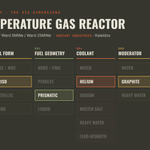
Reactor Anatomy: the design choices that separate one reactor from another
thesecondatomicage.com/anato…

1
25
This is Version 1.0. If you spot an error, a broken link, a typo, or anything that looks off, please tell me: reply here or email [email protected].
Enjoy exploring!
The second atomic age is officially underway!
17
The Race to Criticality - October 29th, 2026 - T+106 days
@RadiantNuclear receives FDSA for the their Kaleidos reactor at INL's Dome! The FDSA is the final approval before an Operational Readiness review and then on to criticality.

Race to Full Power Tracker - teapawt.net/dylan_robideaux/status…

Race to Full Power - Oct 29th, 2026 - T-248 days
@RadiantNuclear receives FDSA for the their Kaleidos reactor at INL's Dome! Next step, criticality.
This tracker is the successor to the Race to Criticality, which followed the DOE pilot reactors to first criticality.

59
Race to Full Power - Oct 29th, 2026 - T-248 days
@RadiantNuclear receives FDSA for the their Kaleidos reactor at INL's Dome! Next step, criticality.
This tracker is the successor to the Race to Criticality, which followed the DOE pilot reactors to first criticality.
Race to Criticality Tracker - teapawt.net/dylan_robideaux/status…
The Race to Criticality - October 29th, 2026 - T+106 days
@RadiantNuclear receives FDSA for the their Kaleidos reactor at INL's Dome! The FDSA is the final approval before an Operational Readiness review and then on to criticality.
43
They are expected to operate Kaleidos at full thermal power, but its unclear if they have a power conversion system setup in the Dome or will reject the heat to atmosphere.
A symbolic deadline of July 4th, 2027, one year after the EO 14301's criticality goal, has been set.
50
The Race to Criticality - October 7th, 2026 - T+95 days
@LastEnergy receives FDSA for the their PWR-5 and jumps up the list! The FDSA is the final approval before an Operational Readiness review and then on to criticality.

ROADMAP TO COMMERCIAL SCALE DEMO - Sep 9th, 2026
Five reactors have gone critical under the DOE pilot program since June. @AntaresNuclear R1 Mark-0, @valaratomics Ward-250, @DeployableE Unity Demo, @AaloAtomics Aalo-X CTR, and @oklo Groves-0.
Each of these companies will tell you that criticality is just the first milestone and now its all about a commercial scale demonstration. But what does that mean?
A commercial scale demonstration consists of six aspects -
• SCALE - the reactor is the commercial unit's physical size
• FUEL - the core carries the full commercial load, not a partial critical loading
• HEAT - coolant is moving nuclear heat at power
• TURBINE - the power-conversion system the product will actually use
• PLANT - the complete plant in deployed configuration
• TIME - a run long enough to count
So far, no test article has cleared more than two of the six. Which two varies by company, and that is where the paths diverge.
For example, Aalo's CTR was full SCALE and FUEL, but no coolant to remove HEAT which TURBINE and TIME both depend on.
Similarly, Deployable's Unity Demo achieved the first two aspects only (SCALE and FUEL), but no HEAT removal.
On the other hand, Valar's Ward-250 was full SCALE and had coolant to remove HEAT, but ran at 100 kWt because it only had a partial FUEL load. They also produced power, but via a thermoelectric generator, not the TURBINE expected for the commercial scale unit.
Antares' Mark-0 and Oklo's Groves-0 cleared none of the six, but both were built that way on purpose. Achieving zero-power criticality is still worth a great deal.
Nobody has cleared TURBINE or PLANT and no test article has completed a continuous run at full, commercial-scale, power.
That is not a criticism of anyone. Most of these test articles were built to answer one question and deliberately leave the rest open - a core that goes critical and nothing else, or a full-scale rig with no fuel in it at all. What the tracker does is say which question each one answered.
It is also why the columns are never summed and there is no score here. Some companies split the work across three machines, some iterate a single machine forward, some take a core test and jump straight to the commercial unit. Those are different routes, not different positions on one track.
That is why it is a roadmap and not a race.
But what matters is putting all six aspects together in a commercial scale demonstration. This tracker follows the test articles that each company is using to get to that stage.

1
3
249
Correction: @AntaresNuclear Mark-0 was in fact full SCALE and FUEL, but not HEAT similar to Deployable Energy and Aalo Atomics. The fuel from Mark-0 will be re-used in the Mark-1 commercial scale demo. Updated tracker here -

3
97
Meet the Janus 5 - @AntaresNuclear @BWXT @GeneralAtomics @RadiantNuclear @WECNuclear
The US Army just named five companies to put nuclear reactors on five bases - Fort Bragg, Fort Campbell, Fort Hood, Fort Benning, and Fort Drum - with a deadline of Sept 30, 2028 to have one reactor operational, T-764 days.
Antares and Radiant are explicitly targeting to meet the deadline provided by the EO.
