




イージーコー retweeted

搞科研的都知道,画图比跑代码还折磨人。
数据跑完了,卡在配色、字体、排版和架构图上,能让人把头发全薅光。
今天挖到四个搞科研绘图的神器,建议直接放进收藏夹吃灰。
第一个,Scientific Visualization。
这玩意儿简直是期刊质检员附体。以前画个柱状图,总因为误差线没标 SEM 还是 SD 被审稿人怼。
它直接内置了顶刊规范,色盲友好和黑白打印模式全都兼容。
最关键的是,导出的 PDF、EPS 和 TIFF 直接满足分辨率要求,省去了反复返工的痛苦。
github.com/Panda-dda/Scienti…
第二个,Academic Research Skills 里的 Visualization Agent。
数据跑出来了不知道配什么图最合适,它能根据数据特点选图,并直接生成能运行的 Python 或 R 代码。
连 LaTeX 插图代码都一并给你写好,绘图和排版一步到位。
github.com/Imbad0202/academi…
第三个,Nature Figure。
专门治几张子图拼在一起像大杂烩的毛病。它会先问你核心结论是什么,再让每张子图各司其职。
生成后自动检查文字遮挡和边距对齐,对不齐直接不让你导出。
主打一个证据链清晰,让外行一眼看懂。
github.com/Yuan1z0825/nature…
第四个,深度之眼开源的 CCF-Figure。
AI 论文的架构图最让人头疼。它会先判断你的论文属于七类中的哪一种,再从十一种结构里匹配布局。
架构闭环和反馈分类都能安排,最后输出中英双语提示词,直接拿去给大模型出图,还附带了翻车自检清单。
github.com/Deepshare-Officia…

イージーコー retweeted

มารอดูเรือสุพรรณหงษ์ แล้วสวยสมมงเรือ No.1 จีงๆ สวยสง่างามมาก วิวโดยรอบยิ่งทำให้ดูขลังแบบโอ้โห้นี่หรือบางกอก นี่ฤาแผ่นดินสยาม
#ขบวนพยุหยาตราทางชลมารค
#ขบวนพยุหยาตราทางชลมารค2569
イージーコー retweeted

📍มาตรการช่วยเหลือผู้โดยสารเพิ่มเติม
จากผลกระทบน้ำท่วมกรุงเทพฯและปริมณฑล เที่ยวบินที่เข้า-ออกจากกรุงเทพฯ (BKK) ระหว่างวันที่ 26 กันยายน - 11 ตุลาคม 2569
✈ผู้โดยสารที่ถือบัตรโดยสารการบินไทย (217-) สามารถเลือกดำเนินการเกี่ยวกับบัตรโดยสารได้ดังนี้
1.การเปลี่ยนแปลงเที่ยวบิน / วันเดินทาง
ㆍ ผู้โดยสารสามารถเปลี่ยนแปลงวันเดินทางได้ 1 ครั้ง กำหนดให้เป็นเส้นทางบินเดิมและชั้นโดยสารเดิม (Same Routing & Same RBD) โดยได้รับยกเว้นค่าธรรมเนียม การเปลี่ยนแปลง, ค่าธรรมเนียม No-Show
ㆍ เที่ยวบินที่ออกจากกรุงเทพฯ ต้องเดินทางภายในวันที่ 11 ตุลาคม 2569
ㆍ กรณีบัตรโดยสารเที่ยวเดียว (One Way) สามารถเปลี่ยนวันเดินทางได้โดยได้รับการยกเว้นค่าธรรมเนียม หากเดินทางหลังวันที่ 11 ตุลาคม 2569 เป็นไปตามเงื่อนไขที่ปรากฎอยู่บนบัตรโดยสาร
ㆍ ผู้โดยสารสามารถเปลี่ยนชั้นโดยสารไปยังชั้นโดยสาร (RBD) ที่สูงขึ้นได้ภายในอายุบัตรโดยสาร โดยไม่มีค่าธรรมเนียมการเปลี่ยน แต่ต้องชำระค่าส่วนต่างค่าโดยสาร (Fare Difference) ที่เกิดขึ้นจริง
2.การคืนบัตรโดยสารที่ได้รับผลกระทบกรณีเที่ยวบินยกเลิก (Flight Cancellation)
ㆍ ผู้โดยสารจะได้รับการคืนค่าบัตรโดยสารเต็มจำนวน กรณีเที่ยวบินยกเลิก
ท่านสามารถตรวจสอบสถานะเที่ยวบินก่อนออกเดินทาง ผ่านช่องทาง ดังต่อไปนี้
✅THAI Mobile Application เว็บไซต์ thaiairways.com
✅THAI Contact Center โทร. +66 2 356 1111 เปิดให้บริการตลอด 24 ชั่วโมง


イージーコー retweeted

Protein–ligand cofolding models are getting incredibly powerful… but do they have to be so slow? 🧬🐢💊
Our new preprint introduces a new flow-map framework called DeCAF for fast few-step cofolding — up to 5× faster while preserving sample quality on the SOTA Pearl model and 20x faster than Boltz 1x. ⚡🧵
📜 Blog: genesis.ml/news/genesis-mode…
🔗arXiv: arxiv.org/abs/2606.08375
Code (coming soon): github.com/genesistherapeuti…


イージーコー retweeted

Fast sampling of protein conformational dynamics @ScienceAdvances
1. Sauer et al. show that the key collective variables (CVs) needed to drive enhanced sampling of protein conformational transitions are encoded in anharmonic low-frequency vibrations, and these CVs can be extracted from short unbiased MD without any prior knowledge of the transition.
2. Core idea: use FRESEAN (frequency-selective anharmonic mode analysis) at (near) zero frequency to isolate collective motions with minimal restoring forces—i.e., “paths of least resistance” for conformational change—avoiding the limitations of harmonic/quasiharmonic normal modes in the low-frequency, diffusive regime.
3. Practical pipeline: run 20 ns unbiased all-atom MD, align trajectories, coarse-grain to a 2-bead-per-residue representation (1 for Gly), compute velocity time-correlation matrices, Fourier transform to frequency domain, then take eigenvectors at zero frequency. Modes 1–6 correspond to translation/rotation and are discarded; modes 7+ capture internal anharmonic low-frequency vibrations.
4. Reproducibility is a central result: across 5 independent 20 ns replicas per protein, the low-frequency modes (especially the 2D subspace spanned by modes 7–8) are consistently recovered, unlike PCA/quasiharmonic modes whose replica-to-replica agreement remains poor even with much longer trajectories.
5. Enhanced sampling step: use modes 7 and 8 as CVs in well-tempered metadynamics (100 ns per run; reported as <24 hours on a single GPU). Across 5 proteins × 5 replicas, 22/25 runs (88%) sample known “closed↔open” transitions within 100 ns; extending to 160 ns yields full sampling for all replicas.
6. Benchmark set spans diverse challenges: HEWL (disulfide-stabilized), HIV-1 protease (homodimer), MCL-1 (allosteric/druggable dynamics), ribose-binding protein (multi-domain hinge motion), and GDP-bound KRAS (switch-region dynamics). The same FRESEAN-to-metadynamics protocol is applied across all systems.
7. Free-energy landscapes (FES) become both fast and statistically controlled by running 20 parallel metadynamics replicas (20 × 100 ns) using the same FRESEAN CVs: single-run uncertainties are typically < ±10 kJ/mol, and averaging reduces standard error to < ±3 kJ/mol, enabling reproducible thermodynamic ensembles rather than just qualitative transitions.
8. Comparison to “hand-crafted” geometric CVs from prior literature is informative: biasing along FRESEAN modes often follows lower-free-energy transition routes and tends to keep sampling within the native folded ensemble, whereas geometric CVs can push systems into partially unfolded high-entropy states (most notably KRAS when biased by residue–residue distances).
9. The authors quantify cross-CV reweighting fidelity using Shannon entropy and Bhattacharyya coefficients: on average, ensembles generated by biasing along low-frequency vibrational CVs preserve at least as much (often more) information when reweighted into geometric-variable space than the reverse, supporting the claim that these vibrations are broadly suitable, system-agnostic CVs.
10. Implication for computational biology/ML: the method enables high-throughput generation of conformational ensembles and FESs (including mutants/conditions), helping address the dataset bottleneck for next-generation sequence→structure→dynamics models beyond single static folds or single thermodynamic states.
💻Code: github.com/HeydenLabASU-coll…
📜Paper: doi.org/10.1126/sciadv.aea46…
#MolecularDynamics #EnhancedSampling #Metadynamics #ProteinDynamics #FreeEnergy #ComputationalBiophysics #CollectiveVariables #FRESEAN #GROMACS #PLUMED

イージーコー retweeted

Boltz-2 for drug discovery - is the hype justified?
A new study tested it on 38,000+ compounds across two targets:weak to moderate correlation with physics-based binding free energies. Among the top 100 compounds: no significant correlation at all.
arxiv.org/abs/2603.05532

イージーコー retweeted

#HighlightOfTheWeek Trajectories showing ligand insertion into the beta-cyclodextrin cavity.
#compchem
pubs.acs.org/doi/10.1021/acs…
イージーコー retweeted

🚨 BREAKING: Claude can now research like an MIT PhD student.
Here are 12 insane Claude prompts that turn 40+ research papers into structured literature reviews, knowledge maps, and research gaps in minutes.
(Save this before it goes viral):

イージーコー retweeted

🚨 BREAKING: You can now run full drug discovery pipelines inside Claude Code with one command.
Claude-Scientific-Skills is an open-source plugin that gives Claude Code 140 ready-to-use scientific workflows with a single install. It covers biology, chemistry, medicine, and ML without manual configuration.
→ Connects to 28+ databases like PubMed and ChEMBL.
→ Run drug discovery pipelines and molecule docking.
→ Analyze raw single-cell data and map gene networks.
→ Cross-reference clinical variants and drug interactions.
100% Open Source.


イージーコー retweeted

นางเอกที่น่าสงสารที่สุดในละครไทย เด็กมปลายแต่งงานใช้หนี้เจ้าสัวที่มีเมีย 3 คนในบ้าน ดันมารักลูกชายเค้า ตอนจบเห็นเจ้าสัวจับคุณนายที่ 3 ถ่วงบ่อหลังบ้าน ตกใจวิ่งหนีหาพระเอก เห็นพระเอกกับเพื่อนเกย์นอนด้วยกัน สติขาดผึง เป็นบ้า เหมือนเอาทั้งชีวิตวัยสาวมาทิ้ง สนุกกว่าดอกส้มสีทองเพราะเล่าจากมุมมองเมีย 4 คนในบ้าน


イージーコー retweeted
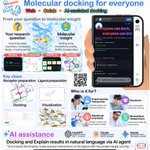
Drug discovery is slow, expensive, and uncertain. On average, it takes 12–15 years and billions of dollars to bring a new therapy to patients. Out of thousands of molecules, maybe one makes it all the way.
This is where computational methods like Molecular Docking are changing the game.
In our latest blog, @TensorTwerker breaks down the fundamentals of docking in drug discovery, not just what it is, but how it actually works under the hood.
🔹 What you’ll learn:
> How docking predicts both binding poses and binding affinity
> The algorithms that power docking (genetic algorithms, Monte Carlo, systematic searches)
> The role of scoring functions (physics-based, empirical, knowledge-based)
> Different types of docking (rigid, flexible, protein–ligand, protein–protein, protein–nucleic acid)
> Docking workflows: from protein/ligand prep to evaluation
> A look at commonly used software (AutoDock, Glide, GOLD, DOCK6, HDOCK, etc.)
> The limitations: protein flexibility, solvation, scoring function accuracy, and the GIGO problem
> How docking fits into a broader pipeline with molecular dynamics, FEP, and experimental validation
Do give it a read. Links in the comment

In our recent blog, @TensorTwerker dives deep to help you understand about molecular docking in drug discovery. Links in the comments.
We discuss topics about how docking works under the hood, different search and scoring algorithms, types of docking (protein–ligand, protein–protein, protein–Nucleic Acid), common software, and the real limitations you need to be aware of.
If you’re working in drug design or just curious about how computational biology is reshaping pharma R&D, or interested in AI x Science, this one’s worth a read.

イージーコー retweeted

1/ In my BIO101 class, I taught water, the solvent of life, unusual properties of which arise due to hydrogen bonding between deceptively simple water molecules. Our existence is inseparably bound up with hydrogen bonding.
Want to know the history of H-bonding? Read the thread.👇

イージーコー retweeted

วิบากกรรมมาก สภาพถ้าเจนวายเป็นสายลับ ซุ่มไม่เงียบเพราะเข่าลั่น ลุกขึ้นยิงไม่ได้เพราะหน้ามืด ถูกเค้นความจริงตอบไม่ได้เพราะลืม5555555
イージーコー retweeted

AI+physics for cryo‑EM ligands 🔬🧊:
Chai‑1 predicts from sequence+SMILES, density‑guided MD refines to the map.
On 10 kinases/GPCRs/SLCs, ligand fit hits 82-95% vs deposits 👀

イージーコー retweeted

If you want to know more about #FeNNix-Bio1, the first foundation model able to perform accurate - long timescale- condensed phase molecular simulations of biological systems at quantum accuracy, join me in incoming live presentations:
• @nvidia #GTC25 (Paris) (lnkd.in/exuYYUnH), Thursday June 12th
• "Data-driven, low-dimensional, and generative models for molecular and materials discovery and design" @cecamEvents workshop (lnkd.in/e_rNe86t), @UChicago Center in Paris, Tuesday June 17th.
• #Watoc 2025 (Oslo) (lnkd.in/eGnZ37jE), Monday June 23rd
and visit @qubit_pharma's booths at #GTC and #Vivatech (10-14 june)!!!
FeNNix-Bio1 is NOT another docking tool and allows you to perform real chemically accurate (< 1kcal/mol) predictions (including true binding free energies!) accross chemical space while offering lightning fast acceleration (i.e. force field speed!) over real ab initio molecular dynamics. It is grounded solely on synthetic quantum chemistry data.
Discover the power of #GPU-accelerated accurate atomistic simulations beyond Density Functional Theory (DFT) quantum accuracy by checking the papers:
- A Foundation Model for Accurate Atomistic Simulations in Drug Design: lnkd.in/e9FuC78C
- Pushing the Accuracy Limit of Foundation Neural Network Models with Quantum Monte Carlo Forces and Path Integrals:
lnkd.in/eu53C3fW
Sorbonne Université / CNRS
Qubit Pharmaceuticals
@Genci_fr AI Factory France @EuroHPC_JU
@argonne
#machinelearning #neuralnetwork #foundationmodel #ArtificialIntelligence #biophysics #drugdesign #hpc #supercomputing
イージーコー retweeted
#compchem Second preprint linked to the FeNNix-Bio1 #machinelearning foundation model. FeNNix-Bio1's inference is pretty fast already with a few GPUs but, "what if", we were able to push it at the #Exascale? Let's have a glimpse into the future (1/3):
"Pushing the Accuracy Limit of Foundation Neural Network Models with Quantum Monte Carlo Forces and Path Integrals"
Check it out 💫: arxiv.org/abs/2504.07948
We propose an end-to-end integrated strategy to produce highly accurate quantum chemistry synthetic datasets (energies and forces) aimed at deriving Foundation Machine Learning models for molecular simulation. Starting from Density Functional Theory (DFT), a "Jacob's Ladder" approach leverages computationally-optimized layers of massively #GPU-accelerated software with increasing accuracy. Thanks to Exascale, this is the first time that the computationally intensive calculation of Quantum Monte Carlo forces (QMC), and the combination of multi-determinant QMC energies and forces with selected-Configuration Interaction wavefunctions, are computed at such scale at the complete basis-set limit. To bridge the gap between accurate QC and condensed-phase Molecular Dynamics, we leverage transfer learning to improve the DFT-based FeNNix-Bio1 foundation model.
🚀The resulting approach is coupled to path integrals adaptive sampling quantum dynamics to perform nanosecond reactive simulations at unprecedented accuracy on a full Satellite Tobacco Mosaic Virus (STMV) 1M, all-atom, complete solvated model (see the video produced using @VTX_mol, @MaximeMARIA_ @MatthieuMontes ). These results demonstrate the promise of Exascale to deepen our understanding of the inner machinery of complex biosystems.
Immense thanks to all co-authors at @qubit_pharma, @LCT_UMR7616 (@Sorbonne_Univ_ /@CNRS ), @UChicago, @SandiaLabs, @ORNL and @argonne for this collaborative efforts. Some are on X: @QMC_Anouar @Thomas__Ple @OlivierApp @EPosenitskiy @blazhynska66497 @ApplencourtT @JeongnimK #HPC
This work was made possible thanks to #INCITE projects enabling the use of Argonne's Aurora exascale system and of the Polaris machine, to @Genci_fr (Jean Zay @ Idris) and @EuroHPC_JU (Leonardo @Cineca1969). #supercomputing