
AI for Biology PhD Student @GriffinCMU | Advised by @jmuiuc and @ericxing | 🪀
Joined June 2021
- Tweets158
- Following715
- Followers265
- Likes1.6K





Pinned Tweet
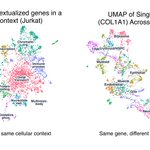
Contextualized gene representations work surprisingly well for predicting multigene perturbation effects.
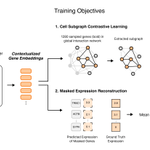
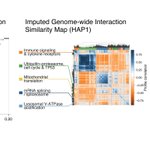
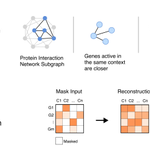
I’m excited to introduce EMBER, a pretrained gene-centric foundation model designed specifically to learn context-specific gene representations. A joint work with @jmuiuc and @ericxing.
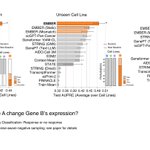
With innovations in single-cell pretraining and dataset curation, EMBER gene representations can be combined with a lightweight probe for single gene knockouts, genetic interactions (double knockouts), and even drug perturbations.
Both a 🧵 and a 🎥, got in front of a camera to share some highlights! (1/n)
fun fun questions and opportunities for evolutionary DNA models and seq2fun folks 👀
I will be reading this very carefully!
congrats to the @zocean636, Evan Trop and the team!

How did the 3D genome architecture evolve? 🧬 Our new review @AnnualReviews by @zocean636 & Evan Trop in the group explores conserved genome folding principles, lineage-specific architectures, and how comparative genomics and #AI may connect sequence evolution to genome folding and function. annualreviews.org/content/jo…

1
9
733
I feel that one way to rise above AI science slop is to build thoughtful and clear visualizations that show that you care.
I hope tools like these increase our standard for science communication, both in the everyday research meeting and at conference talks.
This looks like a great tool! Looking forward to trying it out! @lpachter

Introducing Manimble: a free, open-source slide editor in which every slide is a Manim program (so underlying the deck is Python). It alows for editing like in Keynote or PowerPoint while seamlessly incorporating AI edits / animations. pachterlab.github.io/Manimbl…
1/🧵

10
1,105
Super excited!
Looking forward to welcoming everyone to @CarnegieMellon tomorrow (Nov 13) for our #AI4BIO Symposium! We have a wonderful lineup of invited speakers, alongside AI4BIO Pilot Project presentations and a closing panel discussion on the future of comp bio in the era of AI. It will be an exciting day of ideas and conversations. Many thanks to our speakers and organizing team!

4
325
Huge congrats to the IFM team! So much detail to learn from here! Looking forwards to learning from the technical blog and the open source codebase.

Thrilled to announce the PAN 2 world model. At IFM we studied foundation models, one of our research journey is towards world models with the ability to do simulative reasoning. Think of it as a thought experiment, where we "visualize" what would happen, just like Dr. Strange.
1
10
492
Nicholas Ho retweeted

the transcriptional state of a cell is not generally sufficient to predict its past or future. in our new preprint we show that conditioning on lineage context (sisters, cousins, etc) can help a lot.
this one was v fun :)
arxiv.org/abs/2610.40447


New preprint on generative modeling for mouse development! Rather than single cell trajectories, we set out to model embryos as trees.
Led by @gokl_g, @njwfish, @WilliamNColgan, w/ Philippe Rigollet, @stats_stephen, Zack Smith, @marinkazitnik, @lukekoblan and a wonderful team
This is fantastic! I think one unfortunate side effect of ML research's emphasis on architectural novelty is that adding more bells and whistles can make it hard to tell where the performance gains are actually coming from. Ablations help, but there are always more comparisons to run haha.
Strong simple baselines help keep things grounded and put the results in context.
Congrats @probablybots and team!

We used coding agents to automatically build baselines for 36 "AI for science" deep learning methods from Nature, Science, and Cell-family publications. These baselines recovered a median of ~95% of the score of the published method, and beat them in 33% of cases.

11
878
For drug prediction, we used EMBER by representing each drug as a set of its contextualized gene targets. EMBER came out on top on unseen drug perturbation prediction. (9/n)

All in all, EMBER gives you contextualized gene representations, and those representations can be composed with a small predictor for any perturbation task.
Please check out the paper; there were some other things I didn’t get to touch on like prioritizing trigenic interactions and drug repurposing.
Feel free to reach out for any questions! (n/n)
Preprint: biorxiv.org/content/10.64898…
Code: github.com/ma-compbio-lab/EM…
Data: huggingface.co/datasets/Nick…

1
6
486
Nicholas Ho retweeted

Cell-state conditioned sequence model of chromatin & expression trained jointly across diverse cell contexts by @zhou_jingtian & colleagues. Nice addition to the growing collection of joint cis-trans models of gene regulation. Still lots to do make the trans component causal.

Our cells carry the same DNA, but how this DNA is interpreted differs wildly from cell to cell. In a new preprint, Science Fellow @zhou_jingtian and team introduce Bolero, a model conditioned on cell state that predicts chromatin accessibility and expression from DNA alone.

Nicholas Ho retweeted

In our Nature paper, we introduce the first superhuman Stratego AI, which we built using general techniques that we developed for RL & test-time compute under imperfect information. 1/N

Nicholas Ho retweeted

We asked a basic unanswered question in tissue biology: Can the many molecular exchanges between neighboring cells be organized into reusable communication programs - much like genes into pathways?
We introduce SpiderNet, which learns cell-cell meta-interactions (MIs): directed sender->receiver programs linking sender regulators, ligand-receptor bridges, and receiver responses, while mapping where each program is active in tissue. Across diverse contexts, MIs recur, form multicellular relays, predict neighboring-cell responses to perturbation, and connect local signaling to tissue states and phenotypes.
We hope MIs provide an intermediate language for spatial omics, moving from catalogs of local contacts toward interpretable, comparable, and eventually perturbable programs of multicellular regulation.
📚 Preprint: biorxiv.org/content/10.64898…
🚀 Led by the amazing Junjie Tang @JJTang_1995 in the lab.
