

Founder and CEO · @LowCodeAgency and @phosailabs (400+ products shipped for Coca-Cola, Amex, Zapier, Sotheby's, Medtronic)
Miami, FL
Joined April 2007
- Tweets95.4K
- Following1.8K
- Followers5.3K
- Likes8.4K








Jesus Vargas retweeted
If something in this series felt familiar, that is probably worth a conversation.
A pipeline that is hard to see clearly. A team spending hours on context a system should handle. Product knowledge sitting in too few heads.
These are solvable problems.
We start simple. A real conversation about how your business runs today and where the right layer of infrastructure would make everything above it more valuable.
Reach out. Happy to talk.

Ask this before building a custom CRM: does it tell my team who to call first?
Ours had 1,007 companies and almost no data on them. Reps googled every account before a call, or called whoever replied fastest.
An off-the-shelf CRM only holds what people type in.
So we built our own qualification into it. An AI agent researches each company: headcount, revenue range, AI signals. One rule scores the fit. Every field shows its source.
Reps now open a deal already knowing who to call first.

Getting a healthcare app with an integrated model through Google review does not fail on accuracy.
It fails on tone.
A model that sounds like it is making clinical recommendations triggers review criteria.
The fix is guardrails built into the product design before submission.
System prompts that define what the model can and cannot say.
Response patterns that position it as providing information, not diagnoses.
The review stage is not where you solve this.
The design stage is.

Here is a quick check on how your onboarding and offboarding run today.
Give yourself one point for every question you can answer with a yes.
1. Does one request order every device and software license for a new hire?
2. Can you confirm within minutes which access a departing employee still has?
3. Can you list every device assigned to one person in five minutes?
4. Does every handoff come with a signed record of who has what?
5. Would everything keep running smoothly if the person who knows the process best took a month off?
Four or five points mean your process already runs on a solid foundation. Three or fewer show where a workflow can take over the invisible checklist:
every step that lives in memory and passes between HR, IT, and Facilities.
A shared sheet and a weekly reminder work well at small scale. Once three departments are involved, DM me and I will walk you through the options.


Your competitors have access to the same AI tools you do. The advantage is how fast you integrate it into how your company actually runs.
Process first, training second, development last. That's the sequence that wins.

SEO gets you a spot in Google's list of links. GEO gets your brand named inside the answer ChatGPT or Perplexity writes.
We measured our own agency. Mentioned in 12% of answers, used as a source in 32%. Small sample, but now we have a number to move.
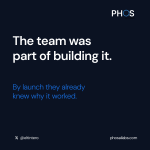
The teams that get the most out of AI are the ones that helped build it.
We bring the right people in from the first session. They walk us through how work actually gets done. They give us context that isn't written down anywhere. They watch the workflow take shape and weigh in before it goes live.
By launch, they already know how it works and why it was built that way.
That's what makes adoption hold.

If something in this series felt familiar, that is probably worth a conversation.
A pipeline that is hard to see clearly. A team spending hours on context a system should handle. Product knowledge sitting in too few heads.
These are solvable problems.
We start simple. A real conversation about how your business runs today and where the right layer of infrastructure would make everything above it more valuable.
Reach out. Happy to talk.
Ask your development partner one question before you sign: who picks up the phone if your main developer is out?
A buyer I talked with said the thing he valued most was knowing the project keeps moving no matter what happens to one person. That's a smart way to evaluate any software partner, right?
Think of it like a construction site with a site manager. If one carpenter is out, the crew keeps building, and the schedule holds.
A solo developer can be a great fit for a small project with a clear scope. A team adds shared knowledge of your project and a backup for every role.
At @LowCodeAgency, everything we build lives in your own accounts. Whoever works on it next, you keep the keys. DM me "continuity."

Two builds for HRM.
An internal operations platform. Then a 24/7 AI agent trained on 16 years of Mexico labor law expertise.
Franklin: "We feel very fortunate to have chosen LowCode as our partner."

The riskiest part of a healthcare app is what you connected to it.
Every third-party tool that touches PHI is a potential Business Associate.
Every Business Associate needs an agreement before it sees any patient data.
Most teams connect first and ask questions later.
The list of vendors who will sign a Business Associate Agreement is shorter than most teams expect.
That list constrains every downstream decision.

The question that starts every engagement: where does time get lost in your day.
Not "what's your AI strategy." Where does the work actually slow down.
The answers are almost always the same: institutional knowledge, feedback analysis, shift handoffs, training. All of it touchable. Most of it untouched.
Start where time gets lost.
Every company has one person who knows how everything works. When the standard process needs a fix, everyone walks to their desk. That person holds the duct tape.
I love those people. They are also a load bearing wall in your operations.
When the workflow lives in someone's head, your operational memory goes wherever they go.
Quick exercise: write down what your most tenured person does when someone joins or leaves. If it fits on one page, a simple tool may cover you.
If it fills five pages, sooner rather than later is a good time to build a system.
DM me and I will walk you through it.

Your AI step is right 99% of the time. Chain 90 of them and the whole process works about 40% of the time.
Four ways it breaks: bad input, made-up facts, drift, silence. Plan for all four before you ship.
A VP of Operations at a specialty manufacturer came to us with a challenge that was as much about people as it was about technology.
There was an IT manager with 25 years in his role. He needed to see something work before committing to anything new. So we started small. Visible results in departments close to his. Nothing that touched his area directly.
By month three, he was asking what else we could build.
He came around because he watched it work next door and saw that nothing broke.
We build for this from day one. Quick wins first. Visible results early.

Every business has a next layer.
Sometimes it is right in front of you. The team is growing faster than the process can handle. Context is getting lost. Managers are making decisions with incomplete information.
Sometimes it takes a conversation to find it.
The hard part is figuring out what the layer is. The build is the easy part.
That is usually where we start. A real conversation about how the business runs today, where context is getting lost, and what one clear promise would make the whole thing worth building.
Figure out your next layer. Build it on something solid.

fricking hell, how are you guys going about rotating all of your secrets with the Railway issue? I'll spend a full day doing this...
A lot of small businesses run on a group text thread.
The team sends photos and updates as work happens, and the owner copies the details into a spreadsheet later. When someone forgets to send an update, that information never reaches the records.
Think of it like carrying water in buckets from a well. Plumbing delivers the same water to every room.
Software can capture those updates at the source. A photo, a note, and a time stamp land in the right record the moment your team submits them, right?
If your team is small and the volume is low, a shared form and a spreadsheet may be enough, and I'll tell you if that's the case.
At @LowCodeAgency, start by mapping how updates move through your day. Happy to help. DM me "workflow."

